Telescope Comparison
Askar 103APO vs Sky-Watcher Esprit 120ED
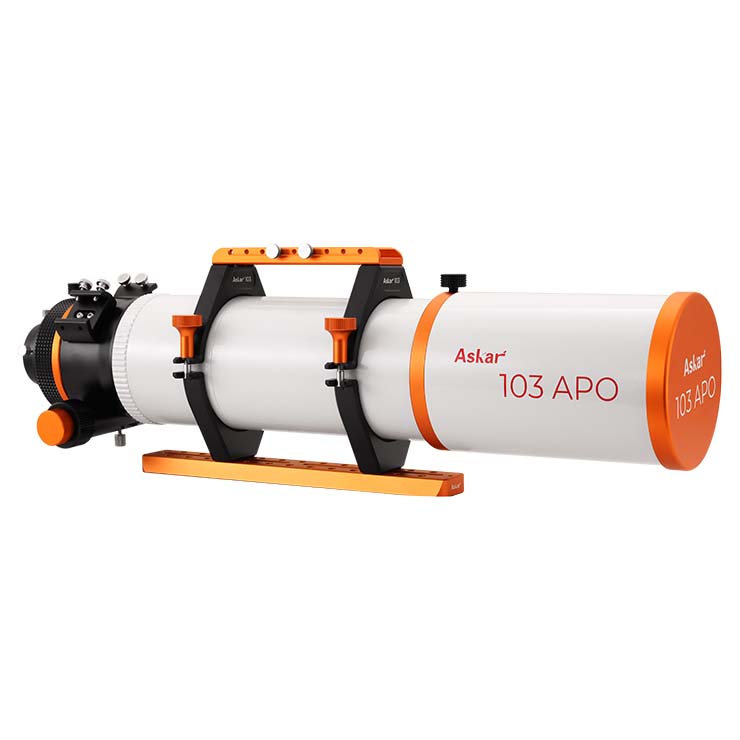
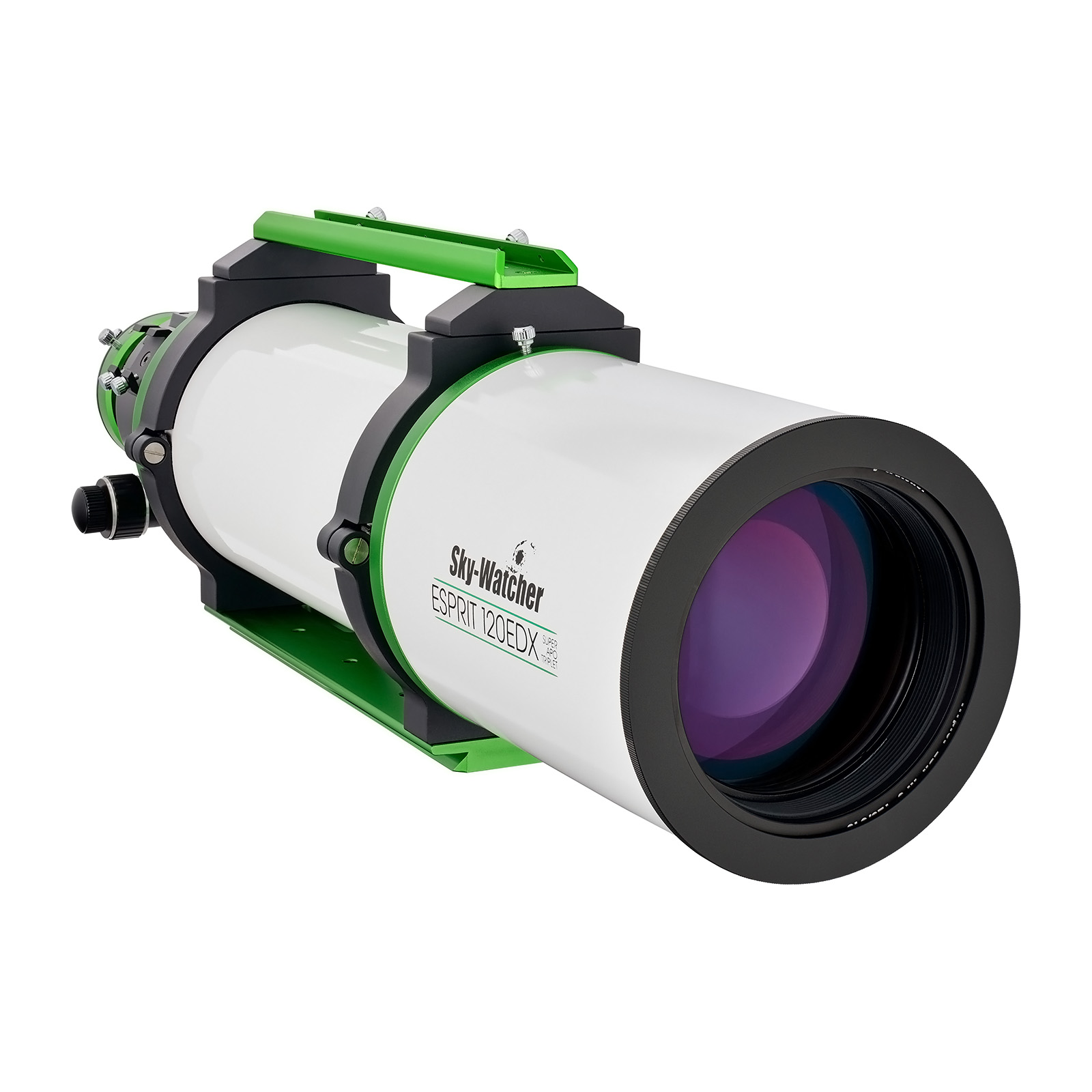
The price gap is real. The question is whether the extra capability is worth it at your stage.
Affiliate links — we earn from qualifying purchases at no extra cost to you.
First light
Askar · 103mm · £1,199
The custom-rig optical tube
- 103mm refractor — optical tube only, no mount included
- 700mm focal length at f/6.8
- Requires a compatible mount before you can observe anything
- Best for: observers who already own a suitable mount or are building a specific imaging rig
- Not a complete purchase — budget at least £100–300 extra for a mount before observing
Sky-Watcher · 120mm · £1,699
The custom-rig optical tube
- 120mm refractor — optical tube only, no mount included
- 840mm focal length at f/7
- Requires a compatible mount before you can observe anything
- Best for: observers who already own a suitable mount or are building a specific imaging rig
- Not a complete purchase — budget at least £100–300 extra for a mount before observing
The full picture
The numbers that separate these two scopes — and what they mean at the eyepiece.
Aperture
Sky-Watcher Esprit 120ED gathers 1.4× more light. On bright targets — Moon, Saturn, Jupiter — you won't notice. On fainter targets — dim galaxies, faint globular clusters — the gap is real.
Focal length
Sky-Watcher Esprit 120ED's longer focal length reaches higher magnification with the same eyepiece — better reach for planetary detail. Askar 103APO's shorter focal length gives a wider true field — better for large open clusters and extended nebulae.
Focal ratio
Askar 103APO's faster f/6.8 delivers wider fields with any eyepiece — better for open clusters and large nebulae. Sky-Watcher Esprit 120ED's f/7 provides more magnification per eyepiece — better for fine planetary detail.
Mount type
Neither scope includes a mount — both require a separate purchase before you can observe.
Weight (OTA)
Askar 103APO's optical tube is 1.9kg lighter. Relevant if you plan to use it on multiple mounts or carry the tube to dark-sky sites separately.
Optical design
Both are refractors — no mirrors to collimate, good contrast, colour-free stars with ED or APO glass. The differences between them are in aperture, focal ratio, and glass quality.
At the eyepiece
| Target | Askar 103APO | Sky-Watcher Esprit 120ED |
|---|---|---|
| Planets | ||
| Moon | Excellent 103mm aperture delivers sharp crater detail and clean terminator views; the ED triplet produces essentially no chromatic fringing on the bright limb | Excellent 120mm apochromatic optics deliver razor-sharp lunar detail with zero chromatic aberration — craterlets and rilles cleanly resolved |
| Saturn | Good Rings clearly defined, Cassini Division visible in steady seeing; 700mm focal length supports useful magnification but aperture limits fine banding detail | Good 120mm aperture and 840mm focal length show rings, Cassini Division in steady seeing, and subtle banding on the disc |
| Jupiter | Good Two main equatorial belts and GRS visible; 103mm resolves some secondary belts in good seeing but can't match larger apertures for fine atmospheric detail | Good Cloud bands, Great Red Spot, and moon transits visible — the clean apo optics give high contrast, though aperture limits finest detail |
| Mars | Moderate Small disc visible with polar cap detectable near opposition; 103mm and 700mm focal length limit the detail available on this demanding target | Moderate Disc visible with polar cap and dark albedo features at opposition, but 120mm limits fine surface detail |
Deep sky | ||
| Orion Nebula (M42) | Excellent 103mm gathers plenty of light and 700mm focal length frames the full nebula complex well; Trapezium resolved and nebulosity extends visually | Excellent 120mm aperture reveals nebulosity easily; 840mm focal length frames the core and wings well on camera or in a wide-field eyepiece |
| Andromeda Galaxy (M31) | Excellent 700mm focal length keeps the full extent of M31 in the field; 103mm aperture shows the bright core and hints of dust lanes | Good 840mm focal length captures the bright core and inner spiral arms but crops the full 3° extent on most sensors and eyepieces |
| Open clusters | Excellent 700mm focal length and wide true field frame showpiece clusters like the Double Cluster and Pleiades beautifully | Good 840mm gives a pleasing field for medium-sized clusters like M35 and the Double Cluster, though the largest clusters may not fully fit |
| Globular clusters | Moderate 103mm shows a granular, textured ball but cannot resolve individual stars in the core; M13 and M3 appear mottled at best | Moderate 120mm resolves granularity at the edges of brighter globulars like M13, but the core remains unresolved |
| Faint galaxies | Moderate 103mm aperture detects brighter Messier galaxies as smudges but struggles with fainter NGC targets visually | Moderate 120mm gathers enough light to detect many Messier and brighter NGC galaxies, but faint detail requires long imaging exposures |
| Milky Way / wide field | Good 700mm is slightly long for sweeping starfield views but still delivers rich fields; a reducer brings it closer to wide-field territory | Moderate 840mm focal length is too narrow for sweeping Milky Way vistas — better suited to individual targets within it |
Other | ||
| Double stars | Good 103mm resolves doubles to about 1.1 arcsecond; f/6.8 is not ideal for high-magnification splitting but the clean optics help | Excellent 120mm aperture resolves to ~1 arcsecond; the apochromatic design produces clean, colour-free Airy discs ideal for tight doubles |
| Astrophotography (deep sky) | Not recommended No mount or tracking included; with a suitable equatorial mount this scope would rate Excellent — f/6.8, 103mm aperture, and ED triplet design are ideal for deep-sky imaging | Not applicable |
| Astrophotography (planetary) | Moderate 103mm aperture captures reasonable planetary detail with a high-speed camera, but aperture and focal length limit resolution compared to larger scopes | Moderate 120mm aperture limits planetary resolution compared to larger scopes; 840mm native focal length benefits from a 2–3× Barlow for better image scale |
| Emission nebulae (imaging) | Excellent 700mm at f/6.8 frames large emission nebulae like the Heart, Soul, and North America Nebula well on APS-C sensors; tight star correction across the field with a matched flattener | Not applicable |
| Galaxy groups (imaging) | Good 700mm focal length provides enough scale for galaxy groups like the Leo Triplet or M81/M82 on common sensor sizes while keeping good signal-to-noise at f/6.8 | Not applicable |
| Compact emission and planetary nebulae | Not applicable | Excellent 840mm focal length and f/7 speed are ideal for imaging targets like the Crescent Nebula, Veil Nebula panels, and the Dumbbell Nebula |
The real tradeoff
Both scopes are capable. The question is which one fits the way you actually observe.
Askar 103APO
- You'll spend £500 less on the OTA, and that money goes straight toward the mount and camera you still need — at 103mm and ~5–6kg loaded, you can get away with a slightly lighter (and cheaper) equatorial mount than the Esprit demands, which meaningfully shrinks your total system cost.
- At 700mm focal length, you're framing larger nebulae more generously on an APS-C sensor — the Veil complex, the North America Nebula, and Andromeda's full disc all fit more comfortably, so you'll spend less time mosaicking and more time stacking single-panel shots.
- You'll need to buy a separate field flattener or reducer to get sharp stars at the edges of your sensor, which means another £150–250 and another element to space correctly — the Esprit ships with its flattener built in, so your setup nights will involve more fiddly back-focus calculations than your rival's.
Sky-Watcher Esprit 120ED
- You'll pull your scope out of the case and know that the integrated field flattener is already matched and spaced — no hunting for the right adapter stack, no second-guessing backfocus distance, just attach your camera and start framing.
- The extra 17mm of aperture and 140mm of focal length mean your galaxy images have noticeably more image scale and signal: M51's spiral arms, the dust lanes of the Leo Triplet, and planetary nebulae like the Dumbbell all show more resolved structure per pixel, rewarding the longer integration times you're already committing to.
- You'll feel the weight penalty on every session — at 7–8kg loaded, you need an EQ6-class mount or better, which means a heavier tripod, a longer setup, and a bigger car boot, and you'll think twice before hauling it to a dark site on a whim.
The dark side
Every scope has a personality. Here’s where each one gets difficult.
Askar
Askar 103APO
The OTA alone is £1,199 with no mount, no diagonal, and no eyepieces — once you add a capable equatorial mount, guide scope, guide camera, and field flattener, your total imaging system will comfortably exceed £3,000.
At f/6.8 the 103APO is moderately fast but noticeably slower than dedicated f/5 astrographs, so you'll need longer individual sub-exposures to reach the same signal-to-noise on faint emission nebulae and galaxy halos.
Without a matched field flattener (sold separately), edge-of-field stars on APS-C and especially full-frame sensors will show elongation and coma — flat-field performance is not native to the OTA as shipped.
Sky-Watcher
Sky-Watcher Esprit 120ED
At £1,699 for the OTA only, the total system cost with a mount rated for 10–12kg imaging payloads, a camera, and guiding equipment typically exceeds £4,000 — this is a serious financial commitment before you capture a single photon.
The 840mm focal length demands accurate autoguiding with sub-arcsecond tracking precision; without it, star trailing will ruin your subs, so there's no shortcut past a proper guide scope and PHD2 setup.
Some users report the retractable dew shield mechanism becomes stiff in cold conditions — if you're imaging through a British winter, you may find yourself wrestling with it at 2am with numb fingers.
Which is right for you?
Two different buyers. Two different right answers.
The custom-rig optical tube
Askar · Askar 103APO
You've been imaging with an 80mm refractor and you know the workflow — stacking, processing, guiding — but you want more aperture and a tighter star field without blowing your budget on both the OTA and a monster mount. You're happy buying a separate flattener and dialling in backfocus yourself. You shoot mostly wide-field nebulae on an APS-C sensor, and you value the lower weight and cost that lets you keep your current mid-range EQ mount. If you're a beginner who doesn't yet own a mount, camera, or guide setup, walk away — the £1,199 price tag is just the opening bid.
The custom-rig optical tube
Sky-Watcher · Sky-Watcher Esprit 120ED
You're an experienced deep-sky imager ready to invest in a reference-quality optical tube that you won't outgrow. You want the integrated field flattener to eliminate guesswork, you shoot on a full-frame sensor where edge correction really matters, and you have (or are prepared to buy) a mount in the EQ6/CEM60 class. You're targeting galaxies and smaller nebulae where 840mm of reach and 120mm of aperture deliver real gains over 80–100mm class refractors. If the total system cost north of £4,000 makes you flinch, or you want a grab-and-go rig you can set up in ten minutes, this isn't your scope.
Our verdict
At £1,199 versus £1,699, the Sky-Watcher Esprit 120ED costs 42% more. It delivers 17mm more aperture — a real and visible advantage on faint targets.
If budget is a genuine constraint, the Askar 103APO will make you a happy observer. The Sky-Watcher Esprit 120ED's optical advantage on faint targets is real and you are unlikely to regret it if you can stretch. If I had to choose without knowing your situation: start with the Askar 103APO, use it for a year, then upgrade knowing exactly what you want.
Askar 103APO
View Askar 103APO →Sky-Watcher Esprit 120ED
View Sky-Watcher Esprit 120ED →Affiliate links — we earn from qualifying purchases at no extra cost to you.
Deep field: Full specifications
Every data point, for those who want to go further.
Full specifications
Fields highlighted in blue or amber indicate the better value for that spec. Data is manufacturer-stated and may vary.
How much can it see?
| Spec | Askar 103APO | Sky-Watcher Esprit 120ED |
|---|---|---|
Apertureⓘ The most important spec — bigger = more light = better views | 103mm | 120mm |
Focal Length Longer = more magnification potential | 700mm | 840mm |
Focal Ratio Lower f-number = wider field of view; higher = more magnification per eyepiece | f/6.8 | f/7 |
Optical Design The type of optics — each design has different strengths | Refractor | Refractor |
Coatings Better coatings = more light transmission through the optics | Fully multi-coated ED triplet on all air-to-glass surfaces | Fully multi-coated ED triplet with FMC on all air-to-glass surfaces |
How do you point it?
| Spec | Askar 103APO | Sky-Watcher Esprit 120ED |
|---|---|---|
Mount Type The mechanical system that holds and moves the telescope | None (OTA only) | None (OTA only) |
GoTo Computer-controlled pointing — finds any of thousands of objects automatically | ||
Tracking Motor keeps objects centred as the Earth rotates — essential for astrophotography |
The focuser
| Spec | Askar 103APO | Sky-Watcher Esprit 120ED |
|---|---|---|
Focuser Size 2" accepts wider eyepieces and gives better low-power views | 2" / 1.25" | 2" |
Focuser Type Rack-and-pinion is standard; Crayford and dual-speed are smoother | Dual-speed Crayford 2" (10:1 reduction) | Dual-speed Crayford (10:1 reduction, with 1.25" adapter) |
Size & weight
| Spec | Askar 103APO | Sky-Watcher Esprit 120ED |
|---|---|---|
OTA Weightⓘ Optical tube only — useful for comparing mount load capacity | 3.8kg | 5.7kg |
Tube Length | 550mm | 730mm |
Tube Material | Aluminium | Aluminium, white powder coat |
What's in the box?
| Spec | Askar 103APO | Sky-Watcher Esprit 120ED |
|---|---|---|
Diagonal Tilts the eyepiece 90° for comfortable viewing — useful on refractors |
Blue highlight: Askar 103APO advantage · Amber highlight: Sky-Watcher Esprit 120ED advantage · Greyed cells: equal or subjective.