Telescope Comparison
Askar 103APO vs William Optics FluoroStar 91
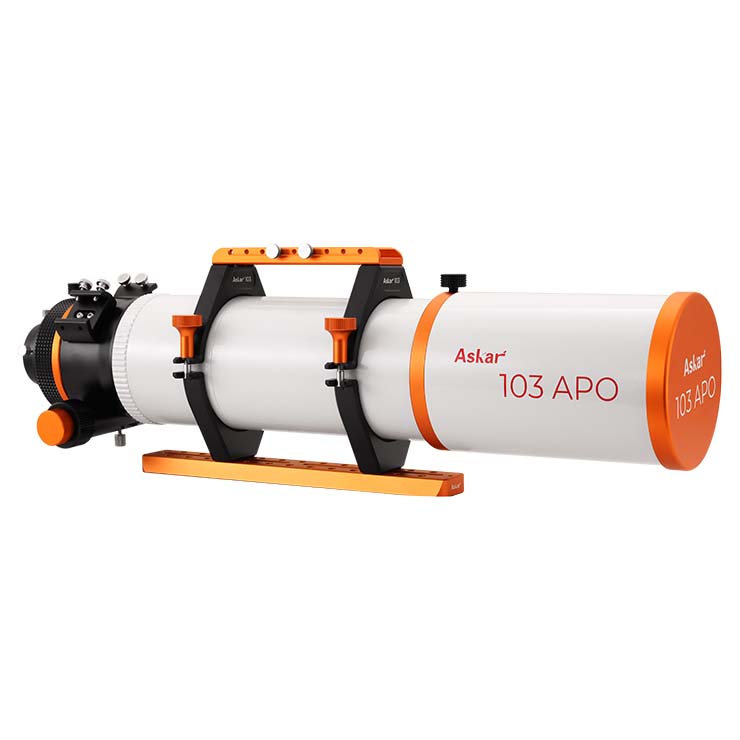
The specs are close. The experience isn't.
Affiliate links — we earn from qualifying purchases at no extra cost to you.
First light
Askar · 103mm · £1,199
The custom-rig optical tube
- 103mm refractor — optical tube only, no mount included
- 700mm focal length at f/6.8
- Requires a compatible mount before you can observe anything
- Best for: observers who already own a suitable mount or are building a specific imaging rig
- Not a complete purchase — budget at least £100–300 extra for a mount before observing
William Optics · 91mm · £1,299
The custom-rig optical tube
- 91mm refractor — optical tube only, no mount included
- 537mm focal length at f/5.9
- Requires a compatible mount before you can observe anything
- Best for: observers who already own a suitable mount or are building a specific imaging rig
- Not a complete purchase — budget at least £100–300 extra for a mount before observing
The full picture
The numbers that separate these two scopes — and what they mean at the eyepiece.
Aperture
Askar 103APO gathers 1.3× more light. On bright targets — Moon, Saturn, Jupiter — you won't notice. On fainter targets — dim galaxies, faint globular clusters — the gap is real.
Focal length
Askar 103APO's longer focal length reaches higher magnification with the same eyepiece — better reach for planetary detail. William Optics FluoroStar 91's shorter focal length gives a wider true field — better for large open clusters and extended nebulae.
Focal ratio
William Optics FluoroStar 91's faster f/5.9 delivers wider fields with any eyepiece — better for open clusters and large nebulae. Askar 103APO's f/6.8 provides more magnification per eyepiece — better for fine planetary detail.
Mount type
Neither scope includes a mount — both require a separate purchase before you can observe.
Weight (OTA)
Similar optical tube weight. Any portability difference between these setups comes from the mount, not the tube itself.
Optical design
Both are refractors — no mirrors to collimate, good contrast, colour-free stars with ED or APO glass. The differences between them are in aperture, focal ratio, and glass quality.
At the eyepiece
| Target | Askar 103APO | William Optics FluoroStar 91 |
|---|---|---|
| Planets | ||
| Moon | Excellent 103mm aperture delivers sharp crater detail and clean terminator views; the ED triplet produces essentially no chromatic fringing on the bright limb | Excellent 91mm aperture and fluorite correction deliver sharp, high-contrast lunar detail with no false colour on the limb |
| Saturn | Good Rings clearly defined, Cassini Division visible in steady seeing; 700mm focal length supports useful magnification but aperture limits fine banding detail | Good Ring structure and Cassini Division visible in good seeing, though short focal length requires high-power eyepieces to push magnification |
| Jupiter | Good Two main equatorial belts and GRS visible; 103mm resolves some secondary belts in good seeing but can't match larger apertures for fine atmospheric detail | Good Main cloud belts and GRS visible; 91mm resolves some detail but the 537mm focal length limits comfortable high-power use |
| Mars | Moderate Small disc visible with polar cap detectable near opposition; 103mm and 700mm focal length limit the detail available on this demanding target | Challenging Disc visible at opposition with hints of albedo features, but 91mm aperture and short focal length make surface detail very difficult |
Deep sky | ||
| Orion Nebula (M42) | Excellent 103mm gathers plenty of light and 700mm focal length frames the full nebula complex well; Trapezium resolved and nebulosity extends visually | Excellent 91mm aperture and 537mm focal length at f/5.9 frame the full nebula complex with bright, detailed nebulosity and resolved Trapezium |
| Andromeda Galaxy (M31) | Excellent 700mm focal length keeps the full extent of M31 in the field; 103mm aperture shows the bright core and hints of dust lanes | Excellent 537mm focal length captures the full extent of M31 including companion galaxies; 91mm aperture shows hints of outer halo structure |
| Open clusters | Excellent 700mm focal length and wide true field frame showpiece clusters like the Double Cluster and Pleiades beautifully | Excellent Wide field at 537mm beautifully frames large clusters like the Double Cluster and Pleiades with tight, colour-free stars |
| Globular clusters | Moderate 103mm shows a granular, textured ball but cannot resolve individual stars in the core; M13 and M3 appear mottled at best | Moderate 91mm shows globulars as granular, concentrated balls — M13 has a bright core but individual stars remain unresolved |
| Faint galaxies | Moderate 103mm aperture detects brighter Messier galaxies as smudges but struggles with fainter NGC targets visually | Challenging 91mm gathers limited light for faint galaxies visually; brighter Messier galaxies visible as faint smudges, but detail is minimal |
| Milky Way / wide field | Good 700mm is slightly long for sweeping starfield views but still delivers rich fields; a reducer brings it closer to wide-field territory | Excellent 537mm at f/5.9 is ideal for rich Milky Way sweeps — star fields through Cygnus and Sagittarius are stunning |
Other | ||
| Double stars | Good 103mm resolves doubles to about 1.1 arcsecond; f/6.8 is not ideal for high-magnification splitting but the clean optics help | Good 91mm resolves wide and moderate doubles cleanly with excellent colour correction, though close pairs need very short eyepieces at this focal length |
| Astrophotography (deep sky) | Not recommended No mount or tracking included; with a suitable equatorial mount this scope would rate Excellent — f/6.8, 103mm aperture, and ED triplet design are ideal for deep-sky imaging | Not recommended No mount or tracking included — optically superb for deep-sky imaging but requires a separate equatorial mount to realise that potential |
| Astrophotography (planetary) | Moderate 103mm aperture captures reasonable planetary detail with a high-speed camera, but aperture and focal length limit resolution compared to larger scopes | Moderate 91mm and 537mm focal length are limited for planetary imaging; usable with a 2–3× Barlow on a tracking mount, but aperture constrains resolution |
| Emission nebulae (imaging) | Excellent 700mm at f/6.8 frames large emission nebulae like the Heart, Soul, and North America Nebula well on APS-C sensors; tight star correction across the field with a matched flattener | Excellent Fast f/5.9 fluorite triplet excels at narrowband and broadband emission nebula imaging — Heart, Soul, North America, and Veil nebulae are ideal targets with a matched flattener |
| Galaxy groups (imaging) | Good 700mm focal length provides enough scale for galaxy groups like the Leo Triplet or M81/M82 on common sensor sizes while keeping good signal-to-noise at f/6.8 | Not applicable |
The real tradeoff
Both scopes are capable. The question is which one fits the way you actually observe.
Askar 103APO
- You'll be framing medium-sized targets — the Veil Nebula, M81/M82, the Leo Triplet — at a 700mm focal length that gives you enough resolution to pull out spiral arm structure and filamentary detail without needing a mosaic.
- You'll appreciate the extra 12mm of aperture over the FluoroStar 91 when you're stacking subs — it's roughly 28% more light-gathering area, which translates into cleaner data per exposure and less total integration time to reach the same signal-to-noise on faint targets.
- You'll need a mount that can handle around 5–6kg of OTA plus camera and guide scope, which pushes you toward a heavier EQ mount — your rig will be noticeably bulkier and less grab-and-go than the FluoroStar 91 setup.
William Optics FluoroStar 91
- You'll be shooting wide — at 537mm and f/5.9, you're fitting the entire Andromeda Galaxy or the full Orion/Running Man complex onto an APS-C sensor in a single frame, and your faster focal ratio means shorter exposures to reach the same depth.
- You'll notice the weight savings on every session: the lighter OTA lets you run a mid-range equatorial mount comfortably, making this a genuinely portable dark-sky travel rig where the 103APO would feel like overkill.
- You're paying a £100 premium over the 103APO for natural fluorite glass and a smaller aperture — you'll see the colour correction payoff in your stacked data as virtually zero star bloat, but you'll feel the aperture deficit on fainter, smaller targets where the 103APO's extra reach and light grasp pull ahead.
The dark side
Every scope has a personality. Here’s where each one gets difficult.
Askar
Askar 103APO
At £1199 for the OTA alone — no mount, diagonal, or eyepieces — your total imaging setup cost will comfortably exceed £3000 once you add a capable equatorial mount, guide scope, field flattener, and camera.
The f/6.8 focal ratio is a full stop slower than the FluoroStar 91's f/5.9, meaning you'll need roughly 30% longer total integration time to match the same signal-to-noise on equivalent targets.
You'll need a matched field flattener or reducer for proper edge-of-field star shapes on APS-C or larger sensors — without one, edge stars will be visibly elongated.
William Optics
William Optics FluoroStar 91
At £1299 for just the OTA — no mount, finder, diagonal, or eyepieces — total system cost for an imaging rig is significantly higher than the sticker price, comparable to the 103APO's total outlay despite the smaller aperture.
The visual premium of natural fluorite over quality FPL-53 ED glass is marginal at the eyepiece — if you're considering this for any visual use, you're paying a fluorite surcharge that primarily benefits long-exposure imaging.
The 91mm aperture and short 537mm focal length seriously limit high-power planetary and double star work — you'll run out of useful magnification well before a 103mm or larger scope would.
Which is right for you?
Two different buyers. Two different right answers.
The custom-rig optical tube
Askar · Askar 103APO
You'll love the Askar 103APO if you're an intermediate astrophotographer stepping up from an 80mm class refractor and you want more focal length and light grasp for targets like galaxy groups and smaller nebulae. You're comfortable budgeting well beyond the OTA price for a solid equatorial mount and accessories, and you want a versatile 700mm imaging platform that can resolve structure in medium-sized deep-sky objects without needing mosaics. This isn't for you if you want a portable, quick-setup rig or if you're a beginner who needs anything resembling a ready-to-use telescope out of the box.
The custom-rig optical tube
William Optics · William Optics FluoroStar 91
You'll love the FluoroStar 91 if you're a dedicated deep-sky imager who prioritises wide-field coverage, portability, and the fastest possible focal ratio in a premium triplet refractor. You want to frame sprawling nebula complexes and large galaxy fields in single exposures, and you travel to dark sites where every kilogram matters. You're experienced enough to know that fluorite-level colour correction pays off in demanding narrowband and broadband stacking. This isn't for you if you need reach for smaller targets, if you value aperture over speed, or if spending £1299 on an OTA with no accessories feels like an incomplete purchase.
Our verdict
At similar price points, these scopes offer different amounts of aperture per pound. The Askar 103APO gives you more light-gathering for your money — and for visual observing, aperture per pound is the most useful single metric.
For pure optical value, the Askar 103APO is the stronger pick. The William Optics FluoroStar 91 compensates with other features — decide whether those trade-offs justify the premium. If I had to choose: the Askar 103APO — more aperture per pound means more sky.
Askar 103APO
View Askar 103APO →William Optics FluoroStar 91
View William Optics FluoroStar 91 →Affiliate links — we earn from qualifying purchases at no extra cost to you.
Deep field: Full specifications
Every data point, for those who want to go further.
Full specifications
Fields highlighted in blue or amber indicate the better value for that spec. Data is manufacturer-stated and may vary.
How much can it see?
| Spec | Askar 103APO | William Optics FluoroStar 91 |
|---|---|---|
Apertureⓘ The most important spec — bigger = more light = better views | 103mm | 91mm |
Focal Length Longer = more magnification potential | 700mm | 537mm |
Focal Ratio Lower f-number = wider field of view; higher = more magnification per eyepiece | f/6.8 | f/5.9 |
Optical Design The type of optics — each design has different strengths | Refractor | Refractor |
Coatings Better coatings = more light transmission through the optics | Fully multi-coated ED triplet on all air-to-glass surfaces | Fully multi-coated fluorite triplet on all air-to-glass surfaces |
How do you point it?
| Spec | Askar 103APO | William Optics FluoroStar 91 |
|---|---|---|
Mount Type The mechanical system that holds and moves the telescope | None (OTA only) | None (OTA only) |
GoTo Computer-controlled pointing — finds any of thousands of objects automatically | ||
Tracking Motor keeps objects centred as the Earth rotates — essential for astrophotography |
The focuser
| Spec | Askar 103APO | William Optics FluoroStar 91 |
|---|---|---|
Focuser Size 2" accepts wider eyepieces and gives better low-power views | 2" / 1.25" | 2" / 1.25" |
Focuser Type Rack-and-pinion is standard; Crayford and dual-speed are smoother | Dual-speed Crayford 2" (10:1 reduction) | Dual-speed Crayford 2" (10:1 reduction fine focus) |
Size & weight
| Spec | Askar 103APO | William Optics FluoroStar 91 |
|---|---|---|
OTA Weightⓘ Optical tube only — useful for comparing mount load capacity | 3.8kg | 3.2kg |
Tube Length | 550mm | 430mm |
Tube Material | Aluminium | Aluminium, anodised |
What's in the box?
| Spec | Askar 103APO | William Optics FluoroStar 91 |
|---|---|---|
Diagonal Tilts the eyepiece 90° for comfortable viewing — useful on refractors |
Blue highlight: Askar 103APO advantage · Amber highlight: William Optics FluoroStar 91 advantage · Greyed cells: equal or subjective.