Telescope Comparison
Askar 80PHQ vs Sky-Watcher Esprit 80ED
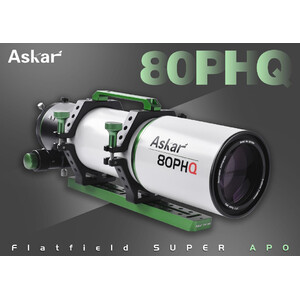
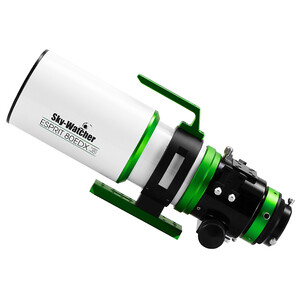
The specs are close. The experience isn't.
Affiliate links — we earn from qualifying purchases at no extra cost to you.
First light
Askar · 80mm · £799
The custom-rig optical tube
- 80mm refractor — optical tube only, no mount included
- 448mm focal length at f/5.6
- Requires a compatible mount before you can observe anything
- Best for: observers who already own a suitable mount or are building a specific imaging rig
- Not a complete purchase — budget at least £100–300 extra for a mount before observing
Sky-Watcher · 80mm · £699
The custom-rig optical tube
- 80mm refractor — optical tube only, no mount included
- 480mm focal length at f/6
- Requires a compatible mount before you can observe anything
- Best for: observers who already own a suitable mount or are building a specific imaging rig
- Not a complete purchase — budget at least £100–300 extra for a mount before observing
The full picture
The numbers that separate these two scopes — and what they mean at the eyepiece.
Aperture
Effectively equal light-gathering. Aperture won't settle this comparison — the mount, focal ratio, and observing experience are what differ.
Focal length
Sky-Watcher Esprit 80ED's longer focal length reaches higher magnification with the same eyepiece — better reach for planetary detail. Askar 80PHQ's shorter focal length gives a wider true field — better for large open clusters and extended nebulae.
Focal ratio
Askar 80PHQ's faster f/5.6 delivers wider fields with any eyepiece — better for open clusters and large nebulae. Sky-Watcher Esprit 80ED's f/6 provides more magnification per eyepiece — better for fine planetary detail.
Mount type
Neither scope includes a mount — both require a separate purchase before you can observe.
Weight (OTA)
Similar optical tube weight. Any portability difference between these setups comes from the mount, not the tube itself.
Optical design
Both are refractors — no mirrors to collimate, good contrast, colour-free stars with ED or APO glass. The differences between them are in aperture, focal ratio, and glass quality.
At the eyepiece
| Target | Askar 80PHQ | Sky-Watcher Esprit 80ED |
|---|---|---|
| Planets | ||
| Moon | Excellent 80mm aperture delivers sharp lunar detail; short focal length limits magnification but crater fields and terminator are crisp | Good Clean, chromatic-aberration-free views through the triplet ED optics, but 80mm aperture and short focal length limit high-magnification fine detail. |
| Saturn | Good Rings clearly visible at modest magnification; 448mm focal length limits high-power planetary detail | Moderate Rings visible and well-defined, but 480mm focal length requires very short eyepieces to reach useful magnification — Cassini Division only in excellent seeing. |
| Jupiter | Good Main cloud belts and Galilean moons visible, but the short focal length constrains useful magnification | Moderate Main cloud belts visible, but 80mm aperture and 480mm focal length limit the detail and magnification ceiling. |
| Mars | Challenging Small disc visible at opposition; 80mm aperture and 448mm focal length insufficient to resolve surface features reliably | Challenging Small disc visible near opposition, but 80mm aperture is insufficient to reliably show surface features or polar cap. |
Deep sky | ||
| Orion Nebula (M42) | Excellent Bright target framed beautifully by the wide field; f/5.6 speed and sub-600mm focal length show full nebula extent | Excellent 80mm aperture exceeds the threshold and the 480mm f/6 optics frame the full nebula extent with rich wide-field context — superb visually and for imaging. |
| Andromeda Galaxy (M31) | Excellent 448mm focal length captures the full extent of M31 including outer halo; 80mm aperture adequate for the bright core and dust lanes | Excellent 480mm focal length captures the full 3°+ extent of the galaxy including companion galaxies; ideal framing for both visual sweeping and imaging. |
| Open clusters | Excellent Wide field at 448mm frames large clusters like the Double Cluster, Pleiades, and Hyades superbly | Excellent 480mm focal length provides a wide true field — the Double Cluster, Pleiades, and Beehive are beautifully framed. |
| Globular clusters | Moderate 80mm aperture shows bright globulars like M13 as granular but unresolved fuzzy patches | Challenging 80mm aperture cannot resolve individual stars — globulars appear as fuzzy, unresolved patches. |
| Faint galaxies | Moderate 80mm aperture detects brighter Messier galaxies as smudges; insufficient light grasp for dim NGC targets visually | Moderate Many galaxies detectable visually as faint smudges; long-exposure imaging through a suitable mount recovers far more, but aperture is the limiting factor. |
| Milky Way / wide field | Excellent 448mm focal length at f/5.6 — ideal for sweeping rich star fields and Milky Way structure | Excellent 480mm focal length at f/6 delivers sweeping star fields visually and wide rich Milky Way frames for imaging. |
Other | ||
| Double stars | Good 80mm resolves wider doubles cleanly; the fast f/5.6 focal ratio is less ideal than a long-FL refractor for tight pairs | Good Clean APO optics and 80mm aperture resolve wide and moderate doubles crisply, though close pairs under 1.5 arcseconds are beyond the Dawes limit. |
| Astrophotography (deep sky) | Not recommended OTA only with no mount — requires a separate equatorial or GoTo mount for any deep-sky imaging; on a suitable mount this would rate Excellent | Not recommended No mount included — the OTA is designed for deep-sky imaging, but without an equatorial tracking mount it cannot be rated. Paired with an HEQ5 or similar, performance would be Excellent. |
| Astrophotography (planetary) | Challenging 80mm aperture and 448mm focal length undersized for planetary imaging; a Barlow helps but cannot overcome the aperture limit | Challenging 80mm aperture and 480mm focal length yield a small planetary image scale; even with a 3× Barlow the effective focal length is modest for planetary work. |
| Wide-field emission nebulae (imaging) | Excellent Fast f/5.6 quad APO with integrated flattener is purpose-built for targets like the Veil, North America, and Rosette Nebulae on a suitable mount | Not applicable |
| Emission nebulae (imaging) | Not applicable | Excellent Fast f/6 focal ratio and wide field are ideal for large emission nebulae like the North America, Heart, and Rosette when paired with a narrowband filter and tracking mount. |
The real tradeoff
Both scopes are capable. The question is which one fits the way you actually observe.
Askar 80PHQ
- You'll appreciate the integrated quadruplet design — no separate field flattener to buy, space, or collimate, which means one less variable when you're troubleshooting elongated corner stars at 2am.
- At f/5.6 you're gathering light roughly 15% faster per sub than the Esprit, which adds up across a night of narrowband imaging — you'll hit your target signal-to-noise ratio sooner and can move on to the next panel or target.
- You'll pay £100 more for the OTA and still face the same mount-and-camera spend, so the total system cost gap is real — but you're buying a four-element optical path with no extra accessories to achieve flat-field performance.
Sky-Watcher Esprit 80ED
- You'll save £100 on the OTA, and Sky-Watcher's wider dealer network means you're more likely to find accessories, adapters, and support without hunting through niche retailers.
- The included matched field flattener is a known quantity — it's purpose-designed for this scope's 55mm back-focus, so you'll find plenty of community-tested spacing solutions for popular cameras rather than working it out from scratch.
- At f/6 and 480mm, your image scale is slightly larger, giving you a touch more resolution on smaller targets like galaxy groups — you'll trade a few minutes of extra exposure time per sub for marginally tighter framing on compact objects.
The dark side
Every scope has a personality. Here’s where each one gets difficult.
Askar
Askar 80PHQ
At £799 for a bare OTA with no mount, finder, diagonal, or eyepiece, your total imaging system cost will comfortably exceed £2,000 before you capture a single photon.
The 55mm back-focus distance must be nailed precisely — get the spacing wrong between your filter drawer, off-axis guider, and camera, and you'll see field curvature and elongated corner stars that defeat the whole purpose of the quadruplet design.
Some users report the stock focuser can struggle under heavy camera payloads, so you may find yourself budgeting for an aftermarket focuser upgrade on top of an already premium OTA price.
Sky-Watcher
Sky-Watcher Esprit 80ED
Like the 80PHQ, this is an OTA-only purchase — no mount, no camera, no eyepiece — so your real investment starts well north of the £699 sticker price.
The field flattener is a separate optical element designed for Sky-Watcher's specific 55mm back-focus spacing; incorrect spacing introduces the very field curvature the flattener is supposed to eliminate, and you'll need to get your adapter stack right.
The 80mm aperture and 480mm focal length make planetary observation impractical — reaching 200× would require a 2.4mm eyepiece, which essentially doesn't exist in usable form, so don't expect this to double as a planetary scope.
Which is right for you?
Two different buyers. Two different right answers.
The custom-rig optical tube
Askar · Askar 80PHQ
You already own a solid equatorial mount and a cooled camera, and you want the simplest, fastest optical path for wide-field deep-sky imaging without fussing with a separate field flattener. You're willing to pay a £100 premium for the integrated quadruplet design and the f/5.6 speed advantage, and you value shorter sub-exposures — especially on narrowband — over saving money on the OTA. If you image the Veil, Heart, or Rosette regularly, you'll love how quickly data stacks up. This isn't for you if you want any meaningful visual capability, if you're assembling your first imaging rig on a budget, or if you're uncomfortable diagnosing back-focus spacing issues when corner stars misbehave.
The custom-rig optical tube
Sky-Watcher · Sky-Watcher Esprit 80ED
You're an intermediate imager building a dedicated wide-field rig and you want a well-proven triplet APO from a mainstream brand with strong community support and a broad accessory ecosystem. You'd rather save £100 on the OTA and spend it toward mount or camera upgrades, and you're comfortable using the included matched field flattener with well-documented spacing solutions. The slightly longer focal length at f/6 suits you if your targets occasionally include tighter galaxy groups alongside the big emission nebulae. This isn't for you if you want a grab-and-go visual scope, if you're on a tight overall budget that can't absorb the mount and camera costs, or if shaving a few minutes off every sub-exposure matters more to you than upfront savings.
Our verdict
Same aperture, same light-gathering, £100 price difference. The extra cost of the Askar 80PHQ buys a different mount — not better optics.
For most beginners, the Sky-Watcher Esprit 80ED is the right starting point — the optics are identical and the savings are better spent on a quality eyepiece or a dark-sky trip. The Askar 80PHQ makes sense if the mount it comes with is specifically what you want to learn. If I had to choose: the Sky-Watcher Esprit 80ED — same sky, less money.
Askar 80PHQ
View Askar 80PHQ →Sky-Watcher Esprit 80ED
View Sky-Watcher Esprit 80ED →Affiliate links — we earn from qualifying purchases at no extra cost to you.
Deep field: Full specifications
Every data point, for those who want to go further.
Full specifications
Fields highlighted in blue or amber indicate the better value for that spec. Data is manufacturer-stated and may vary.
How much can it see?
| Spec | Askar 80PHQ | Sky-Watcher Esprit 80ED |
|---|---|---|
Aperture The most important spec — bigger = more light = better views | 80mm | 80mm |
Focal Length Longer = more magnification potential | 448mm | 480mm |
Focal Ratio Lower f-number = wider field of view; higher = more magnification per eyepiece | f/5.6 | f/6 |
Optical Design The type of optics — each design has different strengths | Refractor | Refractor |
Coatings Better coatings = more light transmission through the optics | Fully multi-coated PHQ quadruplet on all surfaces | Fully multi-coated ED triplet with FMC on all air-to-glass surfaces |
How do you point it?
| Spec | Askar 80PHQ | Sky-Watcher Esprit 80ED |
|---|---|---|
Mount Type The mechanical system that holds and moves the telescope | None (OTA only) | None (OTA only) |
GoTo Computer-controlled pointing — finds any of thousands of objects automatically | ||
Tracking Motor keeps objects centred as the Earth rotates — essential for astrophotography |
The focuser
| Spec | Askar 80PHQ | Sky-Watcher Esprit 80ED |
|---|---|---|
Focuser Size 2" accepts wider eyepieces and gives better low-power views | 2" / 1.25" | 2" |
Focuser Type Rack-and-pinion is standard; Crayford and dual-speed are smoother | Dual-speed Crayford 2" (with 1.25" adapter) | Dual-speed Crayford (10:1 reduction, with 1.25" adapter) |
Size & weight
| Spec | Askar 80PHQ | Sky-Watcher Esprit 80ED |
|---|---|---|
OTA Weightⓘ Optical tube only — useful for comparing mount load capacity | 2.8kg | 2.55kg |
Tube Length | 360mm | 450mm |
Tube Material | Aluminium | Aluminium, white powder coat |
What's in the box?
| Spec | Askar 80PHQ | Sky-Watcher Esprit 80ED |
|---|---|---|
Diagonal Tilts the eyepiece 90° for comfortable viewing — useful on refractors |
Blue highlight: Askar 80PHQ advantage · Amber highlight: Sky-Watcher Esprit 80ED advantage · Greyed cells: equal or subjective.