Telescope Comparison
Askar 80PHQ vs Sky-Watcher Evostar 80ED + HEQ5 Pro
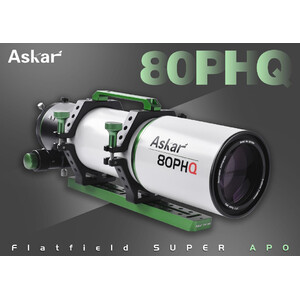
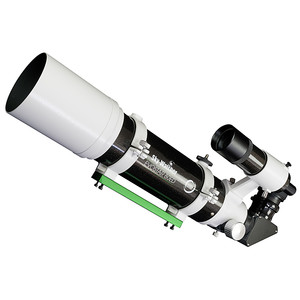
The Sky-Watcher Evostar 80ED + HEQ5 Pro is a complete setup. The Askar 80PHQ needs a mount before it's usable.
Affiliate links — we earn from qualifying purchases at no extra cost to you.
First light
Askar · 80mm · £799
The custom-rig optical tube
- 80mm refractor — optical tube only, no mount included
- 448mm focal length at f/5.6
- Requires a compatible mount before you can observe anything
- Best for: observers who already own a suitable mount or are building a specific imaging rig
- Not a complete purchase — budget at least £100–300 extra for a mount before observing
Sky-Watcher · 80mm · £690
The automated deep-sky platform
- 80mm refractor on a computerised mount with motorised tracking
- Good for: Moon, planets, bright nebulae, star clusters, and deep-sky objects
- GoTo system finds any object in its database after initial star alignment — no star atlas needed
- Tracking motors keep objects centred as Earth rotates — useful above 100×, essential for photography
- 22.5kg total — requires a fixed garden spot or car transport
The full picture
The numbers that separate these two scopes — and what they mean at the eyepiece.
Aperture
Effectively equal light-gathering. Aperture won't settle this comparison — the mount, focal ratio, and observing experience are what differ.
Focal length
Sky-Watcher Evostar 80ED + HEQ5 Pro's longer focal length reaches higher magnification with the same eyepiece — better reach for planetary detail. Askar 80PHQ's shorter focal length gives a wider true field — better for large open clusters and extended nebulae.
Focal ratio
Askar 80PHQ's faster f/5.6 delivers wider fields with any eyepiece — better for open clusters and large nebulae. Sky-Watcher Evostar 80ED + HEQ5 Pro's f/7.5 provides more magnification per eyepiece — better for fine planetary detail.
Mount type
Askar 80PHQ has no mount — add a compatible mount before you can observe. Sky-Watcher Evostar 80ED + HEQ5 Pro is a complete ready-to-use system.
Weight (OTA)
Similar optical tube weight. Any portability difference between these setups comes from the mount, not the tube itself.
Optical design
Both are refractors — no mirrors to collimate, good contrast, colour-free stars with ED or APO glass. The differences between them are in aperture, focal ratio, and glass quality.
At the eyepiece
| Target | Askar 80PHQ | Sky-Watcher Evostar 80ED + HEQ5 Pro |
|---|---|---|
| Planets | ||
| Moon | Excellent 80mm aperture delivers sharp lunar detail; short focal length limits magnification but crater fields and terminator are crisp | Good 80mm aperture delivers sharp, colour-free craters and terminator detail; f/7.5 limits extreme magnification compared to longer focal length scopes |
| Saturn | Good Rings clearly visible at modest magnification; 448mm focal length limits high-power planetary detail | Moderate Rings clearly visible and disc shows colour, but 600mm focal length keeps the image small — Cassini Division requires excellent seeing and high-power eyepieces |
| Jupiter | Good Main cloud belts and Galilean moons visible, but the short focal length constrains useful magnification | Moderate Main equatorial belts visible; 80mm aperture and 600mm focal length limit detail on the Great Red Spot and festoons |
| Mars | Challenging Small disc visible at opposition; 80mm aperture and 448mm focal length insufficient to resolve surface features reliably | Challenging Small orange disc visible at opposition; polar cap glimpsable in ideal conditions but surface albedo features are beyond this aperture |
Deep sky | ||
| Orion Nebula (M42) | Excellent Bright target framed beautifully by the wide field; f/5.6 speed and sub-600mm focal length show full nebula extent | Excellent Wide 600mm field frames the full nebula and Running Man beautifully — bright enough to show structure visually and a superb imaging target |
| Andromeda Galaxy (M31) | Excellent 448mm focal length captures the full extent of M31 including outer halo; 80mm aperture adequate for the bright core and dust lanes | Excellent 600mm focal length captures the full galaxy extent including companion galaxies; one of this scope's signature imaging targets |
| Open clusters | Excellent Wide field at 448mm frames large clusters like the Double Cluster, Pleiades, and Hyades superbly | Excellent Wide field perfectly frames the Double Cluster, Pleiades, and other large clusters with pin-sharp stars across the field |
| Globular clusters | Moderate 80mm aperture shows bright globulars like M13 as granular but unresolved fuzzy patches | Challenging 80mm aperture cannot resolve individual stars — M13 and M3 appear as fuzzy, unresolved glows |
| Faint galaxies | Moderate 80mm aperture detects brighter Messier galaxies as smudges; insufficient light grasp for dim NGC targets visually | Moderate Visually limited by 80mm aperture; however, with camera and stacked exposures, many faint galaxies are accessible photographically |
| Milky Way / wide field | Excellent 448mm focal length at f/5.6 — ideal for sweeping rich star fields and Milky Way structure | Good 600mm focal length is at the long end for sweeping Milky Way fields visually, but on camera the wide field and fast optics capture rich starfields well |
Other | ||
| Double stars | Good 80mm resolves wider doubles cleanly; the fast f/5.6 focal ratio is less ideal than a long-FL refractor for tight pairs | Good Clean ED optics split well-separated doubles cleanly; Dawes limit at 80mm is ~1.45 arcsec, so tight pairs are out of reach |
| Astrophotography (deep sky) | Not recommended OTA only with no mount — requires a separate equatorial or GoTo mount for any deep-sky imaging; on a suitable mount this would rate Excellent | Excellent HEQ5 Pro GoTo mount with tracking, 80mm ED optics at f/7.5 (f/6.3 with reducer), and massive payload headroom make this a benchmark widefield imaging rig |
| Astrophotography (planetary) | Challenging 80mm aperture and 448mm focal length undersized for planetary imaging; a Barlow helps but cannot overcome the aperture limit | Challenging 80mm aperture and 600mm focal length produce a small planetary disc — limited detail even with lucky imaging techniques |
| Wide-field emission nebulae (imaging) | Excellent Fast f/5.6 quad APO with integrated flattener is purpose-built for targets like the Veil, North America, and Rosette Nebulae on a suitable mount | Not applicable |
The real tradeoff
Both scopes are capable. The question is which one fits the way you actually observe.
Askar 80PHQ
- You'll unbox a beautifully optimised imaging OTA — and then spend hundreds more on a mount, guidescope, and camera before you capture a single photon, because absolutely nothing else is included.
- You'll nail flat stars to the corners of a full-frame sensor straight out of the box, with no fumbling with field-flattener spacing — the integrated quad-element design eliminates one of astrophotography's most annoying setup headaches.
- At f/5.6 and 448mm focal length, you'll frame enormous targets like the Veil Nebula complex or Heart and Soul pair in a single shot, and your narrowband sub-exposures will be noticeably shorter than with the slower Evostar — which means more data per hour and earlier nights packing up.
Sky-Watcher Evostar 80ED + HEQ5 Pro
- You'll walk away from the purchase with a complete imaging-capable mount and telescope for £899 — polar-align, attach a camera, and you're genuinely shooting the same night, no separate mount purchase required.
- You'll spend ten minutes each session on polar alignment and balancing, but the HEQ5 Pro rewards you with a mount that can carry nearly four times the OTA's weight — so you can pile on a guidescope, filter wheel, and heavy cooled camera without a second thought.
- You'll need to buy and correctly space a separate field flattener to get sharp corner stars, and if you don't, your first images will show obvious edge distortion that the Askar simply doesn't produce — that's the tax on a simpler doublet design.
The dark side
Every scope has a personality. Here’s where each one gets difficult.
Askar
Askar 80PHQ
At £799 for the OTA alone, you still need a mount, camera, guidescope, and accessories — your total system cost will easily double or triple before first light.
The integrated field flattener demands precise 55mm back-focus spacing; get it wrong by even a millimetre or two and you'll introduce the exact field curvature and star elongation the design is supposed to eliminate.
Some users report the stock focuser flexes under heavy camera payloads — if you're running a cooled full-frame camera plus filter wheel, you may end up budgeting for an aftermarket focuser upgrade.
Sky-Watcher
Sky-Watcher Evostar 80ED + HEQ5 Pro
The ED doublet is not a true APO — bright stars at high magnification show slight residual chromatic aberration, which is unnoticeable in deep-sky images but visible if you try to use this scope visually on planets.
No field flattener is included, so out-of-the-box imaging with any camera sensor will show coma and field curvature at the edges — the 0.85× reducer/corrector is essentially a mandatory add-on purchase.
The HEQ5 Pro head and tripod weigh roughly 10 kg together, so you're committing to a proper setup ritual each session — this is not a grab-and-go rig, and careful polar alignment is non-negotiable every time.
Which is right for you?
Two different buyers. Two different right answers.
The custom-rig optical tube
Askar · Askar 80PHQ
You already own a solid equatorial mount — an HEQ5, EQ6, or iOptron equivalent — and you want the sharpest, fastest 80mm imaging OTA you can bolt onto it. You're past the stage of wondering what a field flattener is; you want one baked in so you can concentrate on acquisition and guiding. You shoot widefield targets on full-frame or APS-C sensors, you value the stop-and-a-half speed advantage over a typical f/7 doublet, and you don't care that this scope is essentially useless for visual observing. If you're a beginner without a mount or camera already in hand, this is not where you start.
The automated deep-sky platform
Sky-Watcher · Sky-Watcher Evostar 80ED + HEQ5 Pro
You're ready to commit to astrophotography but you don't yet own a tracking mount, and you want a single purchase that gets you a proven, well-supported platform capable of real results. You're willing to learn polar alignment, autoguiding, and image stacking — and you want a mount with enough payload headroom that you won't outgrow it when you upgrade cameras or add accessories. You accept that you'll need to buy a field flattener separately and that 80mm won't wow you visually, but you want the security of a known-quantity combo that thousands of imagers have used before you. If you already own a capable EQ mount, you'd be paying for hardware you don't need — look at the Askar instead.
Our verdict
This comparison has a catch: the Askar 80PHQ is a bare optical tube. You cannot use it without a separate mount — which adds meaningful cost and complexity. The Sky-Watcher Evostar 80ED + HEQ5 Pro is a complete, ready-to-observe package.
For most buyers, the Sky-Watcher Evostar 80ED + HEQ5 Pro is the right choice — you can observe the same night it arrives. The Askar 80PHQ makes sense if you already own a compatible mount, or are deliberately building a specific imaging setup piece by piece. If I had to choose for a first telescope: the Sky-Watcher Evostar 80ED + HEQ5 Pro, without hesitation.
Askar 80PHQ
View Askar 80PHQ →Sky-Watcher Evostar 80ED + HEQ5 Pro
View Sky-Watcher Evostar 80ED + HEQ5 Pro →Affiliate links — we earn from qualifying purchases at no extra cost to you.
Deep field: Full specifications
Every data point, for those who want to go further.
Full specifications
Fields highlighted in blue or amber indicate the better value for that spec. Data is manufacturer-stated and may vary.
How much can it see?
| Spec | Askar 80PHQ | Sky-Watcher Evostar 80ED + HEQ5 Pro |
|---|---|---|
Aperture The most important spec — bigger = more light = better views | 80mm | 80mm |
Focal Length Longer = more magnification potential | 448mm | 600mm |
Focal Ratio Lower f-number = wider field of view; higher = more magnification per eyepiece | f/5.6 | f/7.5 |
Optical Design The type of optics — each design has different strengths | Refractor | Refractor |
Coatings Better coatings = more light transmission through the optics | Fully multi-coated PHQ quadruplet on all surfaces | Fully multi-coated ED glass, FMC on all air-to-glass surfaces |
How do you point it?
| Spec | Askar 80PHQ | Sky-Watcher Evostar 80ED + HEQ5 Pro |
|---|---|---|
Mount Type The mechanical system that holds and moves the telescope | None (OTA only) | GoTo (Computerised) |
GoToⓘ Computer-controlled pointing — finds any of thousands of objects automatically | ||
Trackingⓘ Motor keeps objects centred as the Earth rotates — essential for astrophotography |
The focuser
| Spec | Askar 80PHQ | Sky-Watcher Evostar 80ED + HEQ5 Pro |
|---|---|---|
Focuser Size 2" accepts wider eyepieces and gives better low-power views | 2" / 1.25" | 2" |
Focuser Type Rack-and-pinion is standard; Crayford and dual-speed are smoother | Dual-speed Crayford 2" (with 1.25" adapter) | Crayford dual-speed (with 1.25" adapter) |
Size & weight
| Spec | Askar 80PHQ | Sky-Watcher Evostar 80ED + HEQ5 Pro |
|---|---|---|
OTA Weightⓘ Optical tube only — useful for comparing mount load capacity | 2.8kg | 2.2kg |
Total Weight Full setup including mount — this is what you lug to the car | — | 22.5kg |
Tube Length | 360mm | 600mm |
Tube Material | Aluminium | Aluminium, white powder coat |
What's in the box?
| Spec | Askar 80PHQ | Sky-Watcher Evostar 80ED + HEQ5 Pro |
|---|---|---|
Eyepieces Included eyepieces — more is better, but quality matters more than quantity | — | 25mm Super eyepiece |
Finder Scope Helps you locate areas of the sky before switching to the main eyepiece | — | 8x50 right-angle correct-image finder with illuminated reticle |
Diagonal Tilts the eyepiece 90° for comfortable viewing — useful on refractors |
Blue highlight: Askar 80PHQ advantage · Amber highlight: Sky-Watcher Evostar 80ED + HEQ5 Pro advantage · Greyed cells: equal or subjective.