Telescope Comparison
Bresser Messier 10" Dobsonian vs Sky-Watcher Skyliner 200P
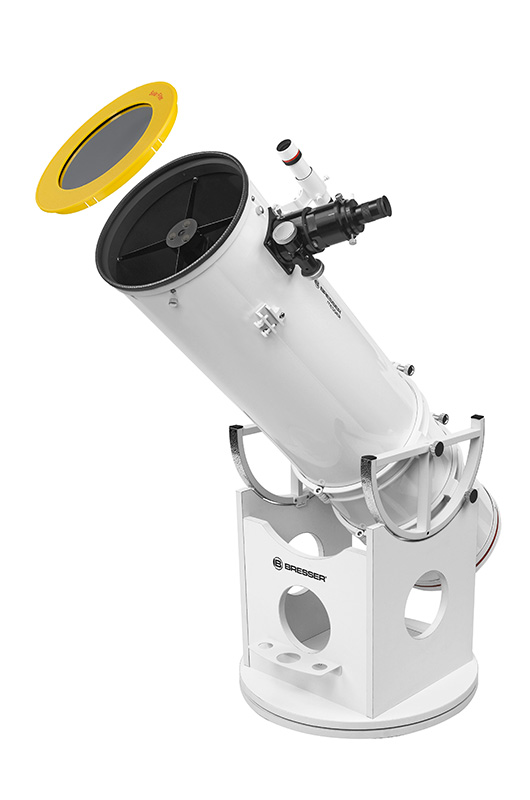
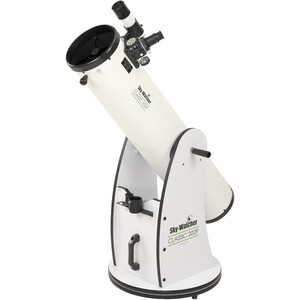
254mm versus 200mm — the aperture difference is the comparison.
Affiliate links — we earn from qualifying purchases at no extra cost to you.
First light
Bresser · 254mm · £499
The maximum-aperture visual reflector
- 254mm Newtonian on a floor-standing Dobsonian alt-az rocker box
- Good for: full visual programme — planets, Moon, globular clusters, galaxies, nebulae
- No alignment required — set up and observe in under 10 minutes
- No motorised tracking — targets drift at high magnification as Earth rotates
- 27kg total — designed for a fixed garden or regular dark-sky site, not casual transport
Sky-Watcher · 200mm · £414
The maximum-aperture visual reflector
- 200mm Newtonian on a floor-standing Dobsonian alt-az rocker box
- Good for: full visual programme — planets, Moon, globular clusters, galaxies, nebulae
- No alignment required — set up and observe in under 10 minutes
- No motorised tracking — targets drift at high magnification as Earth rotates
- 17.5kg total — designed for a fixed garden or regular dark-sky site, not casual transport
The full picture
The numbers that separate these two scopes — and what they mean at the eyepiece.
Aperture
Bresser Messier 10" Dobsonian gathers 1.6× more light. On bright targets — Moon, Saturn, Jupiter — you won't notice. On fainter targets — dim galaxies, faint globular clusters — the gap is real.
Focal length
Bresser Messier 10" Dobsonian's longer focal length reaches higher magnification with the same eyepiece — better reach for planetary detail. Sky-Watcher Skyliner 200P's shorter focal length gives a wider true field — better for large open clusters and extended nebulae.
Focal ratio
Bresser Messier 10" Dobsonian's faster f/5 delivers wider fields with any eyepiece — better for open clusters and large nebulae. Sky-Watcher Skyliner 200P's f/6 provides more magnification per eyepiece — better for fine planetary detail.
Mount type
Same mount type — setup experience and ergonomics will be similar. Differences lie in build quality and included accessories.
Weight (OTA)
Sky-Watcher Skyliner 200P's optical tube is 6.8kg lighter. Relevant if you plan to use it on multiple mounts or carry the tube to dark-sky sites separately.
Optical design
Same optical design — differences between these scopes come from aperture, mount, and focal ratio.
At the eyepiece
| Target | Bresser Messier 10" Dobsonian | Sky-Watcher Skyliner 200P |
|---|---|---|
| Planets | ||
| Moon | Excellent 254mm resolves sub-kilometre crater detail; the terminator is spectacular with hundreds of features visible per session | Excellent 200mm resolves extraordinary lunar detail — crater terracing, rilles, and the Straight Wall are all within reach at 200×+ |
| Saturn | Excellent Cassini Division cleanly split, cloud banding on the globe visible, and multiple moons in the field at 1270mm focal length | Excellent 1200mm focal length and 200mm aperture show the Cassini Division, cloud banding on the disc, and multiple moons in good seeing |
| Jupiter | Excellent Multiple cloud belts, festoons, GRS detail, and moon shadow transits all accessible at 200x+ in steady seeing | Excellent Multiple cloud bands, the Great Red Spot, and Galilean moon shadow transits are all accessible at 150–250× |
| Mars | Excellent 254mm aperture and 1270mm focal length (extendable with Barlows to 2500mm+) reveal dark albedo features, polar caps, and limb phenomena at opposition | Good Polar cap and dark albedo markings visible at opposition; the 1200mm focal length benefits from a Barlow for extra image scale |
Deep sky | ||
| Orion Nebula (M42) | Excellent Bright nebulosity fills the field with structure and hints of colour; the Trapezium cluster is cleanly resolved into four or more stars | Excellent Bright nebulosity with layered structure, the Trapezium cleanly split; some colour perception possible under dark skies |
| Andromeda Galaxy (M31) | Good 1270mm focal length captures the bright core and inner disc well but crops the full 3° extent; dust lanes visible with averted vision | Moderate 1200mm focal length shows the bright core and inner dust lanes well, but the full 3° extent of the galaxy overfills the field even with a wide 2-inch eyepiece |
| Open clusters | Good 1270mm focal length means larger clusters like the Double Cluster just fit the field with a wide-angle 2-inch eyepiece; compact clusters like M37 are stunning | Moderate Smaller clusters like the Double Cluster and M35 look good, but large objects like the Pleiades overfill the field at 1200mm focal length |
| Globular clusters | Excellent 254mm resolves individual stars across the face of M13, M3, and M92 — not just at the edges but into the core region | Excellent 200mm resolves individual stars across M13, M92, and M3 — a major step up from smaller apertures |
| Faint galaxies | Excellent Spiral arms in M51, dust lanes in M82, and structure in dozens of NGC galaxies become accessible under dark skies | Good 200mm reveals dozens of galaxies in Virgo and Leo as distinct glows; spiral structure visible in the brightest examples under dark skies |
| Milky Way / wide field | Moderate 1270mm focal length limits the true field even with a 2-inch eyepiece; individual star clouds are impressive but you cannot sweep wide swathes | Not recommended 1200mm focal length gives too narrow a field for sweeping Milky Way star fields — a short-focal-length instrument is better suited |
Other | ||
| Double stars | Excellent 254mm gives a Dawes limit around 0.46 arcseconds — tight pairs like Porrima and Castor are cleanly split; f/5 may show slight diffraction effects vs longer focal ratios | Excellent 200mm aperture resolves doubles below 1 arcsecond; f/6 is shorter than ideal for splitting but performs well with quality eyepieces |
| Astrophotography (deep sky) | Not recommended Manual Dobsonian mount provides no tracking — long-exposure imaging is not possible without aftermarket equatorial platform | Not recommended Manual Dobsonian mount has no tracking — exposures beyond a fraction of a second show star trails |
| Astrophotography (planetary) | Challenging Short video captures of bright planets are possible with a webcam, but manual tracking at 200x+ is very difficult and results are inconsistent | Challenging Aperture and focal length are sufficient for lucky imaging with a high-speed camera, but manual tracking makes keeping the planet centred very difficult |
The real tradeoff
Both scopes are capable. The question is which one fits the way you actually observe.
Bresser Messier 10" Dobsonian
- You're paying £170 more for an extra 54mm of aperture, and you'll see the difference — M51's spiral arms go from 'detectable with averted vision' to genuinely visible, and globular clusters resolve across their full faces rather than just at the edges.
- You'll wrestle with a longer, heavier tube (~25kg total) that demands an estate car or folded rear seats, and you'll feel every kilogram of that difference when you're carrying it across a dark field at midnight.
- At f/5 you get a slightly faster focal ratio, but coma hits harder at the field edges — you'll want a coma corrector sooner than a Skyliner 200P owner would, adding another £50–100 to an already higher price.
Sky-Watcher Skyliner 200P
- You'll set up in minutes, observe for hours, and still see serious deep-sky structure — M13 resolved into stars, spiral hints in M51, layered detail in M42 — all for under £350, leaving budget for better eyepieces.
- You'll find the tube marginally easier to manage than the 10" — it's still nearly 1.2m long and 24kg total, but that 1kg-ish difference and slightly shorter tube add up across a dozen trips to your dark site.
- At f/6 your eyepieces behave a little better at the edges of the field, and you'll get sharp planetary views at 200× without pushing the seeing as hard — Jupiter and Saturn look excellent without needing premium glass to tame aberrations.
The dark side
Every scope has a personality. Here’s where each one gets difficult.
Bresser
Bresser Messier 10" Dobsonian
The f/5 focal ratio makes coma noticeably worse than the Skyliner 200P at the field edges — a Baader MPCC or equivalent is effectively a required purchase if you use wide-angle eyepieces.
At ~25kg total and with a tube over 1.2m long, transporting this scope requires a suitable vehicle and a plan — it won't fit in a hatchback boot without folding seats, and it's an awkward carry on uneven ground.
The included eyepiece (typically a single 25mm Super Plössl) is worse than the Skyliner 200P's two-eyepiece kit — you'll need to buy at least one additional eyepiece immediately to use the scope at higher powers.
Sky-Watcher
Sky-Watcher Skyliner 200P
The open tube design leaves the secondary mirror exposed to dew and stray light — you'll likely end up building or buying a light shroud, which is an extra cost and hassle the Bresser's enclosed tube doesn't impose.
No tracking on either scope, but at the Skyliner's 200mm aperture you're already at the threshold of deep-sky visibility rather than comfortably above it — faint galaxies that the 10" shows as soft glows may remain invisible here.
Collimation may be needed out of the box, and the included 10mm and 25mm eyepieces are basic enough that most owners replace them quickly — budget another £50–100 for a decent wide-angle eyepiece soon after purchase.
Which is right for you?
Two different buyers. Two different right answers.
The maximum-aperture visual reflector
Bresser · Bresser Messier 10" Dobsonian
You've already owned a smaller scope — maybe a 130mm or 150mm — and you know you love deep-sky observing enough to justify lugging a bigger tube to dark sites. You want to see real structure in galaxies and fully resolved globulars, not just detect them, and you're willing to spend £170 more plus the cost of a coma corrector and extra eyepieces to get there. You have the storage space, the vehicle, and the patience for collimation. This is your scope if aperture is king and you've accepted the logistics.
The maximum-aperture visual reflector
Sky-Watcher · Sky-Watcher Skyliner 200P
You want the most capable visual telescope you can buy for under £350, and you're not convinced you need to spend more to enjoy the hobby seriously. You'll see genuine deep-sky detail — resolved globulars, spiral hints, nebula structure — and you'll have money left over for a better eyepiece or two. You're comfortable with the size and weight being substantial but not quite as punishing as the 10", and you'd rather master star-hopping with a scope that rewards you immediately than stretch your budget for incremental gains you might not notice on most nights.
Our verdict
These two are closer than most comparisons on this site. The spec differences are genuine — mount type, focal ratio — but neither is the wrong answer for a typical observer starting out.
If I had to choose between them: the Bresser Messier 10" Dobsonian is the scope most people will be using regularly six months from now. The Sky-Watcher Skyliner 200P rewards you more once you know what you're doing — it's worth revisiting after your first year.
Bresser Messier 10" Dobsonian
View Bresser Messier 10" Dobsonian →Sky-Watcher Skyliner 200P
View Sky-Watcher Skyliner 200P →Affiliate links — we earn from qualifying purchases at no extra cost to you.
Deep field: Full specifications
Every data point, for those who want to go further.
Full specifications
Fields highlighted in blue or amber indicate the better value for that spec. Data is manufacturer-stated and may vary.
How much can it see?
| Spec | Bresser Messier 10" Dobsonian | Sky-Watcher Skyliner 200P |
|---|---|---|
Apertureⓘ The most important spec — bigger = more light = better views | 254mm | 200mm |
Focal Length Longer = more magnification potential | 1270mm | 1200mm |
Focal Ratio Lower f-number = wider field of view; higher = more magnification per eyepiece | f/5 | f/6 |
Optical Design The type of optics — each design has different strengths | Dobsonian | Dobsonian |
Coatings Better coatings = more light transmission through the optics | Parabolic primary mirror, fully coated | Parabolic primary mirror, fully multi-coated |
How do you point it?
| Spec | Bresser Messier 10" Dobsonian | Sky-Watcher Skyliner 200P |
|---|---|---|
Mount Type The mechanical system that holds and moves the telescope | Dobsonian | Dobsonian |
GoTo Computer-controlled pointing — finds any of thousands of objects automatically | ||
Tracking Motor keeps objects centred as the Earth rotates — essential for astrophotography |
The focuser
| Spec | Bresser Messier 10" Dobsonian | Sky-Watcher Skyliner 200P |
|---|---|---|
Focuser Size 2" accepts wider eyepieces and gives better low-power views | 2" | 2" |
Focuser Type Rack-and-pinion is standard; Crayford and dual-speed are smoother | Dual-speed Crayford (2" with 1.25" adapter) | Dual-speed Crayford (10:1 reduction) |
Size & weight
| Spec | Bresser Messier 10" Dobsonian | Sky-Watcher Skyliner 200P |
|---|---|---|
OTA Weightⓘ Optical tube only — useful for comparing mount load capacity | 18kg | 11.2kg |
Total Weightⓘ Full setup including mount — this is what you lug to the car | 27kg | 17.5kg |
Tube Length | 1270mm | 1200mm |
Tube Material | Steel | Steel |
What's in the box?
| Spec | Bresser Messier 10" Dobsonian | Sky-Watcher Skyliner 200P |
|---|---|---|
Eyepieces Included eyepieces — more is better, but quality matters more than quantity | 25mm and 10mm eyepieces | 25mm and 10mm Super eyepieces |
Finder Scope Helps you locate areas of the sky before switching to the main eyepiece | 8x50 right-angle finder | 8x50 right-angle correct-image finder |
Diagonal Tilts the eyepiece 90° for comfortable viewing — useful on refractors |
Blue highlight: Bresser Messier 10" Dobsonian advantage · Amber highlight: Sky-Watcher Skyliner 200P advantage · Greyed cells: equal or subjective.