Telescope Comparison
Bresser Messier 10" Dobsonian vs Sky-Watcher Skyliner 300P
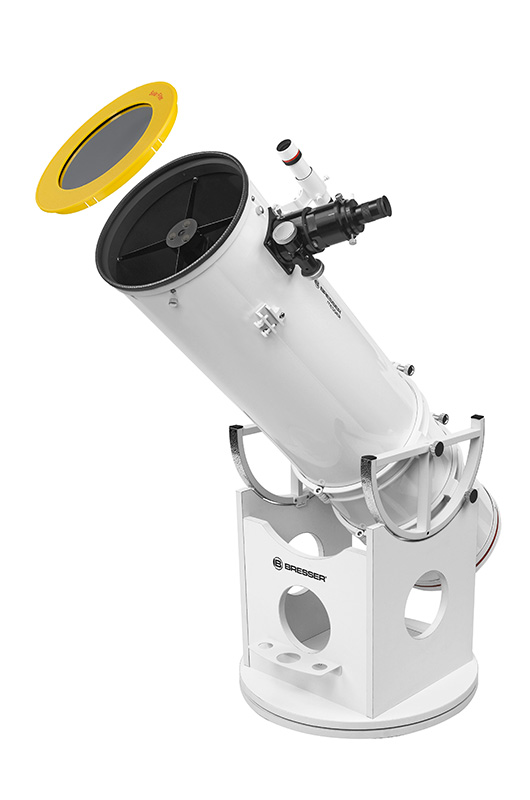
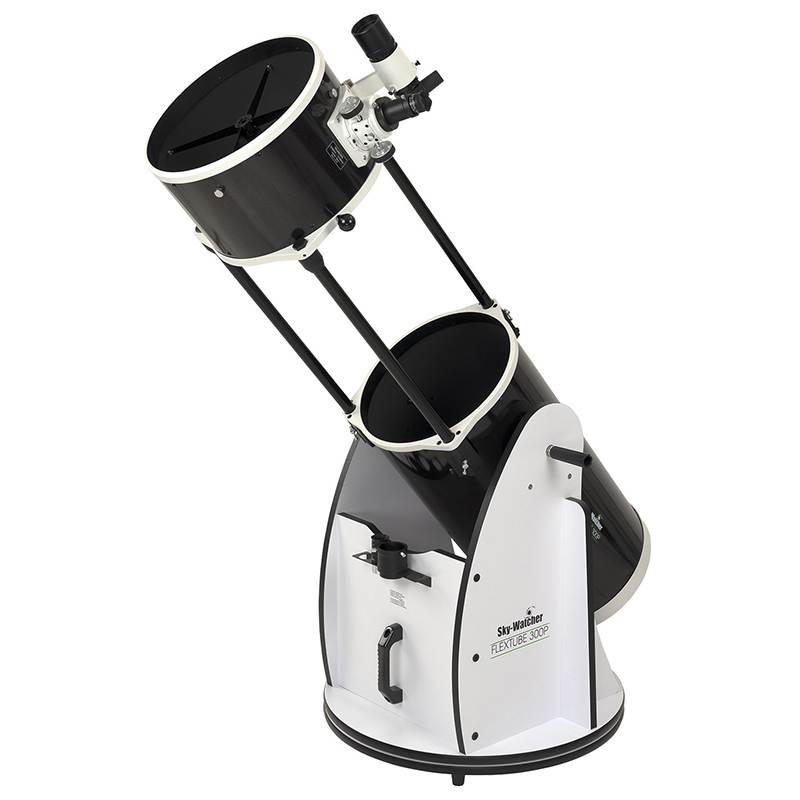
The specs are close. The experience isn't.
Affiliate links — we earn from qualifying purchases at no extra cost to you.
First light
Bresser · 254mm · £499
The maximum-aperture visual reflector
- 254mm Newtonian on a floor-standing Dobsonian alt-az rocker box
- Good for: full visual programme — planets, Moon, globular clusters, galaxies, nebulae
- No alignment required — set up and observe in under 10 minutes
- No motorised tracking — targets drift at high magnification as Earth rotates
- 27kg total — designed for a fixed garden or regular dark-sky site, not casual transport
Sky-Watcher · 304mm · £659
The maximum-aperture visual reflector
- 304mm Newtonian on a floor-standing Dobsonian alt-az rocker box
- Good for: full visual programme — planets, Moon, globular clusters, galaxies, nebulae
- No alignment required — set up and observe in under 10 minutes
- No motorised tracking — targets drift at high magnification as Earth rotates
- 38kg total — designed for a fixed garden or regular dark-sky site, not casual transport
The full picture
The numbers that separate these two scopes — and what they mean at the eyepiece.
Aperture
Sky-Watcher Skyliner 300P gathers 1.4× more light. On bright targets — Moon, Saturn, Jupiter — you won't notice. On fainter targets — dim galaxies, faint globular clusters — the gap is real.
Focal length
Sky-Watcher Skyliner 300P's longer focal length reaches higher magnification with the same eyepiece — better reach for planetary detail. Bresser Messier 10" Dobsonian's shorter focal length gives a wider true field — better for large open clusters and extended nebulae.
Focal ratio
Same focal ratio — the same eyepiece gives equivalent magnification and true field in both scopes.
Mount type
Same mount type — setup experience and ergonomics will be similar. Differences lie in build quality and included accessories.
Weight (OTA)
Bresser Messier 10" Dobsonian's optical tube is 6.0kg lighter. Relevant if you plan to use it on multiple mounts or carry the tube to dark-sky sites separately.
Optical design
Same optical design — differences between these scopes come from aperture, mount, and focal ratio.
At the eyepiece
| Target | Bresser Messier 10" Dobsonian | Sky-Watcher Skyliner 300P |
|---|---|---|
| Planets | ||
| Moon | Excellent 254mm resolves sub-kilometre crater detail; the terminator is spectacular with hundreds of features visible per session | Excellent 304mm aperture delivers overwhelming lunar detail — tiny craterlets, rilles, and mountain shadows at 250x+ |
| Saturn | Excellent Cassini Division cleanly split, cloud banding on the globe visible, and multiple moons in the field at 1270mm focal length | Excellent Cassini Division clear, cloud banding on the disc, and multiple moons visible at 200–300x |
| Jupiter | Excellent Multiple cloud belts, festoons, GRS detail, and moon shadow transits all accessible at 200x+ in steady seeing | Excellent Multiple belt structures, festoons, GRS, and moon shadow transits visible in good seeing |
| Mars | Excellent 254mm aperture and 1270mm focal length (extendable with Barlows to 2500mm+) reveal dark albedo features, polar caps, and limb phenomena at opposition | Excellent 304mm aperture and 1500mm focal length resolve dark surface features and polar caps at opposition |
Deep sky | ||
| Orion Nebula (M42) | Excellent Bright nebulosity fills the field with structure and hints of colour; the Trapezium cluster is cleanly resolved into four or more stars | Excellent Layered nebulosity with structure and possible colour; Trapezium stars pinpoint-sharp |
| Andromeda Galaxy (M31) | Good 1270mm focal length captures the bright core and inner disc well but crops the full 3° extent; dust lanes visible with averted vision | Moderate 1500mm focal length crops the outer halo — you see the bright core and dust lanes, but the full 3° extent is lost |
| Open clusters | Good 1270mm focal length means larger clusters like the Double Cluster just fit the field with a wide-angle 2-inch eyepiece; compact clusters like M37 are stunning | Moderate 1500mm focal length means many large clusters (Pleiades, Double Cluster) overfill the field; compact clusters fare better |
| Globular clusters | Excellent 254mm resolves individual stars across the face of M13, M3, and M92 — not just at the edges but into the core region | Excellent 304mm resolves individual stars across the face of M13, M3, M5 and others — a showpiece target for this scope |
| Faint galaxies | Excellent Spiral arms in M51, dust lanes in M82, and structure in dozens of NGC galaxies become accessible under dark skies | Excellent Spiral arms in M51, dust lane in M82, Leo Triplet resolved — this is where 12 inches of aperture justifies itself |
| Milky Way / wide field | Moderate 1270mm focal length limits the true field even with a 2-inch eyepiece; individual star clouds are impressive but you cannot sweep wide swathes | Not recommended 1500mm focal length gives far too narrow a field for sweeping Milky Way star fields |
Other | ||
| Double stars | Excellent 254mm gives a Dawes limit around 0.46 arcseconds — tight pairs like Porrima and Castor are cleanly split; f/5 may show slight diffraction effects vs longer focal ratios | Excellent 304mm aperture resolves sub-arcsecond pairs; the f/4.9 ratio is less forgiving of seeing than a long-focus refractor, but raw resolving power is high |
| Astrophotography (deep sky) | Not recommended Manual Dobsonian mount provides no tracking — long-exposure imaging is not possible without aftermarket equatorial platform | Not recommended Manual Dobsonian mount with no tracking — long-exposure imaging is not viable |
| Astrophotography (planetary) | Challenging Short video captures of bright planets are possible with a webcam, but manual tracking at 200x+ is very difficult and results are inconsistent | Challenging Planetary video capture is theoretically possible with short exposures, but manual tracking at 1500mm makes it very difficult in practice |
The real tradeoff
Both scopes are capable. The question is which one fits the way you actually observe.
Bresser Messier 10" Dobsonian
- You can wrestle the whole setup into a hatchback with the rear seats folded — at ~25kg total, you'll manage it in one trip and won't dread the carry from the car park to the observing field.
- You'll see genuine structure in galaxies and resolved globulars, but M51's spiral arms need averted vision and patience; you're at the threshold of 'impressive' rather than 'dramatic' on faint targets.
- You'll save £160 upfront and have a scope that's meaningfully easier to live with day-to-day — which means you'll actually take it out on a Wednesday night instead of waiting for a 'perfect' weekend session that never comes.
Sky-Watcher Skyliner 300P
- You'll need to measure your boot before buying and accept that setup means two trips from the car — at 38kg and a 1.5m tube, this is a commitment every single session, and you'll feel it in your back.
- You'll see things the 10-inch simply cannot show you: M82's dust lane jumps out rather than hiding, globulars resolve across their entire face rather than mostly, and faint galaxies that were 'just about there' in the Bresser become definite sightings.
- You'll spend the first 30–60 minutes waiting for the 12-inch mirror to cool down on cold nights while the 10-inch owner next to you is already observing — a fan accessory moves from 'nice to have' to near-essential in British winters.
The dark side
Every scope has a personality. Here’s where each one gets difficult.
Bresser
Bresser Messier 10" Dobsonian
At f/5, coma distorts star shapes at the edges of wide-field eyepieces — budget another £40–80 for a Baader MPCC or similar coma corrector if clean edge-to-edge fields matter to you.
The included 25mm Super Plössl is a placeholder, not a real eyepiece kit — you'll need to buy at least a low-power 2-inch eyepiece and a high-power planetary eyepiece to see what the scope can actually do.
Collimation shifts during transport and needs checking every session; without a laser collimator or Cheshire eyepiece (not included), you're flying blind on optical alignment.
Sky-Watcher
Sky-Watcher Skyliner 300P
The 1.5m tube will not fit in many hatchbacks — you need an estate, van, or SUV, and you need to physically confirm this before purchase, not assume it'll squeeze in.
At f/4.9, coma is more aggressive than in the Bresser's f/5 — a coma corrector isn't optional if you're using wide-field eyepieces, and the open tube design benefits from a light shroud to cut stray light, adding further to your accessory spend.
No tracking at 1500mm focal length means objects drift out of a high-power eyepiece noticeably faster than in the shorter-focal-length Bresser — you'll be nudging the tube constantly at 200x+, which makes detailed planetary study an exercise in patience.
Which is right for you?
Two different buyers. Two different right answers.
The maximum-aperture visual reflector
Bresser · Bresser Messier 10" Dobsonian
You're stepping up from a smaller scope and want to see real structure in deep-sky objects without re-engineering your life around the hobby. You have a car but not necessarily a huge one, and you value the difference between a scope you'll use twice a month and one that stays in the garage. You're happy investing in a couple of good eyepieces and a coma corrector over time, and you'd rather spend £499 now and upgrade later than overcommit on size and weight today. This isn't for you if you need tracking for astrophotography, want grab-and-go convenience from a balcony, or lack storage for a 1.2m tube.
The maximum-aperture visual reflector
Sky-Watcher · Sky-Watcher Skyliner 300P
You're a committed visual observer who already knows you love deep-sky hunting and you're ready to optimise for aperture above all else. You have an estate car or SUV, you're physically comfortable handling nearly 40kg of telescope, and you have access to dark-sky sites worth driving to. You understand that the extra 50mm over the Bresser isn't incremental — it's roughly 43% more light-gathering area, and that translates directly into galaxies showing structure instead of just existing. This isn't for you if you don't have a vehicle that can swallow a 1.5m tube, if you observe casually from a light-polluted garden, or if the idea of a 30-minute cool-down and constant manual nudging sounds like punishment rather than ritual.
Our verdict
These two are closer than most comparisons on this site. The spec differences are genuine — mount type, focal ratio — but neither is the wrong answer for a typical observer starting out.
If I had to choose between them: the Bresser Messier 10" Dobsonian is the scope most people will be using regularly six months from now. The Sky-Watcher Skyliner 300P rewards you more once you know what you're doing — it's worth revisiting after your first year.
Bresser Messier 10" Dobsonian
View Bresser Messier 10" Dobsonian →Sky-Watcher Skyliner 300P
View Sky-Watcher Skyliner 300P →Affiliate links — we earn from qualifying purchases at no extra cost to you.
Deep field: Full specifications
Every data point, for those who want to go further.
Full specifications
Fields highlighted in blue or amber indicate the better value for that spec. Data is manufacturer-stated and may vary.
How much can it see?
| Spec | Bresser Messier 10" Dobsonian | Sky-Watcher Skyliner 300P |
|---|---|---|
Apertureⓘ The most important spec — bigger = more light = better views | 254mm | 304mm |
Focal Length Longer = more magnification potential | 1270mm | 1500mm |
Focal Ratio Lower f-number = wider field of view; higher = more magnification per eyepiece | f/5 | f/4.93 |
Optical Design The type of optics — each design has different strengths | Dobsonian | Dobsonian |
Coatings Better coatings = more light transmission through the optics | Parabolic primary mirror, fully coated | Parabolic primary mirror, fully multi-coated |
How do you point it?
| Spec | Bresser Messier 10" Dobsonian | Sky-Watcher Skyliner 300P |
|---|---|---|
Mount Type The mechanical system that holds and moves the telescope | Dobsonian | Dobsonian |
GoTo Computer-controlled pointing — finds any of thousands of objects automatically | ||
Tracking Motor keeps objects centred as the Earth rotates — essential for astrophotography |
The focuser
| Spec | Bresser Messier 10" Dobsonian | Sky-Watcher Skyliner 300P |
|---|---|---|
Focuser Size 2" accepts wider eyepieces and gives better low-power views | 2" | 2" |
Focuser Type Rack-and-pinion is standard; Crayford and dual-speed are smoother | Dual-speed Crayford (2" with 1.25" adapter) | Dual-speed Crayford (10:1 reduction) |
Size & weight
| Spec | Bresser Messier 10" Dobsonian | Sky-Watcher Skyliner 300P |
|---|---|---|
OTA Weightⓘ Optical tube only — useful for comparing mount load capacity | 18kg | 24kg |
Total Weightⓘ Full setup including mount — this is what you lug to the car | 27kg | 38kg |
Tube Length | 1270mm | 1500mm |
Tube Material | Steel | Steel |
What's in the box?
| Spec | Bresser Messier 10" Dobsonian | Sky-Watcher Skyliner 300P |
|---|---|---|
Eyepieces Included eyepieces — more is better, but quality matters more than quantity | 25mm and 10mm eyepieces | 25mm and 10mm Super eyepieces |
Finder Scope Helps you locate areas of the sky before switching to the main eyepiece | 8x50 right-angle finder | 8x50 right-angle correct-image finder |
Diagonal Tilts the eyepiece 90° for comfortable viewing — useful on refractors |
Blue highlight: Bresser Messier 10" Dobsonian advantage · Amber highlight: Sky-Watcher Skyliner 300P advantage · Greyed cells: equal or subjective.