Telescope Comparison
Bresser Messier 8" Dobsonian vs Sky-Watcher Skyliner 250PX
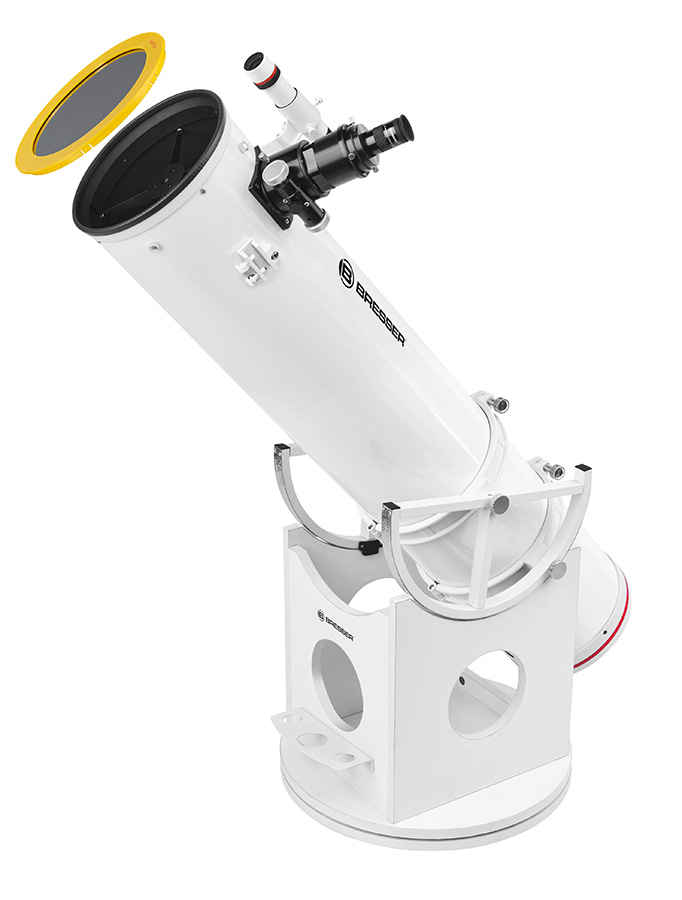
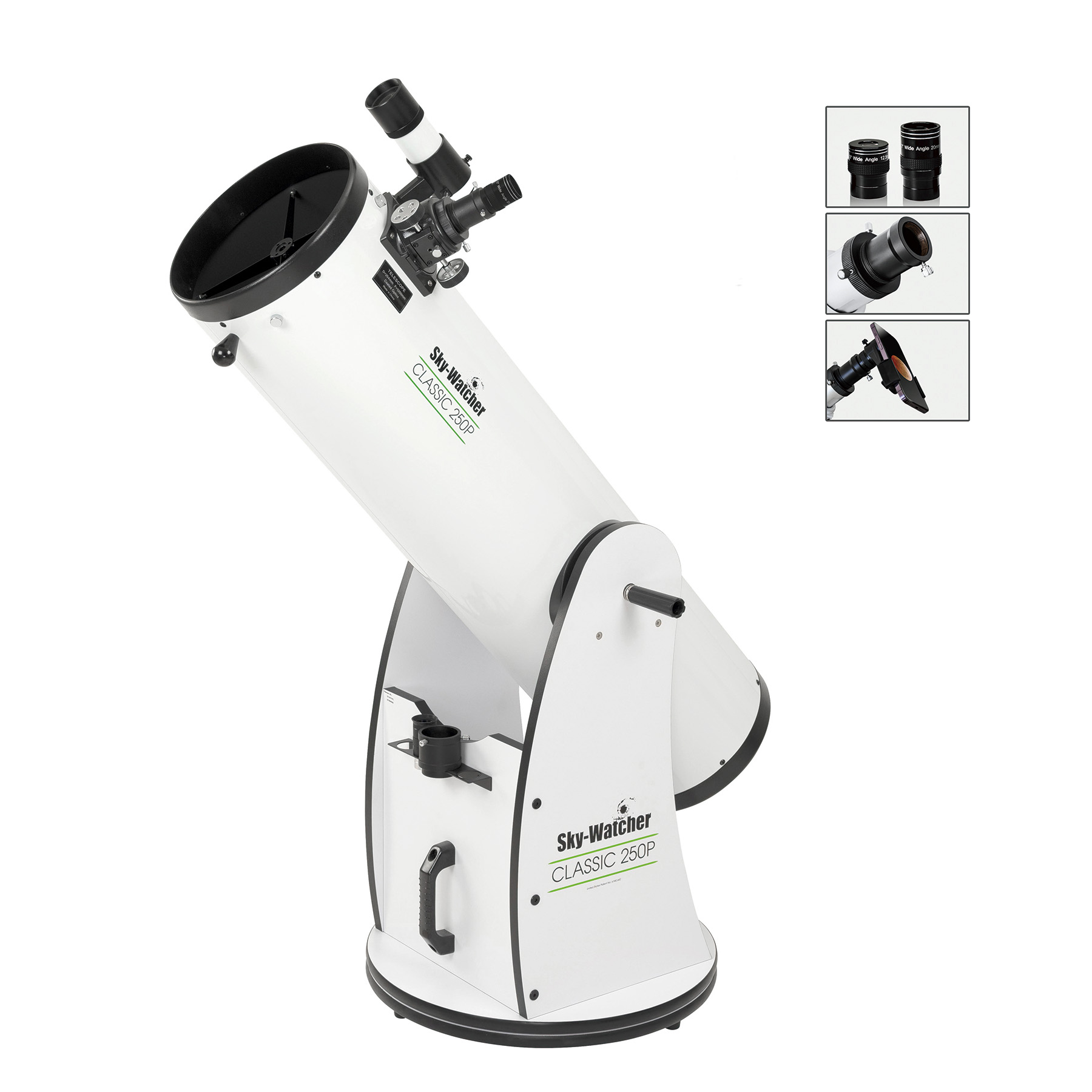
254mm versus 203mm — the aperture difference is the comparison.
Affiliate links — we earn from qualifying purchases at no extra cost to you.
First light
Bresser · 203mm · £349
The maximum-aperture visual reflector
- 203mm Newtonian on a floor-standing Dobsonian alt-az rocker box
- Good for: full visual programme — planets, Moon, globular clusters, galaxies, nebulae
- No alignment required — set up and observe in under 10 minutes
- No motorised tracking — targets drift at high magnification as Earth rotates
- 17.5kg total — designed for a fixed garden or regular dark-sky site, not casual transport
Sky-Watcher · 254mm · £499
The maximum-aperture visual reflector
- 254mm Newtonian on a floor-standing Dobsonian alt-az rocker box
- Good for: full visual programme — planets, Moon, globular clusters, galaxies, nebulae
- No alignment required — set up and observe in under 10 minutes
- No motorised tracking — targets drift at high magnification as Earth rotates
- 26kg total — designed for a fixed garden or regular dark-sky site, not casual transport
The full picture
The numbers that separate these two scopes — and what they mean at the eyepiece.
Aperture
Sky-Watcher Skyliner 250PX gathers 1.6× more light. On bright targets — Moon, Saturn, Jupiter — you won't notice. On fainter targets — dim galaxies, faint globular clusters — the gap is real.
Focal length
Same focal length — identical magnification with any given eyepiece. Differences come from optical design and coatings.
Focal ratio
Sky-Watcher Skyliner 250PX's faster f/4.72 delivers wider fields with any eyepiece — better for open clusters and large nebulae. Bresser Messier 8" Dobsonian's f/5.91 provides more magnification per eyepiece — better for fine planetary detail.
Mount type
Same mount type — setup experience and ergonomics will be similar. Differences lie in build quality and included accessories.
Weight (OTA)
Bresser Messier 8" Dobsonian's optical tube is 5.5kg lighter. Relevant if you plan to use it on multiple mounts or carry the tube to dark-sky sites separately.
Optical design
Same optical design — differences between these scopes come from aperture, mount, and focal ratio.
At the eyepiece
| Target | Bresser Messier 8" Dobsonian | Sky-Watcher Skyliner 250PX |
|---|---|---|
| Planets | ||
| Moon | Excellent 203mm aperture resolves craters down to a few kilometres; the dual-speed focuser helps nail sharp focus at high power | Excellent 254mm resolves fine rilles, crater chains, and shadow detail across the terminator — almost overwhelming detail at high power |
| Saturn | Excellent Cassini Division visible in steady seeing, cloud banding on the disc, and several moons including Titan easily spotted | Excellent Cassini Division clearly visible, cloud banding on the disc, and multiple moons resolved in good seeing |
| Jupiter | Excellent Multiple cloud belts, Great Red Spot, and all four Galilean moons with shadow transits visible | Excellent Multiple cloud belts, festoons, GRS detail, and moon shadow transits all within reach at 200x+ |
| Mars | Good Polar cap and dark surface features visible at opposition; the 1200mm focal length allows useful magnification with a short eyepiece | Excellent Dark surface markings, polar cap, and limb brightening visible at opposition — 1200mm focal length supports high magnification with a Barlow |
Deep sky | ||
| Orion Nebula (M42) | Excellent Bright layered nebulosity with Trapezium resolved; 1200mm focal length crops the widest extent but detail in the core is superb | Excellent Bright nebulosity with extensive structure and colour hints; the Trapezium splits cleanly into four or more stars |
| Andromeda Galaxy (M31) | Moderate 1200mm focal length shows the bright core and inner disc well, but the full 3° extent of the galaxy is cropped even with a wide-field 2" eyepiece | Moderate Bright core and inner dust lanes visible, but 1200mm focal length crops the outer halo — you'll only frame the central portion |
| Open clusters | Moderate Compact clusters like the Double Cluster look fine, but large sprawling clusters like the Pleiades overfill the field at 1200mm | Moderate 1200mm focal length means large clusters like the Double Cluster or Pleiades overfill the field; compact clusters fare better |
| Globular clusters | Excellent 203mm resolves individual stars across the outer regions of M13 and M5; a defining strength of this aperture class | Excellent 254mm resolves individual stars across M13, M92, M3 and others — one of this scope's signature strengths |
| Faint galaxies | Good Galaxy groups like the Leo Triplet and Virgo Cluster members are within reach; spiral arm hints visible in M51 under dark skies | Excellent Spiral arms in M51, dust lane in M82, and dozens of Virgo Cluster galaxies detectable — aperture is king here |
| Milky Way / wide field | Not recommended 1200mm focal length is far too narrow for sweeping star fields — a wide-field refractor or binoculars serve this purpose better | Not recommended 1200mm focal length gives too narrow a field for sweeping star fields — a short refractor or binoculars serve better |
Other | ||
| Double stars | Excellent 203mm aperture resolves doubles down to about 0.6 arcseconds; Dawes limit easily splits Albireo, the Double Double in Lyra, and many tighter pairs | Excellent 254mm aperture gives a Dawes limit around 0.46 arcsec; f/4.7 is fast for the purpose but a Barlow helps at high power |
| Astrophotography (deep sky) | Not recommended No tracking means exposures beyond a second or two trail; manual Dobsonian mount is unsuitable for deep-sky imaging | Not recommended Manual Dobsonian mount with no tracking — long-exposure imaging is not feasible |
| Astrophotography (planetary) | Moderate Planetary video capture with a high-speed camera is feasible — 203mm aperture and 1200mm focal length give a usable image scale, but manual tracking makes it fiddly | Challenging Bright planets can be captured with a high-speed camera in short exposures, but manual tracking makes it difficult to keep the target centred |
The real tradeoff
Both scopes are capable. The question is which one fits the way you actually observe.
Bresser Messier 8" Dobsonian
- You'll set up faster, carry it more willingly, and find yourself observing on weeknights when the 250PX would stay in the shed — the lighter, more compact tube makes the difference between 'I'll go out tonight' and 'maybe next weekend'.
- You'll nail sharp planetary focus more easily thanks to the dual-speed Crayford focuser that comes standard — at 250× on Saturn, that fine-focus knob pays for itself the first clear night you use it.
- You'll see M13 as a resolved ball of stars and the Whirlpool's spiral arms under dark skies, and for many observers that's genuinely enough — but you'll occasionally wonder what you're missing with that extra two inches of aperture.
Sky-Watcher Skyliner 250PX
- You'll see things the 8-inch simply cannot show you — the Veil Nebula becomes a traceable arc rather than a maybe-I-see-it smudge, and globular clusters go from 'partially resolved' to 'carpet of stars' in a way that genuinely changes the experience.
- You'll pay for that aperture in collimation discipline — the FlexTube design means you're re-collimating every time you extend the tube, and at f/4.7 even a small misalignment punishes you more than the Bresser's f/5.9 ever would.
- You'll also pay for it at the eyepiece — budget eyepieces that work acceptably in the Bresser will show ugly coma at the field edges in this scope, so factor in £100–200 for at least one quality wide-field eyepiece to actually realise the aperture advantage.
The dark side
Every scope has a personality. Here’s where each one gets difficult.
Bresser
Bresser Messier 8" Dobsonian
The Dobsonian base lacks fine altitude adjustment out of the box — heavier eyepieces or a Barlow can cause the tube to drift, and you'll likely end up adding a tension spring mod to keep it balanced.
The supplied 25mm and 9mm eyepieces are functional but uninspiring — plan to budget for at least one decent eyepiece early on, because the dual-speed focuser deserves better glass in front of it.
At roughly 20kg assembled with a 1.2m tube, this isn't a scope you'll casually move to the garden — every session is a deliberate decision, and you'll need somewhere to store it upright or on its side.
Sky-Watcher
Sky-Watcher Skyliner 250PX
The f/4.7 focal ratio makes coma a constant companion — stars at the edge of wide-field eyepieces look like little wedges, and a coma corrector adds £80–150 on top of the scope price to fix it.
The FlexTube truss needs re-collimation each time you extend it, and at f/4.7 even slight miscollimation visibly degrades views — this is not a scope for people who want to skip the maintenance ritual.
The optical tube alone weighs approximately 17kg before you add the base — carrying this any real distance to a dark site is a two-trip affair or a two-person job.
Which is right for you?
Two different buyers. Two different right answers.
The maximum-aperture visual reflector
Bresser · Bresser Messier 8" Dobsonian
You're new to astronomy or buying for a family, you want the most capability for the least fuss, and you'd rather spend £349 and observe tonight than spend £499 and still need another £150 in eyepieces before the scope performs at its best. You value the dual-speed focuser for planetary work, you don't mind that galaxies are a little fainter than they'd be in a 10-inch, and you want a scope light enough that you'll actually use it on a clear Tuesday. This isn't for you if you're already an intermediate observer hungry for more aperture, or if you need portability — at 1.2m long and 20kg, it's still a commitment.
The maximum-aperture visual reflector
Sky-Watcher · Sky-Watcher Skyliner 250PX
You've already looked through a smaller scope and you know you want more — more resolved stars in globulars, more structure in galaxies, more faint nebulae crossing the threshold from invisible to visible. You're willing to collimate before every session, invest in quality eyepieces that can handle f/4.7, and wrestle a 17kg tube into position because you know the views will justify it. The collapsible tube helps with storage, not with grab-and-go convenience. This isn't for you if collimation sounds tedious rather than routine, if you can't physically manage the weight, or if you expect the bundled eyepieces to show you what this scope can really do.
Our verdict
The Bresser Messier 8" Dobsonian is designed to get a new observer to the eyepiece quickly with minimal friction. The Sky-Watcher Skyliner 250PX assumes you already know what you want from the sky, or are genuinely willing to put in the learning time.
If this is your first telescope, buy the Bresser Messier 8" Dobsonian. You'll spend a year learning what you actually want, and those lessons are cheaper at £349. The Sky-Watcher Skyliner 250PX is the scope to buy when you've outgrown your first one and know exactly why you want it. If I had to choose for a first-time buyer: the Bresser Messier 8" Dobsonian.
Bresser Messier 8" Dobsonian
View Bresser Messier 8" Dobsonian →Sky-Watcher Skyliner 250PX
View Sky-Watcher Skyliner 250PX →Affiliate links — we earn from qualifying purchases at no extra cost to you.
Deep field: Full specifications
Every data point, for those who want to go further.
Full specifications
Fields highlighted in blue or amber indicate the better value for that spec. Data is manufacturer-stated and may vary.
How much can it see?
| Spec | Bresser Messier 8" Dobsonian | Sky-Watcher Skyliner 250PX |
|---|---|---|
Apertureⓘ The most important spec — bigger = more light = better views | 203mm | 254mm |
Focal Length Longer = more magnification potential | 1200mm | 1200mm |
Focal Ratio Lower f-number = wider field of view; higher = more magnification per eyepiece | f/5.91 | f/4.72 |
Optical Design The type of optics — each design has different strengths | Dobsonian | Dobsonian |
Coatings Better coatings = more light transmission through the optics | Parabolic primary mirror, fully coated | Parabolic primary mirror, fully multi-coated |
How do you point it?
| Spec | Bresser Messier 8" Dobsonian | Sky-Watcher Skyliner 250PX |
|---|---|---|
Mount Type The mechanical system that holds and moves the telescope | Dobsonian | Dobsonian |
GoTo Computer-controlled pointing — finds any of thousands of objects automatically | ||
Tracking Motor keeps objects centred as the Earth rotates — essential for astrophotography |
The focuser
| Spec | Bresser Messier 8" Dobsonian | Sky-Watcher Skyliner 250PX |
|---|---|---|
Focuser Size 2" accepts wider eyepieces and gives better low-power views | 2" | 2" |
Focuser Type Rack-and-pinion is standard; Crayford and dual-speed are smoother | Dual-speed Crayford (2" with 1.25" adapter) | Dual-speed Crayford (10:1 reduction) |
Size & weight
| Spec | Bresser Messier 8" Dobsonian | Sky-Watcher Skyliner 250PX |
|---|---|---|
OTA Weightⓘ Optical tube only — useful for comparing mount load capacity | 11.5kg | 17kg |
Total Weightⓘ Full setup including mount — this is what you lug to the car | 17.5kg | 26kg |
Tube Length | 1200mm | 1200mm |
Tube Material | Steel | Steel (collapsible FlexTube) |
What's in the box?
| Spec | Bresser Messier 8" Dobsonian | Sky-Watcher Skyliner 250PX |
|---|---|---|
Eyepieces Included eyepieces — more is better, but quality matters more than quantity | 25mm and 10mm eyepieces | 25mm and 10mm Super eyepieces |
Finder Scope Helps you locate areas of the sky before switching to the main eyepiece | 8x50 right-angle finder | 8x50 right-angle correct-image finder |
Diagonal Tilts the eyepiece 90° for comfortable viewing — useful on refractors |
Blue highlight: Bresser Messier 8" Dobsonian advantage · Amber highlight: Sky-Watcher Skyliner 250PX advantage · Greyed cells: equal or subjective.