Telescope Comparison
Bresser Messier 8" Dobsonian vs Sky-Watcher Virtuoso GTi 150P
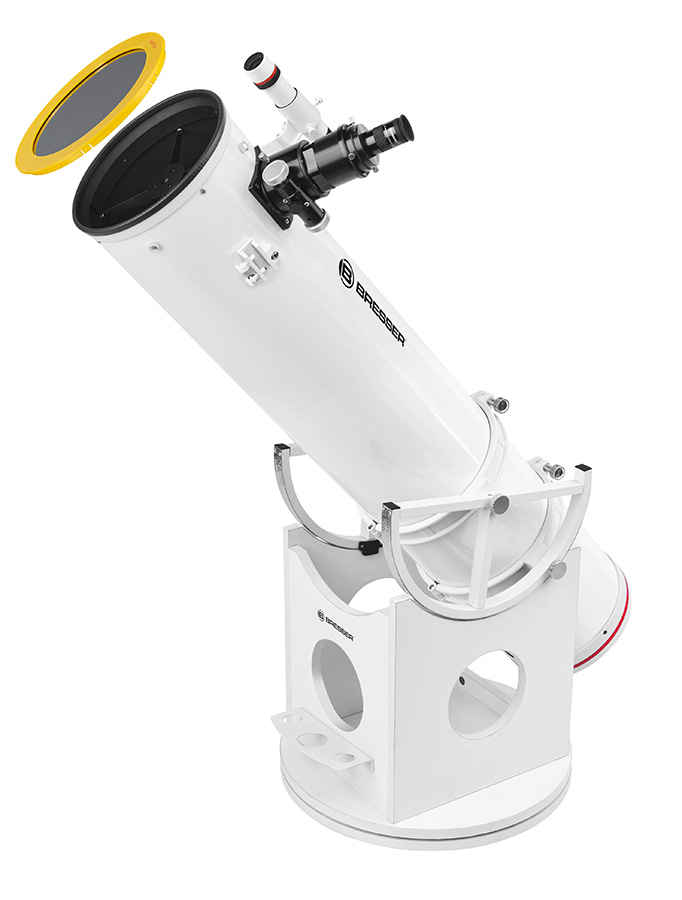
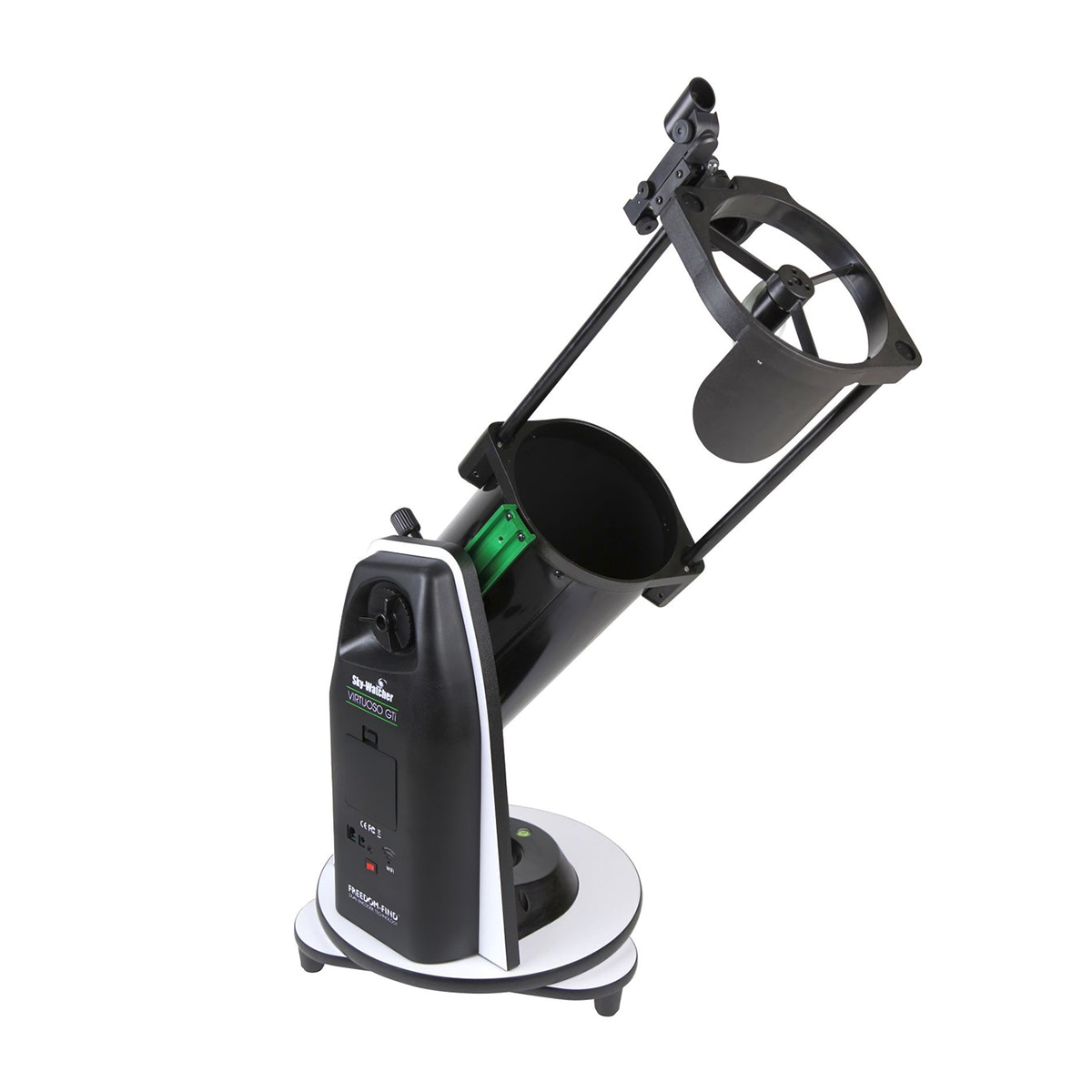
One finds objects for you. The other makes you learn the sky — and gives you more aperture in return.
Affiliate links — we earn from qualifying purchases at no extra cost to you.
First light
Bresser · 203mm · £349
The maximum-aperture visual reflector
- 203mm Newtonian on a floor-standing Dobsonian alt-az rocker box
- Good for: full visual programme — planets, Moon, globular clusters, galaxies, nebulae
- No alignment required — set up and observe in under 10 minutes
- No motorised tracking — targets drift at high magnification as Earth rotates
- 17.5kg total — designed for a fixed garden or regular dark-sky site, not casual transport
Sky-Watcher · 150mm · £449
The guided beginner's telescope
- 150mm newtonian reflector on a computerised mount with motorised tracking
- Good for: Moon, planets, bright nebulae, star clusters, and deep-sky objects
- GoTo system finds any object in its database after initial star alignment — no star atlas needed
- Tracking motors keep objects centred as Earth rotates — useful above 100×, essential for photography
- 6.5kg total — requires a fixed garden spot or car transport
The full picture
The numbers that separate these two scopes — and what they mean at the eyepiece.
Aperture
Bresser Messier 8" Dobsonian gathers 1.8× more light. On bright targets — Moon, Saturn, Jupiter — you won't notice. On fainter targets — dim galaxies, faint globular clusters — the gap is real.
Focal length
Bresser Messier 8" Dobsonian's longer focal length reaches higher magnification with the same eyepiece — better reach for planetary detail. Sky-Watcher Virtuoso GTi 150P's shorter focal length gives a wider true field — better for large open clusters and extended nebulae.
Focal ratio
Sky-Watcher Virtuoso GTi 150P's faster f/5 delivers wider fields with any eyepiece — better for open clusters and large nebulae. Bresser Messier 8" Dobsonian's f/5.91 provides more magnification per eyepiece — better for fine planetary detail.
Mount type
Sky-Watcher Virtuoso GTi 150P adds GoTo — it finds any target in its database after alignment. Bresser Messier 8" Dobsonian requires manual navigation.
Weight (OTA)
Sky-Watcher Virtuoso GTi 150P's optical tube is 5.0kg lighter. Relevant if you plan to use it on multiple mounts or carry the tube to dark-sky sites separately.
Optical design
Bresser Messier 8" Dobsonian is a DOBSONIAN; Sky-Watcher Virtuoso GTi 150P is a Newtonian reflector (mirrors, needs occasional collimation). Different optical formulas produce different strengths — reflectors give more aperture per pound; refractors give sharper contrast and require no collimation.
At the eyepiece
Bresser
Bresser Messier 8" Dobsonian
The Moon fills the field at low power with more detail than you'll have time to explore on any given night. Saturn's rings are unmistakable from the first session; in good seeing, the Cassini Division — the dark gap between the A and B rings — is a genuine target at higher magnification. Jupiter shows two equatorial cloud bands clearly, the four Galilean moons changing position night to night. The Orion Nebula (M42) shows wide nebulosity with the Trapezium splitting cleanly into four points at 80×. The Hercules Cluster (M13) begins to resolve into individual stars at the outer edges at higher magnification. The Andromeda Galaxy (M31) fills a wide-field eyepiece; the bright core and inner disc are obvious, and on a dark night the dust lane becomes visible with careful looking. The Bresser Messier 8" Dobsonian gathers 1.8× more light than the Sky-Watcher Virtuoso GTi 150P — a difference that's marginal on bright targets but visible on fainter ones: dimmer galaxies, faint globular clusters, and extended nebulosity that sits below the threshold of the smaller aperture.
Sky-Watcher
Sky-Watcher Virtuoso GTi 150P
The Moon fills the field at low power with more detail than you'll have time to explore on any given night. Saturn's rings are unmistakable from the first session; in good seeing, the Cassini Division — the dark gap between the A and B rings — is a genuine target at higher magnification. Jupiter shows two equatorial cloud bands clearly, the four Galilean moons changing position night to night. The Orion Nebula (M42) shows clear structure — nebulosity spreading around the Trapezium, which splits at moderate power. The Andromeda Galaxy (M31) shows a concentrated core clearly. The Hercules Cluster (M13) shows some resolution at the edges at higher magnification.
The real tradeoff
Both scopes are capable. The question is which one fits the way you actually observe.
Bresser Messier 8" Dobsonian
- You'll see noticeably more — those extra 53mm of aperture translate to resolved stars across M13's outer halo, visible spiral arms in M51, and fainter belts on Jupiter that the 150mm simply can't pull out of the background.
- You'll spend a few minutes at the start of each session nudging the scope around the sky by hand, and at 200× on Saturn you'll be re-centering every 30–60 seconds — but the dual-speed Crayford focuser means you'll nail sharp focus faster than on almost any scope at this price.
- You'll commit to this scope: hauling a 1.2-metre tube and 20kg of assembled weight outside, letting it cool down, and spending time with a star chart or phone app to find targets — but what you find will look genuinely impressive because the aperture rewards the effort.
Sky-Watcher Virtuoso GTi 150P
- You'll tap M13 on your phone, the mount slews to it, and you're observing in seconds — on a clear weeknight when you only have 45 minutes, that GoTo convenience means you'll actually use this scope instead of leaving a bigger one in the closet.
- You'll need to find a rock-solid table or build a dedicated pillar, because a wobbly surface at high magnification turns every breeze or accidental bump into a frustrating vibration — the scope is portable, but the table problem is yours to solve.
- You'll enjoy genuinely wide star fields at 750mm focal length — the Double Cluster and Pleiades frame beautifully — but on galaxies and globulars, you'll notice you're seeing shapes and hints of structure rather than the resolved detail the 8-inch Bresser reveals.
The dark side
Every scope has a personality. Here’s where each one gets difficult.
Bresser
Bresser Messier 8" Dobsonian
The Dobsonian base has no fine altitude adjustment — heavier eyepieces can cause the tube to flop, and you may end up adding a tension spring mod to keep it balanced.
At f/5.9 coma distortion is visible at the edges of wide-angle eyepieces, and a coma corrector adds £80–£120 to a scope that was supposed to be the budget option.
No tracking whatsoever: at planetary magnifications objects drift out of the field in under a minute, so high-power observing becomes a constant cycle of nudge, refocus, nudge — newcomers often underestimate how tiring this gets.
Sky-Watcher
Sky-Watcher Virtuoso GTi 150P
There's no hand controller — alignment and GoTo control run entirely through the SynScan app on your phone or tablet, so a flat battery or a phone software update at the wrong moment can leave you with a dumb mount.
The alt-az GoTo mount introduces field rotation during tracking, capping useful astrophotography exposures at a few seconds — this is not a stepping stone to deep-sky imaging despite having motorised tracking.
The f/5 focal ratio is faster than the Bresser's f/5.9 and produces more pronounced coma at the field edge, meaning the included basic eyepieces show noticeably soft stars away from centre — budget for quality wide-field eyepieces early.
Which is right for you?
Two different buyers. Two different right answers.
The maximum-aperture visual reflector
Bresser · Bresser Messier 8" Dobsonian
You want the best views your budget can buy and you're willing to work for them. You have storage space for a metre-long tube, you don't mind learning to collimate, and you'd rather spend £349 and put the savings toward a good eyepiece than pay more for motorised convenience. You'll set up in the garden or drive to a dark site, spend an unhurried couple of hours star-hopping, and be rewarded with resolved globular clusters and genuine galaxy structure that a smaller scope simply cannot deliver. This isn't for you if you live in a flat with only a balcony, if you want a scope you can set up in five minutes on a weeknight, or if the idea of manually tracking objects sounds more tedious than meditative.
The guided beginner's telescope
Sky-Watcher · Sky-Watcher Virtuoso GTi 150P
You want to observe, not hunt — you'd rather tap a target on your phone and be looking at it ten seconds later than spend fifteen minutes star-hopping to a faint galaxy. You value portability and quick sessions: the scope fits in a car boot or a cupboard easily, and you can be observing from a patio table within minutes of stepping outside. You'll accept that the 150mm aperture shows less detail than an 8-inch, because you know that a scope you actually use beats a bigger one you leave in the garage. This isn't for you if maximising deep-sky detail matters most, if you expect to graduate into long-exposure astrophotography with this mount, or if you don't have a genuinely stable surface to set it on.
Our verdict
The Sky-Watcher Virtuoso GTi 150P finds every object in its database after alignment — you spend the session observing, not navigating. The Bresser Messier 8" Dobsonian asks you to navigate yourself but gives you more aperture for the same money.
If learning the night sky sounds like part of the fun, choose the Bresser Messier 8" Dobsonian — the extra aperture is a genuine bonus. If you want to spend your evenings observing rather than navigating, the Sky-Watcher Virtuoso GTi 150P is the more honest choice for most beginners. If I had to choose for someone starting out and unsure: the Sky-Watcher Virtuoso GTi 150P — find things first, learn the sky later.
Bresser Messier 8" Dobsonian
View Bresser Messier 8" Dobsonian →Sky-Watcher Virtuoso GTi 150P
View Sky-Watcher Virtuoso GTi 150P →Affiliate links — we earn from qualifying purchases at no extra cost to you.
Deep field: Full specifications
Every data point, for those who want to go further.
Full specifications
Fields highlighted in blue or amber indicate the better value for that spec. Data is manufacturer-stated and may vary.
How much can it see?
| Spec | Bresser Messier 8" Dobsonian | Sky-Watcher Virtuoso GTi 150P |
|---|---|---|
Apertureⓘ The most important spec — bigger = more light = better views | 203mm | 150mm |
Focal Length Longer = more magnification potential | 1200mm | 750mm |
Focal Ratio Lower f-number = wider field of view; higher = more magnification per eyepiece | f/5.91 | f/5 |
Optical Design The type of optics — each design has different strengths | Dobsonian | Newtonian Reflector |
Coatings Better coatings = more light transmission through the optics | Parabolic primary mirror, fully coated | Parabolic primary mirror with multi-coated optics |
How do you point it?
| Spec | Bresser Messier 8" Dobsonian | Sky-Watcher Virtuoso GTi 150P |
|---|---|---|
Mount Type The mechanical system that holds and moves the telescope | Dobsonian | GoTo (Computerised) |
GoToⓘ Computer-controlled pointing — finds any of thousands of objects automatically | ||
Trackingⓘ Motor keeps objects centred as the Earth rotates — essential for astrophotography |
The focuser
| Spec | Bresser Messier 8" Dobsonian | Sky-Watcher Virtuoso GTi 150P |
|---|---|---|
Focuser Size 2" accepts wider eyepieces and gives better low-power views | 2" | 1.25" |
Focuser Type Rack-and-pinion is standard; Crayford and dual-speed are smoother | Dual-speed Crayford (2" with 1.25" adapter) | Rack and pinion |
Size & weight
| Spec | Bresser Messier 8" Dobsonian | Sky-Watcher Virtuoso GTi 150P |
|---|---|---|
OTA Weightⓘ Optical tube only — useful for comparing mount load capacity | 11.5kg | 6.5kg |
Total Weightⓘ Full setup including mount — this is what you lug to the car | 17.5kg | 6.5kg |
Tube Length | 1200mm | — |
Tube Material | Steel | Steel (collapsible FlexTube) |
What's in the box?
| Spec | Bresser Messier 8" Dobsonian | Sky-Watcher Virtuoso GTi 150P |
|---|---|---|
Eyepieces Included eyepieces — more is better, but quality matters more than quantity | 25mm and 10mm eyepieces | 25mm and 10mm Super eyepieces |
Finder Scope Helps you locate areas of the sky before switching to the main eyepiece | 8x50 right-angle finder | Red dot finder |
Diagonal Tilts the eyepiece 90° for comfortable viewing — useful on refractors |
Smart features
| Spec | Bresser Messier 8" Dobsonian | Sky-Watcher Virtuoso GTi 150P |
|---|---|---|
Built-in Camera Records and stacks images automatically — no separate camera needed | ||
App Controlled | ||
WiFi | ||
Battery Included |
Blue highlight: Bresser Messier 8" Dobsonian advantage · Amber highlight: Sky-Watcher Virtuoso GTi 150P advantage · Greyed cells: equal or subjective.