Telescope Comparison
Bresser Messier AR-102 vs Sky-Watcher Evostar 72ED
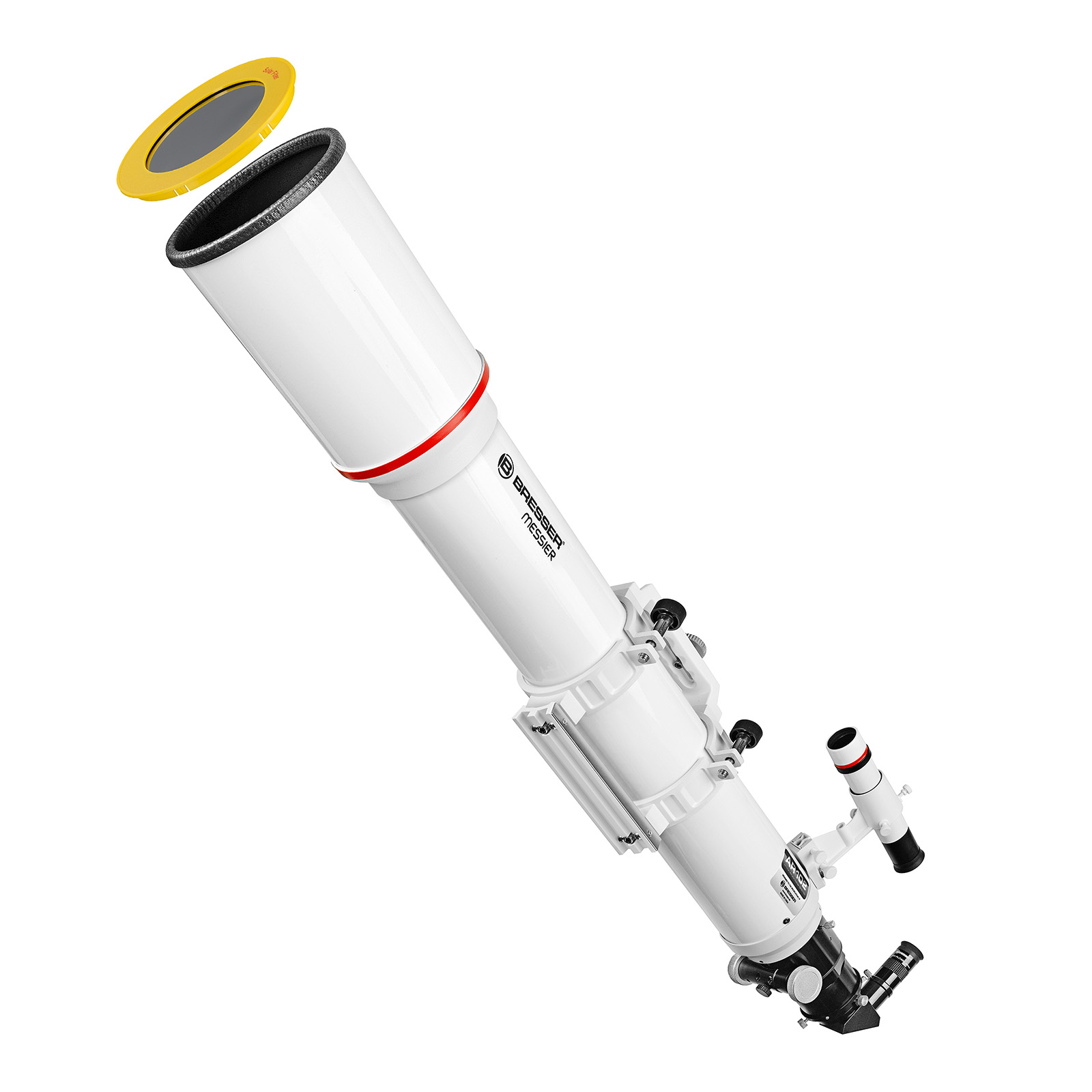
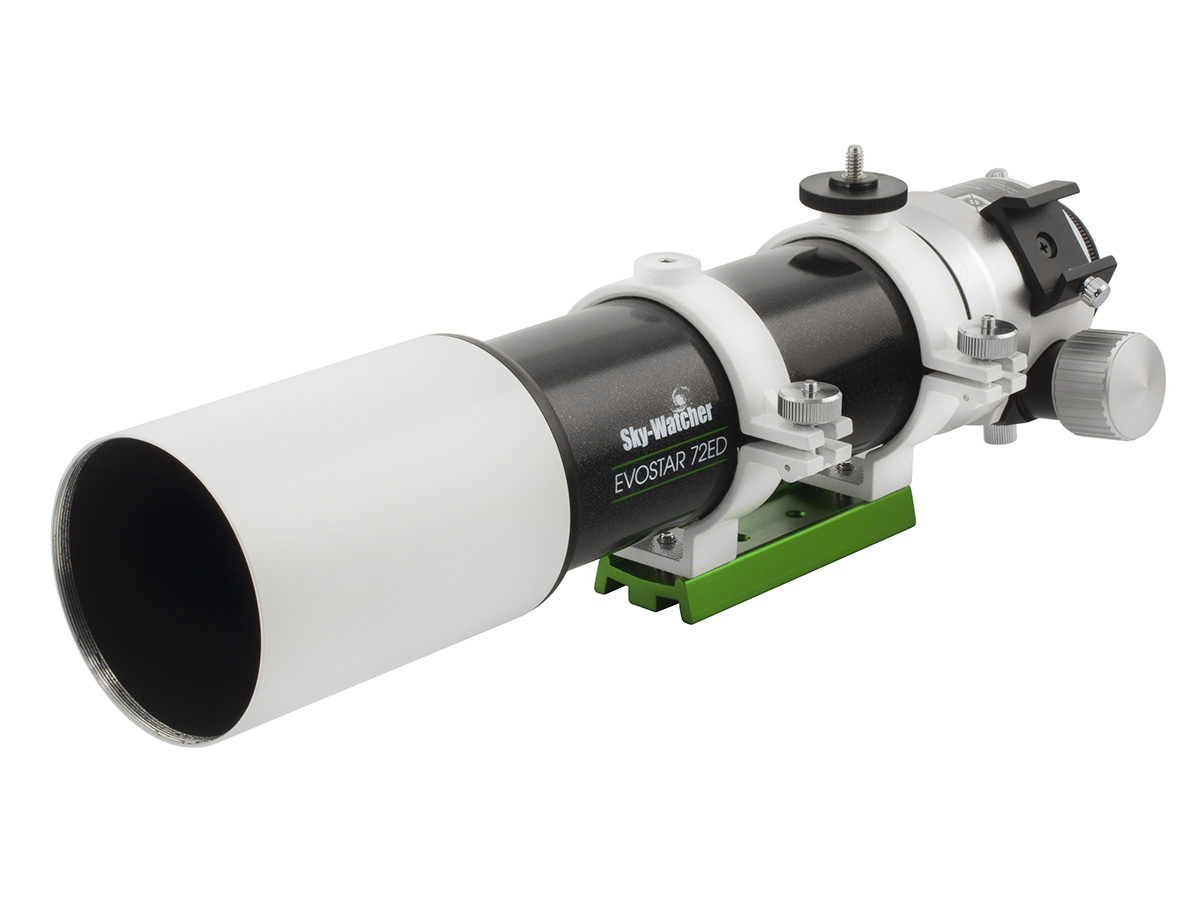
The Bresser Messier AR-102 is a complete setup. The Sky-Watcher Evostar 72ED needs a mount before it's usable.
Affiliate links — we earn from qualifying purchases at no extra cost to you.
First light
Bresser · 102mm · £299
The sky-learner's equatorial scope
- 102mm refractor on a manual equatorial mount
- Good for: Moon, planets, bright star clusters and nebulae
- Setup includes rough polar alignment before observing — more steps than a simple alt-az
- Mount axes feel counterintuitive at first; users find they become natural after several sessions
- Keeps the door open for adding tracking motors and moving into astrophotography later
Sky-Watcher · 72mm · £199
The custom-rig optical tube
- 72mm refractor — optical tube only, no mount included
- 420mm focal length at f/5.83
- Requires a compatible mount before you can observe anything
- Best for: observers who already own a suitable mount or are building a specific imaging rig
- Not a complete purchase — budget at least £100–300 extra for a mount before observing
The full picture
The numbers that separate these two scopes — and what they mean at the eyepiece.
Aperture
Bresser Messier AR-102 gathers 2× more light. On bright targets — Moon, Saturn, Jupiter — you won't notice. On fainter targets — dim galaxies, faint globular clusters — the gap is real.
Focal length
Bresser Messier AR-102's longer focal length reaches higher magnification with the same eyepiece — better reach for planetary detail. Sky-Watcher Evostar 72ED's shorter focal length gives a wider true field — better for large open clusters and extended nebulae.
Focal ratio
Sky-Watcher Evostar 72ED's faster f/5.83 delivers wider fields with any eyepiece — better for open clusters and large nebulae. Bresser Messier AR-102's f/6.47 provides more magnification per eyepiece — better for fine planetary detail.
Mount type
Sky-Watcher Evostar 72ED has no mount — add a compatible mount before you can observe. Bresser Messier AR-102 is a complete ready-to-use system.
Weight (OTA)
Sky-Watcher Evostar 72ED's optical tube is 1.6kg lighter. Relevant if you plan to use it on multiple mounts or carry the tube to dark-sky sites separately.
Optical design
Both are refractors — no mirrors to collimate, good contrast, colour-free stars with ED or APO glass. The differences between them are in aperture, focal ratio, and glass quality.
At the eyepiece
| Target | Bresser Messier AR-102 | Sky-Watcher Evostar 72ED |
|---|---|---|
| Planets | ||
| Moon | Excellent 102mm aperture delivers sharp crater detail; some purple fringing at the bright limb from the achromatic design, reduced with a fringe-killer filter | Moderate 72mm aperture shows craters and terminator detail, but short focal length (420mm) means high magnification requires very short eyepieces; ED glass gives clean, colour-free views |
| Saturn | Good Rings clearly separated from the disc, Cassini Division visible in steady seeing; chromatic aberration softens the image above 130× | Moderate Rings visible and disc discernible at 70–100×, but Cassini Division needs excellent seeing; 420mm focal length keeps the image small |
| Jupiter | Good Two main equatorial belts and the four Galilean moons are easy; further belt detail limited by chromatic aberration at this focal ratio | Moderate Disc and two main equatorial belts visible, but fine banding and GRS detail require more aperture and focal length |
| Mars | Moderate Disc and polar cap visible near opposition, but the short focal length and chromatic aberration limit surface detail | Challenging Small orange disc visible at opposition; polar cap may be glimpsed in excellent seeing but surface detail is beyond this aperture |
Deep sky | ||
| Orion Nebula (M42) | Excellent 102mm at f/6.5 shows the full nebula extent with bright wings and the Trapezium resolved cleanly | Good Short focal length frames the full nebula complex nicely; 72mm shows the bright core and surrounding nebulosity but fainter wisps need more aperture |
| Andromeda Galaxy (M31) | Excellent 660mm focal length frames the bright core and inner halo in one field; 102mm aperture helps reveal dust lane hints under dark skies | Excellent 420mm focal length captures the full extent of M31 including companion galaxies; visually the core is bright but outer arms need dark skies |
| Open clusters | Excellent Wide field and 660mm focal length are ideal — the Double Cluster, Pleiades, and M35 all fit comfortably | Excellent Wide field of view at 420mm is ideal — Pleiades, Double Cluster, and M35 are beautifully framed with surrounding star context |
| Globular clusters | Moderate M13 and M3 appear granular at the edges; core remains unresolved at 102mm | Challenging 72mm cannot resolve individual stars; M13 and M3 appear as fuzzy, unresolved glows |
| Faint galaxies | Moderate Brighter Messier galaxies like M81/M82 visible as fuzzy patches; insufficient aperture for detail in fainter targets | Challenging 72mm aperture limits detection to only the brightest galaxies; most appear as faint smudges or are invisible |
| Milky Way / wide field | Good 660mm focal length gives wide fields at low power; slightly longer than the ideal ≤400mm for sweeping but still very effective for rich star fields | Excellent 420mm at f/5.8 is a natural wide-field instrument — sweeping Milky Way star fields and large-scale structures are this scope's visual sweet spot |
Other | ||
| Double stars | Good 102mm resolves to ~1.1 arcsecond; the fast focal ratio and chromatic aberration reduce contrast on close bright pairs compared to a longer f/ratio scope | Good 72mm resolves wider doubles like Albireo cleanly with good colour; closer pairs below ~2 arcseconds are beyond the Dawes limit |
| Astrophotography (planetary) | Not applicable | Challenging 72mm aperture and 420mm focal length produce a very small planetary image scale; a Barlow helps but cannot overcome the aperture limit |
| Wide-field astrophotography (nebulae and Milky Way) | Not applicable | Excellent This is the scope's primary design purpose — fast focal ratio, ED glass, and compact size pair perfectly with a star tracker for large emission nebulae, Milky Way panels, and galaxy fields |
The real tradeoff
Both scopes are capable. The question is which one fits the way you actually observe.
Bresser Messier AR-102
- You'll unbox a complete system — mount, tripod, finder, eyepieces — and be observing the same night, but you'll also spend ten minutes balancing the EQ mount and learning to track objects by hand as they drift through the field.
- You'll see noticeably more through 102mm than 72mm: the spiral structure in M31's core region, resolved outer stars in M13, and the full wings of M42 — targets where the extra aperture genuinely matters for visual observing.
- You'll enjoy the Moon and planets at 80–130× with good contrast and a precise dual-speed Crayford focuser, but the moment you push past 150× on Jupiter or Saturn, purple fringing will remind you this is an achromat at f/6.5, not an ED scope.
Sky-Watcher Evostar 72ED
- You'll open the box and find a tube — no mount, no diagonal, no eyepieces — so your first session depends on what else you already own or are willing to buy, and total system cost will far exceed the £199 OTA price.
- You'll attach a DSLR to a star tracker and pull colour and nebulosity out of the Veil complex or North America Nebula in stacked 30–60 second exposures — this is the scope's reason for existing, and it does it beautifully at f/5.8 with minimal chromatic aberration.
- You'll appreciate how light and compact it is when you grab it for a quick visual session on open clusters like the Pleiades, but you'll hit the ceiling fast — 72mm simply can't resolve globulars, and planets remain small, dim discs with limited detail.
The dark side
Every scope has a personality. Here’s where each one gets difficult.
Bresser
Bresser Messier AR-102
Chromatic aberration is real and visible — expect purple fringing on the lunar limb and bright planet edges above roughly 120×, an inherent limitation of an achromatic doublet at f/6.5.
The equatorial mount ships with no tracking motor, so objects drift out of view at higher magnifications and any form of long-exposure astrophotography requires an aftermarket motor drive.
The tube is near the mount's practical weight limit, so adding a heavier eyepiece, camera, or guide scope can introduce noticeable vibration and slow settling times.
Sky-Watcher
Sky-Watcher Evostar 72ED
Sold as an OTA only — you need to budget separately for a mount, diagonal, finder, and eyepieces before you can observe or image anything, pushing the real system cost well beyond £199.
Without a dedicated field flattener, star images at the edges of a camera sensor show noticeable curvature and elongation, so serious imaging requires an additional accessory purchase.
The included rack-and-pinion focuser can flex under the weight of a DSLR or cooled camera, and some users find upgrading to a Crayford-style focuser necessary for consistent imaging focus.
Which is right for you?
Two different buyers. Two different right answers.
The sky-learner's equatorial scope
Bresser · Bresser Messier AR-102
You want a complete, ready-to-observe telescope system at a modest price and you plan to spend most of your time looking through the eyepiece. You're drawn to sweeping the Milky Way, framing open clusters, and soaking in the Moon's detail — and you're fine with moderate chromatic aberration as the price of 102mm of aperture and a real equatorial mount. You're not chasing astrophotography and you don't mind the bulk of a counterweighted EQ setup. If you want more visual reach than a small ED scope can offer and you don't need colour-corrected optics for a camera, this is your scope.
The custom-rig optical tube
Sky-Watcher · Sky-Watcher Evostar 72ED
You already own a DSLR and a star tracker — or you're about to buy them — and your goal is wide-field astrophotography of large nebulae and the Milky Way, not visual observing. You want a compact, colour-corrected OTA you can throw in a backpack, and you're comfortable building a system piece by piece rather than buying a boxed kit. If visual astronomy is your main interest, 72mm will leave you wanting more — but if your ambition is to stack frames of the Andromeda Galaxy or the Cygnus region and you need a fast, portable imaging scope to get started, this is the right entry point.
Our verdict
This comparison has a catch: the Sky-Watcher Evostar 72ED is a bare optical tube. You cannot use it without a separate mount — which adds meaningful cost and complexity. The Bresser Messier AR-102 is a complete, ready-to-observe package.
For most buyers, the Bresser Messier AR-102 is the right choice — you can observe the same night it arrives. The Sky-Watcher Evostar 72ED makes sense if you already own a compatible mount, or are deliberately building a specific imaging setup piece by piece. If I had to choose for a first telescope: the Bresser Messier AR-102, without hesitation.
Bresser Messier AR-102
View Bresser Messier AR-102 →Sky-Watcher Evostar 72ED
View Sky-Watcher Evostar 72ED →Affiliate links — we earn from qualifying purchases at no extra cost to you.
Deep field: Full specifications
Every data point, for those who want to go further.
Full specifications
Fields highlighted in blue or amber indicate the better value for that spec. Data is manufacturer-stated and may vary.
How much can it see?
| Spec | Bresser Messier AR-102 | Sky-Watcher Evostar 72ED |
|---|---|---|
Apertureⓘ The most important spec — bigger = more light = better views | 102mm | 72mm |
Focal Length Longer = more magnification potential | 660mm | 420mm |
Focal Ratio Lower f-number = wider field of view; higher = more magnification per eyepiece | f/6.47 | f/5.83 |
Optical Design The type of optics — each design has different strengths | Refractor | Refractor |
Coatings Better coatings = more light transmission through the optics | Fully multi-coated achromatic doublet | Fully multi-coated ED doublet |
How do you point it?
| Spec | Bresser Messier AR-102 | Sky-Watcher Evostar 72ED |
|---|---|---|
Mount Type The mechanical system that holds and moves the telescope | Equatorial | None (OTA only) |
GoTo Computer-controlled pointing — finds any of thousands of objects automatically | ||
Tracking Motor keeps objects centred as the Earth rotates — essential for astrophotography |
The focuser
| Spec | Bresser Messier AR-102 | Sky-Watcher Evostar 72ED |
|---|---|---|
Focuser Size 2" accepts wider eyepieces and gives better low-power views | 2" | 2" |
Focuser Type Rack-and-pinion is standard; Crayford and dual-speed are smoother | Dual-speed Crayford (2" with 1.25" adapter) | Dual-speed Crayford (with 1.25" adapter) |
Size & weight
| Spec | Bresser Messier AR-102 | Sky-Watcher Evostar 72ED |
|---|---|---|
OTA Weightⓘ Optical tube only — useful for comparing mount load capacity | 3kg | 1.4kg |
Total Weight Full setup including mount — this is what you lug to the car | 9.5kg | — |
Tube Length | 660mm | 390mm |
Tube Material | Aluminium | Aluminium |
What's in the box?
| Spec | Bresser Messier AR-102 | Sky-Watcher Evostar 72ED |
|---|---|---|
Eyepieces Included eyepieces — more is better, but quality matters more than quantity | 25mm and 10mm eyepieces | — |
Finder Scope Helps you locate areas of the sky before switching to the main eyepiece | 8x50 optical finder | — |
Diagonalⓘ Tilts the eyepiece 90° for comfortable viewing — useful on refractors |
Blue highlight: Bresser Messier AR-102 advantage · Amber highlight: Sky-Watcher Evostar 72ED advantage · Greyed cells: equal or subjective.