Telescope Comparison
Bresser Messier N-150/750 vs Sky-Watcher Heritage 150P
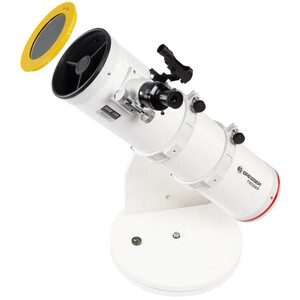
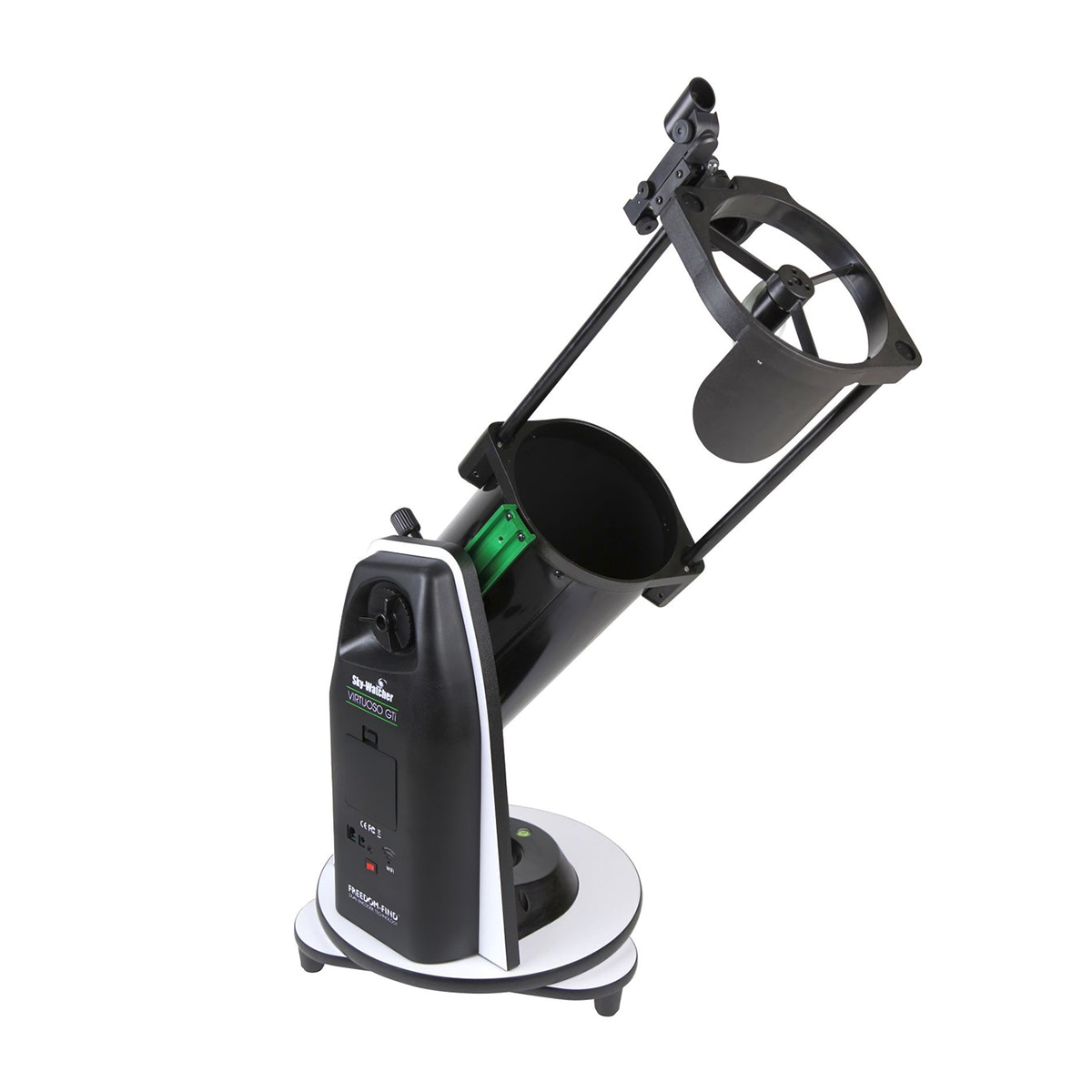
Same optics. Different mount philosophy.
Affiliate links — we earn from qualifying purchases at no extra cost to you.
First light
Bresser · 150mm · £229
The sky-learner's equatorial scope
- 150mm newtonian reflector on a manual equatorial mount
- Good for: Moon, planets, bright star clusters and nebulae
- Setup includes rough polar alignment before observing — more steps than a simple alt-az
- Mount axes feel counterintuitive at first; users find they become natural after several sessions
- Keeps the door open for adding tracking motors and moving into astrophotography later
Sky-Watcher · 150mm · £199
The grab-and-go tabletop reflector
- 150mm Newtonian on a tabletop Dobsonian rocker-box mount
- Good for: Moon, planets, open clusters, bright nebulae
- No alignment procedure — set it on any solid surface and observe immediately
- Needs a stable surface at a comfortable height: garden table, wall, or car tailgate
- Mirrors need occasional collimation — straightforward with a Cheshire eyepiece once learned
The full picture
The numbers that separate these two scopes — and what they mean at the eyepiece.
Aperture
Effectively equal light-gathering. Aperture won't settle this comparison — the mount, focal ratio, and observing experience are what differ.
Focal length
Same focal length — identical magnification with any given eyepiece. Differences come from optical design and coatings.
Focal ratio
Same focal ratio — the same eyepiece gives equivalent magnification and true field in both scopes.
Mount type
Sky-Watcher Heritage 150P's Dobsonian is immediately intuitive — no alignment, push to aim, observe. Bresser Messier N-150/750's equatorial mount requires polar alignment before each session but tracks the sky as Earth rotates, keeping objects centred.
Weight (OTA)
Similar optical tube weight. Any portability difference between these setups comes from the mount, not the tube itself.
Optical design
Both are Newtonian reflectors — the same optical formula. Any performance difference comes from collimation quality, focal ratio, and eyepiece choice, not the design itself.
At the eyepiece
| Target | Bresser Messier N-150/750 | Sky-Watcher Heritage 150P |
|---|---|---|
| Planets | ||
| Moon | Excellent 150mm resolves craterlets, rilles, and mountain shadows with crisp detail; f/5 handles high magnification well on lunar targets | Excellent 150mm aperture delivers crisp crater walls, rilles, and shadow detail; the relatively short f/5 ratio benefits from a Barlow for high-power lunar work |
| Saturn | Good Rings clearly defined, Cassini Division visible in steady seeing at 150–200x; focal length of 750mm is adequate but not ideal for high-power planetary work | Good Rings clearly defined, Cassini Division visible in steady seeing; 750mm focal length means you'll need a short eyepiece or Barlow for best scale |
| Jupiter | Good Two main cloud belts and GRS visible; 150mm shows some detail in the equatorial bands at 150x+ | Good Two main equatorial belts, Great Red Spot, and Galilean moons; 150mm resolves some secondary belt structure in good conditions |
| Mars | Good Disc and polar cap visible at opposition; some dark surface markings detectable in good seeing | Good At opposition the disc shows polar cap and dark surface markings; limited by the 750mm focal length requiring high-power eyepieces |
Deep sky | ||
| Orion Nebula (M42) | Excellent Bright nebulosity with extensive structure visible; Trapezium resolved; f/5 gives good wide-field context | Excellent Bright nebulosity fills the field with sweeping wings of gas; Trapezium stars cleanly split; f/5 speed gives excellent surface brightness |
| Andromeda Galaxy (M31) | Excellent 750mm focal length and 150mm aperture show the core, dust lane, and outer halo in a wide-field eyepiece | Good Bright core and inner halo visible with hints of dust lane; at 750mm focal length the full 3° extent is cropped in most eyepieces but the core view is detailed |
| Open clusters | Excellent Wide field at low power frames clusters like the Double Cluster and Pleiades beautifully | Excellent 750mm focal length with a wide-field eyepiece frames the Double Cluster, Pleiades, and M35 beautifully; f/5 speed gives bright star images |
| Globular clusters | Good 150mm begins to resolve stars at the edges of M13 and M22; cores remain granular but not fully resolved | Good M13 and M3 show partial resolution into stars at the edges with a granular core — 150mm is right at the threshold for meaningful resolution |
| Faint galaxies | Good 150mm pulls in galaxies across Virgo and Leo as defined smudges; brighter examples like M81/M82 show shape and contrast | Good 150mm pulls in galaxies like M81/M82, M51, and the Leo Triplet as defined smudges with hints of structure under dark skies |
| Milky Way / wide field | Good 750mm focal length is slightly long for sweeping panoramas but still delivers rich star fields at low power | Good 750mm focal length with a 25mm+ eyepiece gives attractive star-rich sweeps through Cygnus and Sagittarius; wider dedicated instruments do this better |
Other | ||
| Double stars | Excellent 150mm aperture resolves sub-arcsecond pairs; f/5 is forgiving enough with quality eyepieces, though less clean than f/10+ refractors | Good 150mm resolves doubles down to about 0.8 arcseconds; the f/5 focal ratio means less clean diffraction patterns than a long-focal-ratio refractor, but Albireo, the Double Double, and Mizar are easy |
| Astrophotography (planetary) | Good 150mm at 750mm focal length works well with a planetary camera and Barlow; no tracking needed for short video captures | Moderate Short planetary video captures are possible with a webcam or phone adapter, but manual tracking makes keeping the planet centered difficult at high magnification |
| Astrophotography (deep sky) | Not recommended The included EQ mount has no motor drive or tracking — long exposures are not possible without upgrading to at least a single-axis motor | Not applicable |
The real tradeoff
Both scopes are capable. The question is which one fits the way you actually observe.
Bresser Messier N-150/750
- You'll spend a few minutes assembling the tube on its EQ mount and polar-aligning before every session, but once you're set up, you can track objects smoothly by turning a single slow-motion knob — at 200x on Saturn, that's a real comfort compared to nudging a Dob base.
- The dual-speed Crayford focuser is genuinely unusual at this price and you'll feel the difference immediately: dialling in razor-sharp focus on a planetary disc or a tight double star is precise and satisfying, not the sticky, overshoot-prone experience cheaper focusers give you.
- You're buying a platform that can grow into basic astrophotography — bolt on a motor drive and you can shoot short exposures of the Moon, Jupiter, and bright nebulae, something the Heritage 150P simply cannot offer.
Sky-Watcher Heritage 150P
- You'll pull this off a shelf, set it on a garden table, and be looking at M13 inside two minutes — no counterweights, no polar alignment, no tripod legs to level, just point and observe.
- The collapsible FlexTube means it stores in a space smaller than a carry-on bag; if you observe from a balcony or travel to dark-sky sites, you'll appreciate this every single time you pack it away.
- You're saving £30 over the Bresser and getting identical aperture and focal ratio — every photon that hits the Bresser's mirror hits yours too, so the views through the eyepiece are essentially the same; you're trading the equatorial mount and nicer focuser for portability and immediacy.
The dark side
Every scope has a personality. Here’s where each one gets difficult.
Bresser
Bresser Messier N-150/750
The included EQ mount has no motor drive, so at 150x+ you'll watch planets slide out of view and need to re-centre every 30–60 seconds — and adding a motor still leaves you with a mount that shows flexure and vibration under camera weight, capping your astrophotography potential.
At f/5, collimation has to be spot-on or you lose sharpness fast; expect to check and tweak alignment regularly, especially after transport, because this focal ratio is much less forgiving than an f/8 scope.
The tube and equatorial mount together make a setup that's bulky to store and slow to deploy — this is not a scope you'll grab for a quick 20-minute session on a whim.
Sky-Watcher
Sky-Watcher Heritage 150P
You need a rock-solid table or stand at the right height — the 5.6 kg tube on a wobbly patio table will shake for seconds after every touch, and using it on the ground puts the eyepiece uncomfortably low.
The open FlexTube design lets stray light flood in from the side, washing out contrast on faint nebulae and galaxies; a fabric light shroud is a near-essential aftermarket buy to get the best from this scope.
The included 25mm and 10mm eyepieces are adequate starters but won't show you what the optics can really do — the 10mm in particular shows noticeable coma and edge blur at f/5, and you'll want to budget for at least one better eyepiece early on.
Which is right for you?
Two different buyers. Two different right answers.
The sky-learner's equatorial scope
Bresser · Bresser Messier N-150/750
You want a proper equatorial setup that can track objects and grow with you. You're happy to spend five minutes on assembly and polar alignment because you plan to linger at the eyepiece — sketching detail on Jupiter, splitting double stars, or eventually experimenting with a planetary camera. You value the dual-speed Crayford focuser as a tool you won't need to upgrade, and you see the EQ mount as a stepping stone toward motorised tracking rather than a burden. If the idea of a structured observing session appeals to you more than a quick peek, this is the scope that rewards that patience.
The grab-and-go tabletop reflector
Sky-Watcher · Sky-Watcher Heritage 150P
You want to observe tonight, not spend the evening setting up. You've got a solid table on a balcony or in the garden, and you want to pull a scope off the shelf and be staring into M42 inside two minutes. You value portability — maybe you'll take it to a dark-sky site in the boot of your car — and you'd rather spend the £30 you save on a better eyepiece than on a mount you'll wrestle with. You've accepted that astrophotography beyond a phone snap of the Moon isn't happening with this scope, and you're fine with that because you bought it to look, not to photograph.
Our verdict
Same aperture, same light-gathering, £30 price difference. The extra cost of the Bresser Messier N-150/750 buys a different mount — not better optics.
For most beginners, the Sky-Watcher Heritage 150P is the right starting point — the optics are identical and the savings are better spent on a quality eyepiece or a dark-sky trip. The Bresser Messier N-150/750 makes sense if the mount it comes with is specifically what you want to learn. If I had to choose: the Sky-Watcher Heritage 150P — same sky, less money.
Bresser Messier N-150/750
View Bresser Messier N-150/750 →Sky-Watcher Heritage 150P
View Sky-Watcher Heritage 150P →Affiliate links — we earn from qualifying purchases at no extra cost to you.
Deep field: Full specifications
Every data point, for those who want to go further.
Full specifications
Fields highlighted in blue or amber indicate the better value for that spec. Data is manufacturer-stated and may vary.
How much can it see?
| Spec | Bresser Messier N-150/750 | Sky-Watcher Heritage 150P |
|---|---|---|
Aperture The most important spec — bigger = more light = better views | 150mm | 150mm |
Focal Length Longer = more magnification potential | 750mm | 750mm |
Focal Ratio Lower f-number = wider field of view; higher = more magnification per eyepiece | f/5 | f/5 |
Optical Design The type of optics — each design has different strengths | Newtonian Reflector | Newtonian Reflector |
Coatings Better coatings = more light transmission through the optics | Parabolic primary mirror, fully coated | Parabolic primary mirror with multi-coated optics |
How do you point it?
| Spec | Bresser Messier N-150/750 | Sky-Watcher Heritage 150P |
|---|---|---|
Mount Type The mechanical system that holds and moves the telescope | Equatorial | Dobsonian |
GoTo Computer-controlled pointing — finds any of thousands of objects automatically | ||
Tracking Motor keeps objects centred as the Earth rotates — essential for astrophotography |
The focuser
| Spec | Bresser Messier N-150/750 | Sky-Watcher Heritage 150P |
|---|---|---|
Focuser Size 2" accepts wider eyepieces and gives better low-power views | 2" | 1.25" |
Focuser Type Rack-and-pinion is standard; Crayford and dual-speed are smoother | Dual-speed Crayford (2" with 1.25" adapter) | Rack and pinion |
Size & weight
| Spec | Bresser Messier N-150/750 | Sky-Watcher Heritage 150P |
|---|---|---|
OTA Weightⓘ Optical tube only — useful for comparing mount load capacity | 5kg | 5.2kg |
Total Weightⓘ Full setup including mount — this is what you lug to the car | 13.5kg | 5.2kg |
Tube Length | 670mm | 550mm |
Tube Material | Steel | Steel (collapsible FlexTube) |
What's in the box?
| Spec | Bresser Messier N-150/750 | Sky-Watcher Heritage 150P |
|---|---|---|
Eyepieces Included eyepieces — more is better, but quality matters more than quantity | 25mm and 10mm eyepieces | 25mm and 10mm Super eyepieces |
Finder Scope Helps you locate areas of the sky before switching to the main eyepiece | 8x50 optical finder | Red dot finder |
Diagonal Tilts the eyepiece 90° for comfortable viewing — useful on refractors |
Blue highlight: Bresser Messier N-150/750 advantage · Amber highlight: Sky-Watcher Heritage 150P advantage · Greyed cells: equal or subjective.