Telescope Comparison
Celestron AstroMaster 130EQ vs Omegon Advanced 114/900 EQ3
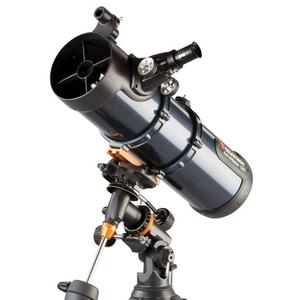
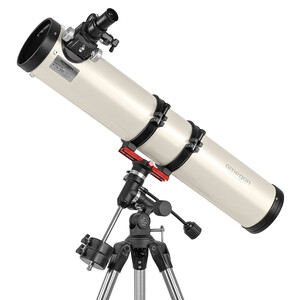
The specs are close. The experience isn't.
Affiliate links — we earn from qualifying purchases at no extra cost to you.
First light
Celestron · 130mm · £169
The sky-learner's equatorial scope
- 130mm newtonian reflector on a manual equatorial mount
- Good for: Moon, planets, bright star clusters and nebulae
- Setup includes rough polar alignment before observing — more steps than a simple alt-az
- Mount axes feel counterintuitive at first; users find they become natural after several sessions
- Keeps the door open for adding tracking motors and moving into astrophotography later
Omegon · 114mm · £179
The sky-learner's equatorial scope
- 114mm newtonian reflector on a manual equatorial mount
- Good for: Moon, planets, bright star clusters and nebulae
- Setup includes rough polar alignment before observing — more steps than a simple alt-az
- Mount axes feel counterintuitive at first; users find they become natural after several sessions
- Keeps the door open for adding tracking motors and moving into astrophotography later
The full picture
The numbers that separate these two scopes — and what they mean at the eyepiece.
Aperture
Celestron AstroMaster 130EQ gathers 1.3× more light. On bright targets — Moon, Saturn, Jupiter — you won't notice. On fainter targets — dim galaxies, faint globular clusters — the gap is real.
Focal length
Omegon Advanced 114/900 EQ3's longer focal length reaches higher magnification with the same eyepiece — better reach for planetary detail. Celestron AstroMaster 130EQ's shorter focal length gives a wider true field — better for large open clusters and extended nebulae.
Focal ratio
Celestron AstroMaster 130EQ's faster f/5 delivers wider fields with any eyepiece — better for open clusters and large nebulae. Omegon Advanced 114/900 EQ3's f/7.9 provides more magnification per eyepiece — better for fine planetary detail.
Mount type
Same mount type — setup experience and ergonomics will be similar. Differences lie in build quality and included accessories.
Weight (OTA)
Similar optical tube weight. Any portability difference between these setups comes from the mount, not the tube itself.
Optical design
Both are Newtonian reflectors — the same optical formula. Any performance difference comes from collimation quality, focal ratio, and eyepiece choice, not the design itself.
At the eyepiece
Celestron
Celestron AstroMaster 130EQ
The Moon fills the field at low power with more detail than you'll have time to explore on any given night. Saturn's rings are unmistakable from the first session; in good seeing, the Cassini Division — the dark gap between the A and B rings — is a genuine target at higher magnification. Jupiter shows two equatorial cloud bands clearly, the four Galilean moons changing position night to night. The Orion Nebula (M42) shows clear structure — nebulosity spreading around the Trapezium, which splits at moderate power. The Andromeda Galaxy (M31) shows a concentrated core clearly. The Hercules Cluster (M13) shows some resolution at the edges at higher magnification.
Omegon
Omegon Advanced 114/900 EQ3
The Moon fills the field at low power with more detail than you'll have time to explore on any given night. Saturn's rings are unmistakable from the first session; in good seeing, the Cassini Division — the dark gap between the A and B rings — is a genuine target at higher magnification. Jupiter shows two equatorial cloud bands clearly, the four Galilean moons changing position night to night. The Orion Nebula (M42) shows clear structure — nebulosity spreading around the Trapezium, which splits at moderate power. The Andromeda Galaxy (M31) shows a concentrated core clearly. The Hercules Cluster (M13) shows some resolution at the edges at higher magnification.
The real tradeoff
Both scopes are capable. The question is which one fits the way you actually observe.
Both scopes are solving a similar problem in a similar way. The differences are real — focal ratio and field of view — but these show up after several months of regular use, not on the first night. Pick the one whose design best matches how you actually plan to observe.
The dark side
Every scope has a personality. Here’s where each one gets difficult.
Celestron
Celestron AstroMaster 130EQ
Mount axes feel counterintuitive at first
An equatorial mount does not move up/down and left/right as you expect — it follows the rotation of the sky. Users consistently report that it takes several sessions before it begins to feel natural.
Collimation: the skill nobody mentions in the listing
The mirrors go out of alignment with use. Stars look bloated rather than sharp when this happens. Users report that a Cheshire eyepiece makes collimation straightforward once learned, but most beginners don't discover they need it until their second or third month.
Omegon
Omegon Advanced 114/900 EQ3
Mount axes feel counterintuitive at first
An equatorial mount does not move up/down and left/right as you expect — it follows the rotation of the sky. Users consistently report that it takes several sessions before it begins to feel natural.
Which is right for you?
Two different buyers. Two different right answers.
The sky-learner's equatorial scope
Celestron · Celestron AstroMaster 130EQ
You’ll love this if…
- You want to understand how an equatorial mount works — and you're prepared to spend a few sessions on polar alignment before it becomes second nature
- You plan to observe from a fixed spot in the garden, where the mount can stay roughly polar-aligned between sessions
- Astrophotography is on your radar even if you're not starting there — this mount keeps that option open with a motor drive upgrade
This will frustrate you if…
- You find the equatorial mount's axes feel wrong — objects move in unexpected directions and polar alignment adds a step each session that takes several outings to become automatic
- You notice that stars look bloated rather than sharp and don't know why — users report this is usually a collimation issue that's straightforward to fix once you know about it, but the listing doesn't mention it
The sky-learner's equatorial scope
Omegon · Omegon Advanced 114/900 EQ3
You’ll love this if…
- You want to understand how an equatorial mount works — and you're prepared to spend a few sessions on polar alignment before it becomes second nature
- You plan to observe from a fixed spot in the garden, where the mount can stay roughly polar-aligned between sessions
- Astrophotography is on your radar even if you're not starting there — this mount keeps that option open with a motor drive upgrade
This will frustrate you if…
- You find the equatorial mount's axes feel wrong — objects move in unexpected directions and polar alignment adds a step each session that takes several outings to become automatic
Our verdict
At similar price points, these scopes offer different amounts of aperture per pound. The Celestron AstroMaster 130EQ gives you more light-gathering for your money — and for visual observing, aperture per pound is the most useful single metric.
For pure optical value, the Celestron AstroMaster 130EQ is the stronger pick. The Omegon Advanced 114/900 EQ3 compensates with other features — decide whether those trade-offs justify the premium. If I had to choose: the Celestron AstroMaster 130EQ — more aperture per pound means more sky.
Celestron AstroMaster 130EQ
View Celestron AstroMaster 130EQ →Omegon Advanced 114/900 EQ3
View Omegon Advanced 114/900 EQ3 →Affiliate links — we earn from qualifying purchases at no extra cost to you.
Deep field: Full specifications
Every data point, for those who want to go further.
Full specifications
Fields highlighted in blue or amber indicate the better value for that spec. Data is manufacturer-stated and may vary.
How much can it see?
| Spec | Celestron AstroMaster 130EQ | Omegon Advanced 114/900 EQ3 |
|---|---|---|
Apertureⓘ The most important spec — bigger = more light = better views | 130mm | 114mm |
Focal Length Longer = more magnification potential | 650mm | 900mm |
Focal Ratio Lower f-number = wider field of view; higher = more magnification per eyepiece | f/5 | f/7.9 |
Optical Design The type of optics — each design has different strengths | Newtonian Reflector | Newtonian Reflector |
Coatings Better coatings = more light transmission through the optics | Fully coated parabolic mirror | Parabolic primary mirror with aluminium coating and SiO2 overcoat |
How do you point it?
| Spec | Celestron AstroMaster 130EQ | Omegon Advanced 114/900 EQ3 |
|---|---|---|
Mount Type The mechanical system that holds and moves the telescope | Equatorial | Equatorial |
GoTo Computer-controlled pointing — finds any of thousands of objects automatically | ||
Tracking Motor keeps objects centred as the Earth rotates — essential for astrophotography |
The focuser
| Spec | Celestron AstroMaster 130EQ | Omegon Advanced 114/900 EQ3 |
|---|---|---|
Focuser Size 2" accepts wider eyepieces and gives better low-power views | 1.25" | 1.25" |
Focuser Type Rack-and-pinion is standard; Crayford and dual-speed are smoother | Rack and pinion | Rack and pinion |
Size & weight
| Spec | Celestron AstroMaster 130EQ | Omegon Advanced 114/900 EQ3 |
|---|---|---|
OTA Weightⓘ Optical tube only — useful for comparing mount load capacity | 3.9kg | 3.5kg |
Total Weightⓘ Full setup including mount — this is what you lug to the car | 10.5kg | 8.5kg |
Tube Length | 640mm | 470mm |
Tube Material | Steel | Aluminium |
What's in the box?
| Spec | Celestron AstroMaster 130EQ | Omegon Advanced 114/900 EQ3 |
|---|---|---|
Eyepieces Included eyepieces — more is better, but quality matters more than quantity | 10mm and 20mm eyepieces | 10mm and 25mm eyepieces |
Finder Scope Helps you locate areas of the sky before switching to the main eyepiece | StarPointer red dot finder | 6x30 finder scope |
Diagonal Tilts the eyepiece 90° for comfortable viewing — useful on refractors |
Blue highlight: Celestron AstroMaster 130EQ advantage · Amber highlight: Omegon Advanced 114/900 EQ3 advantage · Greyed cells: equal or subjective.