Telescope Comparison
Celestron AstroMaster 70AZ vs Celestron StarSense Explorer LT 80AZ
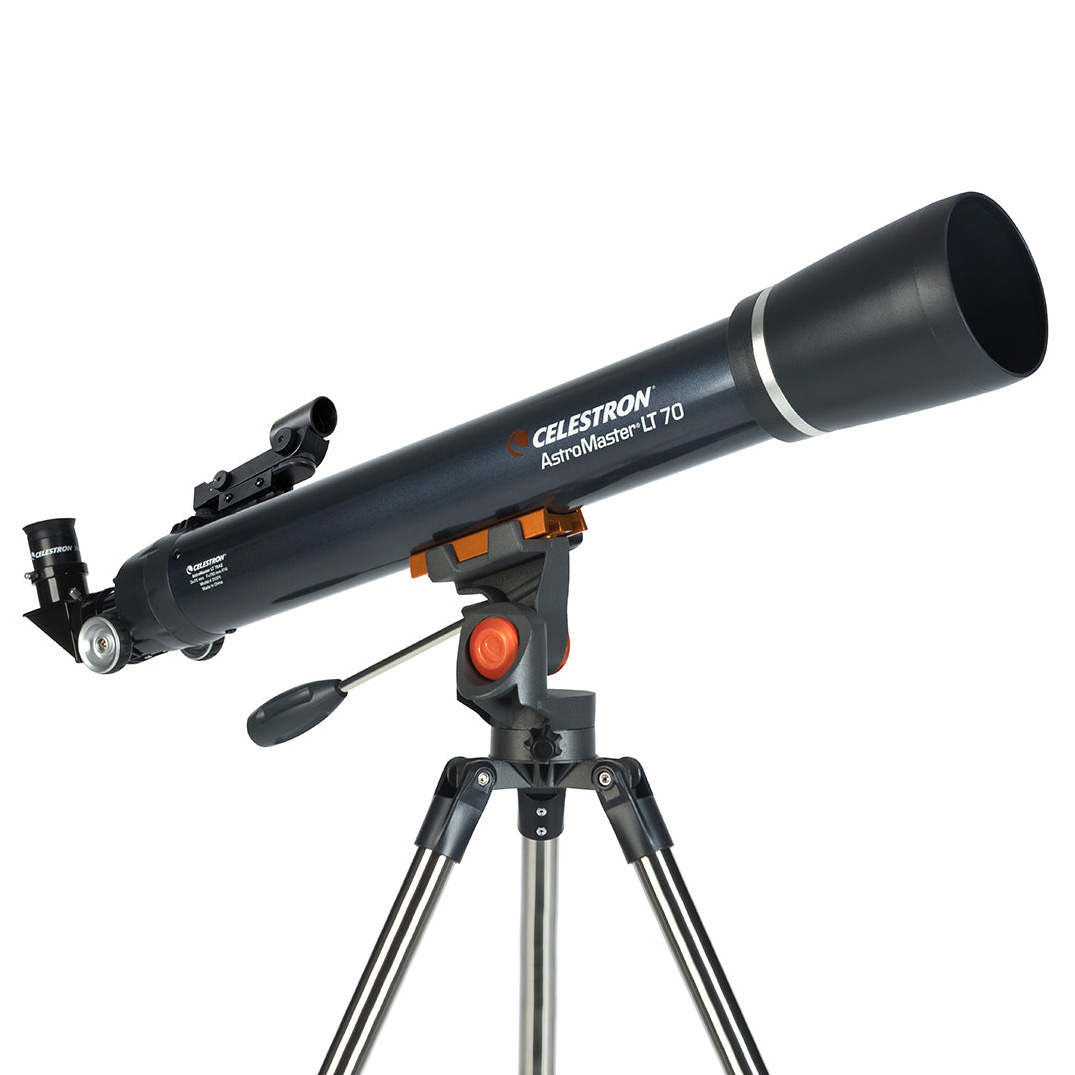
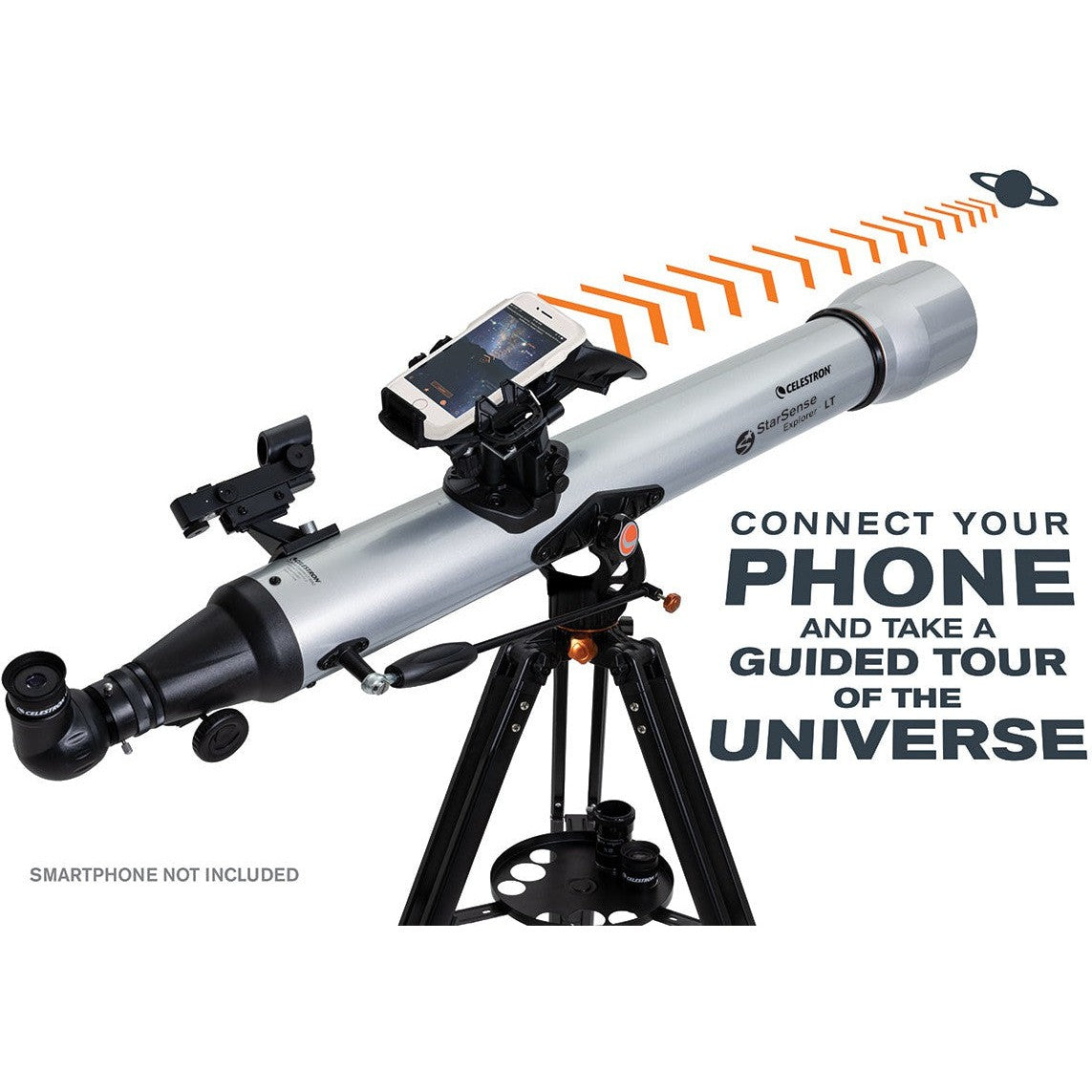
The specs are close. The experience isn't.
Affiliate links — we earn from qualifying purchases at no extra cost to you.
First light
Celestron · 70mm · £89
The simple alt-az visual scope
- 70mm refractor on a simple alt-az mount
- Good for: Moon, planets, bright open clusters
- No alignment required — quick to set up, intuitive to move
- Finding objects requires learning to star-hop: navigate with a finder scope and sky chart
- 4.9kg total — manageable to carry to dark-sky sites
Celestron · 80mm · £159
The simple alt-az visual scope
- 80mm refractor on a simple alt-az mount
- Good for: Moon, planets, bright open clusters
- No alignment required — quick to set up, intuitive to move
- Finding objects requires learning to star-hop: navigate with a finder scope and sky chart
- 5.8kg total — manageable to carry to dark-sky sites
The full picture
The numbers that separate these two scopes — and what they mean at the eyepiece.
Aperture
Celestron StarSense Explorer LT 80AZ gathers 1.3× more light. On bright targets — Moon, Saturn, Jupiter — you won't notice. On fainter targets — dim galaxies, faint globular clusters — the gap is real.
Focal length
Same focal length — identical magnification with any given eyepiece. Differences come from optical design and coatings.
Focal ratio
Celestron StarSense Explorer LT 80AZ's faster f/11.25 delivers wider fields with any eyepiece — better for open clusters and large nebulae. Celestron AstroMaster 70AZ's f/12.86 provides more magnification per eyepiece — better for fine planetary detail.
Mount type
Same mount type — setup experience and ergonomics will be similar. Differences lie in build quality and included accessories.
Weight (OTA)
Similar optical tube weight. Any portability difference between these setups comes from the mount, not the tube itself.
Optical design
Both are refractors — no mirrors to collimate, good contrast, colour-free stars with ED or APO glass. The differences between them are in aperture, focal ratio, and glass quality.
At the eyepiece
| Target | Celestron AstroMaster 70AZ | Celestron StarSense Explorer LT 80AZ |
|---|---|---|
| Planets | ||
| Moon | Good 70mm aperture meets the threshold for detailed lunar viewing, and the very long f/12.9 ratio delivers sharp, high-contrast crater detail at high magnification. | Excellent 80mm aperture clears the threshold, and f/11.25 provides high-contrast, high-magnification lunar detail — craters, rilles, and terminator shadows are crisp |
| Saturn | Moderate 70mm shows the ring system clearly separated from the disc; Cassini Division requires perfect seeing and is rarely visible at this aperture. | Good 80mm and 900mm focal length show rings clearly separated from the disc; Cassini Division visible in good seeing |
| Jupiter | Moderate Two main equatorial cloud bands visible; Great Red Spot occasionally glimpsed in steady seeing. All four Galilean moons easy. | Good Two main cloud belts and all four Galilean moons visible; the long focal ratio provides clean planetary contrast |
| Mars | Challenging Small orange disc visible at opposition; polar cap may be glimpsed but surface markings are beyond 70mm. | Challenging Small orange disc visible at opposition with hints of a polar cap, but 80mm cannot resolve surface albedo features |
Deep sky | ||
| Orion Nebula (M42) | Good Bright core and Trapezium stars visible, but 70mm limits extent of nebulosity; the f/12.9 ratio narrows the field of view around the nebula. | Good 80mm gathers enough light to show the bright core and surrounding nebulosity, but the 900mm focal length crops the full extent of the nebula |
| Andromeda Galaxy (M31) | Moderate 900mm focal length frames only the bright core; outer spiral arms and companion galaxies need wider field and more aperture. | Moderate 900mm focal length frames only the bright core; the outer halo and dust lanes are largely lost to the narrow field |
| Open clusters | Moderate 900mm focal length means many large clusters like the Pleiades overfill the field; compact clusters like M35 fare better. | Moderate 900mm focal length means larger clusters like the Pleiades overfill the field; smaller clusters like M36/M37 fare better |
| Globular clusters | Challenging 70mm aperture shows fuzzy unresolved balls — M13 is detectable but no individual stars are resolved. | Challenging 80mm aperture shows M13 and M3 as fuzzy unresolved spots — no individual stars resolved |
| Faint galaxies | Challenging Only the brightest Messier galaxies (M81, M82) are faintly detectable as smudges under dark skies; most are invisible. | Challenging 80mm gathers limited light; only the brightest galaxies like M81/M82 are detectable as faint smudges |
| Milky Way / wide field | Not recommended 900mm focal length is far too narrow for sweeping star fields; maximum true field is roughly 1.5°. | Not recommended 900mm focal length is far too narrow for sweeping star fields or Milky Way scanning |
Other | ||
| Double stars | Good The long f/12.9 focal ratio provides clean diffraction patterns and good contrast for splitting doubles like Albireo and Mizar; resolving power limited to about 1.7 arcseconds by aperture. | Good 80mm resolves doubles down to about 1.5 arcseconds; the long f/11.25 focal ratio provides clean, high-contrast splits on pairs like Albireo and Mizar |
The real tradeoff
Both scopes are capable. The question is which one fits the way you actually observe.
Celestron AstroMaster 70AZ
- You'll be out the door and looking at the Moon in under five minutes — there's nothing to configure, no phone to dock, no app to download — and that f/12.9 focal ratio delivers some of the sharpest lunar views you can buy for under £100.
- You'll spend most of your sessions on the Moon and maybe Saturn or Jupiter, because finding anything fainter means squinting at a star chart and nudging a mount with no slow-motion controls — most beginners give up before they find M42.
- You'll notice the tripod shaking every time you touch the focuser or a breeze picks up that long 900mm tube, and at high magnification those vibrations turn a crisp crater into a wobbling smear for several seconds.
Celestron StarSense Explorer LT 80AZ
- You'll dock your phone, launch the app, and within a minute you'll have a live bullseye guiding you to objects you'd never have found on your own — that single feature means you'll actually visit dozens of targets in your first month instead of staring at the Moon and giving up.
- You'll pay £70 more and get only 10mm of extra aperture, so the views themselves aren't dramatically better — the real upgrade is navigational, not optical, and you need to decide whether finding objects is worth that premium to you.
- You'll drain your phone battery faster than you expect during a two-hour session, and every time you nudge the scope to follow an object the lightweight mount vibrates enough to blur the view for a few seconds — there's still no tracking, so at 180× planets drift out of the eyepiece within a minute.
The dark side
Every scope has a personality. Here’s where each one gets difficult.
Celestron
Celestron AstroMaster 70AZ
At 70mm aperture, most galaxies, nebulae, and globular clusters are either faint smudges or completely invisible — deep-sky observing is essentially off the table.
Some versions of the alt-az mount lack slow-motion controls entirely, making it genuinely frustrating to track planets at high magnification as they drift out of view.
The lightweight tripod is prone to vibration, and the long 900mm tube acts as a sail in even light wind — the combination means shaky views are a recurring annoyance.
Celestron
Celestron StarSense Explorer LT 80AZ
The StarSense dock requires a compatible smartphone with a functioning camera and the free Celestron app; if your phone isn't supported or the battery dies mid-session, you're left with a basic unguided refractor.
The included 25mm and 10mm Kellner eyepieces are basic — eye relief is short and sharpness falls off at the edges, and upgrading them adds meaningfully to the total cost.
Chromatic aberration is present on bright targets at high power — this is a budget achromatic design, not an ED or APO refractor, so expect purple fringing around the lunar limb and bright planet edges.
Which is right for you?
Two different buyers. Two different right answers.
The simple alt-az visual scope
Celestron · Celestron AstroMaster 70AZ
You'll love this if you want the cheapest possible route to sharp lunar craters and your first glimpse of Saturn's rings, and you're happy spending almost every session on the Moon and planets. You're buying a first telescope for a child or yourself, you want zero setup complexity, and you're not yet sure you care about deep-sky objects. This isn't for you if you want to explore beyond the solar system, if you plan to keep this scope for more than a year, or if the idea of manually hunting for faint targets with no guidance sounds like a chore rather than an adventure.
The simple alt-az visual scope
Celestron · Celestron StarSense Explorer LT 80AZ
You'll love this if the thing that's stopped you from getting into astronomy is the fear of not knowing where to point the scope — the StarSense dock solves that problem completely and means you'll actually use this telescope regularly instead of letting it gather dust after the Moon novelty fades. You're a complete beginner or you're buying a gift for one, and the extra £70 over the AstroMaster is worth it to you for guided object-finding and a slight aperture bump. This isn't for you if you already know your way around the sky, if you want serious deep-sky capability, or if spending £159 on a scope you'll likely outgrow within a year feels like too much — that money could go toward a larger Dobsonian that will last far longer.
Our verdict
At £89 versus £159, the Celestron StarSense Explorer LT 80AZ costs 79% more. It delivers 10mm more aperture — a real and visible advantage on faint targets.
If budget is a genuine constraint, the Celestron AstroMaster 70AZ will make you a happy observer. The Celestron StarSense Explorer LT 80AZ's optical advantage on faint targets is real and you are unlikely to regret it if you can stretch. If I had to choose without knowing your situation: start with the Celestron AstroMaster 70AZ, use it for a year, then upgrade knowing exactly what you want.
Celestron AstroMaster 70AZ
View Celestron AstroMaster 70AZ →Celestron StarSense Explorer LT 80AZ
View Celestron StarSense Explorer LT 80AZ →Affiliate links — we earn from qualifying purchases at no extra cost to you.
Deep field: Full specifications
Every data point, for those who want to go further.
Full specifications
Fields highlighted in blue or amber indicate the better value for that spec. Data is manufacturer-stated and may vary.
How much can it see?
| Spec | Celestron AstroMaster 70AZ | Celestron StarSense Explorer LT 80AZ |
|---|---|---|
Apertureⓘ The most important spec — bigger = more light = better views | 70mm | 80mm |
Focal Length Longer = more magnification potential | 900mm | 900mm |
Focal Ratio Lower f-number = wider field of view; higher = more magnification per eyepiece | f/12.86 | f/11.25 |
Optical Design The type of optics — each design has different strengths | Refractor | Refractor |
Coatings Better coatings = more light transmission through the optics | Fully coated glass optics | Fully coated achromatic refractor optics |
How do you point it?
| Spec | Celestron AstroMaster 70AZ | Celestron StarSense Explorer LT 80AZ |
|---|---|---|
Mount Type The mechanical system that holds and moves the telescope | Alt-Az | Alt-Az |
GoTo Computer-controlled pointing — finds any of thousands of objects automatically | ||
Tracking Motor keeps objects centred as the Earth rotates — essential for astrophotography |
The focuser
| Spec | Celestron AstroMaster 70AZ | Celestron StarSense Explorer LT 80AZ |
|---|---|---|
Focuser Size 2" accepts wider eyepieces and gives better low-power views | 1.25" | 1.25" |
Focuser Type Rack-and-pinion is standard; Crayford and dual-speed are smoother | Rack and pinion | Rack and pinion |
Size & weight
| Spec | Celestron AstroMaster 70AZ | Celestron StarSense Explorer LT 80AZ |
|---|---|---|
OTA Weightⓘ Optical tube only — useful for comparing mount load capacity | 1.8kg | 2.1kg |
Total Weightⓘ Full setup including mount — this is what you lug to the car | 4.9kg | 5.8kg |
Tube Length | 760mm | 900mm |
Tube Material | Aluminium | Aluminium |
What's in the box?
| Spec | Celestron AstroMaster 70AZ | Celestron StarSense Explorer LT 80AZ |
|---|---|---|
Eyepieces Included eyepieces — more is better, but quality matters more than quantity | 20mm and 10mm eyepieces | 25mm and 10mm eyepieces |
Finder Scope Helps you locate areas of the sky before switching to the main eyepiece | StarPointer red dot finder | StarSense sky recognition dock (uses your smartphone) |
Diagonal Tilts the eyepiece 90° for comfortable viewing — useful on refractors |
Blue highlight: Celestron AstroMaster 70AZ advantage · Amber highlight: Celestron StarSense Explorer LT 80AZ advantage · Greyed cells: equal or subjective.