Telescope Comparison
Celestron NexStar 130SLT vs Celestron StarSense Explorer DX 130AZ
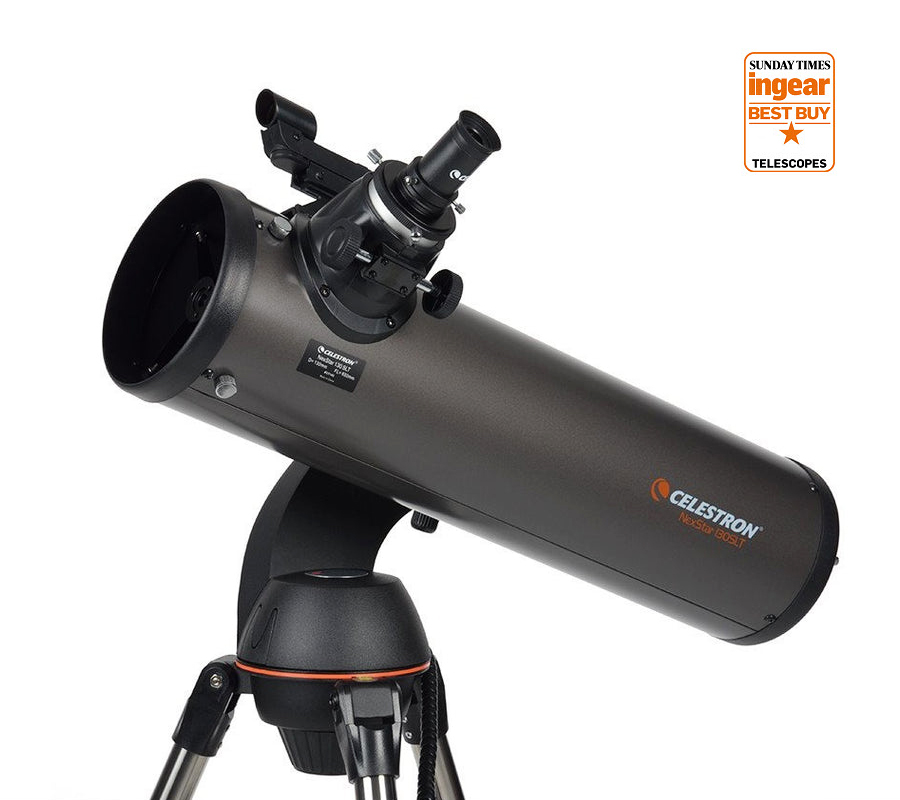
One finds objects for you. The other makes you earn them.
Affiliate links — we earn from qualifying purchases at no extra cost to you.
First light
Celestron · 130mm · £499
The guided beginner's telescope
- 130mm newtonian reflector on a computerised mount with motorised tracking
- Good for: Moon, planets, bright nebulae, star clusters, and deep-sky objects
- GoTo system finds any object in its database after initial star alignment — no star atlas needed
- Tracking motors keep objects centred as Earth rotates — useful above 100×, essential for photography
- 8.5kg total — requires a fixed garden spot or car transport
Celestron · 130mm · £520
The simple alt-az visual scope
- 130mm newtonian reflector on a simple alt-az mount
- Good for: Moon, planets, bright open clusters
- No alignment required — quick to set up, intuitive to move
- Finding objects requires learning to star-hop: navigate with a finder scope and sky chart
- 7.8kg total — manageable to carry to dark-sky sites
The full picture
The numbers that separate these two scopes — and what they mean at the eyepiece.
Aperture
Effectively equal light-gathering. Aperture won't settle this comparison — the mount, focal ratio, and observing experience are what differ.
Focal length
Same focal length — identical magnification with any given eyepiece. Differences come from optical design and coatings.
Focal ratio
Same focal ratio — the same eyepiece gives equivalent magnification and true field in both scopes.
Mount type
Celestron NexStar 130SLT adds GoTo — it finds any target in its database after alignment. Celestron StarSense Explorer DX 130AZ requires manual navigation.
Weight (OTA)
Similar optical tube weight. Any portability difference between these setups comes from the mount, not the tube itself.
Optical design
Both are Newtonian reflectors — the same optical formula. Any performance difference comes from collimation quality, focal ratio, and eyepiece choice, not the design itself.
At the eyepiece
| Target | Celestron NexStar 130SLT | Celestron StarSense Explorer DX 130AZ |
|---|---|---|
| Planets | ||
| Moon | Excellent 130mm resolves craters, rilles, and mountain shadows in fine detail; the GoTo tracking keeps the Moon centred as it drifts | Excellent 130mm aperture delivers crisp crater detail; the fast f/5 ratio means you'll want a Barlow or short eyepiece for high-magnification lunar work |
| Saturn | Good Rings clearly separated, Cassini Division visible in good seeing; 650mm focal length limits useful magnification compared to longer-focal-length scopes | Good Rings clearly visible and Cassini Division detectable in good seeing, though the 650mm focal length means the disc is small without a Barlow |
| Jupiter | Good Two main equatorial belts and Galilean moons easily visible; hints of additional belt structure on steady nights | Good Equatorial cloud bands and all four Galilean moons visible; a Barlow helps pull out detail from the 650mm focal length |
| Mars | Moderate Disc and polar cap visible at opposition; surface albedo features require excellent seeing and are subtle at 130mm | Moderate Small orange disc with polar cap visible near opposition; 130mm aperture and 650mm focal length limit fine surface detail |
Deep sky | ||
| Orion Nebula (M42) | Excellent 130mm at f/5 shows extensive nebulosity and the Trapezium; short focal length frames the full nebula with surrounding context | Excellent Bright nebulosity with visible structure and the Trapezium resolved; the f/5 ratio and 650mm focal length frame the nebula beautifully |
| Andromeda Galaxy (M31) | Excellent 650mm focal length captures the bright core and extended halo in a single field; 130mm aperture shows dust lane hints under dark skies | Excellent 650mm focal length captures the core and extended halo; 130mm aperture reveals dust lane structure from a dark site |
| Open clusters | Excellent Wide true field at 650mm frames large clusters like the Double Cluster and Pleiades beautifully with fully resolved stars | Excellent Short 650mm focal length gives wide true fields — the Pleiades, Double Cluster, and M35 are all well-framed and richly resolved |
| Globular clusters | Moderate M13 and M3 appear as bright granular balls with hints of resolution at the edges; cores remain unresolved at 130mm | Moderate M13 and M22 appear granular but the core remains unresolved at 130mm; still rewarding targets for visual exploration |
| Faint galaxies | Moderate Galaxy pairs like M81/M82 visible as soft glows with distinguishable shapes; fainter targets require dark skies and averted vision | Moderate Galaxy pairs like M81/M82 are visible as soft glows from a dark site; StarSense app makes locating them easy, but detail is limited at 130mm |
| Milky Way / wide field | Good 650mm focal length is slightly long for sweeping Milky Way panoramas but still shows rich star fields with a wide-angle eyepiece | Good 650mm focal length is slightly long for panoramic sweeps but the f/5 ratio keeps fields bright; rich star fields in Sagittarius and Cygnus are rewarding |
Other | ||
| Double stars | Good 130mm resolves doubles down to about 1 arcsecond; the fast f/5 focal ratio makes tight splits harder than in a longer-focal-ratio scope | Good 130mm aperture resolves sub-arcsecond doubles in theory; the fast f/5 ratio makes tight pairs slightly harder than a longer focal ratio scope |
| Astrophotography (planetary) | Moderate 130mm with GoTo tracking supports webcam planetary imaging; the alt-az mount and mount vibration limit results compared to equatorial setups | Moderate Planetary webcam imaging is possible but the lack of tracking means you must constantly re-centre; short video bursts with stacking can still yield results |
The real tradeoff
Both scopes are capable. The question is which one fits the way you actually observe.
Celestron NexStar 130SLT
- You'll press a button and the scope slews to the target on its own — once aligned, you can cycle through hundreds of objects in an evening without touching the tube, which is genuinely transformative on cold nights when you just want to see things.
- You'll also spend time managing the GoTo system's appetite for power: eight AA batteries drain in a couple of hours of slewing, so you'll quickly find yourself buying a mains adapter or a portable power tank before you can trust a full session.
- Tracking keeps objects centred in the eyepiece at low and moderate magnifications, so you can linger on the Orion Nebula or Saturn without constant nudging — but at high power the single-arm mount's flexure and vibration make fine planetary work an exercise in patience.
Celestron StarSense Explorer DX 130AZ
- You'll dock your phone, let the app plate-solve the sky, and follow an on-screen arrow to each target — it's almost as fast as GoTo for finding objects, but your hands never leave the tube because nothing is motorised.
- You'll save £200 upfront and never buy batteries or a power supply for the mount, but you'll pay for that simplicity every time Jupiter drifts out of the eyepiece at 130× and you have to nudge it back by hand.
- Setup is genuinely quicker — no alignment stars to identify, no levelling ritual, no waiting for motors to initialise — so if you're the kind of observer who grabs the scope for a 30-minute session on a clear weeknight, you'll actually use this telescope more often.
The dark side
Every scope has a personality. Here’s where each one gets difficult.
Celestron
Celestron NexStar 130SLT
The single-arm SLT mount vibrates noticeably after you touch the focuser, with several seconds of settling time — at magnifications above 150× this becomes a real obstacle to comfortable viewing.
The GoTo alignment process requires you to identify two or three bright stars by name, which is an ironic hurdle for a scope marketed at people who don't yet know the sky.
Default power is 8× AA batteries that drain within a few hours of active GoTo slewing; a separate 12V power supply is effectively a mandatory additional purchase.
Celestron
Celestron StarSense Explorer DX 130AZ
There is no motorised tracking at all — objects drift through the eyepiece continuously, and at magnifications above about 100× you'll be nudging the tube every 20–30 seconds to keep a planet centred.
The StarSense system requires a compatible smartphone with a functioning rear camera; if your phone isn't supported, or its camera is damaged, the scope's main finding advantage disappears entirely.
The 1.25-inch focuser rules out 2-inch wide-field eyepieces, capping the maximum true field of view and limiting an upgrade path that many owners eventually want.
Which is right for you?
Two different buyers. Two different right answers.
The guided beginner's telescope
Celestron · Celestron NexStar 130SLT
You want a hands-off experience: press a button, let the mount find the target, and keep it tracked in the eyepiece while you observe. You're willing to spend £200 more — plus the ongoing cost of batteries or a power supply — for the convenience of motorised slewing and tracking. You'll love this if you want to spend a full evening touring dozens of deep-sky objects without manually nudging anything, and you don't mind a slightly longer setup routine to get the GoTo aligned. This isn't for you if you want a rock-solid mount for high-magnification planetary work, or if the idea of managing power cables and alignment procedures sounds like more hassle than it's worth.
The simple alt-az visual scope
Celestron · Celestron StarSense Explorer DX 130AZ
You want the fastest possible path from opening the box to seeing the Orion Nebula, and you'd rather spend the £200 you save on better eyepieces than on motors and batteries. You'll love this if you observe in short, spontaneous bursts — dock your phone, follow the arrow, and you're on target in under a minute with zero alignment ritual. You're comfortable keeping one hand on the scope to nudge objects back into view, and you accept that motorised tracking isn't part of the deal. This isn't for you if manually re-centring a planet every 30 seconds at high power sounds tedious, or if you want to sit back and let the scope do the driving.
Our verdict
The Celestron NexStar 130SLT handles object location automatically — align once, the scope slews to anything in its database. The Celestron StarSense Explorer DX 130AZ asks you to navigate by star-hopping, which takes longer but builds real sky knowledge.
For most beginners, the Celestron NexStar 130SLT removes the biggest early frustration: not being able to find anything from a light-polluted garden. The Celestron StarSense Explorer DX 130AZ is the better choice if learning the sky manually is part of why you want a telescope. If I had to choose for a first-time buyer: the Celestron NexStar 130SLT — find things first, learn the sky later.
Celestron NexStar 130SLT
View Celestron NexStar 130SLT →Celestron StarSense Explorer DX 130AZ
View Celestron StarSense Explorer DX 130AZ →Affiliate links — we earn from qualifying purchases at no extra cost to you.
Deep field: Full specifications
Every data point, for those who want to go further.
Full specifications
Fields highlighted in blue or amber indicate the better value for that spec. Data is manufacturer-stated and may vary.
How much can it see?
| Spec | Celestron NexStar 130SLT | Celestron StarSense Explorer DX 130AZ |
|---|---|---|
Aperture The most important spec — bigger = more light = better views | 130mm | 130mm |
Focal Length Longer = more magnification potential | 650mm | 650mm |
Focal Ratio Lower f-number = wider field of view; higher = more magnification per eyepiece | f/5 | f/5 |
Optical Design The type of optics — each design has different strengths | Newtonian Reflector | Newtonian Reflector |
Coatings Better coatings = more light transmission through the optics | Fully multi-coated parabolic mirror | Fully multi-coated optics |
How do you point it?
| Spec | Celestron NexStar 130SLT | Celestron StarSense Explorer DX 130AZ |
|---|---|---|
Mount Type The mechanical system that holds and moves the telescope | GoTo (Computerised) | Alt-Az |
GoToⓘ Computer-controlled pointing — finds any of thousands of objects automatically | ||
Trackingⓘ Motor keeps objects centred as the Earth rotates — essential for astrophotography |
The focuser
| Spec | Celestron NexStar 130SLT | Celestron StarSense Explorer DX 130AZ |
|---|---|---|
Focuser Size 2" accepts wider eyepieces and gives better low-power views | 1.25" | 1.25" |
Focuser Type Rack-and-pinion is standard; Crayford and dual-speed are smoother | Rack and pinion | Rack and pinion |
Size & weight
| Spec | Celestron NexStar 130SLT | Celestron StarSense Explorer DX 130AZ |
|---|---|---|
OTA Weightⓘ Optical tube only — useful for comparing mount load capacity | 2.9kg | 3.6kg |
Total Weightⓘ Full setup including mount — this is what you lug to the car | 8.5kg | 7.8kg |
Tube Length | 620mm | 600mm |
Tube Material | Steel | Steel |
What's in the box?
| Spec | Celestron NexStar 130SLT | Celestron StarSense Explorer DX 130AZ |
|---|---|---|
Eyepieces Included eyepieces — more is better, but quality matters more than quantity | 25mm and 9mm eyepieces | 25mm and 10mm Kellner |
Finder Scope Helps you locate areas of the sky before switching to the main eyepiece | StarPointer red dot finder | StarSense sky recognition dock (uses your smartphone) |
Diagonal Tilts the eyepiece 90° for comfortable viewing — useful on refractors |
Blue highlight: Celestron NexStar 130SLT advantage · Amber highlight: Celestron StarSense Explorer DX 130AZ advantage · Greyed cells: equal or subjective.