Telescope Comparison
Celestron NexStar 4SE vs Sky-Watcher SkyMax 127 AZ-GTe
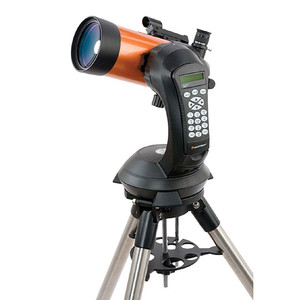
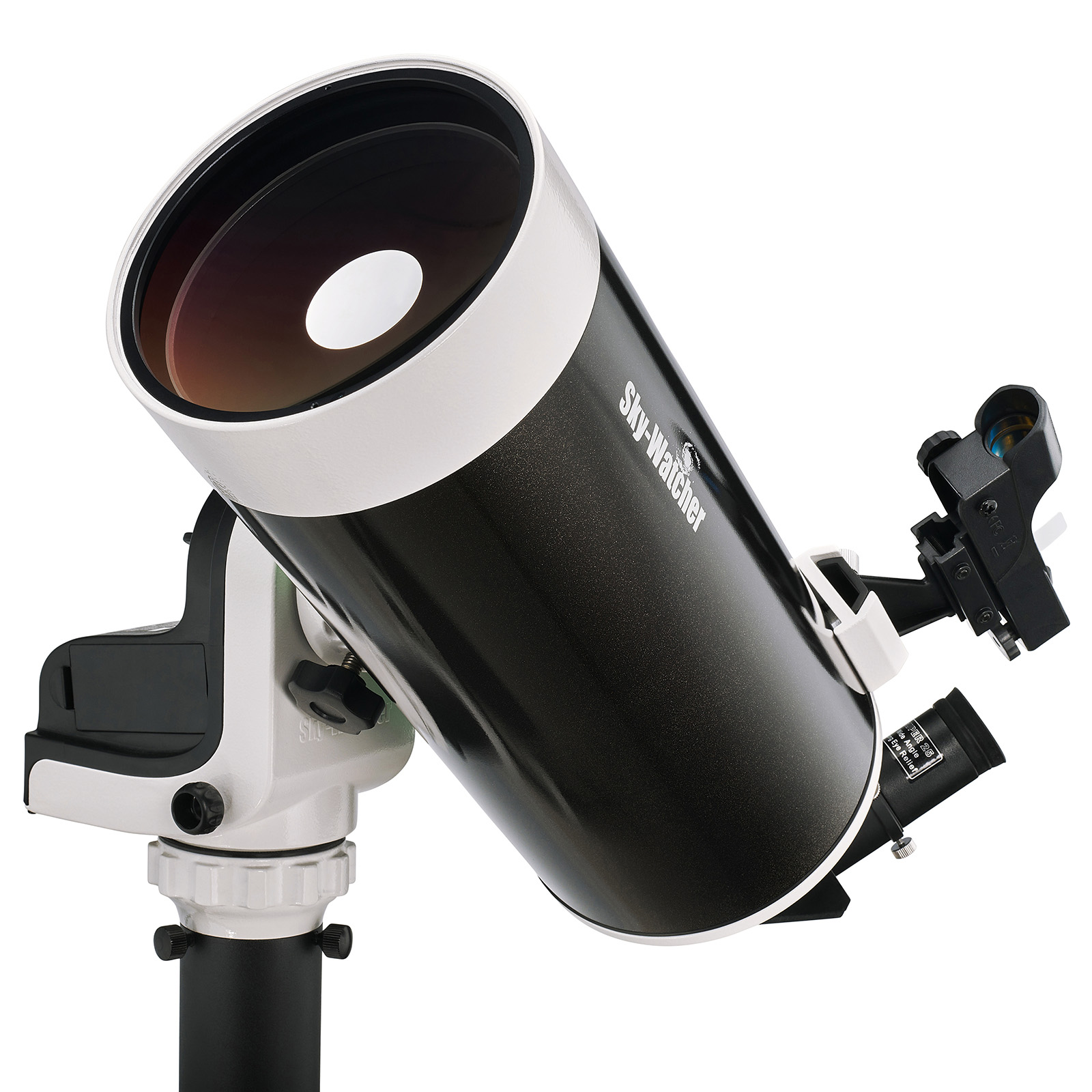
The price gap is real. The question is whether the extra capability is worth it at your stage.
Affiliate links — we earn from qualifying purchases at no extra cost to you.
First light
Celestron · 102mm · £850
The guided beginner's telescope
- 102mm maksutov-cassegrain on a computerised mount with motorised tracking
- Good for: Moon, planets, bright nebulae, star clusters, and deep-sky objects
- GoTo system finds any object in its database after initial star alignment — no star atlas needed
- Tracking motors keep objects centred as Earth rotates — useful above 100×, essential for photography
- 4.5kg total — requires a fixed garden spot or car transport
Sky-Watcher · 127mm · £449
The guided beginner's telescope
- 127mm maksutov-cassegrain on a computerised mount with motorised tracking
- Good for: Moon, planets, bright nebulae, star clusters, and deep-sky objects
- GoTo system finds any object in its database after initial star alignment — no star atlas needed
- Tracking motors keep objects centred as Earth rotates — useful above 100×, essential for photography
- 7kg total — requires a fixed garden spot or car transport
The full picture
The numbers that separate these two scopes — and what they mean at the eyepiece.
Aperture
Sky-Watcher SkyMax 127 AZ-GTe gathers 1.6× more light. On bright targets — Moon, Saturn, Jupiter — you won't notice. On fainter targets — dim galaxies, faint globular clusters — the gap is real.
Focal length
Sky-Watcher SkyMax 127 AZ-GTe's longer focal length reaches higher magnification with the same eyepiece — better reach for planetary detail. Celestron NexStar 4SE's shorter focal length gives a wider true field — better for large open clusters and extended nebulae.
Focal ratio
Sky-Watcher SkyMax 127 AZ-GTe's faster f/11.81 delivers wider fields with any eyepiece — better for open clusters and large nebulae. Celestron NexStar 4SE's f/12.99 provides more magnification per eyepiece — better for fine planetary detail.
Mount type
Same mount type — setup experience and ergonomics will be similar. Differences lie in build quality and included accessories.
Weight (OTA)
Celestron NexStar 4SE's optical tube is 1.0kg lighter. Relevant if you plan to use it on multiple mounts or carry the tube to dark-sky sites separately.
Optical design
Both Maksutov-Cassegrains — compact tubes, long focal length, excellent planetary contrast. Performance differences come from aperture and mount, not optical formula.
At the eyepiece
| Target | Celestron NexStar 4SE | Sky-Watcher SkyMax 127 AZ-GTe |
|---|---|---|
| Planets | ||
| Moon | Excellent 102mm aperture at f/13 delivers high-contrast, sharp lunar detail — craters, rilles, and mountain shadows snap into focus at high magnification | Excellent 127mm aperture and f/11.8 focal ratio deliver exceptional lunar detail — craterlets, rilles, and sharp shadow detail at high magnification |
| Saturn | Good 1,325mm focal length provides strong native magnification; rings clearly defined and Cassini Division visible in steady seeing, though 102mm limits fine detail | Good 1500mm focal length and high-contrast Mak optics show rings clearly with Cassini Division in good seeing; 127mm just misses the Excellent threshold |
| Jupiter | Good Two main cloud bands, GRS, and Galilean moon shadows visible; the long focal ratio gives clean contrast, but aperture limits finer belt structure | Good Multiple cloud belts, Great Red Spot, and all four Galilean moons visible; 127mm resolves more banding than a 102mm but less than a 150mm |
| Mars | Moderate Disc visible at opposition with polar ice cap; albedo markings are at the edge of what 102mm can resolve | Moderate Polar cap and major dark albedo features visible at opposition; 127mm is squarely in the moderate range for Mars detail |
Deep sky | ||
| Orion Nebula (M42) | Excellent Bright core and trapezium resolved easily; however the f/13 focal ratio and narrow field crop the nebula's full extent compared to faster, shorter scopes | Good Bright core and Trapezium well shown with 127mm aperture, but the 1500mm focal length crops the full nebula extent significantly |
| Andromeda Galaxy (M31) | Moderate At 1,325mm focal length only the bright core fits in the field — the galaxy's 3°+ extent is far wider than any eyepiece can frame here | Moderate 1500mm focal length shows only the bright core — the galaxy's 3°+ extent vastly overfills the field of view |
| Open clusters | Moderate Many open clusters like the Pleiades overfill the narrow field; smaller clusters such as M36/M37 fare better | Moderate Narrow field of view means many clusters (Pleiades, Double Cluster) overfill or fill the eyepiece, losing their visual impact |
| Globular clusters | Moderate M13 and M5 appear granular but core stars are unresolved at 102mm — looks like a textured fuzzy ball | Moderate M13 and M92 appear granular with hints of edge resolution; the long focal length gives good image scale but 127mm can't fully resolve cores |
| Faint galaxies | Moderate 102mm gathers enough light to detect brighter Messier galaxies as faint smudges, but detail and fainter NGC targets are out of reach | Moderate GoTo locates targets easily but 127mm aperture shows only the brightest galaxy cores as dim fuzzy patches |
| Milky Way / wide field | Not recommended 1,325mm focal length gives far too narrow a field for sweeping star fields — maximum true field is roughly 1.2° | Not recommended 1500mm focal length gives far too narrow a field for Milky Way sweeping — this scope is the opposite of a wide-field instrument |
Other | ||
| Double stars | Excellent The long f/13 focal ratio produces clean, tight Airy discs; Dawes' limit of ~1.1 arcsec resolves pairs like Castor and Porrima cleanly | Excellent 127mm aperture at f/11.8 is ideal for splitting doubles — clean Airy discs and high magnification per mm of focal length |
| Astrophotography (deep sky) | Moderate Alt-az GoTo mount tracks but introduces field rotation on longer exposures; f/13 is very slow for faint targets — planetary-only imaging is more realistic | Moderate Alt-az GoTo mount tracks but introduces field rotation, limiting exposures to a few seconds; f/11.8 is very slow for faint targets |
| Astrophotography (planetary) | Moderate 102mm aperture and 1,325mm focal length can produce respectable planetary video captures; the GoTo tracking helps keep targets centred | Moderate 127mm at 1500mm native focal length gives good image scale for planetary video capture; GoTo tracking keeps the planet in frame |
The real tradeoff
Both scopes are capable. The question is which one fits the way you actually observe.
{"scopeAHeading":"Celestron NexStar 4SE","scopeABullets":["You'll be set up and observing faster — the smaller 102mm tube reaches thermal equilibrium quicker than the SkyMax 127, so you're not waiting 30–45 minutes for planetary views to sharpen up on a cold night.","You'll get beautiful, contrasty views of the Moon and bright doubles like Castor, but when you push into deep sky you'll feel the 102mm aperture ceiling hard — M13 stays a fuzzy ball, never hinting at resolved stars the way the 127mm can.","You'll save £50 upfront and get a scope that's even more compact and lighter, but you'll likely spend some of that saving on an external power supply and a wider-field eyepiece to replace the fairly limited 25mm Plossl in the box."],"scopeBHeading":"Sky-Watcher SkyMax 127 AZ-GTe","scopeBullets":["You'll see noticeably more on every target — that extra 25mm of aperture means Jupiter shows festoon detail the 4SE can't quite reach, M13 starts to hint at individual stars at the edges, and faint deep-sky smudges that are invisible in 102mm become detectable.","You'll pay for that extra aperture with patience — on a winter evening, you're looking at 30–45 minutes of cool-down before the Maksutov tube delivers the sharp planetary views you bought it for, so spontaneous five-minute sessions aren't really on the menu.","You'll appreciate the Wi-Fi app control on the AZ-GTe mount — it's a genuinely smoother experience than the NexStar hand controller for browsing targets — but the mount itself feels slightly shaky at high power, and you're just as battery-dependent as the 4SE without an external supply."]}
The dark side
Every scope has a personality. Here’s where each one gets difficult.
Celestron
Celestron NexStar 4SE
The single-arm fork mount vibrates for several seconds every time you touch the focuser — at 200x+ magnification, this means you're constantly waiting for the image to settle before you can actually observe.
Eight AA batteries drain fast in cold weather, and a full GoTo alignment-and-observe session can exhaust them; budget for an external power tank as an essential accessory, not an optional one.
The 1.25-inch focuser caps your true field of view at around 1.2° — the Pleiades overfill the eyepiece and even framing the full extent of M31's core region is a squeeze.
Sky-Watcher
Sky-Watcher SkyMax 127 AZ-GTe
The sealed Maksutov tube takes 30–45 minutes to reach thermal equilibrium — until it does, planetary views are noticeably soft and mushy, which can be frustrating if you only have a short window to observe.
The true field of view is under 1° with the longest eyepiece included, making manual target-finding essentially impossible — if the GoTo alignment fails or battery dies mid-session, you're effectively stranded.
The AZ-GTe mount is adequate but not generous for this OTA — vibrations after focusing take a few seconds to damp out, and the whole setup can feel slightly precarious at the high magnifications the optics invite you to use.
Which is right for you?
Two different buyers. Two different right answers.
The guided beginner's telescope
Celestron · Celestron NexStar 4SE
You want the most grab-and-go planetary scope possible and you're working with a tight budget. You live in a light-polluted area, you mostly care about the Moon, planets, and bright double stars, and you value being able to carry the whole setup out in one trip. You don't mind that deep-sky will always be limited — you bought this for Saturn's rings and lunar craters, and the £50 you save over the SkyMax 127 goes toward the external power supply you'll definitely need. If you're a complete beginner who just wants sharp, contrasty views of the showpiece objects without learning to navigate the sky, the 4SE gets you there with less weight and faster cool-down.
The guided beginner's telescope
Sky-Watcher · Sky-Watcher SkyMax 127 AZ-GTe
You're willing to spend the extra £50 and wait out a longer cool-down because you want to see more detail on everything — not just planets, but globular clusters that start to hint at resolution and fainter deep-sky objects the 4SE simply can't pull in. You're planning to observe for an hour or more per session, not quick ten-minute peeks, so the thermal equilibrium time doesn't bother you. You like the idea of controlling your scope from your phone via Wi-Fi rather than a wired handset. If you suspect your interests will grow beyond the Moon and planets into brighter deep-sky targets, the 127mm aperture gives you meaningfully more room to explore before you hit the wall.
Our verdict
At £449 versus £850, the Celestron NexStar 4SE costs 89% more. The extra money buys a more capable mount and better build quality, not larger optics.
For most buyers starting out, the Sky-Watcher SkyMax 127 AZ-GTe is the sensible choice — put the savings into a better eyepiece. The Celestron NexStar 4SE makes sense once you know exactly why you need what it offers. If I had to choose: the Sky-Watcher SkyMax 127 AZ-GTe, and spend the difference on a quality eyepiece.
Celestron NexStar 4SE
View Celestron NexStar 4SE →Sky-Watcher SkyMax 127 AZ-GTe
View Sky-Watcher SkyMax 127 AZ-GTe →Affiliate links — we earn from qualifying purchases at no extra cost to you.
Deep field: Full specifications
Every data point, for those who want to go further.
Full specifications
Fields highlighted in blue or amber indicate the better value for that spec. Data is manufacturer-stated and may vary.
How much can it see?
| Spec | Celestron NexStar 4SE | Sky-Watcher SkyMax 127 AZ-GTe |
|---|---|---|
Apertureⓘ The most important spec — bigger = more light = better views | 102mm | 127mm |
Focal Length Longer = more magnification potential | 1325mm | 1500mm |
Focal Ratio Lower f-number = wider field of view; higher = more magnification per eyepiece | f/12.99 | f/11.81 |
Optical Design The type of optics — each design has different strengths | Maksutov-Cassegrain | Maksutov-Cassegrain |
Coatings Better coatings = more light transmission through the optics | StarBright XLT fully multi-coated | Fully multi-coated Maksutov-Cassegrain optics |
How do you point it?
| Spec | Celestron NexStar 4SE | Sky-Watcher SkyMax 127 AZ-GTe |
|---|---|---|
Mount Type The mechanical system that holds and moves the telescope | GoTo (Computerised) | GoTo (Computerised) |
GoTo Computer-controlled pointing — finds any of thousands of objects automatically | ||
Tracking Motor keeps objects centred as the Earth rotates — essential for astrophotography |
The focuser
| Spec | Celestron NexStar 4SE | Sky-Watcher SkyMax 127 AZ-GTe |
|---|---|---|
Focuser Size 2" accepts wider eyepieces and gives better low-power views | 1.25" | 1.25" |
Focuser Type Rack-and-pinion is standard; Crayford and dual-speed are smoother | SCT rear cell with focuser knob | Rear-cell focuser |
Size & weight
| Spec | Celestron NexStar 4SE | Sky-Watcher SkyMax 127 AZ-GTe |
|---|---|---|
OTA Weightⓘ Optical tube only — useful for comparing mount load capacity | 1.36kg | 2.4kg |
Total Weightⓘ Full setup including mount — this is what you lug to the car | 4.5kg | 7kg |
Tube Length | 330mm | 370mm |
Tube Material | Aluminium | Aluminium |
What's in the box?
| Spec | Celestron NexStar 4SE | Sky-Watcher SkyMax 127 AZ-GTe |
|---|---|---|
Eyepieces Included eyepieces — more is better, but quality matters more than quantity | 25mm Plössl | 25mm Super eyepiece |
Finder Scope Helps you locate areas of the sky before switching to the main eyepiece | StarPointer red dot finder | Red dot finder |
Diagonal Tilts the eyepiece 90° for comfortable viewing — useful on refractors |
Smart features
| Spec | Celestron NexStar 4SE | Sky-Watcher SkyMax 127 AZ-GTe |
|---|---|---|
Built-in Camera Records and stacks images automatically — no separate camera needed | ||
App Controlled | ||
WiFi | ||
Battery Included |
Blue highlight: Celestron NexStar 4SE advantage · Amber highlight: Sky-Watcher SkyMax 127 AZ-GTe advantage · Greyed cells: equal or subjective.