Telescope Comparison
Celestron NexStar 5SE vs Celestron NexStar 6SE
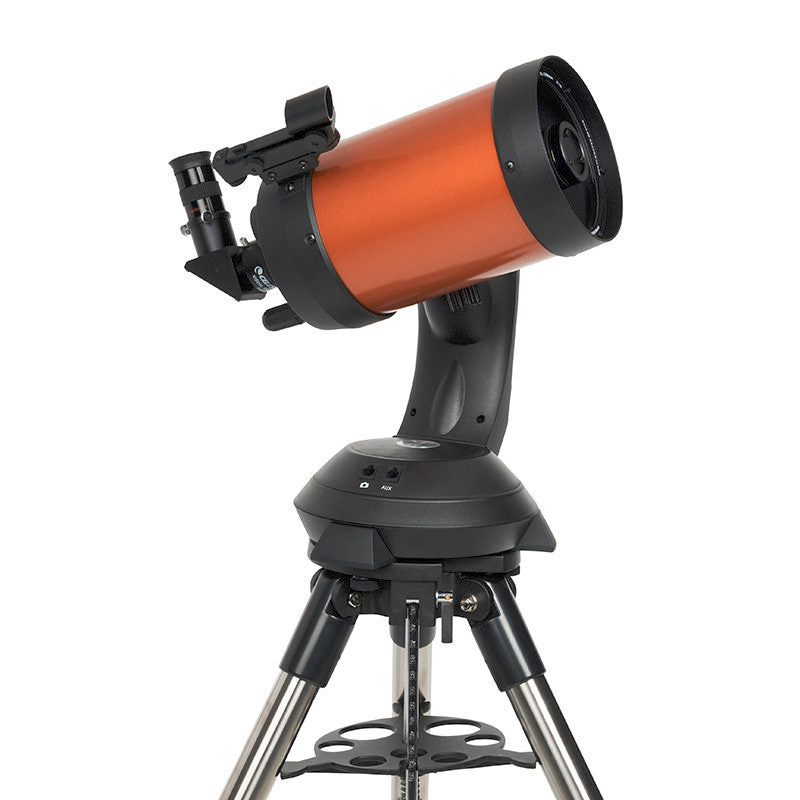
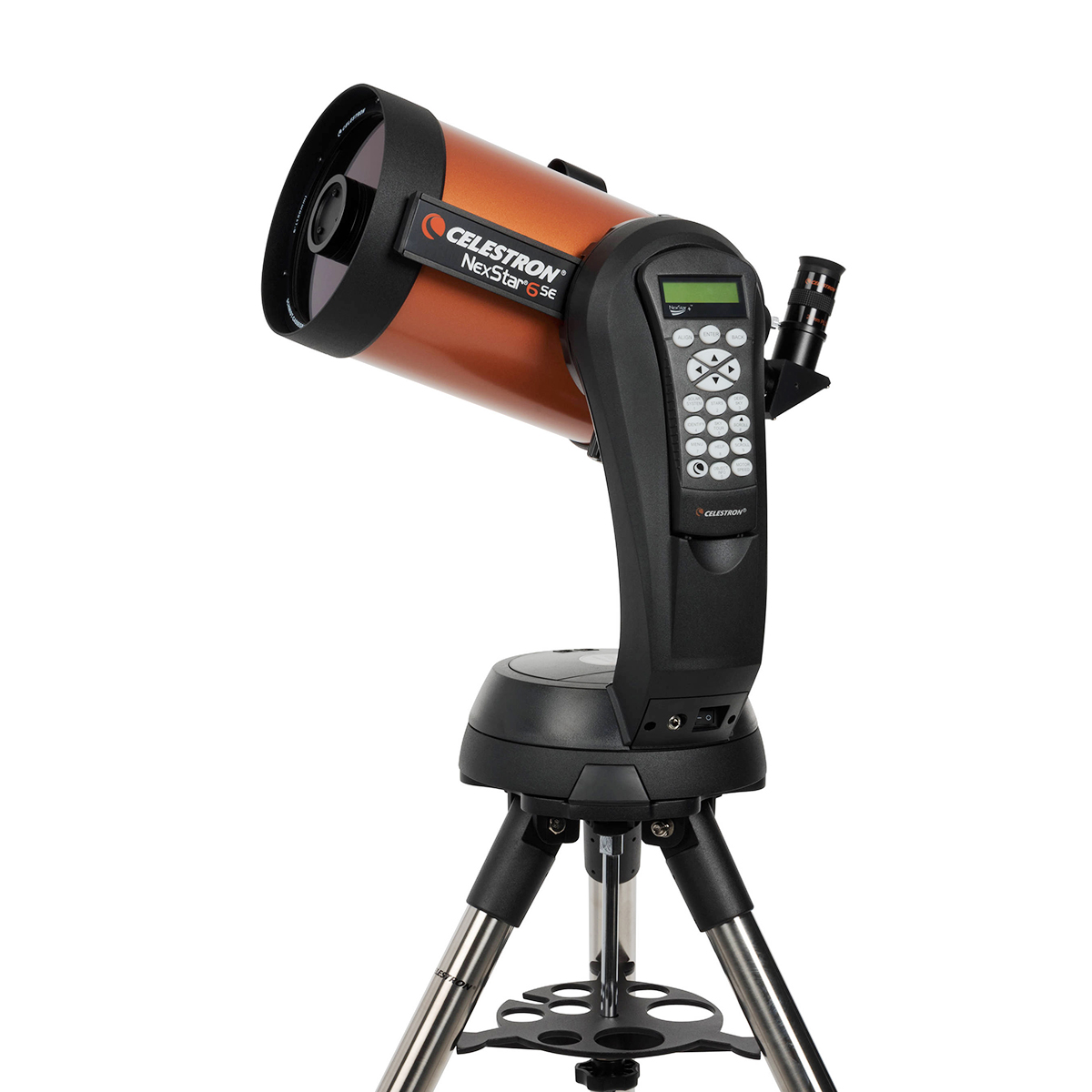
The specs are close. The experience isn't.
Affiliate links — we earn from qualifying purchases at no extra cost to you.
First light
Celestron · 125mm · £799
The automated deep-sky platform
- 125mm schmidt-cassegrain on a computerised mount with motorised tracking
- Good for: Moon, planets, bright nebulae, star clusters, and deep-sky objects
- GoTo system finds any object in its database after initial star alignment — no star atlas needed
- Tracking motors keep objects centred as Earth rotates — useful above 100×, essential for photography
- 9.8kg total — requires a fixed garden spot or car transport
Celestron · 150mm · £999
The automated deep-sky platform
- 150mm schmidt-cassegrain on a computerised mount with motorised tracking
- Good for: Moon, planets, bright nebulae, star clusters, and deep-sky objects
- GoTo system finds any object in its database after initial star alignment — no star atlas needed
- Tracking motors keep objects centred as Earth rotates — useful above 100×, essential for photography
- 11.5kg total — requires a fixed garden spot or car transport
The full picture
The numbers that separate these two scopes — and what they mean at the eyepiece.
Aperture
Celestron NexStar 6SE gathers 1.4× more light. On bright targets — Moon, Saturn, Jupiter — you won't notice. On fainter targets — dim galaxies, faint globular clusters — the gap is real.
Focal length
Celestron NexStar 6SE's longer focal length reaches higher magnification with the same eyepiece — better reach for planetary detail. Celestron NexStar 5SE's shorter focal length gives a wider true field — better for large open clusters and extended nebulae.
Focal ratio
Same focal ratio — the same eyepiece gives equivalent magnification and true field in both scopes.
Mount type
Same mount type — setup experience and ergonomics will be similar. Differences lie in build quality and included accessories.
Weight (OTA)
Similar optical tube weight. Any portability difference between these setups comes from the mount, not the tube itself.
Optical design
Both Schmidt-Cassegrain designs — versatile, compact, good for planets and deep-sky. Differences come from aperture and mount.
At the eyepiece
| Target | Celestron NexStar 5SE | Celestron NexStar 6SE |
|---|---|---|
| Planets | ||
| Moon | Excellent 125mm aperture and f/10 focal ratio reward high-magnification lunar detail — craters, rilles, and shadow features are crisp and well-defined | Excellent 150mm aperture and f/10 focal ratio reward high magnification — craterlets, rilles, and sharp terminator shadows are all accessible |
| Saturn | Good Rings clearly defined, Cassini Division visible in good seeing; 125mm aperture just misses the top tier but 1250mm focal length suits planetary scale | Excellent 150mm and 1500mm focal length put Cassini Division, ring shadow, and disc banding within reach in steady seeing |
| Jupiter | Good Two or more cloud belts, Great Red Spot, and Galilean moon shadows visible; focal length supports 200×+ comfortably | Excellent Multiple cloud belts, Great Red Spot, and moon shadow transits visible; 1500mm focal length gives a generously sized disc |
| Mars | Moderate Polar cap and major albedo features visible at opposition; 125mm aperture limits fine surface detail | Good Polar cap and major dark albedo features visible at opposition; 150mm is below the 200mm threshold for truly detailed Mars observation |
Deep sky | ||
| Orion Nebula (M42) | Good Bright core and Trapezium well resolved, but 1250mm focal length and f/10 ratio crop the full extent of the nebulosity | Good Bright nebulosity and Trapezium are impressive, but the 1500mm focal length crops the full extent of the nebula; f/10 doesn't favour wide-field context |
| Andromeda Galaxy (M31) | Moderate 1250mm focal length shows only the bright core; the galaxy's full 3° extent is far wider than the eyepiece field | Moderate 1500mm focal length frames only the bright core — the outer halo and full disc extend well beyond the field even with a wide eyepiece |
| Open clusters | Moderate Many open clusters overfill the narrow field of view; best suited to compact clusters like M37 or M11 | Moderate Larger clusters like the Pleiades and Double Cluster overfill the field; works better on compact clusters like M35 or M11 |
| Globular clusters | Moderate Granular texture visible in M13 and M3 at high power, but 125mm aperture cannot fully resolve individual stars across the core | Good M13 and M5 show granular texture with partial star resolution at the edges; 150mm is below the threshold for full resolution across the cluster |
| Faint galaxies | Moderate 125mm gathers enough light for dozens of Messier and brighter NGC galaxies as small fuzzy patches; limited detail | Good 150mm gathers enough light to show structure in brighter galaxies like M51 and M104; fainter targets appear as dim smudges |
| Milky Way / wide field | Not recommended 1250mm focal length gives far too narrow a field for sweeping star fields or Milky Way context | Not recommended 1500mm focal length gives far too narrow a field for sweeping Milky Way views — this scope is the opposite of a wide-field instrument |
Other | ||
| Double stars | Excellent 125mm aperture and f/10 focal ratio produce clean, tight Airy discs — resolves pairs down to about 1 arcsecond | Excellent 150mm aperture and f/10 focal ratio produce clean Airy discs — excellent for splitting close pairs and showing colour contrast |
| Astrophotography (deep sky) | Moderate Alt-az GoTo mount tracks but introduces field rotation, limiting useful exposures to a few seconds; suited to EAA or lucky imaging, not long-exposure work | Moderate Alt-az GoTo mount causes field rotation limiting exposures to a few seconds; usable for EAA and short-exposure stacking but not long-exposure imaging |
| Astrophotography (planetary) | Moderate 1250mm focal length and tracking mount suit webcam/planetary camera stacking; 125mm aperture is the limiting factor for fine detail | Good 1500mm focal length and tracking mount suit lucky-imaging with a planetary camera; 150mm aperture gives solid detail but falls short of 200mm+ scopes |
The real tradeoff
Both scopes are capable. The question is which one fits the way you actually observe.
Celestron NexStar 5SE
- You'll carry this tube in one hand and have SkyAlign tracking in under five minutes — it's the closest thing to a true grab-and-go GoTo SCT, and that means you'll actually use it on weeknights when the 6SE might stay indoors.
- You'll get sharp Saturn rings and Jupiter belts at 150–200×, but you're working with 125mm of aperture, so on nights of average seeing you'll notice you're bumping against the resolution ceiling sooner than the 6SE — faint detail in globular clusters stays granular rather than truly resolving into stars.
- You'll save roughly £200 over the 6SE, which buys you a decent external power tank and a wider-field eyepiece — two accessories you'll want almost immediately — and still come in under budget.
Celestron NexStar 6SE
- You'll wait 30–45 minutes for the optics to cool down on a cold night before planetary views sharpen up — that's time the smaller 5SE mostly avoids — but once the tube reaches thermal equilibrium, the extra 25mm of aperture rewards you with festoons between Jupiter's belts and stars beginning to resolve around the edges of M13.
- You'll notice the 6SE is noticeably heavier and bulkier than the 5SE; it still fits on a small table, but carrying it out to a dark site feels like a deliberate outing rather than a casual grab-and-go.
- You'll find compact deep-sky targets like M81/M82 and M57 look meaningfully brighter and more detailed than in the 5SE — the 44% increase in light-gathering area is real, and it's most obvious on galaxies and planetary nebulae where every photon counts.
The dark side
Every scope has a personality. Here’s where each one gets difficult.
Celestron
Celestron NexStar 5SE
The plastic tripod legs flex under the weight of the OTA and single-arm fork, and at high magnification every touch or breeze triggers several seconds of wobble — you'll learn to observe hands-off and wait out the vibrations.
The supplied 25mm Plössl yields only a 0.6° true field at 50×, which crops even moderately extended objects like M31 to their bright core — a wider-field eyepiece is essentially a required purchase.
Eight AA batteries drain fast in cold weather; an external 12V power supply is a practical necessity rather than an optional accessory.
Celestron
Celestron NexStar 6SE
The single-arm fork mount vibrates for 2–3 seconds after every focus adjustment or accidental touch — the same fundamental weakness as the 5SE, but the heavier 6-inch OTA makes the wobble slightly more pronounced.
No 2-inch visual back is included, so even if you buy a wide-field 2-inch eyepiece you'll need the adapter first — the stock 1.25-inch back caps your true field at roughly 0.8°, which is still narrow for deep-sky sweeping.
Cool-down time of 30–45 minutes in cold weather is a real session cost; thermal currents inside the sealed tube visibly degrade planetary detail until the optics equilibrate, so spontaneous 20-minute observing sessions rarely deliver the scope's best performance.
Which is right for you?
Two different buyers. Two different right answers.
The automated deep-sky platform
Celestron · Celestron NexStar 5SE
You'll love the 5SE if you observe from a balcony or patio, prize portability above all else, and want to spend most of your time on planets, the Moon, and double stars without wrestling heavy equipment. If your sessions are often short and spontaneous — 30 minutes before bed, a quick Saturn peek between dinner and a film — the 5SE's light weight and fast setup let you actually follow through. This isn't for you if you're chasing faint galaxies and nebulae, want wide-field views, or plan to do any serious deep-sky astrophotography — the 125mm aperture and alt-az mount will leave you wanting more.
The automated deep-sky platform
Celestron · Celestron NexStar 6SE
You'll love the 6SE if you're stepping up from a smaller scope and want meaningfully more planetary detail and brighter deep-sky views without jumping to a full-sized setup. You're willing to wait out a 30–45 minute cool-down and spend £200 more because you know the extra aperture pays dividends on globular clusters, planetary nebulae, and tight double stars. This isn't for you if true grab-and-go convenience is your top priority, if you need wide-field framing for large nebulae and open clusters, or if you're hoping to do long-exposure deep-sky astrophotography — the single-arm alt-az mount limits you to the same few-second exposures as the 5SE.
Our verdict
These two are closer than most comparisons on this site. The spec differences are genuine — mount type, focal ratio — but neither is the wrong answer for a typical observer starting out.
If I had to choose between them: the Celestron NexStar 5SE is the scope most people will be using regularly six months from now. The Celestron NexStar 6SE rewards you more once you know what you're doing — it's worth revisiting after your first year.
Celestron NexStar 5SE
View Celestron NexStar 5SE →Celestron NexStar 6SE
View Celestron NexStar 6SE →Affiliate links — we earn from qualifying purchases at no extra cost to you.
Deep field: Full specifications
Every data point, for those who want to go further.
Full specifications
Fields highlighted in blue or amber indicate the better value for that spec. Data is manufacturer-stated and may vary.
How much can it see?
| Spec | Celestron NexStar 5SE | Celestron NexStar 6SE |
|---|---|---|
Apertureⓘ The most important spec — bigger = more light = better views | 125mm | 150mm |
Focal Length Longer = more magnification potential | 1250mm | 1500mm |
Focal Ratio Lower f-number = wider field of view; higher = more magnification per eyepiece | f/10 | f/10 |
Optical Design The type of optics — each design has different strengths | Schmidt-Cassegrain | Schmidt-Cassegrain |
Coatings Better coatings = more light transmission through the optics | StarBright XLT fully multi-coated on all optical surfaces | StarBright XLT fully multi-coated on all optical surfaces |
How do you point it?
| Spec | Celestron NexStar 5SE | Celestron NexStar 6SE |
|---|---|---|
Mount Type The mechanical system that holds and moves the telescope | GoTo (Computerised) | GoTo (Computerised) |
GoTo Computer-controlled pointing — finds any of thousands of objects automatically | ||
Tracking Motor keeps objects centred as the Earth rotates — essential for astrophotography |
The focuser
| Spec | Celestron NexStar 5SE | Celestron NexStar 6SE |
|---|---|---|
Focuser Size 2" accepts wider eyepieces and gives better low-power views | 1.25" | 1.25" |
Focuser Type Rack-and-pinion is standard; Crayford and dual-speed are smoother | SCT rear-cell focuser | SCT rear-cell focuser |
Size & weight
| Spec | Celestron NexStar 5SE | Celestron NexStar 6SE |
|---|---|---|
OTA Weightⓘ Optical tube only — useful for comparing mount load capacity | 2.7kg | 3.5kg |
Total Weightⓘ Full setup including mount — this is what you lug to the car | 9.8kg | 11.5kg |
Tube Length | 330mm | 394mm |
Tube Material | Aluminium | Aluminium |
What's in the box?
| Spec | Celestron NexStar 5SE | Celestron NexStar 6SE |
|---|---|---|
Eyepieces Included eyepieces — more is better, but quality matters more than quantity | 25mm Plössl | 25mm Plössl |
Finder Scope Helps you locate areas of the sky before switching to the main eyepiece | StarPointer red dot finder | StarPointer red dot finder |
Diagonal Tilts the eyepiece 90° for comfortable viewing — useful on refractors |
Blue highlight: Celestron NexStar 5SE advantage · Amber highlight: Celestron NexStar 6SE advantage · Greyed cells: equal or subjective.