Telescope Comparison
Celestron NexStar 6SE vs Celestron NexStar Evolution 8
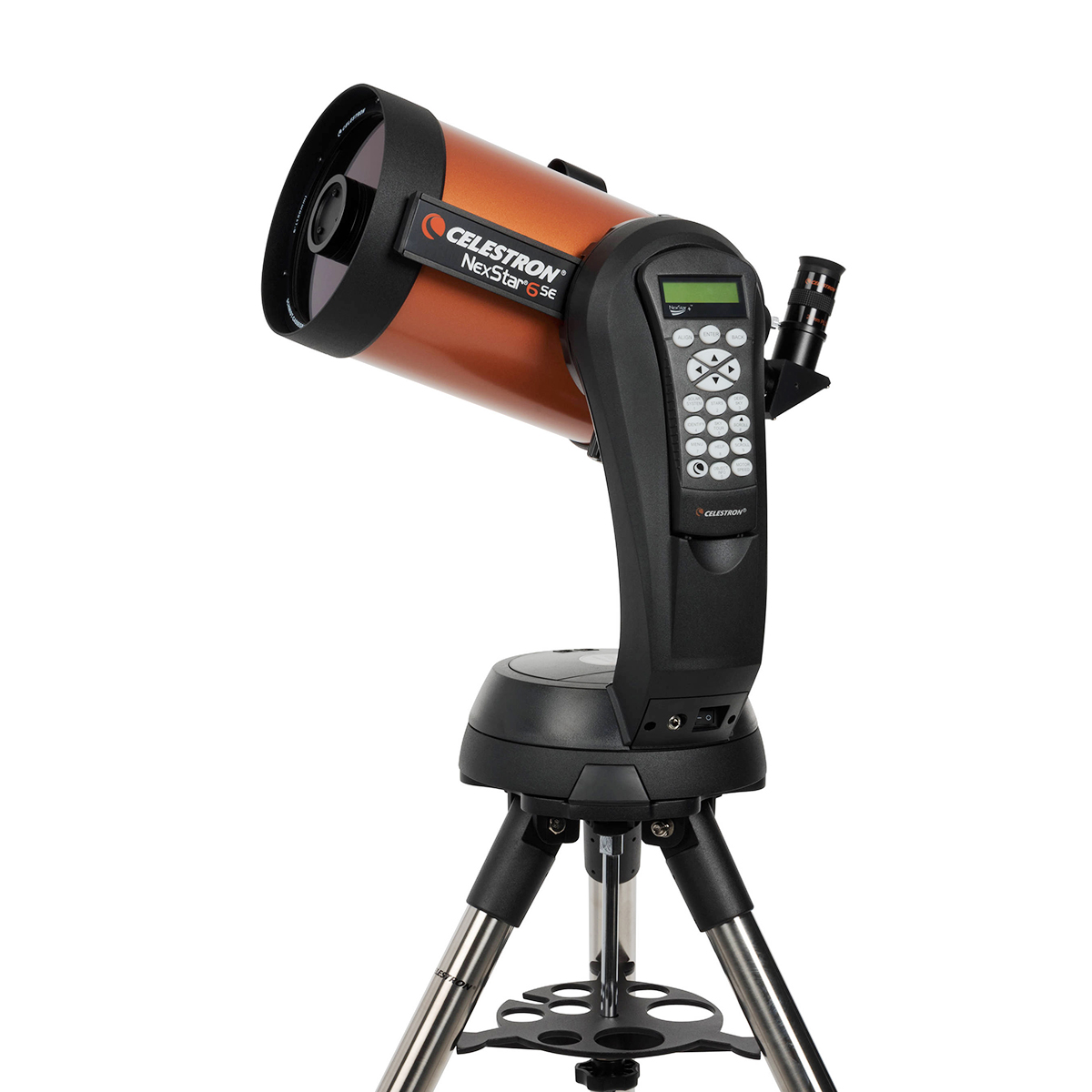
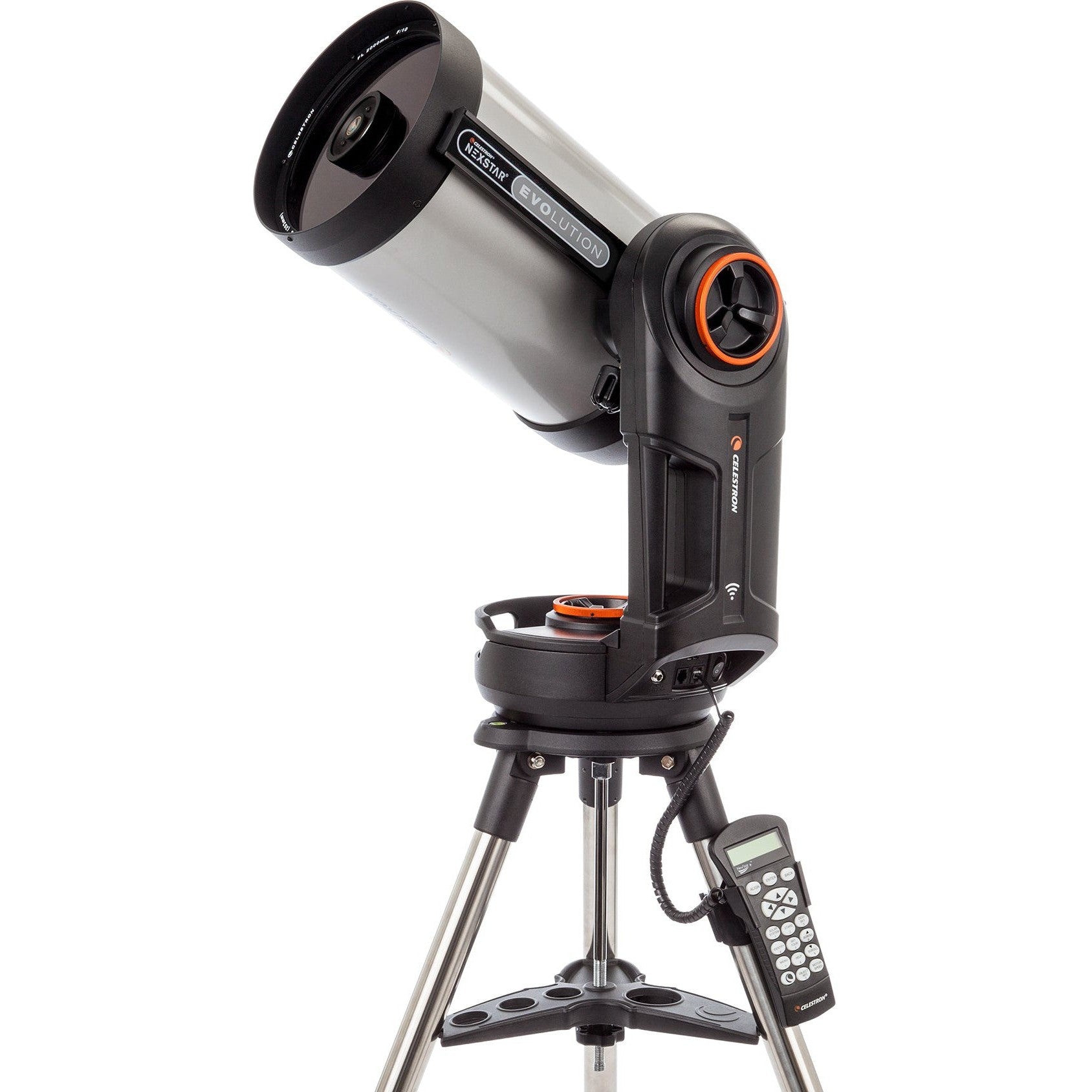
The price gap is real. The question is whether the extra capability is worth it at your stage.
Affiliate links — we earn from qualifying purchases at no extra cost to you.
First light
Celestron · 150mm · £999
The automated deep-sky platform
- 150mm schmidt-cassegrain on a computerised mount with motorised tracking
- Good for: Moon, planets, bright nebulae, star clusters, and deep-sky objects
- GoTo system finds any object in its database after initial star alignment — no star atlas needed
- Tracking motors keep objects centred as Earth rotates — useful above 100×, essential for photography
- 11.5kg total — requires a fixed garden spot or car transport
Celestron · 203mm · £1,799
The automated deep-sky platform
- 203mm schmidt-cassegrain on a computerised mount with motorised tracking
- Good for: Moon, planets, bright nebulae, star clusters, and deep-sky objects
- GoTo system finds any object in its database after initial star alignment — no star atlas needed
- Tracking motors keep objects centred as Earth rotates — useful above 100×, essential for photography
- 17.5kg total — requires a fixed garden spot or car transport
The full picture
The numbers that separate these two scopes — and what they mean at the eyepiece.
Aperture
Celestron NexStar Evolution 8 gathers 1.8× more light. On bright targets — Moon, Saturn, Jupiter — you won't notice. On fainter targets — dim galaxies, faint globular clusters — the gap is real.
Focal length
Celestron NexStar Evolution 8's longer focal length reaches higher magnification with the same eyepiece — better reach for planetary detail. Celestron NexStar 6SE's shorter focal length gives a wider true field — better for large open clusters and extended nebulae.
Focal ratio
Same focal ratio — the same eyepiece gives equivalent magnification and true field in both scopes.
Mount type
Same mount type — setup experience and ergonomics will be similar. Differences lie in build quality and included accessories.
Weight (OTA)
Celestron NexStar 6SE's optical tube is 1.9kg lighter. Relevant if you plan to use it on multiple mounts or carry the tube to dark-sky sites separately.
Optical design
Both Schmidt-Cassegrain designs — versatile, compact, good for planets and deep-sky. Differences come from aperture and mount.
At the eyepiece
| Target | Celestron NexStar 6SE | Celestron NexStar Evolution 8 |
|---|---|---|
| Planets | ||
| Moon | Excellent 150mm aperture and f/10 focal ratio reward high magnification — craterlets, rilles, and sharp terminator shadows are all accessible | Excellent 203mm aperture and f/10 focal ratio deliver razor-sharp high-magnification lunar detail — craterlets, rilles, and shadow play across the terminator |
| Saturn | Excellent 150mm and 1500mm focal length put Cassini Division, ring shadow, and disc banding within reach in steady seeing | Excellent 203mm aperture and 2032mm focal length comfortably show ring structure, Cassini Division, and subtle cloud banding on the disc |
| Jupiter | Excellent Multiple cloud belts, Great Red Spot, and moon shadow transits visible; 1500mm focal length gives a generously sized disc | Excellent Multiple cloud belts, festoons, the Great Red Spot, and Galilean moon shadows are all within reach at 200×–300× in good seeing |
| Mars | Good Polar cap and major dark albedo features visible at opposition; 150mm is below the 200mm threshold for truly detailed Mars observation | Excellent 203mm aperture and long focal length reveal polar cap, dark albedo features, and occasional dust storm activity at opposition |
Deep sky | ||
| Orion Nebula (M42) | Good Bright nebulosity and Trapezium are impressive, but the 1500mm focal length crops the full extent of the nebula; f/10 doesn't favour wide-field context | Good Bright core and Trapezium are vivid, but the 2032mm focal length crops the nebula's full extent — use with f/6.3 reducer for better framing |
| Andromeda Galaxy (M31) | Moderate 1500mm focal length frames only the bright core — the outer halo and full disc extend well beyond the field even with a wide eyepiece | Moderate Only the bright core is visible in the narrow field of view — the galaxy's full 3° extent is far beyond what any eyepiece can frame at this focal length |
| Open clusters | Moderate Larger clusters like the Pleiades and Double Cluster overfill the field; works better on compact clusters like M35 or M11 | Moderate Many open clusters overfill the field — best for compact clusters like M11; the Pleiades and Double Cluster are impractical |
| Globular clusters | Good M13 and M5 show granular texture with partial star resolution at the edges; 150mm is below the threshold for full resolution across the cluster | Excellent A highlight of this scope — 203mm resolves individual stars in M13, M92, and M5; the long focal length provides detailed high-power views |
| Faint galaxies | Good 150mm gathers enough light to show structure in brighter galaxies like M51 and M104; fainter targets appear as dim smudges | Good 203mm gathers enough light to detect galaxies in the Virgo cluster and Leo Triplet as soft glows with hints of structure in the brightest |
| Milky Way / wide field | Not recommended 1500mm focal length gives far too narrow a field for sweeping Milky Way views — this scope is the opposite of a wide-field instrument | Not recommended At 2032mm focal length the true field is far too narrow for sweeping star fields — this is fundamentally the wrong tool for wide-field observing |
Other | ||
| Double stars | Excellent 150mm aperture and f/10 focal ratio produce clean Airy discs — excellent for splitting close pairs and showing colour contrast | Excellent 203mm aperture resolves to ~0.57 arcseconds; the f/10 focal ratio provides clean, high-contrast Airy patterns ideal for splitting close pairs |
| Astrophotography (deep sky) | Moderate Alt-az GoTo mount causes field rotation limiting exposures to a few seconds; usable for EAA and short-exposure stacking but not long-exposure imaging | Moderate Alt-az GoTo mount tracks but introduces field rotation limiting exposures to a few seconds; suitable for EAA with stacking, not for traditional long-exposure imaging |
| Astrophotography (planetary) | Good 1500mm focal length and tracking mount suit lucky-imaging with a planetary camera; 150mm aperture gives solid detail but falls short of 200mm+ scopes | Good 203mm aperture and 2032mm native focal length on a tracking mount produce excellent planetary video frames; Barlow can push to f/20 for ideal sampling |
The real tradeoff
Both scopes are capable. The question is which one fits the way you actually observe.
Celestron NexStar 6SE
- You'll carry this to your observing spot in one trip without breaking a sweat — it's noticeably lighter and more compact than the Evolution 8, and it sits comfortably on a small table or even a sturdy stool.
- You'll spend your sessions marvelling at Jupiter's belts and Saturn's Cassini Division, but you'll notice the 150mm aperture runs out of steam on faint galaxies where the 8-inch would still be pulling out structure — globular clusters look granular rather than fully resolved, and Virgo galaxies are dimmer smudges.
- You'll align with the classic NexStar hand controller, which is proven and reliable but feels old-school — there's no WiFi, no app control, and you'll need a 12V power source or batteries every session, so your accessory bag always has one more thing in it.
Celestron NexStar Evolution 8
- You'll leave the hand controller and power tank at home — the built-in rechargeable battery and WiFi-driven SkyPortal app mean you point your phone at the sky and tap a target, which genuinely reduces your setup clutter.
- You'll see the payoff of that extra 53mm of aperture on every target: M13 resolves individual stars where the 6SE only hints at them, faint galaxies in Virgo actually show shape rather than just existing, and planetary detail is crisper with more light to push magnification higher.
- You'll feel the weight difference on every trip — at roughly 14kg assembled, it's a two-handed carry that demands a solid table, and in any breeze that single fork arm wobbles more because the heavier OTA acts as a bigger lever.
The dark side
Every scope has a personality. Here’s where each one gets difficult.
Celestron
Celestron NexStar 6SE
The single-arm fork vibrates for 2–3 seconds every time you touch the focuser — at 200×+ on planets, you'll spend a noticeable fraction of your session waiting for the image to settle.
There's no 2-inch visual back in the box, so your maximum true field of view is limited to about 0.8° with the stock 1.25-inch 25mm Plössl — you'll want to budget for the adapter and a wider eyepiece immediately.
Cool-down takes 30–45 minutes in cold weather as thermal currents churn inside the sealed tube, and until the optics equilibrate, your planetary views will be mushy — so your first half-hour on a winter night is mostly waiting.
Celestron
Celestron NexStar Evolution 8
The SCT corrector plate is a dew magnet — in UK conditions you'll almost certainly need a dew shield or heated strip, which is an extra cost and setup step that the scope effectively demands from night one.
At 2032mm focal length, your true field of view with the included 40mm Plössl is only about 0.35° — the Orion Nebula won't fit in one view, M31 is reduced to its core, and the eyepiece itself has short eye relief that punishes eyeglass wearers.
Collimation can drift during transport, and checking it via a star test at this focal length is a fiddly process that can intimidate SCT newcomers — you'll need to learn and periodically repeat it to keep planetary views sharp.
Which is right for you?
Two different buyers. Two different right answers.
The automated deep-sky platform
Celestron · Celestron NexStar 6SE
You'll love the 6SE if you're an intermediate observer who wants sharp planetary and lunar views with GoTo convenience but without the weight or price of a larger scope. You're probably observing from a balcony, patio, or suburban garden, and you value being able to set up quickly and carry everything in one trip. You're happy trading some deep-sky reach for a scope that genuinely disappears into a closet when the session's over. This isn't for you if you crave wide-field sweeping, want to resolve individual stars in distant globulars, or plan to do any serious deep-sky astrophotography — the alt-az mount and 1500mm focal length rule all of that out.
The automated deep-sky platform
Celestron · Celestron NexStar Evolution 8
You'll love the Evolution 8 if you want the most planetary and lunar detail you can get from a single-arm GoTo package, and you're drawn to electronic assisted astronomy — short-exposure stacking through the SkyPortal app opens up colour nebula and galaxy views that visual observing through either scope can't touch. You value the cord-free, phone-controlled experience and you're willing to spend £1799 plus accessories to get it. This isn't for you if you're on a budget, want lightweight grab-and-go simplicity, or need wide-field views — at 2032mm focal length you'll never frame the Veil Nebula or the full extent of Andromeda, and the 14kg weight means every session requires genuine commitment to haul and set up.
Our verdict
At £999 versus £1,799, the Celestron NexStar Evolution 8 costs 80% more. It delivers 53mm more aperture — a real and visible advantage on faint targets.
If budget is a genuine constraint, the Celestron NexStar 6SE will make you a happy observer. The Celestron NexStar Evolution 8's optical advantage on faint targets is real and you are unlikely to regret it if you can stretch. If I had to choose without knowing your situation: start with the Celestron NexStar 6SE, use it for a year, then upgrade knowing exactly what you want.
Celestron NexStar 6SE
View Celestron NexStar 6SE →Celestron NexStar Evolution 8
View Celestron NexStar Evolution 8 →Affiliate links — we earn from qualifying purchases at no extra cost to you.
Deep field: Full specifications
Every data point, for those who want to go further.
Full specifications
Fields highlighted in blue or amber indicate the better value for that spec. Data is manufacturer-stated and may vary.
How much can it see?
| Spec | Celestron NexStar 6SE | Celestron NexStar Evolution 8 |
|---|---|---|
Apertureⓘ The most important spec — bigger = more light = better views | 150mm | 203mm |
Focal Length Longer = more magnification potential | 1500mm | 2032mm |
Focal Ratio Lower f-number = wider field of view; higher = more magnification per eyepiece | f/10 | f/10.01 |
Optical Design The type of optics — each design has different strengths | Schmidt-Cassegrain | Schmidt-Cassegrain |
Coatings Better coatings = more light transmission through the optics | StarBright XLT fully multi-coated on all optical surfaces | StarBright XLT fully multi-coated on all optical surfaces |
How do you point it?
| Spec | Celestron NexStar 6SE | Celestron NexStar Evolution 8 |
|---|---|---|
Mount Type The mechanical system that holds and moves the telescope | GoTo (Computerised) | GoTo (Computerised) |
GoTo Computer-controlled pointing — finds any of thousands of objects automatically | ||
Tracking Motor keeps objects centred as the Earth rotates — essential for astrophotography |
The focuser
| Spec | Celestron NexStar 6SE | Celestron NexStar Evolution 8 |
|---|---|---|
Focuser Size 2" accepts wider eyepieces and gives better low-power views | 1.25" | 1.25" |
Focuser Type Rack-and-pinion is standard; Crayford and dual-speed are smoother | SCT rear-cell focuser | SCT rear-cell focuser |
Size & weight
| Spec | Celestron NexStar 6SE | Celestron NexStar Evolution 8 |
|---|---|---|
OTA Weightⓘ Optical tube only — useful for comparing mount load capacity | 3.5kg | 5.4kg |
Total Weightⓘ Full setup including mount — this is what you lug to the car | 11.5kg | 17.5kg |
Tube Length | 394mm | 432mm |
Tube Material | Aluminium | Aluminium |
What's in the box?
| Spec | Celestron NexStar 6SE | Celestron NexStar Evolution 8 |
|---|---|---|
Eyepieces Included eyepieces — more is better, but quality matters more than quantity | 25mm Plössl | 25mm Plössl |
Finder Scope Helps you locate areas of the sky before switching to the main eyepiece | StarPointer red dot finder | StarPointer red dot finder |
Diagonal Tilts the eyepiece 90° for comfortable viewing — useful on refractors |
Smart features
| Spec | Celestron NexStar 6SE | Celestron NexStar Evolution 8 |
|---|---|---|
Built-in Camera Records and stacks images automatically — no separate camera needed | ||
App Controlled | ||
WiFi | ||
Battery Included |
Blue highlight: Celestron NexStar 6SE advantage · Amber highlight: Celestron NexStar Evolution 8 advantage · Greyed cells: equal or subjective.