Telescope Comparison
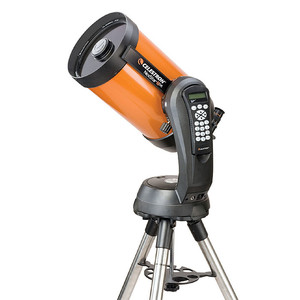
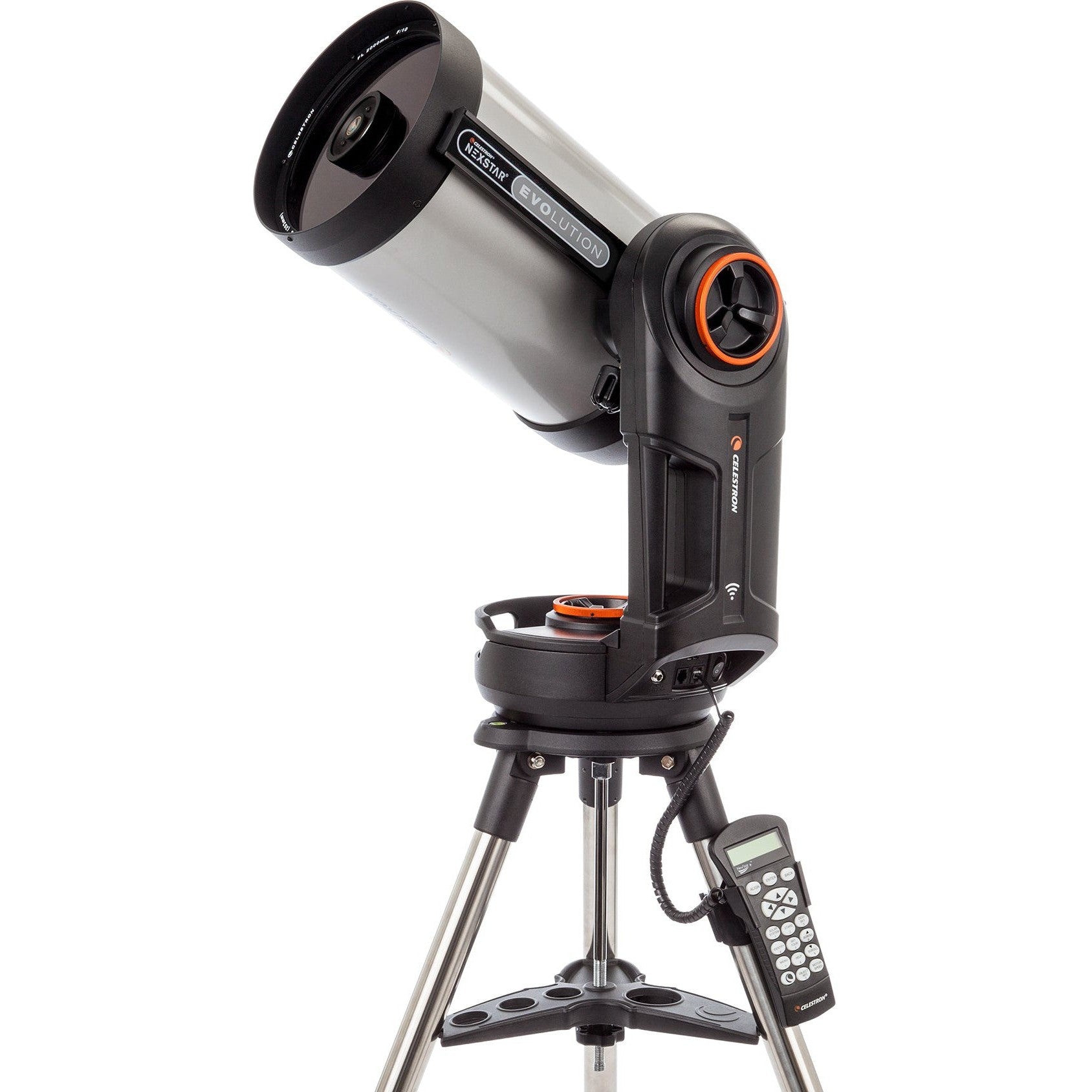
Celestron NexStar 8SE vs Celestron NexStar Evolution 8
The specs are close. The experience isn't.
Affiliate links — we earn from qualifying purchases at no extra cost to you.
First light
Celestron · 203mm · £1,860
The automated deep-sky platform
- 203mm schmidt-cassegrain on a computerised mount with motorised tracking
- Good for: Moon, planets, bright nebulae, star clusters, and deep-sky objects
- GoTo system finds any object in its database after initial star alignment — no star atlas needed
- Tracking motors keep objects centred as Earth rotates — useful above 100×, essential for photography
- 18kg total — requires a fixed garden spot or car transport
Celestron · 203mm · £1,799
The automated deep-sky platform
- 203mm schmidt-cassegrain on a computerised mount with motorised tracking
- Good for: Moon, planets, bright nebulae, star clusters, and deep-sky objects
- GoTo system finds any object in its database after initial star alignment — no star atlas needed
- Tracking motors keep objects centred as Earth rotates — useful above 100×, essential for photography
- 17.5kg total — requires a fixed garden spot or car transport
The full picture
The numbers that separate these two scopes — and what they mean at the eyepiece.
Aperture
Effectively equal light-gathering. Aperture won't settle this comparison — the mount, focal ratio, and observing experience are what differ.
Focal length
Same focal length — identical magnification with any given eyepiece. Differences come from optical design and coatings.
Focal ratio
Same focal ratio — the same eyepiece gives equivalent magnification and true field in both scopes.
Mount type
Same mount type — setup experience and ergonomics will be similar. Differences lie in build quality and included accessories.
Weight (OTA)
Similar optical tube weight. Any portability difference between these setups comes from the mount, not the tube itself.
Optical design
Both Schmidt-Cassegrain designs — versatile, compact, good for planets and deep-sky. Differences come from aperture and mount.
At the eyepiece
| Target | Celestron NexStar 8SE | Celestron NexStar Evolution 8 |
|---|---|---|
| Planets | ||
| Moon | Excellent 203mm aperture at f/10 is ideal for high-magnification lunar detail — craterlets, rilles, and terminator shadow features are crisp and rewarding | Excellent 203mm aperture and f/10 focal ratio deliver razor-sharp high-magnification lunar detail — craterlets, rilles, and shadow play across the terminator |
| Saturn | Excellent 203mm aperture and 2032mm focal length put this firmly in the top tier — Cassini Division, ring shadow, and cloud banding visible in good seeing | Excellent 203mm aperture and 2032mm focal length comfortably show ring structure, Cassini Division, and subtle cloud banding on the disc |
| Jupiter | Excellent Multiple cloud belts, the Great Red Spot, and Galilean moon shadow transits are all accessible at 200×–300× | Excellent Multiple cloud belts, festoons, the Great Red Spot, and Galilean moon shadows are all within reach at 200×–300× in good seeing |
| Mars | Good 203mm aperture resolves dark albedo features and polar caps at opposition; focal length supports high magnification but aperture is just short of the 'Excellent' threshold | Excellent 203mm aperture and long focal length reveal polar cap, dark albedo features, and occasional dust storm activity at opposition |
Deep sky | ||
| Orion Nebula (M42) | Good Bright core and Trapezium are vivid, but 2032mm focal length restricts the field — you see the central region only, not the full nebula extent | Good Bright core and Trapezium are vivid, but the 2032mm focal length crops the nebula's full extent — use with f/6.3 reducer for better framing |
| Andromeda Galaxy (M31) | Moderate 2032mm focal length shows only the bright nucleus and inner core — the outer halo and dust lanes are cropped well beyond the field of view | Moderate Only the bright core is visible in the narrow field of view — the galaxy's full 3° extent is far beyond what any eyepiece can frame at this focal length |
| Open clusters | Moderate The very narrow field of view means most open clusters overfill the eyepiece; individual stars are sharp but the cluster context is lost | Moderate Many open clusters overfill the field — best for compact clusters like M11; the Pleiades and Double Cluster are impractical |
| Globular clusters | Excellent 203mm aperture resolves individual stars across the outer regions of M13, M22, and similar globulars; the long focal length magnifies them beautifully | Excellent A highlight of this scope — 203mm resolves individual stars in M13, M92, and M5; the long focal length provides detailed high-power views |
| Faint galaxies | Good 203mm gathers enough light to show structure in brighter galaxies (M81, M82, M51) and detect fainter ones as diffuse smudges | Good 203mm gathers enough light to detect galaxies in the Virgo cluster and Leo Triplet as soft glows with hints of structure in the brightest |
| Milky Way / wide field | Not recommended 2032mm focal length gives far too narrow a field — this scope cannot produce sweeping star field views | Not recommended At 2032mm focal length the true field is far too narrow for sweeping star fields — this is fundamentally the wrong tool for wide-field observing |
Other | ||
| Double stars | Excellent 203mm aperture at f/10 is textbook for splitting close doubles — clean diffraction pattern and high magnification potential | Excellent 203mm aperture resolves to ~0.57 arcseconds; the f/10 focal ratio provides clean, high-contrast Airy patterns ideal for splitting close pairs |
| Astrophotography (deep sky) | Moderate GoTo tracking is present but the alt-az mount introduces field rotation, limiting exposures to ~15–30 seconds; an equatorial wedge or EAA live stacking improves results | Moderate Alt-az GoTo mount tracks but introduces field rotation limiting exposures to a few seconds; suitable for EAA with stacking, not for traditional long-exposure imaging |
| Astrophotography (planetary) | Excellent 203mm aperture and 2032mm focal length are ideal for high-resolution lucky imaging of planets; the GoTo mount tracks well enough for video capture | Good 203mm aperture and 2032mm native focal length on a tracking mount produce excellent planetary video frames; Barlow can push to f/20 for ideal sampling |
The real tradeoff
Both scopes are capable. The question is which one fits the way you actually observe.
Celestron NexStar 8SE
- You'll plug in an external power supply or lug a power tank to the field, align using the hand controller's button-mashing interface, and be observing Saturn's Cassini Division fifteen minutes later — the ritual is old-school but reliable, and there's nothing between you and the scope that needs a firmware update.
- You'll save £400 upfront, but you'll almost certainly spend some of that on a better eyepiece immediately — the included 25mm Plössl is functional but underwhelming for a scope this capable, and the narrow 0.5° field of view it delivers makes finding targets before GoTo alignment an exercise in patience.
- You'll find the 8SE rewards you most on planets, the Moon, and compact deep-sky targets like globulars and planetary nebulae — objects that play to its aperture and focal length — but if you point it at the Pleiades or try to frame all of Andromeda, you'll wonder why you bothered.
Celestron NexStar Evolution 8
- You'll set up in the garden, pull out your phone, tap a target in SkyPortal, and the scope slews to it — no hand controller, no power tank, just the built-in battery and WiFi doing the work, which makes impulsive midweek sessions genuinely effortless.
- You'll see exactly the same views through both scopes — identical optics, identical aperture, identical focal length — so the extra £400 is buying you wireless control, an internal rechargeable battery, and freedom from cables, not sharper stars.
- You'll find EAA particularly seamless here because the self-contained electronics mean fewer things to plug together in the dark, and the alt-az tracking handles short-exposure stacking without fuss — but you'll still hit the same field-rotation wall as the 8SE if you try exposures beyond about 30 seconds.
The dark side
Every scope has a personality. Here’s where each one gets difficult.
Celestron
Celestron NexStar 8SE
The single-arm fork mount flexes noticeably under heavier accessories like binoviewers or cameras, and at 200×+ magnification that translates to annoying vibration every time you refocus or the wind picks up.
The sealed 8-inch SCT tube takes 30–60 minutes to reach thermal equilibrium — you'll spend the first half-hour looking at soft, bloated stars before the optics settle, which can eat into a short midweek session.
You're dependent on an external 12V power source since there's no internal battery — forget the power tank and the GoTo doesn't work, which turns your computerised scope into a very awkward manual telescope.
Celestron
Celestron NexStar Evolution 8
The SCT corrector plate is a dew magnet in UK conditions — you'll want a dew shield or heated strip from night one, because once moisture forms on that front glass your session is effectively over until it clears.
At roughly 14kg assembled, the single-arm fork can wobble in wind at high magnification, and the vibration takes several seconds to damp — touching the focuser during planetary observing requires patience.
The included 40mm Plössl has punishingly short eye relief and mediocre edge sharpness — for a scope at this price point, you'll feel shortchanged and will likely budget for a replacement eyepiece almost immediately.
Which is right for you?
Two different buyers. Two different right answers.
The automated deep-sky platform
Celestron · Celestron NexStar 8SE
You want serious 8-inch SCT performance for planets, the Moon, and compact deep-sky targets, and you'd rather pocket the £400 difference and spend it on quality eyepieces or a camera for EAA. You don't mind plugging in a power tank and navigating a hand controller — you might even prefer hardware buttons to a phone app. If you already own a 12V supply from camping or a previous scope, the 8SE gives you identical optical performance to the Evolution for meaningfully less money.
The automated deep-sky platform
Celestron · Celestron NexStar Evolution 8
You're the observer who values a frictionless setup above all else — you want to walk outside with one piece of kit, power it on from a built-in battery, and control everything from your phone without fumbling with cables or a hand controller in the dark. You're willing to pay £400 more for that convenience even though the views through the eyepiece are optically identical to the 8SE. If tearing down a complicated setup on a work night is the thing that keeps your scope in the cupboard, the Evolution's self-contained design is specifically engineered to eliminate that excuse.
Our verdict
Same aperture, same light-gathering, £61 price difference. The extra cost of the Celestron NexStar 8SE buys a different mount — not better optics.
For most beginners, the Celestron NexStar Evolution 8 is the right starting point — the optics are identical and the savings are better spent on a quality eyepiece or a dark-sky trip. The Celestron NexStar 8SE makes sense if the mount it comes with is specifically what you want to learn. If I had to choose: the Celestron NexStar Evolution 8 — same sky, less money.
Celestron NexStar 8SE
View Celestron NexStar 8SE →Celestron NexStar Evolution 8
View Celestron NexStar Evolution 8 →Affiliate links — we earn from qualifying purchases at no extra cost to you.
Deep field: Full specifications
Every data point, for those who want to go further.
Full specifications
Fields highlighted in blue or amber indicate the better value for that spec. Data is manufacturer-stated and may vary.
How much can it see?
| Spec | Celestron NexStar 8SE | Celestron NexStar Evolution 8 |
|---|---|---|
Aperture The most important spec — bigger = more light = better views | 203mm | 203mm |
Focal Length Longer = more magnification potential | 2032mm | 2032mm |
Focal Ratio Lower f-number = wider field of view; higher = more magnification per eyepiece | f/10.01 | f/10.01 |
Optical Design The type of optics — each design has different strengths | Schmidt-Cassegrain | Schmidt-Cassegrain |
Coatings Better coatings = more light transmission through the optics | StarBright XLT fully multi-coated on all optical surfaces | StarBright XLT fully multi-coated on all optical surfaces |
How do you point it?
| Spec | Celestron NexStar 8SE | Celestron NexStar Evolution 8 |
|---|---|---|
Mount Type The mechanical system that holds and moves the telescope | GoTo (Computerised) | GoTo (Computerised) |
GoTo Computer-controlled pointing — finds any of thousands of objects automatically | ||
Tracking Motor keeps objects centred as the Earth rotates — essential for astrophotography |
The focuser
| Spec | Celestron NexStar 8SE | Celestron NexStar Evolution 8 |
|---|---|---|
Focuser Size 2" accepts wider eyepieces and gives better low-power views | 1.25" | 1.25" |
Focuser Type Rack-and-pinion is standard; Crayford and dual-speed are smoother | SCT rear-cell focuser | SCT rear-cell focuser |
Size & weight
| Spec | Celestron NexStar 8SE | Celestron NexStar Evolution 8 |
|---|---|---|
OTA Weightⓘ Optical tube only — useful for comparing mount load capacity | 5.44kg | 5.4kg |
Total Weightⓘ Full setup including mount — this is what you lug to the car | 18kg | 17.5kg |
Tube Length | 432mm | 432mm |
Tube Material | Aluminium | Aluminium |
What's in the box?
| Spec | Celestron NexStar 8SE | Celestron NexStar Evolution 8 |
|---|---|---|
Eyepieces Included eyepieces — more is better, but quality matters more than quantity | 25mm Plössl | 25mm Plössl |
Finder Scope Helps you locate areas of the sky before switching to the main eyepiece | StarPointer red dot finder | StarPointer red dot finder |
Diagonal Tilts the eyepiece 90° for comfortable viewing — useful on refractors |
Smart features
| Spec | Celestron NexStar 8SE | Celestron NexStar Evolution 8 |
|---|---|---|
Built-in Camera Records and stacks images automatically — no separate camera needed | ||
App Controlled | ||
WiFi | ||
Battery Included |
Blue highlight: Celestron NexStar 8SE advantage · Amber highlight: Celestron NexStar Evolution 8 advantage · Greyed cells: equal or subjective.