Telescope Comparison
Celestron NexStar Evolution 6 vs Celestron RASA 8"
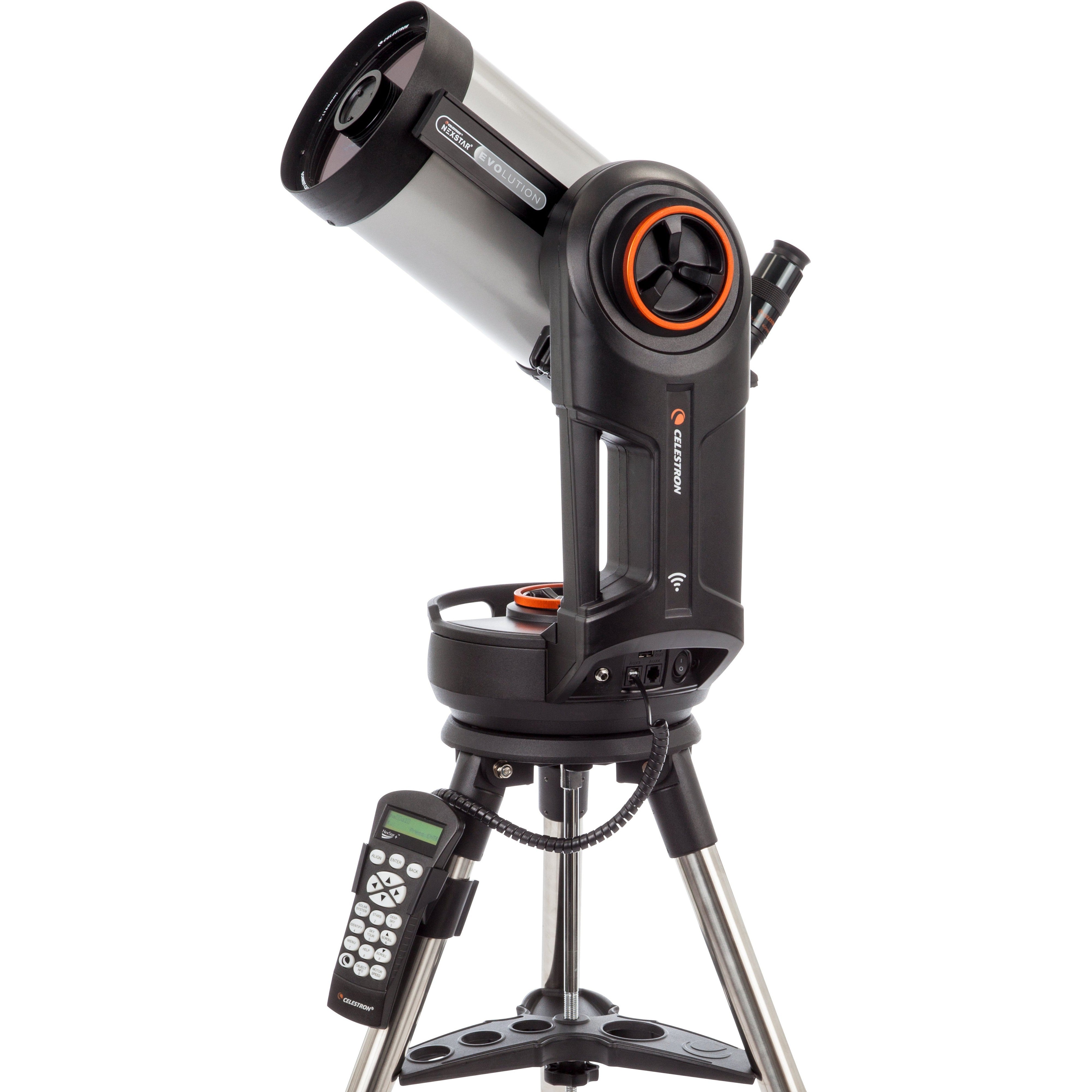
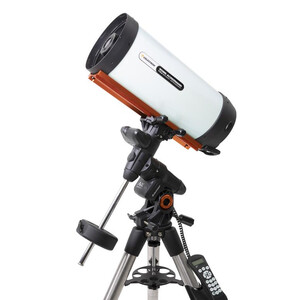
The Celestron NexStar Evolution 6 is a complete setup. The Celestron RASA 8" needs a mount before it's usable.
Affiliate links — we earn from qualifying purchases at no extra cost to you.
First light
Celestron · 150mm · £1,299
The automated deep-sky platform
- 150mm schmidt-cassegrain on a computerised mount with motorised tracking
- Good for: Moon, planets, bright nebulae, star clusters, and deep-sky objects
- GoTo system finds any object in its database after initial star alignment — no star atlas needed
- Tracking motors keep objects centred as Earth rotates — useful above 100×, essential for photography
- 12.5kg total — requires a fixed garden spot or car transport
Celestron · 203mm · £1,799
The custom-rig optical tube
- 203mm schmidt-cassegrain — optical tube only, no mount included
- 406mm focal length at f/2
- Requires a compatible mount before you can observe anything
- Best for: observers who already own a suitable mount or are building a specific imaging rig
- Not a complete purchase — budget at least £100–300 extra for a mount before observing
The full picture
The numbers that separate these two scopes — and what they mean at the eyepiece.
Aperture
Celestron RASA 8" gathers 1.8× more light. On bright targets — Moon, Saturn, Jupiter — you won't notice. On fainter targets — dim galaxies, faint globular clusters — the gap is real.
Focal length
Celestron NexStar Evolution 6's longer focal length reaches higher magnification with the same eyepiece — better reach for planetary detail. Celestron RASA 8"'s shorter focal length gives a wider true field — better for large open clusters and extended nebulae.
Focal ratio
Celestron RASA 8"'s faster f/2 delivers wider fields with any eyepiece — better for open clusters and large nebulae. Celestron NexStar Evolution 6's f/10 provides more magnification per eyepiece — better for fine planetary detail.
Mount type
Celestron RASA 8" has no mount — add a compatible mount before you can observe. Celestron NexStar Evolution 6 is a complete ready-to-use system.
Weight (OTA)
Celestron NexStar Evolution 6's optical tube is 2.4kg lighter. Relevant if you plan to use it on multiple mounts or carry the tube to dark-sky sites separately.
Optical design
Both Schmidt-Cassegrain designs — versatile, compact, good for planets and deep-sky. Differences come from aperture and mount.
At the eyepiece
| Target | Celestron NexStar Evolution 6 | Celestron RASA 8" |
|---|---|---|
| Planets | ||
| Moon | Excellent 150mm aperture at f/10 delivers superb high-magnification lunar detail — rilles, crater chains, and mountain shadows are crisp | Not recommended Imaging-only instrument with no visual capability; 406mm focal length gives very small lunar image scale even for imaging |
| Saturn | Excellent 150mm aperture and 1500mm focal length resolve the Cassini Division and subtle cloud banding in good seeing | Not recommended No visual use possible; 406mm focal length produces a tiny planetary disc even with high-resolution cameras |
| Jupiter | Excellent Multiple cloud belts, GRS, and moon shadow transits visible at 150–250x | Not recommended Far too short a focal length for planetary imaging; no visual capability |
| Mars | Good 150mm aperture shows dark albedo features and polar cap at opposition; surface detail improves with a red filter | Not recommended Extremely small image scale at 406mm; the scope is fundamentally unsuitable for planetary work |
Deep sky | ||
| Orion Nebula (M42) | Good Core and trapezium resolved well, but 1500mm focal length crops the full nebula extent | Excellent 203mm aperture at f/2 captures the full nebula and running man in seconds; HDR blending reveals both bright core and faint outer wisps |
| Andromeda Galaxy (M31) | Moderate 1500mm focal length shows only the bright core — the outer halo and companion galaxies overfill the field | Excellent 406mm focal length frames the entire galaxy including companion galaxies M32 and M110 on an APS-C sensor; f/2 speed reveals outer spiral arms quickly |
| Open clusters | Moderate Narrow field crops large clusters like the Pleiades; compact clusters like M11 fare better | Excellent Wide field at 406mm perfectly frames large clusters like the Double Cluster and M45 with surrounding nebulosity |
| Globular clusters | Good 150mm resolves outer stars in M13 and M92; cores remain granular but impressive | Good 203mm aperture resolves outer stars in imaging; short focal length means globulars appear small but well-exposed |
| Faint galaxies | Good 150mm gathers enough light for M51, M81/M82, and other Messier galaxies as soft glows with some structure hints | Good 203mm aperture and f/2 speed reveal faint galaxy groups and tidal streams in modest integration times; small image scale limits detail on individual galaxies |
| Milky Way / wide field | Not recommended 1500mm focal length is far too narrow for sweeping star fields — field of view under 1° | Excellent 406mm at f/2 is purpose-built for wide-field imaging; captures large Milky Way structures like the Cygnus region in a single frame with extraordinary speed |
Other | ||
| Double stars | Excellent 150mm aperture at f/10 cleanly splits sub-arcsecond pairs; diffraction-limited performance rewards tight doubles | Not recommended No visual capability; double star work requires visual observation or very long focal lengths for imaging |
| Astrophotography (planetary) | Good 150mm at 1500mm focal length with GoTo tracking is well suited to lucky imaging with a planetary camera | Not applicable |
| Astrophotography (deep sky) | Moderate Alt-az GoTo mount limits exposures to ~15–30 seconds before field rotation becomes apparent; bright targets only | Not applicable |
| Large emission nebulae (Veil, North America, Heart) | Not applicable | Excellent The RASA 8's defining use case — f/2 speed with 406mm focal length frames and deeply exposes multi-degree emission nebulae in a fraction of conventional integration times |
| Narrowband imaging (Ha, OIII, SII) | Not applicable | Excellent f/2 speed makes narrowband practical in short subs; requires filters rated for fast focal ratios to avoid halos |
The real tradeoff
Both scopes are capable. The question is which one fits the way you actually observe.
Celestron NexStar Evolution 6
- You'll set up in the garden, open the Celestron app on your phone, run a quick alignment, and be looking at Saturn's rings within fifteen minutes — no laptop, no cables, no imaging software to wrestle with.
- Your typical session is a tour of the sky's highlights: you'll tap a target, watch the scope slew, and settle in at the eyepiece — Jupiter's cloud belts, the resolved stars of M13, a crisp split of Albireo — all with tracking that keeps things centred while you swap eyepieces or call someone over to look.
- You'll spend the first half-hour waiting for the closed tube to cool down, and if you forget, the planets will shimmer like they're underwater — but once thermal equilibrium hits, the long focal length rewards you with genuinely detailed planetary views that wider, faster scopes can't match.
Celestron RASA 8
- You'll never put your eye to this telescope — your entire experience happens on a laptop screen, and setup means mounting the OTA on your equatorial mount, connecting your guide camera, calibrating tilt, and running acquisition software before a single photon hits the sensor.
- Your reward for that complexity is absurd speed: you'll watch a 30-second sub pull in structure in the Veil Nebula that would take other scopes five or ten minutes to match, and on a work night you can capture a publishable dataset on a large nebula in under two hours of total integration.
- You'll become obsessive about collimation, tilt adjustment, and buying the right fast-optics filters — because at f/2, every shortcut shows up as bloated stars, halos, or ugly gradients that no amount of post-processing will fix.
The dark side
Every scope has a personality. Here’s where each one gets difficult.
Celestron
Celestron NexStar Evolution 6
The alt-az GoTo mount causes field rotation, so deep-sky exposures longer than about 15–30 seconds will show star trailing — you're limited to short-exposure planetary video, not long-exposure nebula photography.
The 1500mm focal length gives you a true field of roughly 0.8° with a 25mm Plössl, which means large objects like the full Andromeda Galaxy or the Pleiades simply won't fit — and manual star-hopping is essentially impractical without the GoTo.
The built-in rechargeable battery lasts around 10 hours, but takes several hours to fully recharge via USB — forget to charge the night before and your session is cut short.
Celestron
Celestron RASA 8"
There is physically no eyepiece holder — the camera sits where a secondary mirror would be, so this telescope cannot be used for visual astronomy under any circumstances.
The OTA ships alone for £1,799, but you'll need a capable equatorial mount (£1,000–1,500+), a dedicated astronomy camera, a guide scope and camera, and cabling — realistically doubling or tripling the total system cost.
Standard narrowband and light-pollution filters are unusable at f/2; they produce severe halos and gradients, so you'll need to budget for specialist fast-optic filters on top of everything else.
Which is right for you?
Two different buyers. Two different right answers.
The automated deep-sky platform
Celestron · Celestron NexStar Evolution 6
You want to actually look through a telescope. You're an intermediate observer who values convenience — you'd rather tap your phone and be on-target in seconds than fiddle with cables and laptops. You observe from a suburban garden, you love splitting double stars and studying planetary detail, and you want GoTo to navigate the narrow field of view that comes with a long focal length SCT. You're not chasing faint nebulae or serious astrophotography; you're chasing the pleasure of seeing Saturn's Cassini Division or the resolved core of a globular cluster with your own eyes, and you want a self-contained system that doesn't demand a pile of accessories to get started.
The custom-rig optical tube
Celestron · Celestron RASA 8"
You don't care about visual observing — you might not even own an eyepiece — and your goal is capturing wide-field deep-sky images as efficiently as possible. You already have an equatorial mount that can handle a 20+ pound payload, a dedicated astronomy camera, and a guiding setup, and you understand back-focus, collimation, and tilt adjustment. You want to frame entire large nebulae in a single shot without mosaics, and you want the f/2 speed to make narrowband imaging practical on weeknights. If you don't already own the supporting equipment, this isn't where you start — the RASA 8 is a specialist tool for an experienced astrophotographer's existing rig, not a first telescope.
Our verdict
This comparison has a catch: the Celestron RASA 8" is a bare optical tube. You cannot use it without a separate mount — which adds meaningful cost and complexity. The Celestron NexStar Evolution 6 is a complete, ready-to-observe package.
For most buyers, the Celestron NexStar Evolution 6 is the right choice — you can observe the same night it arrives. The Celestron RASA 8" makes sense if you already own a compatible mount, or are deliberately building a specific imaging setup piece by piece. If I had to choose for a first telescope: the Celestron NexStar Evolution 6, without hesitation.
Celestron NexStar Evolution 6
View Celestron NexStar Evolution 6 →Celestron RASA 8"
View Celestron RASA 8" →Affiliate links — we earn from qualifying purchases at no extra cost to you.
Deep field: Full specifications
Every data point, for those who want to go further.
Full specifications
Fields highlighted in blue or amber indicate the better value for that spec. Data is manufacturer-stated and may vary.
How much can it see?
| Spec | Celestron NexStar Evolution 6 | Celestron RASA 8" |
|---|---|---|
Apertureⓘ The most important spec — bigger = more light = better views | 150mm | 203mm |
Focal Length Longer = more magnification potential | 1500mm | 406mm |
Focal Ratio Lower f-number = wider field of view; higher = more magnification per eyepiece | f/10 | f/2 |
Optical Design The type of optics — each design has different strengths | Schmidt-Cassegrain | Schmidt-Cassegrain |
Coatings Better coatings = more light transmission through the optics | StarBright XLT fully multi-coated on all optical surfaces | Fully multi-coated Rowe-Ackermann Schmidt optics |
How do you point it?
| Spec | Celestron NexStar Evolution 6 | Celestron RASA 8" |
|---|---|---|
Mount Type The mechanical system that holds and moves the telescope | GoTo (Computerised) | None (OTA only) |
GoToⓘ Computer-controlled pointing — finds any of thousands of objects automatically | ||
Trackingⓘ Motor keeps objects centred as the Earth rotates — essential for astrophotography |
The focuser
| Spec | Celestron NexStar Evolution 6 | Celestron RASA 8" |
|---|---|---|
Focuser Size 2" accepts wider eyepieces and gives better low-power views | 1.25" | — |
Focuser Type Rack-and-pinion is standard; Crayford and dual-speed are smoother | SCT rear-cell focuser | Camera threads directly to rear cell (T-thread) |
Size & weight
| Spec | Celestron NexStar Evolution 6 | Celestron RASA 8" |
|---|---|---|
OTA Weightⓘ Optical tube only — useful for comparing mount load capacity | 3.5kg | 5.9kg |
Total Weight Full setup including mount — this is what you lug to the car | 12.5kg | — |
Tube Length | 394mm | 368mm |
Tube Material | Aluminium | Aluminium |
What's in the box?
| Spec | Celestron NexStar Evolution 6 | Celestron RASA 8" |
|---|---|---|
Eyepieces Included eyepieces — more is better, but quality matters more than quantity | 25mm Plössl | — |
Finder Scope Helps you locate areas of the sky before switching to the main eyepiece | StarPointer red dot finder | — |
Diagonal Tilts the eyepiece 90° for comfortable viewing — useful on refractors |
Smart features
| Spec | Celestron NexStar Evolution 6 | Celestron RASA 8" |
|---|---|---|
Built-in Camera Records and stacks images automatically — no separate camera needed | ||
App Controlled | ||
WiFi | ||
Battery Included |
Blue highlight: Celestron NexStar Evolution 6 advantage · Amber highlight: Celestron RASA 8" advantage · Greyed cells: equal or subjective.