Telescope Comparison
Celestron NexStar Evolution 6 vs Sky-Watcher SkyMax 180 Pro
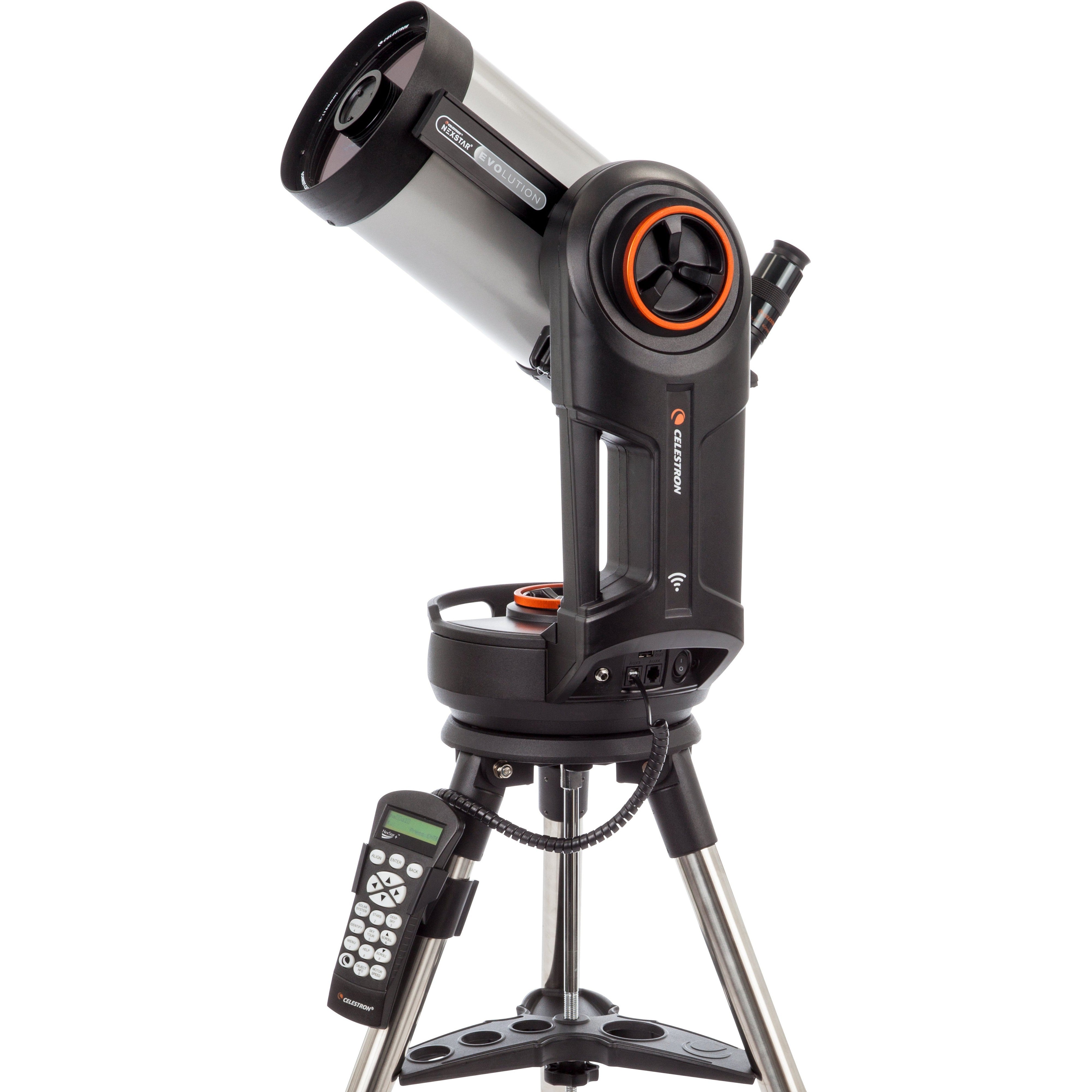
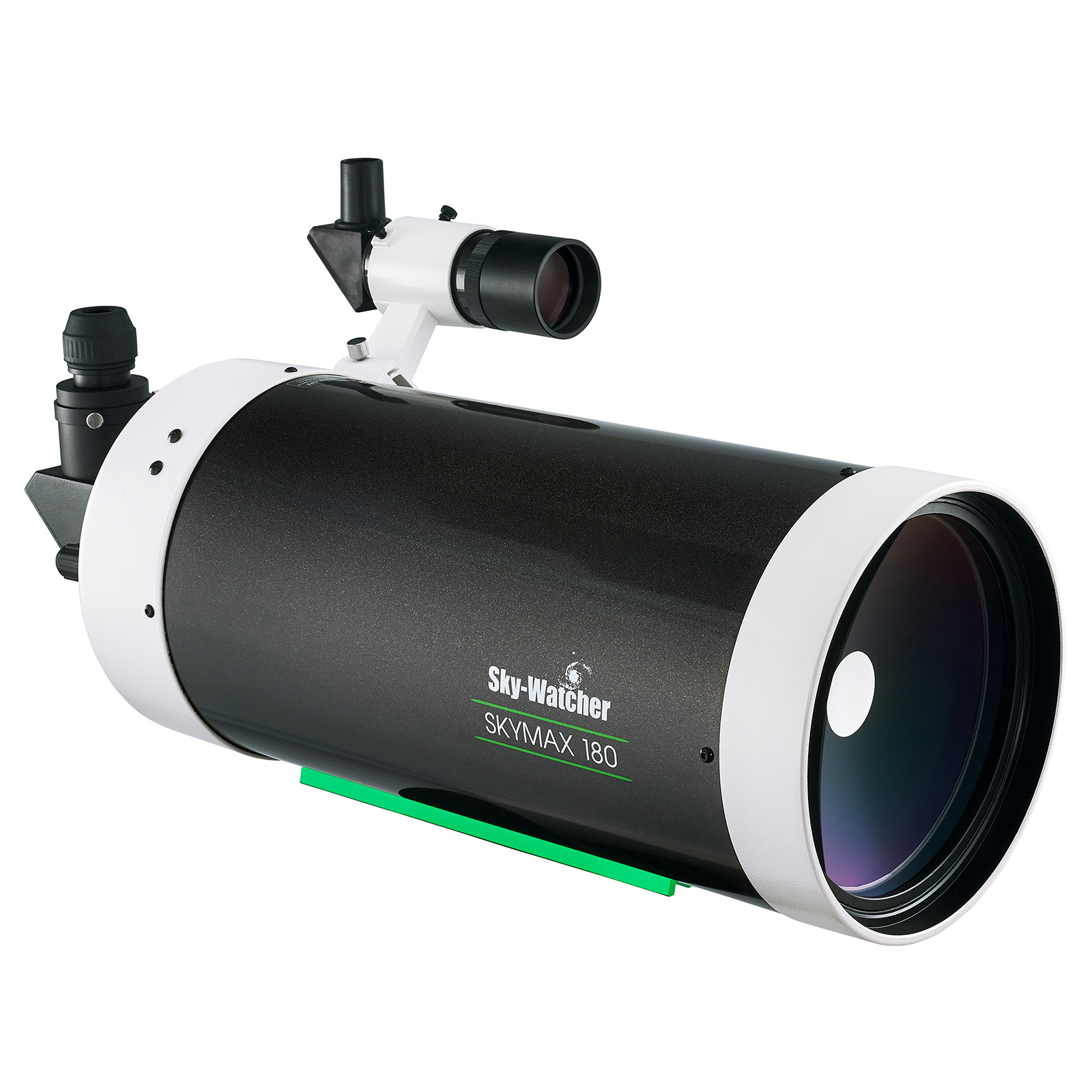
The specs are close. The experience isn't.
Affiliate links — we earn from qualifying purchases at no extra cost to you.
First light
Celestron · 150mm · £1,299
The automated deep-sky platform
- 150mm schmidt-cassegrain on a computerised mount with motorised tracking
- Good for: Moon, planets, bright nebulae, star clusters, and deep-sky objects
- GoTo system finds any object in its database after initial star alignment — no star atlas needed
- Tracking motors keep objects centred as Earth rotates — useful above 100×, essential for photography
- 12.5kg total — requires a fixed garden spot or car transport
Sky-Watcher · 180mm · £1,499
The automated deep-sky platform
- 180mm maksutov-cassegrain on a computerised mount with motorised tracking
- Good for: Moon, planets, bright nebulae, star clusters, and deep-sky objects
- GoTo system finds any object in its database after initial star alignment — no star atlas needed
- Tracking motors keep objects centred as Earth rotates — useful above 100×, essential for photography
- 30kg total — requires a fixed garden spot or car transport
The full picture
The numbers that separate these two scopes — and what they mean at the eyepiece.
Aperture
Sky-Watcher SkyMax 180 Pro gathers 1.4× more light. On bright targets — Moon, Saturn, Jupiter — you won't notice. On fainter targets — dim galaxies, faint globular clusters — the gap is real.
Focal length
Sky-Watcher SkyMax 180 Pro's longer focal length reaches higher magnification with the same eyepiece — better reach for planetary detail. Celestron NexStar Evolution 6's shorter focal length gives a wider true field — better for large open clusters and extended nebulae.
Focal ratio
Celestron NexStar Evolution 6's faster f/10 delivers wider fields with any eyepiece — better for open clusters and large nebulae. Sky-Watcher SkyMax 180 Pro's f/15 provides more magnification per eyepiece — better for fine planetary detail.
Mount type
Same mount type — setup experience and ergonomics will be similar. Differences lie in build quality and included accessories.
Weight (OTA)
Celestron NexStar Evolution 6's optical tube is 4.0kg lighter. Relevant if you plan to use it on multiple mounts or carry the tube to dark-sky sites separately.
Optical design
Celestron NexStar Evolution 6 is a Schmidt-Cassegrain (mirror and corrector, versatile focal lengths); Sky-Watcher SkyMax 180 Pro is a Maksutov-Cassegrain (mirror and lens corrector, compact tube). Different optical formulas produce different strengths — reflectors give more aperture per pound; refractors give sharper contrast and require no collimation.
At the eyepiece
| Target | Celestron NexStar Evolution 6 | Sky-Watcher SkyMax 180 Pro |
|---|---|---|
| Planets | ||
| Moon | Excellent 150mm aperture at f/10 delivers superb high-magnification lunar detail — rilles, crater chains, and mountain shadows are crisp | Excellent 180mm aperture and f/15 focal ratio deliver extraordinary high-magnification lunar detail — rilles, craterlets, and dome structures visible on steady nights |
| Saturn | Excellent 150mm aperture and 1500mm focal length resolve the Cassini Division and subtle cloud banding in good seeing | Excellent 180mm aperture and 2700mm focal length comfortably exceed the threshold; Cassini Division, ring shadow, and subtle globe banding visible |
| Jupiter | Excellent Multiple cloud belts, GRS, and moon shadow transits visible at 150–250x | Excellent 2700mm focal length and 180mm aperture show festoons, individual belt detail, the Great Red Spot's internal structure, and moon shadows in transit |
| Mars | Good 150mm aperture shows dark albedo features and polar cap at opposition; surface detail improves with a red filter | Good 180mm aperture and 2700mm focal length show polar cap, dark albedo features, and occasionally limb clouds at opposition; falls just short of the 200mm threshold for Excellent |
Deep sky | ||
| Orion Nebula (M42) | Good Core and trapezium resolved well, but 1500mm focal length crops the full nebula extent | Good 180mm aperture gathers plenty of light, but 2700mm focal length frames only the Trapezium core region — the full nebula extent is lost outside the narrow field |
| Andromeda Galaxy (M31) | Moderate 1500mm focal length shows only the bright core — the outer halo and companion galaxies overfill the field | Moderate At 2700mm focal length only the bright core fits in the field; the galaxy's 3°+ extent is severely cropped |
| Open clusters | Moderate Narrow field crops large clusters like the Pleiades; compact clusters like M11 fare better | Moderate Narrow field of view at 2700mm means most open clusters overfill the eyepiece — individual stars are sharp but the cluster context is lost |
| Globular clusters | Good 150mm resolves outer stars in M13 and M92; cores remain granular but impressive | Good 180mm aperture partially resolves stars at the edges of bright globulars like M13; long focal length provides high magnification to dig into the cluster structure |
| Faint galaxies | Good 150mm gathers enough light for M51, M81/M82, and other Messier galaxies as soft glows with some structure hints | Good 180mm aperture gathers enough light to show many NGC galaxies, though the narrow field and slow focal ratio limit context and surface brightness |
| Milky Way / wide field | Not recommended 1500mm focal length is far too narrow for sweeping star fields — field of view under 1° | Not recommended 2700mm focal length gives far too narrow a field — the scope cannot sweep star fields meaningfully |
Other | ||
| Double stars | Excellent 150mm aperture at f/10 cleanly splits sub-arcsecond pairs; diffraction-limited performance rewards tight doubles | Excellent 180mm aperture with f/15 focal ratio produces textbook-clean Airy discs; resolves close pairs well below 1 arcsecond separation |
| Astrophotography (planetary) | Good 150mm at 1500mm focal length with GoTo tracking is well suited to lucky imaging with a planetary camera | Excellent 180mm aperture and 2700mm native focal length on a tracking GoTo mount make this a superb lucky-imaging platform for planets and the Moon |
| Astrophotography (deep sky) | Moderate Alt-az GoTo mount limits exposures to ~15–30 seconds before field rotation becomes apparent; bright targets only | Challenging f/15 focal ratio demands extremely long exposures; while the GoTo equatorial mount provides tracking, the slow speed and narrow field make deep sky imaging impractical for most targets |
| Planetary nebulae | Not applicable | Excellent High magnification and 180mm aperture are ideal for small, bright planetary nebulae like M57 and M27 — angular size and surface brightness suit this scope perfectly |
The real tradeoff
Both scopes are capable. The question is which one fits the way you actually observe.
Celestron NexStar Evolution 6
- You'll unbox a complete system — tripod, mount, optics, built-in battery — connect your phone over WiFi, run a quick alignment, and be observing within 15 minutes, no cable spaghetti and no mount-matching headaches.
- You'll get genuinely good planetary views — the Cassini Division, Jupiter's cloud belts, lunar rilles — but on deep-sky nights you'll also chase down M13, M51, and dozens of Messier targets with a field of view wide enough (~0.8°) to frame them comfortably, giving you a scope that doesn't lock you into one observing style.
- You'll wait 30–45 minutes for cooldown rather than over an hour, and when you're done you'll carry one 13kg package back inside instead of disassembling a heavy OTA from a separate equatorial mount — it's the scope you'll actually set up on a weeknight.
Sky-Watcher SkyMax 180 Pro
- You'll spend your first sessions learning what 'good seeing' really means, because on a steady night this scope will show you festoons inside Jupiter's belts and craterlets inside lunar craters that the Evolution 6 simply cannot resolve — the extra 30mm of aperture and f/15 focal ratio reward patience with genuinely elite planetary detail.
- You'll need to budget well beyond the OTA price: an HEQ5 at minimum, ideally an EQ6-R, plus counterweights, power supply, and a GoTo handset, putting your real outlay around £2,400–£2,800 and your setup time at 20–30 minutes of assembly and polar alignment before you even power on.
- You'll accept that deep-sky is an afterthought — your 0.3° true field of view turns even M13 into a hunt without GoTo, and large objects like M31 are hopelessly cropped — because what you're really buying is a planetary specialist that extracts every arc-second of detail the atmosphere will surrender.
The dark side
Every scope has a personality. Here’s where each one gets difficult.
Celestron
Celestron NexStar Evolution 6
The alt-az GoTo mount introduces field rotation, capping deep-sky exposures at roughly 15–30 seconds before star trailing appears — serious astrophotography is off the table without a wedge.
The sealed SCT tube needs 30–45 minutes of cooldown before views stabilise; until thermal equilibrium is reached, planetary images shimmer and fine detail washes out.
The built-in battery lasts around 10 hours but takes several hours to fully recharge via USB — forget to charge after a session and your next night out starts with a dead scope.
Sky-Watcher
Sky-Watcher SkyMax 180 Pro
The OTA alone weighs ~6.5kg and no mount is included at the listed price — you'll need an HEQ5 or EQ6-R class mount, pushing total system cost to £2,400–£2,800 and total carry weight well above 20kg.
Cooldown is brutal: the sealed Maksutov corrector traps tube currents, and 45–90 minutes of thermal equilibration is typical — on a short winter night you may lose a quarter of your observing time just waiting.
At f/15, collimation drift from transport is immediately punished with bloated, asymmetric star images — you'll need to check and adjust the secondary mirror regularly, and the consequences of skipping that step are far more visible than on the faster f/10 Evolution.
Which is right for you?
Two different buyers. Two different right answers.
The automated deep-sky platform
Celestron · Celestron NexStar Evolution 6
You want a modern, self-contained system you can carry out in one trip, align from your phone, and use to observe planets, the Moon, and a broad range of deep-sky targets without worrying about mount compatibility or power cables. You observe from suburban or light-polluted skies, you value convenience as much as optical performance, and you'd rather spend your evening looking through the eyepiece than assembling and polar-aligning a heavy equatorial rig. If you're an intermediate observer who wants one scope that does most things well rather than one thing perfectly, the Evolution 6 fits your life.
The automated deep-sky platform
Sky-Watcher · Sky-Watcher SkyMax 180 Pro
You already know you're a planetary and lunar observer first, and you're willing to invest in a serious equatorial mount, endure long cooldown times, and accept an extremely narrow field of view to get the absolute best high-magnification views a mid-range telescope can deliver. You have the budget for the full system (£2,400+), the patience for 45–90 minutes of thermal settling, and the skill to maintain collimation — and you'll be rewarded with detail on Jupiter, Saturn, and the Moon that the Evolution 6 simply cannot match. If wide-field deep sky or grab-and-go convenience matter to you at all, look elsewhere.
Our verdict
These two are closer than most comparisons on this site. The spec differences are genuine — mount type, focal ratio — but neither is the wrong answer for a typical observer starting out.
If I had to choose between them: the Celestron NexStar Evolution 6 is the scope most people will be using regularly six months from now. The Sky-Watcher SkyMax 180 Pro rewards you more once you know what you're doing — it's worth revisiting after your first year.
Celestron NexStar Evolution 6
View Celestron NexStar Evolution 6 →Sky-Watcher SkyMax 180 Pro
View Sky-Watcher SkyMax 180 Pro →Affiliate links — we earn from qualifying purchases at no extra cost to you.
Deep field: Full specifications
Every data point, for those who want to go further.
Full specifications
Fields highlighted in blue or amber indicate the better value for that spec. Data is manufacturer-stated and may vary.
How much can it see?
| Spec | Celestron NexStar Evolution 6 | Sky-Watcher SkyMax 180 Pro |
|---|---|---|
Apertureⓘ The most important spec — bigger = more light = better views | 150mm | 180mm |
Focal Length Longer = more magnification potential | 1500mm | 2700mm |
Focal Ratio Lower f-number = wider field of view; higher = more magnification per eyepiece | f/10 | f/15 |
Optical Design The type of optics — each design has different strengths | Schmidt-Cassegrain | Maksutov-Cassegrain |
Coatings Better coatings = more light transmission through the optics | StarBright XLT fully multi-coated on all optical surfaces | Fully multi-coated Maksutov-Cassegrain optics |
How do you point it?
| Spec | Celestron NexStar Evolution 6 | Sky-Watcher SkyMax 180 Pro |
|---|---|---|
Mount Type The mechanical system that holds and moves the telescope | GoTo (Computerised) | GoTo (Computerised) |
GoTo Computer-controlled pointing — finds any of thousands of objects automatically | ||
Tracking Motor keeps objects centred as the Earth rotates — essential for astrophotography |
The focuser
| Spec | Celestron NexStar Evolution 6 | Sky-Watcher SkyMax 180 Pro |
|---|---|---|
Focuser Size 2" accepts wider eyepieces and gives better low-power views | 1.25" | 1.25" |
Focuser Type Rack-and-pinion is standard; Crayford and dual-speed are smoother | SCT rear-cell focuser | Rear-cell focuser |
Size & weight
| Spec | Celestron NexStar Evolution 6 | Sky-Watcher SkyMax 180 Pro |
|---|---|---|
OTA Weightⓘ Optical tube only — useful for comparing mount load capacity | 3.5kg | 7.5kg |
Total Weightⓘ Full setup including mount — this is what you lug to the car | 12.5kg | 30kg |
Tube Length | 394mm | 580mm |
Tube Material | Aluminium | Aluminium |
What's in the box?
| Spec | Celestron NexStar Evolution 6 | Sky-Watcher SkyMax 180 Pro |
|---|---|---|
Eyepieces Included eyepieces — more is better, but quality matters more than quantity | 25mm Plössl | 25mm Super eyepiece |
Finder Scope Helps you locate areas of the sky before switching to the main eyepiece | StarPointer red dot finder | 8x50 right-angle finder with illuminated reticle |
Diagonal Tilts the eyepiece 90° for comfortable viewing — useful on refractors |
Smart features
| Spec | Celestron NexStar Evolution 6 | Sky-Watcher SkyMax 180 Pro |
|---|---|---|
Built-in Camera Records and stacks images automatically — no separate camera needed | ||
App Controlled | ||
WiFi | ||
Battery Included |
Blue highlight: Celestron NexStar Evolution 6 advantage · Amber highlight: Sky-Watcher SkyMax 180 Pro advantage · Greyed cells: equal or subjective.