Telescope Comparison
Celestron NexStar Evolution 8 vs Celestron RASA 8"
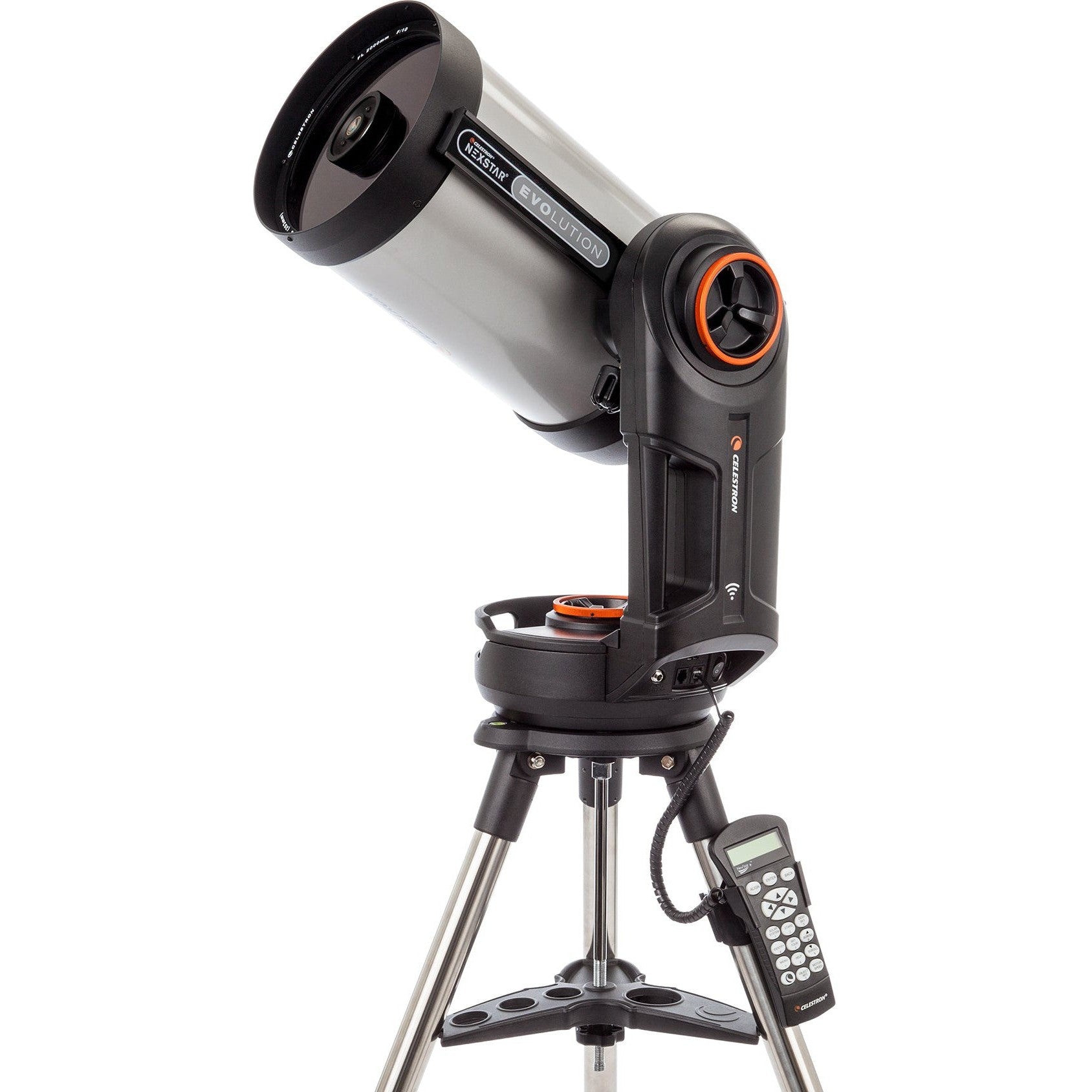
The Celestron NexStar Evolution 8 is a complete setup. The Celestron RASA 8" needs a mount before it's usable.
Affiliate links — we earn from qualifying purchases at no extra cost to you.
First light
Celestron · 203mm · £1,799
The automated deep-sky platform
- 203mm schmidt-cassegrain on a computerised mount with motorised tracking
- Good for: Moon, planets, bright nebulae, star clusters, and deep-sky objects
- GoTo system finds any object in its database after initial star alignment — no star atlas needed
- Tracking motors keep objects centred as Earth rotates — useful above 100×, essential for photography
- 17.5kg total — requires a fixed garden spot or car transport
Celestron · 203mm · £1,799
The custom-rig optical tube
- 203mm schmidt-cassegrain — optical tube only, no mount included
- 406mm focal length at f/2
- Requires a compatible mount before you can observe anything
- Best for: observers who already own a suitable mount or are building a specific imaging rig
- Not a complete purchase — budget at least £100–300 extra for a mount before observing
The full picture
The numbers that separate these two scopes — and what they mean at the eyepiece.
Aperture
Effectively equal light-gathering. Aperture won't settle this comparison — the mount, focal ratio, and observing experience are what differ.
Focal length
Celestron NexStar Evolution 8's longer focal length reaches higher magnification with the same eyepiece — better reach for planetary detail. Celestron RASA 8"'s shorter focal length gives a wider true field — better for large open clusters and extended nebulae.
Focal ratio
Celestron RASA 8"'s faster f/2 delivers wider fields with any eyepiece — better for open clusters and large nebulae. Celestron NexStar Evolution 8's f/10.01 provides more magnification per eyepiece — better for fine planetary detail.
Mount type
Celestron RASA 8" has no mount — add a compatible mount before you can observe. Celestron NexStar Evolution 8 is a complete ready-to-use system.
Weight (OTA)
Similar optical tube weight. Any portability difference between these setups comes from the mount, not the tube itself.
Optical design
Both Schmidt-Cassegrain designs — versatile, compact, good for planets and deep-sky. Differences come from aperture and mount.
At the eyepiece
| Target | Celestron NexStar Evolution 8 | Celestron RASA 8" |
|---|---|---|
| Planets | ||
| Moon | Excellent 203mm aperture and f/10 focal ratio deliver razor-sharp high-magnification lunar detail — craterlets, rilles, and shadow play across the terminator | Not recommended Imaging-only instrument with no visual capability; 406mm focal length gives very small lunar image scale even for imaging |
| Saturn | Excellent 203mm aperture and 2032mm focal length comfortably show ring structure, Cassini Division, and subtle cloud banding on the disc | Not recommended No visual use possible; 406mm focal length produces a tiny planetary disc even with high-resolution cameras |
| Jupiter | Excellent Multiple cloud belts, festoons, the Great Red Spot, and Galilean moon shadows are all within reach at 200×–300× in good seeing | Not recommended Far too short a focal length for planetary imaging; no visual capability |
| Mars | Excellent 203mm aperture and long focal length reveal polar cap, dark albedo features, and occasional dust storm activity at opposition | Not recommended Extremely small image scale at 406mm; the scope is fundamentally unsuitable for planetary work |
Deep sky | ||
| Orion Nebula (M42) | Good Bright core and Trapezium are vivid, but the 2032mm focal length crops the nebula's full extent — use with f/6.3 reducer for better framing | Excellent 203mm aperture at f/2 captures the full nebula and running man in seconds; HDR blending reveals both bright core and faint outer wisps |
| Andromeda Galaxy (M31) | Moderate Only the bright core is visible in the narrow field of view — the galaxy's full 3° extent is far beyond what any eyepiece can frame at this focal length | Excellent 406mm focal length frames the entire galaxy including companion galaxies M32 and M110 on an APS-C sensor; f/2 speed reveals outer spiral arms quickly |
| Open clusters | Moderate Many open clusters overfill the field — best for compact clusters like M11; the Pleiades and Double Cluster are impractical | Excellent Wide field at 406mm perfectly frames large clusters like the Double Cluster and M45 with surrounding nebulosity |
| Globular clusters | Excellent A highlight of this scope — 203mm resolves individual stars in M13, M92, and M5; the long focal length provides detailed high-power views | Good 203mm aperture resolves outer stars in imaging; short focal length means globulars appear small but well-exposed |
| Faint galaxies | Good 203mm gathers enough light to detect galaxies in the Virgo cluster and Leo Triplet as soft glows with hints of structure in the brightest | Good 203mm aperture and f/2 speed reveal faint galaxy groups and tidal streams in modest integration times; small image scale limits detail on individual galaxies |
| Milky Way / wide field | Not recommended At 2032mm focal length the true field is far too narrow for sweeping star fields — this is fundamentally the wrong tool for wide-field observing | Excellent 406mm at f/2 is purpose-built for wide-field imaging; captures large Milky Way structures like the Cygnus region in a single frame with extraordinary speed |
Other | ||
| Double stars | Excellent 203mm aperture resolves to ~0.57 arcseconds; the f/10 focal ratio provides clean, high-contrast Airy patterns ideal for splitting close pairs | Not recommended No visual capability; double star work requires visual observation or very long focal lengths for imaging |
| Astrophotography (planetary) | Good 203mm aperture and 2032mm native focal length on a tracking mount produce excellent planetary video frames; Barlow can push to f/20 for ideal sampling | Not applicable |
| Astrophotography (deep sky) | Moderate Alt-az GoTo mount tracks but introduces field rotation limiting exposures to a few seconds; suitable for EAA with stacking, not for traditional long-exposure imaging | Not applicable |
| Large emission nebulae (Veil, North America, Heart) | Not applicable | Excellent The RASA 8's defining use case — f/2 speed with 406mm focal length frames and deeply exposes multi-degree emission nebulae in a fraction of conventional integration times |
| Narrowband imaging (Ha, OIII, SII) | Not applicable | Excellent f/2 speed makes narrowband practical in short subs; requires filters rated for fast focal ratios to avoid halos |
The real tradeoff
Both scopes are capable. The question is which one fits the way you actually observe.
Celestron NexStar Evolution 8
- You'll set up in the garden, power on the built-in battery, connect your phone to the WiFi, and be looking at Saturn's Cassini Division within fifteen minutes — no laptop, no cables, no external power brick required.
- You'll spend your sessions hopping between planets, globulars, and bright galaxies at high magnification, marvelling at resolved stars in M13 and cloud belts on Jupiter — but you'll feel the narrow f/10 field of view every time you try to frame something larger than a globular cluster.
- When you're ready for more, you'll mount a small camera and try EAA with short stacked exposures, pulling colour out of nebulae on a weeknight — but you'll hit a hard ceiling when you realise the alt-az mount's field rotation makes anything beyond 30-second subs a losing battle.
Celestron RASA 8
- You'll never once put your eye to this telescope — there's nowhere to put it — and your entire observing session will be spent at a laptop, framing targets, adjusting tilt, and watching sub-frames roll in at a pace that makes every other scope you've owned feel glacially slow.
- You'll capture the entire Veil Nebula complex in a single shot, grab usable Ha subs in 60 seconds from a Bortle 7 back garden, and wonder why you ever spent three-hour sessions chasing the same data at f/7 — the f/2 speed genuinely changes what's possible on a work night.
- You'll spend nearly as much again on the equatorial mount, guide camera, and dedicated astro camera needed to actually use this thing — the £1,799 OTA price is just the entry ticket to a system that realistically costs £3,500–4,500 all in.
The dark side
Every scope has a personality. Here’s where each one gets difficult.
Celestron
Celestron NexStar Evolution 8
The SCT corrector plate dews over relentlessly in UK conditions — you'll need a dew shield or heater from night one, adding cost and setup time to every session.
The single-arm fork mount wobbles noticeably at high magnification in any breeze, and the 2032mm focal length amplifies every vibration — don't expect rock-steady views of Jupiter on a breezy night.
The included 40mm Plössl eyepiece has painfully short eye relief and mediocre optical quality; budget for at least one decent replacement eyepiece on top of the £1,799 purchase price.
Celestron
Celestron RASA 8"
Standard narrowband and light-pollution filters produce halos, reflections, and severe gradients at f/2 — you must buy filters specifically designed for fast optical systems, which are significantly more expensive.
Collimation and sensor tilt are brutally unforgiving at f/2; even a fraction of a millimetre of misalignment produces visibly elongated stars at the field edges, and you'll be chasing perfect tilt adjustment session after session.
The camera and its cabling sit at the front of the tube obstructing part of the aperture, creating diffraction spikes in every image — and the OTA ships with no mount, no camera, and no guider, so you're realistically doubling the system cost before you capture a single photon.
Which is right for you?
Two different buyers. Two different right answers.
The automated deep-sky platform
Celestron · Celestron NexStar Evolution 8
You want to actually look through a telescope. You love splitting Saturn's rings, resolving globular clusters, and chasing planetary detail at high magnification — and you want GoTo to find targets for you at that punishing focal length. You're an intermediate visual observer who might dabble in EAA but isn't chasing publication-quality deep-sky images. You value the all-in-one convenience of a self-contained system with built-in battery and WiFi, and you're willing to spend a bit more on better eyepieces to unlock what 203mm of aperture can really show you. This isn't for you if you dream of wide-field nebula shots or plan to do any serious long-exposure astrophotography — the alt-az mount and field rotation will stop you cold.
The custom-rig optical tube
Celestron · Celestron RASA 8"
You've already got an HEQ5 or EQ6 in the shed, a dedicated cooled camera, a guide scope, and a laptop full of processing software — and you're tired of spending four hours capturing what you know a faster system could grab in twenty minutes. You're an experienced astrophotographer who wants to image large emission nebulae and galaxy fields at breathtaking speed, especially in narrowband from a light-polluted site. This is absolutely not for you if you want to look through an eyepiece even once, if you don't already own a capable equatorial mount, or if the idea of chasing sub-millimetre sensor tilt sounds like a nightmare rather than a satisfying challenge.
Our verdict
This comparison has a catch: the Celestron RASA 8" is a bare optical tube. You cannot use it without a separate mount — which adds meaningful cost and complexity. The Celestron NexStar Evolution 8 is a complete, ready-to-observe package.
For most buyers, the Celestron NexStar Evolution 8 is the right choice — you can observe the same night it arrives. The Celestron RASA 8" makes sense if you already own a compatible mount, or are deliberately building a specific imaging setup piece by piece. If I had to choose for a first telescope: the Celestron NexStar Evolution 8, without hesitation.
Celestron NexStar Evolution 8
View Celestron NexStar Evolution 8 →Celestron RASA 8"
View Celestron RASA 8" →Affiliate links — we earn from qualifying purchases at no extra cost to you.
Deep field: Full specifications
Every data point, for those who want to go further.
Full specifications
Fields highlighted in blue or amber indicate the better value for that spec. Data is manufacturer-stated and may vary.
How much can it see?
| Spec | Celestron NexStar Evolution 8 | Celestron RASA 8" |
|---|---|---|
Aperture The most important spec — bigger = more light = better views | 203mm | 203mm |
Focal Length Longer = more magnification potential | 2032mm | 406mm |
Focal Ratio Lower f-number = wider field of view; higher = more magnification per eyepiece | f/10.01 | f/2 |
Optical Design The type of optics — each design has different strengths | Schmidt-Cassegrain | Schmidt-Cassegrain |
Coatings Better coatings = more light transmission through the optics | StarBright XLT fully multi-coated on all optical surfaces | Fully multi-coated Rowe-Ackermann Schmidt optics |
How do you point it?
| Spec | Celestron NexStar Evolution 8 | Celestron RASA 8" |
|---|---|---|
Mount Type The mechanical system that holds and moves the telescope | GoTo (Computerised) | None (OTA only) |
GoToⓘ Computer-controlled pointing — finds any of thousands of objects automatically | ||
Trackingⓘ Motor keeps objects centred as the Earth rotates — essential for astrophotography |
The focuser
| Spec | Celestron NexStar Evolution 8 | Celestron RASA 8" |
|---|---|---|
Focuser Size 2" accepts wider eyepieces and gives better low-power views | 1.25" | — |
Focuser Type Rack-and-pinion is standard; Crayford and dual-speed are smoother | SCT rear-cell focuser | Camera threads directly to rear cell (T-thread) |
Size & weight
| Spec | Celestron NexStar Evolution 8 | Celestron RASA 8" |
|---|---|---|
OTA Weightⓘ Optical tube only — useful for comparing mount load capacity | 5.4kg | 5.9kg |
Total Weight Full setup including mount — this is what you lug to the car | 17.5kg | — |
Tube Length | 432mm | 368mm |
Tube Material | Aluminium | Aluminium |
What's in the box?
| Spec | Celestron NexStar Evolution 8 | Celestron RASA 8" |
|---|---|---|
Eyepieces Included eyepieces — more is better, but quality matters more than quantity | 25mm Plössl | — |
Finder Scope Helps you locate areas of the sky before switching to the main eyepiece | StarPointer red dot finder | — |
Diagonal Tilts the eyepiece 90° for comfortable viewing — useful on refractors |
Smart features
| Spec | Celestron NexStar Evolution 8 | Celestron RASA 8" |
|---|---|---|
Built-in Camera Records and stacks images automatically — no separate camera needed | ||
App Controlled | ||
WiFi | ||
Battery Included |
Blue highlight: Celestron NexStar Evolution 8 advantage · Amber highlight: Celestron RASA 8" advantage · Greyed cells: equal or subjective.