Telescope Comparison
Celestron NexStar Evolution 8 vs Sky-Watcher SkyMax 150 Pro + HEQ5
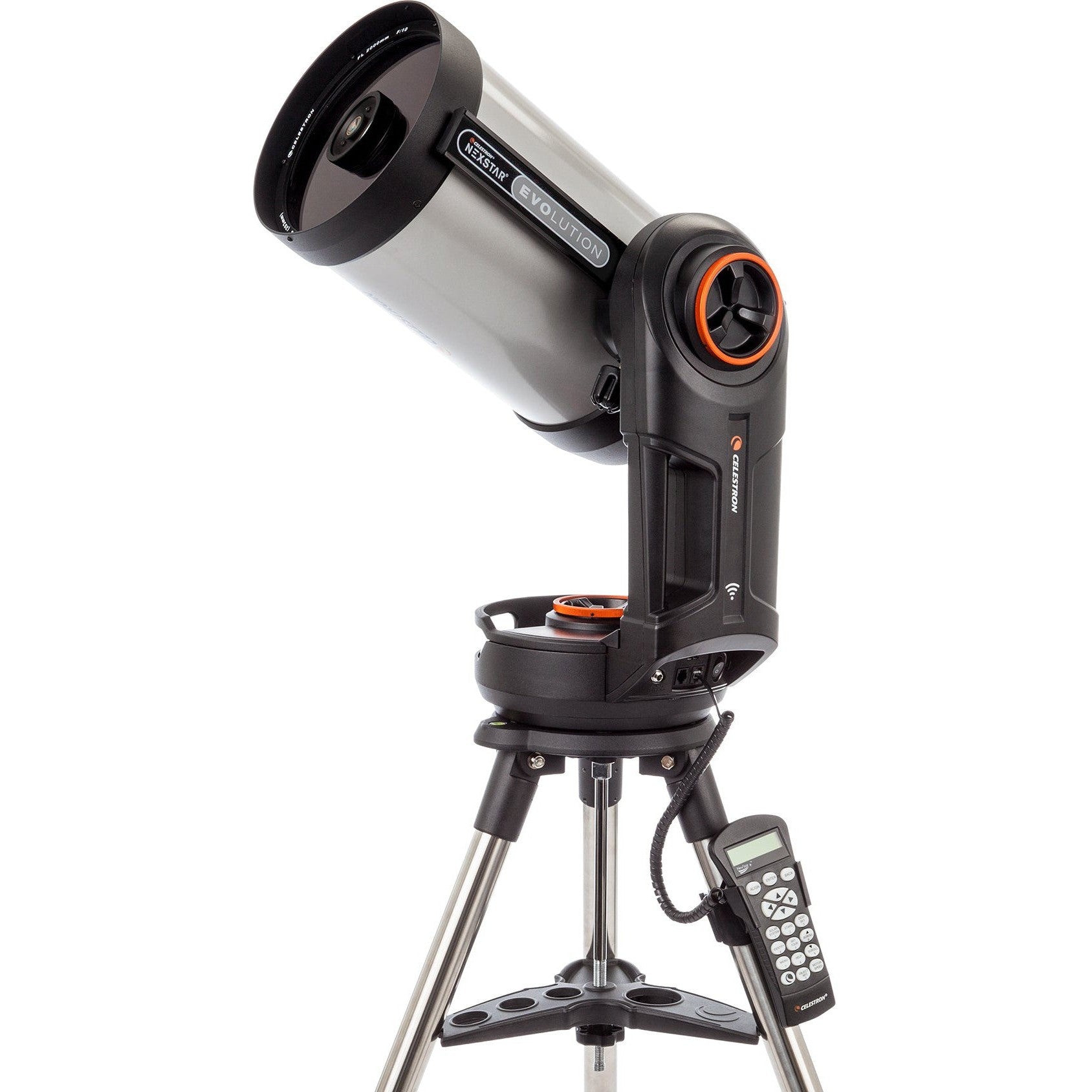
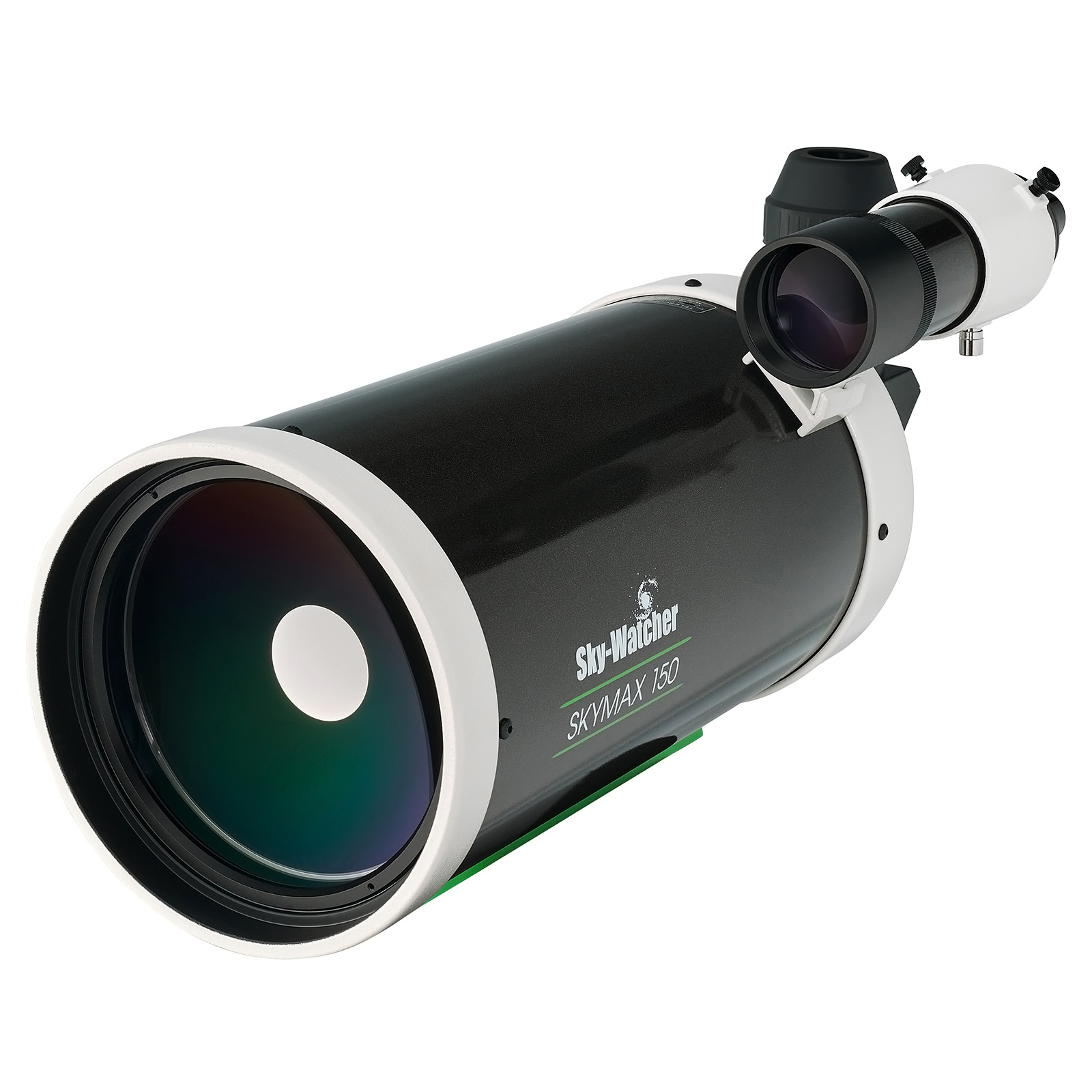
The price gap is real. The question is whether the extra capability is worth it at your stage.
Affiliate links — we earn from qualifying purchases at no extra cost to you.
First light
Celestron · 203mm · £1,799
The automated deep-sky platform
- 203mm schmidt-cassegrain on a computerised mount with motorised tracking
- Good for: Moon, planets, bright nebulae, star clusters, and deep-sky objects
- GoTo system finds any object in its database after initial star alignment — no star atlas needed
- Tracking motors keep objects centred as Earth rotates — useful above 100×, essential for photography
- 17.5kg total — requires a fixed garden spot or car transport
Sky-Watcher · 150mm · £999
The automated deep-sky platform
- 150mm maksutov-cassegrain on a computerised mount with motorised tracking
- Good for: Moon, planets, bright nebulae, star clusters, and deep-sky objects
- GoTo system finds any object in its database after initial star alignment — no star atlas needed
- Tracking motors keep objects centred as Earth rotates — useful above 100×, essential for photography
- 24kg total — requires a fixed garden spot or car transport
The full picture
The numbers that separate these two scopes — and what they mean at the eyepiece.
Aperture
Celestron NexStar Evolution 8 gathers 1.8× more light. On bright targets — Moon, Saturn, Jupiter — you won't notice. On fainter targets — dim galaxies, faint globular clusters — the gap is real.
Focal length
Celestron NexStar Evolution 8's longer focal length reaches higher magnification with the same eyepiece — better reach for planetary detail. Sky-Watcher SkyMax 150 Pro + HEQ5's shorter focal length gives a wider true field — better for large open clusters and extended nebulae.
Focal ratio
Celestron NexStar Evolution 8's faster f/10.01 delivers wider fields with any eyepiece — better for open clusters and large nebulae. Sky-Watcher SkyMax 150 Pro + HEQ5's f/12 provides more magnification per eyepiece — better for fine planetary detail.
Mount type
Same mount type — setup experience and ergonomics will be similar. Differences lie in build quality and included accessories.
Weight (OTA)
Sky-Watcher SkyMax 150 Pro + HEQ5's optical tube is 1.2kg lighter. Relevant if you plan to use it on multiple mounts or carry the tube to dark-sky sites separately.
Optical design
Celestron NexStar Evolution 8 is a Schmidt-Cassegrain (mirror and corrector, versatile focal lengths); Sky-Watcher SkyMax 150 Pro + HEQ5 is a Maksutov-Cassegrain (mirror and lens corrector, compact tube). Different optical formulas produce different strengths — reflectors give more aperture per pound; refractors give sharper contrast and require no collimation.
At the eyepiece
| Target | Celestron NexStar Evolution 8 | Sky-Watcher SkyMax 150 Pro + HEQ5 |
|---|---|---|
| Planets | ||
| Moon | Excellent 203mm aperture and f/10 focal ratio deliver razor-sharp high-magnification lunar detail — craterlets, rilles, and shadow play across the terminator | Excellent 150mm aperture and f/12 focal ratio deliver exceptional lunar detail — rilles, crater terraces, and shadow play at high magnification |
| Saturn | Excellent 203mm aperture and 2032mm focal length comfortably show ring structure, Cassini Division, and subtle cloud banding on the disc | Excellent 150mm aperture and 1800mm focal length clearly show the Cassini Division, disc banding, and shadow of the rings on the globe |
| Jupiter | Excellent Multiple cloud belts, festoons, the Great Red Spot, and Galilean moon shadows are all within reach at 200×–300× in good seeing | Excellent Multiple cloud belts, the Great Red Spot, and moon shadow transits are visible; 1800mm focal length gives large image scale |
| Mars | Excellent 203mm aperture and long focal length reveal polar cap, dark albedo features, and occasional dust storm activity at opposition | Good 150mm aperture shows polar cap and major dark surface features at opposition; falls short of the 200mm+ needed for Excellent |
Deep sky | ||
| Orion Nebula (M42) | Good Bright core and Trapezium are vivid, but the 2032mm focal length crops the nebula's full extent — use with f/6.3 reducer for better framing | Good Bright core, trapezium stars, and inner nebulosity are well-resolved, but 1800mm focal length frames only the central region |
| Andromeda Galaxy (M31) | Moderate Only the bright core is visible in the narrow field of view — the galaxy's full 3° extent is far beyond what any eyepiece can frame at this focal length | Moderate 1800mm focal length crops heavily — only the bright nucleus and inner core are visible; outer spiral arms are entirely out of field |
| Open clusters | Moderate Many open clusters overfill the field — best for compact clusters like M11; the Pleiades and Double Cluster are impractical | Moderate Narrow field restricts most large open clusters; compact clusters like M11 are rewarding but Pleiades or Double Cluster overflow the field |
| Globular clusters | Excellent A highlight of this scope — 203mm resolves individual stars in M13, M92, and M5; the long focal length provides detailed high-power views | Good 150mm resolves stars at the edges of M13 and M92; the long focal length helps by providing high magnification natively |
| Faint galaxies | Good 203mm gathers enough light to detect galaxies in the Virgo cluster and Leo Triplet as soft glows with hints of structure in the brightest | Good 150mm gathers enough light for brighter Messier and some NGC galaxies, though the narrow field makes finding them harder |
| Milky Way / wide field | Not recommended At 2032mm focal length the true field is far too narrow for sweeping star fields — this is fundamentally the wrong tool for wide-field observing | Not recommended 1800mm focal length produces far too narrow a field for star-field sweeping — less than 1° even with the longest eyepieces |
Other | ||
| Double stars | Excellent 203mm aperture resolves to ~0.57 arcseconds; the f/10 focal ratio provides clean, high-contrast Airy patterns ideal for splitting close pairs | Excellent 150mm aperture with f/12 unobstructed optics produces clean, high-contrast Airy discs ideal for splitting tight pairs down to ~0.8 arcseconds |
| Astrophotography (planetary) | Good 203mm aperture and 2032mm native focal length on a tracking mount produce excellent planetary video frames; Barlow can push to f/20 for ideal sampling | Good 150mm aperture and 1800mm native focal length give large image scale for lucky imaging; HEQ5 tracking keeps targets centred |
| Astrophotography (deep sky) | Moderate Alt-az GoTo mount tracks but introduces field rotation limiting exposures to a few seconds; suitable for EAA with stacking, not for traditional long-exposure imaging | Moderate HEQ5 provides equatorial tracking but f/12 demands impractically long exposures for faint targets; narrow field limits suitable subjects |
The real tradeoff
Both scopes are capable. The question is which one fits the way you actually observe.
Celestron NexStar Evolution 8
- You'll unbox this, set it on a table or tripod, connect your phone to its built-in WiFi, and be on Saturn within five minutes — no polar alignment, no hand controller, no external power pack to forget at home.
- Those extra 53mm of aperture over the SkyMax 150 pay real dividends on faint targets: you'll resolve individual stars across the face of M13 more convincingly, pull slightly more structure from faint galaxies in the Virgo Cluster, and find EAA stacking with a camera genuinely rewarding on nebulae that would be featureless smudges in the smaller scope.
- You'll pay for that convenience in narrowness — at f/10 and 2032mm focal length, every eyepiece view feels like looking through a keyhole, and the single-arm fork mount will remind you it's there on breezy nights when high-magnification views wobble after every touch.
Sky-Watcher SkyMax 150 Pro + HEQ5
- You'll spend the first ten minutes of every session polar-aligning the HEQ5, and you'll spend the first thirty minutes after that waiting for the sealed Maksutov tube to cool down — but once both are done, the equatorial tracking is smooth, steady, and doesn't introduce field rotation.
- If planetary and lunar imaging is your actual goal, the HEQ5's equatorial tracking gives you a direct upgrade path that the Evolution's alt-az fork simply can't match — you'll plug in a high-speed camera and shoot lucky-imaging sequences at 1800mm native focal length without needing a wedge or worrying about frame rotation.
- You'll feel the 24kg total weight every time you carry it outside, and you'll notice the 150mm aperture ceiling on deep-sky nights when globulars stay granular rather than fully resolved and faint galaxies barely register — this scope is unapologetically built for the planets and the Moon, and it doesn't pretend otherwise.
The dark side
Every scope has a personality. Here’s where each one gets difficult.
Celestron
Celestron NexStar Evolution 8
The SCT corrector plate dews up aggressively in UK conditions — budget for a dew shield or heater from day one, because without one you'll lose half your observing sessions to a fogged-up front element.
The included 40mm Plössl eyepiece has poor eye relief and mediocre optics; at £1,799 you're effectively buying a scope that needs another £100–200 in eyepieces before it performs to its potential.
The alt-az fork mount means field rotation accumulates during any exposure longer than a few seconds, ruling out traditional long-exposure deep-sky astrophotography entirely unless you add an equatorial wedge — an accessory that undercuts the grab-and-go premise.
Sky-Watcher
Sky-Watcher SkyMax 150 Pro + HEQ5
The sealed Maksutov tube needs 30–60 minutes to reach thermal equilibrium before high-magnification views stabilise — on short winter evenings, you may lose a significant chunk of your session to cool-down.
At roughly 24kg assembled, the HEQ5 is near its practical payload limit with this OTA and accessories; adding a camera, guidescope, and dew heater may push the mount into unreliable tracking territory.
Deep-sky astrophotography is essentially a non-starter at f/12 — even with a focal reducer the field remains narrow and the system is painfully slow, so if your interests evolve beyond planets you'll need a different optical tube entirely.
Which is right for you?
Two different buyers. Two different right answers.
The automated deep-sky platform
Celestron · Celestron NexStar Evolution 8
You want to walk outside with one piece of equipment, tap a target on your phone, and be observing within minutes. You're drawn to planets and the Moon but you also want the aperture to make deep-sky EAA sessions worthwhile — stacking short exposures on galaxies and nebulae through a camera and seeing colour on screen that your eye can't detect. You're an intermediate visual observer who values convenience over imaging purity, and you're willing to spend £1,799 plus accessories for a self-contained system that doesn't demand polar alignment or cable management. This isn't for you if you want wide-field Milky Way sweeps, serious long-exposure astrophotography, or a scope you can hand to a beginner without explanation.
The automated deep-sky platform
Sky-Watcher · Sky-Watcher SkyMax 150 Pro + HEQ5
You already know you want to image the planets and the Moon, and you want a mount that gives you a genuine equatorial tracking platform to grow into. You're comfortable with polar alignment, you don't mind a 30-minute cool-down ritual, and you'd rather have a proven imaging mount under a slightly smaller aperture than a bigger scope on a fork that can't track without field rotation. At £999, you're saving £800 over the Evolution 8 and getting a mount — the HEQ5 — that will serve you for years even if you eventually swap the optical tube. This isn't for you if portability matters, if you want to observe extended deep-sky objects visually, or if the idea of hauling 24kg outside and spending time on setup sounds like a chore rather than part of the hobby.
Our verdict
At £999 versus £1,799, the Celestron NexStar Evolution 8 costs 80% more. It delivers 53mm more aperture — a real and visible advantage on faint targets.
If budget is a genuine constraint, the Sky-Watcher SkyMax 150 Pro + HEQ5 will make you a happy observer. The Celestron NexStar Evolution 8's optical advantage on faint targets is real and you are unlikely to regret it if you can stretch. If I had to choose without knowing your situation: start with the Sky-Watcher SkyMax 150 Pro + HEQ5, use it for a year, then upgrade knowing exactly what you want.
Celestron NexStar Evolution 8
View Celestron NexStar Evolution 8 →Sky-Watcher SkyMax 150 Pro + HEQ5
View Sky-Watcher SkyMax 150 Pro + HEQ5 →Affiliate links — we earn from qualifying purchases at no extra cost to you.
Deep field: Full specifications
Every data point, for those who want to go further.
Full specifications
Fields highlighted in blue or amber indicate the better value for that spec. Data is manufacturer-stated and may vary.
How much can it see?
| Spec | Celestron NexStar Evolution 8 | Sky-Watcher SkyMax 150 Pro + HEQ5 |
|---|---|---|
Apertureⓘ The most important spec — bigger = more light = better views | 203mm | 150mm |
Focal Length Longer = more magnification potential | 2032mm | 1800mm |
Focal Ratio Lower f-number = wider field of view; higher = more magnification per eyepiece | f/10.01 | f/12 |
Optical Design The type of optics — each design has different strengths | Schmidt-Cassegrain | Maksutov-Cassegrain |
Coatings Better coatings = more light transmission through the optics | StarBright XLT fully multi-coated on all optical surfaces | Fully multi-coated Maksutov-Cassegrain optics |
How do you point it?
| Spec | Celestron NexStar Evolution 8 | Sky-Watcher SkyMax 150 Pro + HEQ5 |
|---|---|---|
Mount Type The mechanical system that holds and moves the telescope | GoTo (Computerised) | GoTo (Computerised) |
GoTo Computer-controlled pointing — finds any of thousands of objects automatically | ||
Tracking Motor keeps objects centred as the Earth rotates — essential for astrophotography |
The focuser
| Spec | Celestron NexStar Evolution 8 | Sky-Watcher SkyMax 150 Pro + HEQ5 |
|---|---|---|
Focuser Size 2" accepts wider eyepieces and gives better low-power views | 1.25" | 1.25" |
Focuser Type Rack-and-pinion is standard; Crayford and dual-speed are smoother | SCT rear-cell focuser | Rear-cell focuser |
Size & weight
| Spec | Celestron NexStar Evolution 8 | Sky-Watcher SkyMax 150 Pro + HEQ5 |
|---|---|---|
OTA Weightⓘ Optical tube only — useful for comparing mount load capacity | 5.4kg | 4.2kg |
Total Weightⓘ Full setup including mount — this is what you lug to the car | 17.5kg | 24kg |
Tube Length | 432mm | 480mm |
Tube Material | Aluminium | Aluminium |
What's in the box?
| Spec | Celestron NexStar Evolution 8 | Sky-Watcher SkyMax 150 Pro + HEQ5 |
|---|---|---|
Eyepieces Included eyepieces — more is better, but quality matters more than quantity | 25mm Plössl | 25mm Super eyepiece |
Finder Scope Helps you locate areas of the sky before switching to the main eyepiece | StarPointer red dot finder | 8x50 right-angle finder with illuminated reticle |
Diagonal Tilts the eyepiece 90° for comfortable viewing — useful on refractors |
Smart features
| Spec | Celestron NexStar Evolution 8 | Sky-Watcher SkyMax 150 Pro + HEQ5 |
|---|---|---|
Built-in Camera Records and stacks images automatically — no separate camera needed | ||
App Controlled | ||
WiFi | ||
Battery Included |
Blue highlight: Celestron NexStar Evolution 8 advantage · Amber highlight: Sky-Watcher SkyMax 150 Pro + HEQ5 advantage · Greyed cells: equal or subjective.