Telescope Comparison
Celestron StarSense Explorer DX 102AZ vs Celestron StarSense Explorer LT 80AZ
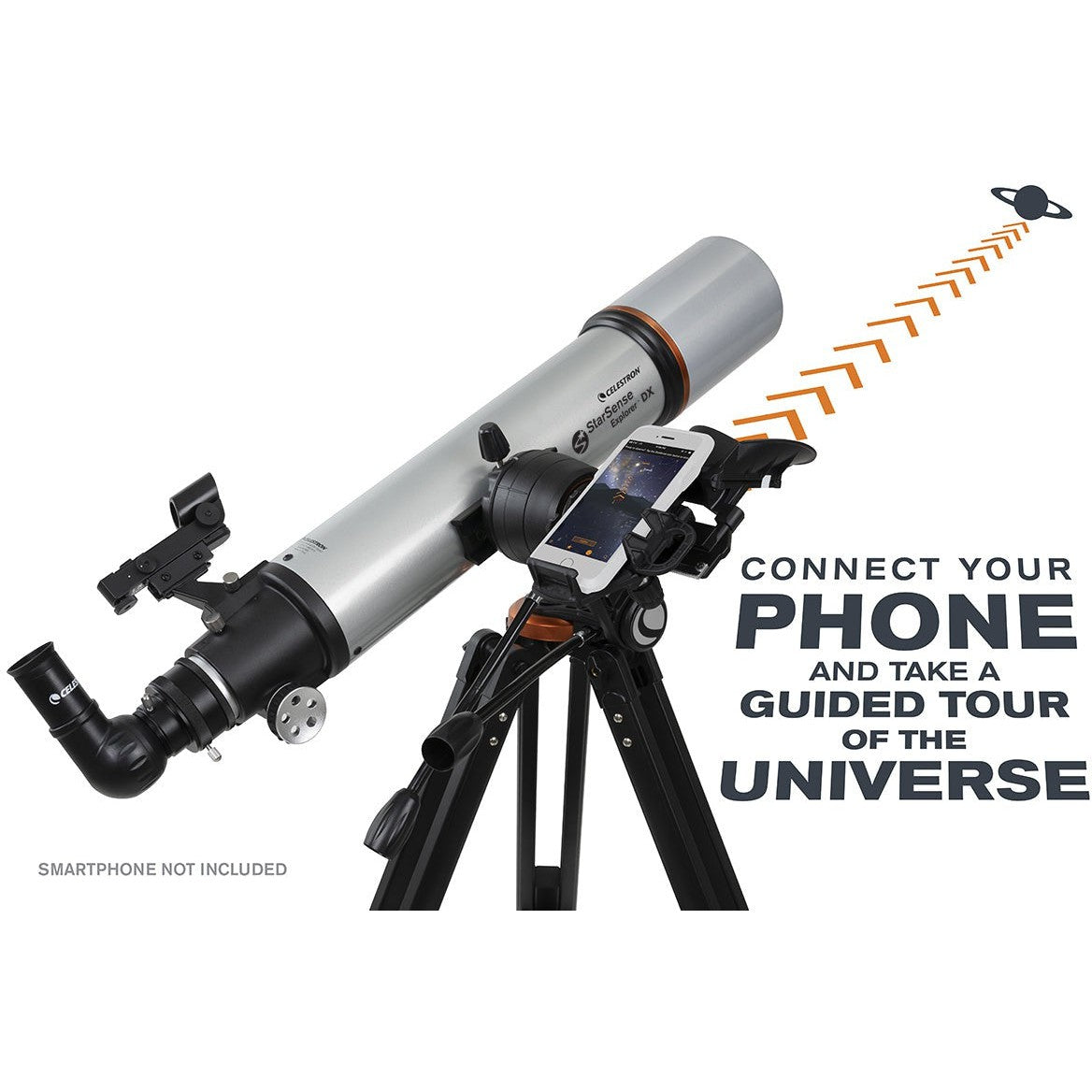
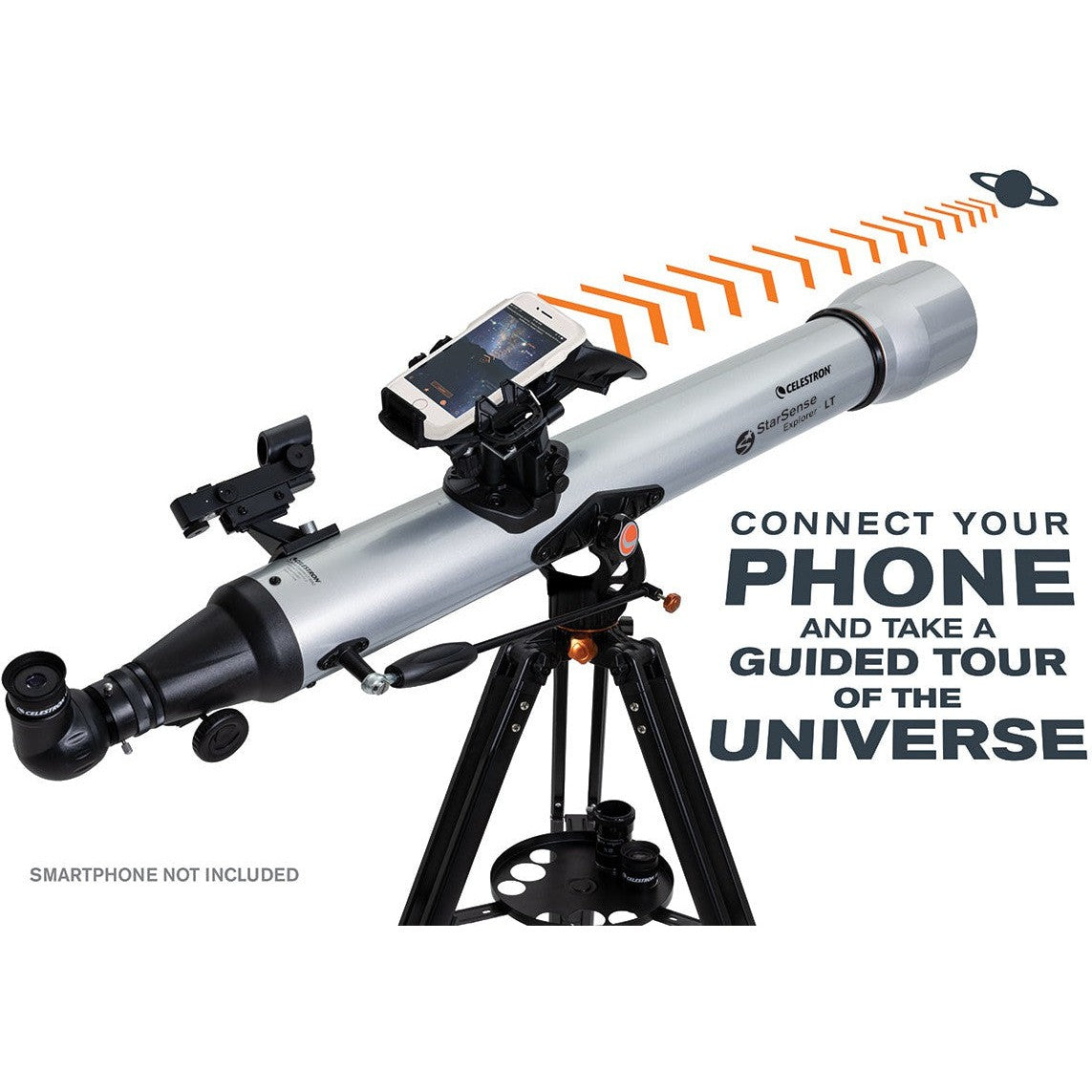
The specs are close. The experience isn't.
Affiliate links — we earn from qualifying purchases at no extra cost to you.
First light
Celestron · 102mm · £229
The simple alt-az visual scope
- 102mm refractor on a simple alt-az mount
- Good for: Moon, planets, bright open clusters
- No alignment required — quick to set up, intuitive to move
- Finding objects requires learning to star-hop: navigate with a finder scope and sky chart
- 7.5kg total — manageable to carry to dark-sky sites
Celestron · 80mm · £159
The simple alt-az visual scope
- 80mm refractor on a simple alt-az mount
- Good for: Moon, planets, bright open clusters
- No alignment required — quick to set up, intuitive to move
- Finding objects requires learning to star-hop: navigate with a finder scope and sky chart
- 5.8kg total — manageable to carry to dark-sky sites
The full picture
The numbers that separate these two scopes — and what they mean at the eyepiece.
Aperture
Celestron StarSense Explorer DX 102AZ gathers 1.6× more light. On bright targets — Moon, Saturn, Jupiter — you won't notice. On fainter targets — dim galaxies, faint globular clusters — the gap is real.
Focal length
Celestron StarSense Explorer LT 80AZ's longer focal length reaches higher magnification with the same eyepiece — better reach for planetary detail. Celestron StarSense Explorer DX 102AZ's shorter focal length gives a wider true field — better for large open clusters and extended nebulae.
Focal ratio
Celestron StarSense Explorer DX 102AZ's faster f/6.47 delivers wider fields with any eyepiece — better for open clusters and large nebulae. Celestron StarSense Explorer LT 80AZ's f/11.25 provides more magnification per eyepiece — better for fine planetary detail.
Mount type
Same mount type — setup experience and ergonomics will be similar. Differences lie in build quality and included accessories.
Weight (OTA)
Celestron StarSense Explorer LT 80AZ's optical tube is 1.1kg lighter. Relevant if you plan to use it on multiple mounts or carry the tube to dark-sky sites separately.
Optical design
Both are refractors — no mirrors to collimate, good contrast, colour-free stars with ED or APO glass. The differences between them are in aperture, focal ratio, and glass quality.
At the eyepiece
| Target | Celestron StarSense Explorer DX 102AZ | Celestron StarSense Explorer LT 80AZ |
|---|---|---|
| Planets | ||
| Moon | Excellent 102mm aperture delivers sharp crater detail, rilles, and mountain shadows; chromatic aberration adds a purple fringe at high power but doesn't obscure detail | Excellent 80mm aperture clears the threshold, and f/11.25 provides high-contrast, high-magnification lunar detail — craters, rilles, and terminator shadows are crisp |
| Saturn | Good Rings clearly defined at 100–130×, Cassini Division visible in steady seeing; 660mm focal length limits magnification headroom without a Barlow | Good 80mm and 900mm focal length show rings clearly separated from the disc; Cassini Division visible in good seeing |
| Jupiter | Good Two main cloud belts and Galilean moons easily seen; some chromatic aberration softens fine detail at higher magnifications | Good Two main cloud belts and all four Galilean moons visible; the long focal ratio provides clean planetary contrast |
| Mars | Moderate Small orange disc visible at opposition with hints of the polar cap; 102mm aperture and 660mm focal length limit surface detail | Challenging Small orange disc visible at opposition with hints of a polar cap, but 80mm cannot resolve surface albedo features |
Deep sky | ||
| Orion Nebula (M42) | Excellent 102mm gathers enough light for bright nebulosity and the Trapezium; 660mm focal length frames the full nebula extent well | Good 80mm gathers enough light to show the bright core and surrounding nebulosity, but the 900mm focal length crops the full extent of the nebula |
| Andromeda Galaxy (M31) | Excellent 660mm focal length captures the bright core and inner halo in a single field; 102mm aperture helps reveal outer structure from dark sites | Moderate 900mm focal length frames only the bright core; the outer halo and dust lanes are largely lost to the narrow field |
| Open clusters | Excellent 660mm focal length gives wide enough true fields to frame the Pleiades, Double Cluster, and other showpiece clusters | Moderate 900mm focal length means larger clusters like the Pleiades overfill the field; smaller clusters like M36/M37 fare better |
| Globular clusters | Moderate M13 and M22 appear as bright, grainy balls; 102mm cannot resolve individual stars across the cluster | Challenging 80mm aperture shows M13 and M3 as fuzzy unresolved spots — no individual stars resolved |
| Faint galaxies | Moderate Brighter Messier galaxies like M81/M82 visible as faint smudges; limited by 102mm light grasp | Challenging 80mm gathers limited light; only the brightest galaxies like M81/M82 are detectable as faint smudges |
| Milky Way / wide field | Good 660mm focal length is slightly long for true sweeping panoramas but still delivers pleasant rich-field views of star clouds | Not recommended 900mm focal length is far too narrow for sweeping star fields or Milky Way scanning |
Other | ||
| Double stars | Excellent 102mm cleanly splits Albireo, Mizar, and wider doubles; close pairs below 1.5" are limited by chromatic aberration at f/6.5 | Good 80mm resolves doubles down to about 1.5 arcseconds; the long f/11.25 focal ratio provides clean, high-contrast splits on pairs like Albireo and Mizar |
The real tradeoff
Both scopes are capable. The question is which one fits the way you actually observe.
Celestron StarSense Explorer DX 102AZ
- You'll gather 60% more light than the LT 80AZ, and you'll feel the difference — M13 goes from a featureless fuzz to a grainy, textured ball, and the Orion Nebula's wispy extensions actually emerge from the core rather than being swallowed by the background.
- Your wider true field of view at 660mm focal length means the Pleiades, the Double Cluster, and Andromeda's halo all fit comfortably in the eyepiece — objects that overfill or frustrate the LT 80's narrow 900mm field.
- You'll pay for that shorter f/6.5 focal ratio with more noticeable purple fringing on the Moon's limb and around Jupiter — the LT 80's slower f/11.25 design controls chromatic aberration better on planets, so your high-power planetary views trade sharpness at the edge for brighter, wider deep-sky frames.
Celestron StarSense Explorer LT 80AZ
- You'll spend £70 less and still get the same StarSense plate-solving experience — if finding objects is the problem you're solving, this scope solves it identically to the DX 102AZ.
- Your f/11.25 focal ratio is genuinely forgiving on planets: Saturn's rings snap into focus with cleaner contrast and less colour fringing than the faster DX 102, so if the Moon and planets are your main targets, the image quality punches closer to the bigger scope than the aperture gap suggests.
- You'll hit the ceiling faster on deep sky — Andromeda is just a core smudge, globulars stay unresolved, and the narrow field means you're constantly hunting for objects that won't fully fit, so you'll know sooner whether you want to invest in a bigger scope.
The dark side
Every scope has a personality. Here’s where each one gets difficult.
Celestron
Celestron StarSense Explorer DX 102AZ
Chromatic aberration is baked into the f/6.5 achromatic design — expect a persistent purple halo around the lunar limb and Jupiter's disc at any magnification above about 80×, and no filter or eyepiece upgrade fully eliminates it.
The alt-az mount can feel stiff and jerky during fine adjustments at high power, and with no tracking, objects drift out of view in under a minute, so you'll spend as much time nudging as observing on planets.
The StarSense dock requires a smartphone with a capable rear camera; older or budget phones may fail to plate-solve in light-polluted skies, effectively turning your navigation advantage into a dead bracket on the focuser.
Celestron
Celestron StarSense Explorer LT 80AZ
The 900mm focal length gives such a narrow true field that the Pleiades can overfill the eyepiece even with the 25mm kit Kellner — large showpiece objects become frustrating rather than rewarding.
The lightweight alt-az mount vibrates noticeably every time you nudge the tube or touch the focuser at high magnification, and settling time eats into your viewing — a problem the DX 102's slightly sturdier mount handles marginally better.
Phone battery drain during StarSense sessions is significant; a two-hour observing run can flatten a phone that started at 60%, so you'll want a power bank clipped to your tripod if you observe past the first hour.
Which is right for you?
Two different buyers. Two different right answers.
The simple alt-az visual scope
Celestron · Celestron StarSense Explorer DX 102AZ
You're a beginner or a family who wants the StarSense magic but also plans to explore beyond planets — you want the Orion Nebula to actually look like something, you want open clusters to dazzle, and you're willing to spend an extra £70 to get a meaningfully wider, brighter view. You don't own a scope yet, you don't know the constellations, and you want to visit fifty objects in your first month rather than five. This is also the better pick if you suspect deep sky will eventually hook you, because the wider field and extra aperture buy you genuine headroom the LT 80 simply doesn't have.
The simple alt-az visual scope
Celestron · Celestron StarSense Explorer LT 80AZ
You're buying your first telescope — or buying one as a gift — and the budget matters more than the last increment of performance. You mostly want the Moon and Saturn to look spectacular, and the StarSense app to take the guesswork out of finding them. You're not planning marathon deep-sky sessions; you want to step outside for thirty minutes, see three or four jaw-dropping sights, and come back inside. If you later decide astronomy is your thing, you'll upgrade to a larger instrument entirely — and this scope will have cost you £70 less in the meantime.
Our verdict
At £159 versus £229, the Celestron StarSense Explorer DX 102AZ costs 44% more. It delivers 22mm more aperture — a real and visible advantage on faint targets.
If budget is a genuine constraint, the Celestron StarSense Explorer LT 80AZ will make you a happy observer. The Celestron StarSense Explorer DX 102AZ's optical advantage on faint targets is real and you are unlikely to regret it if you can stretch. If I had to choose without knowing your situation: start with the Celestron StarSense Explorer LT 80AZ, use it for a year, then upgrade knowing exactly what you want.
Celestron StarSense Explorer DX 102AZ
View Celestron StarSense Explorer DX 102AZ →Celestron StarSense Explorer LT 80AZ
View Celestron StarSense Explorer LT 80AZ →Affiliate links — we earn from qualifying purchases at no extra cost to you.
Deep field: Full specifications
Every data point, for those who want to go further.
Full specifications
Fields highlighted in blue or amber indicate the better value for that spec. Data is manufacturer-stated and may vary.
How much can it see?
| Spec | Celestron StarSense Explorer DX 102AZ | Celestron StarSense Explorer LT 80AZ |
|---|---|---|
Apertureⓘ The most important spec — bigger = more light = better views | 102mm | 80mm |
Focal Length Longer = more magnification potential | 660mm | 900mm |
Focal Ratio Lower f-number = wider field of view; higher = more magnification per eyepiece | f/6.47 | f/11.25 |
Optical Design The type of optics — each design has different strengths | Refractor | Refractor |
Coatings Better coatings = more light transmission through the optics | Fully multi-coated achromatic refractor | Fully coated achromatic refractor optics |
How do you point it?
| Spec | Celestron StarSense Explorer DX 102AZ | Celestron StarSense Explorer LT 80AZ |
|---|---|---|
Mount Type The mechanical system that holds and moves the telescope | Alt-Az | Alt-Az |
GoTo Computer-controlled pointing — finds any of thousands of objects automatically | ||
Tracking Motor keeps objects centred as the Earth rotates — essential for astrophotography |
The focuser
| Spec | Celestron StarSense Explorer DX 102AZ | Celestron StarSense Explorer LT 80AZ |
|---|---|---|
Focuser Size 2" accepts wider eyepieces and gives better low-power views | 1.25" | 1.25" |
Focuser Type Rack-and-pinion is standard; Crayford and dual-speed are smoother | Rack and pinion | Rack and pinion |
Size & weight
| Spec | Celestron StarSense Explorer DX 102AZ | Celestron StarSense Explorer LT 80AZ |
|---|---|---|
OTA Weightⓘ Optical tube only — useful for comparing mount load capacity | 3.2kg | 2.1kg |
Total Weightⓘ Full setup including mount — this is what you lug to the car | 7.5kg | 5.8kg |
Tube Length | 660mm | 900mm |
Tube Material | Aluminium | Aluminium |
What's in the box?
| Spec | Celestron StarSense Explorer DX 102AZ | Celestron StarSense Explorer LT 80AZ |
|---|---|---|
Eyepieces Included eyepieces — more is better, but quality matters more than quantity | 25mm and 10mm Kellner | 25mm and 10mm eyepieces |
Finder Scope Helps you locate areas of the sky before switching to the main eyepiece | StarSense sky recognition dock (uses your smartphone) | StarSense sky recognition dock (uses your smartphone) |
Diagonal Tilts the eyepiece 90° for comfortable viewing — useful on refractors |
Blue highlight: Celestron StarSense Explorer DX 102AZ advantage · Amber highlight: Celestron StarSense Explorer LT 80AZ advantage · Greyed cells: equal or subjective.