Telescope Comparison
Celestron StarSense Explorer DX 102AZ vs Vixen A80Mf
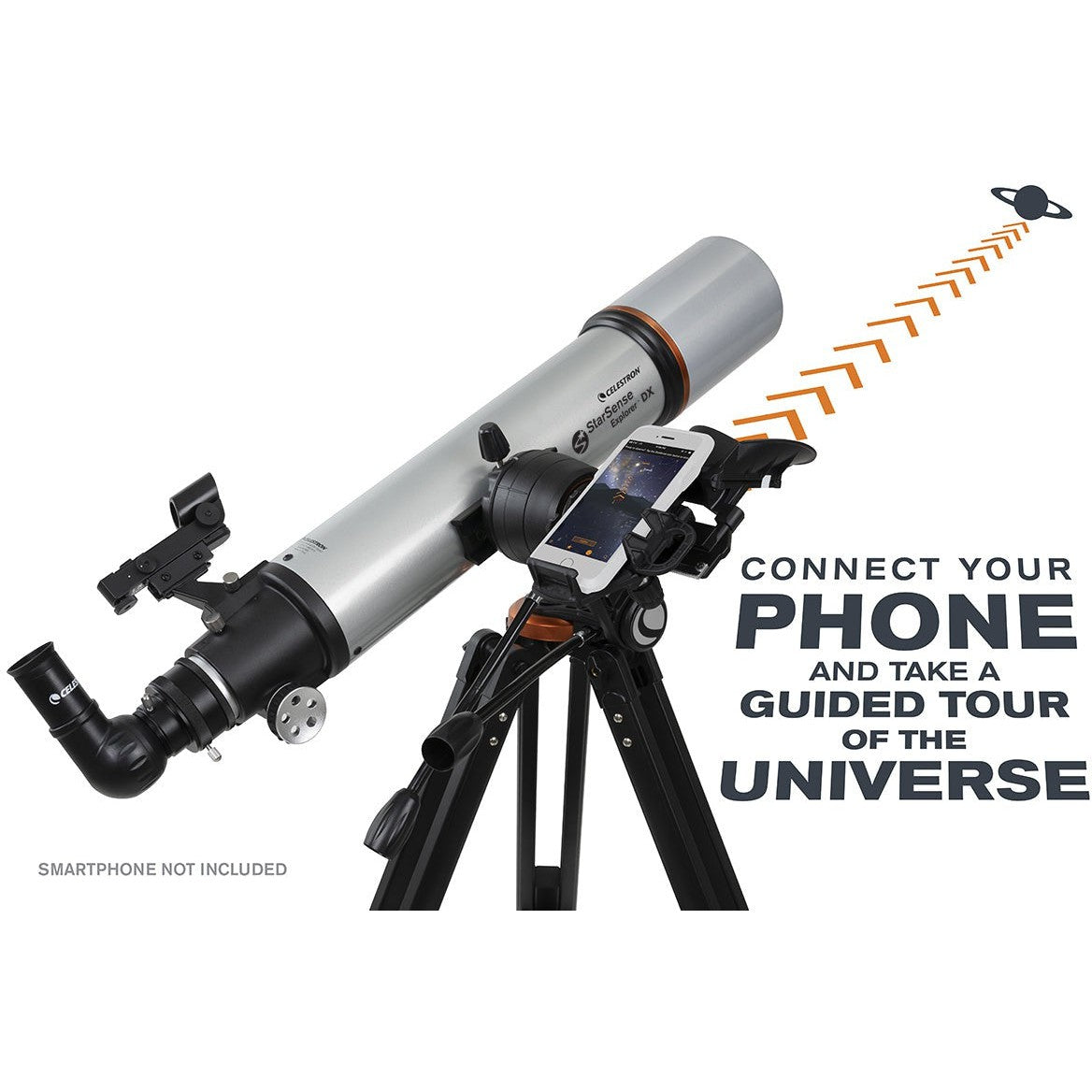
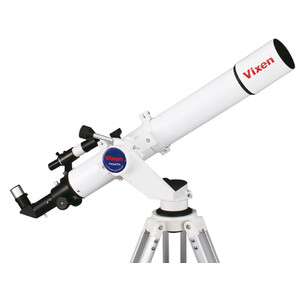
The specs are close. The experience isn't.
Affiliate links — we earn from qualifying purchases at no extra cost to you.
First light
Celestron · 102mm · £229
The simple alt-az visual scope
- 102mm refractor on a simple alt-az mount
- Good for: Moon, planets, bright open clusters
- No alignment required — quick to set up, intuitive to move
- Finding objects requires learning to star-hop: navigate with a finder scope and sky chart
- 7.5kg total — manageable to carry to dark-sky sites
Vixen · 80mm · £329
The simple alt-az visual scope
- 80mm refractor on a simple alt-az mount
- Good for: Moon, planets, bright open clusters
- No alignment required — quick to set up, intuitive to move
- Finding objects requires learning to star-hop: navigate with a finder scope and sky chart
- 6kg total — manageable to carry to dark-sky sites
The full picture
The numbers that separate these two scopes — and what they mean at the eyepiece.
Aperture
Celestron StarSense Explorer DX 102AZ gathers 1.6× more light. On bright targets — Moon, Saturn, Jupiter — you won't notice. On fainter targets — dim galaxies, faint globular clusters — the gap is real.
Focal length
Vixen A80Mf's longer focal length reaches higher magnification with the same eyepiece — better reach for planetary detail. Celestron StarSense Explorer DX 102AZ's shorter focal length gives a wider true field — better for large open clusters and extended nebulae.
Focal ratio
Celestron StarSense Explorer DX 102AZ's faster f/6.47 delivers wider fields with any eyepiece — better for open clusters and large nebulae. Vixen A80Mf's f/11.38 provides more magnification per eyepiece — better for fine planetary detail.
Mount type
Same mount type — setup experience and ergonomics will be similar. Differences lie in build quality and included accessories.
Weight (OTA)
Vixen A80Mf's optical tube is 1.6kg lighter. Relevant if you plan to use it on multiple mounts or carry the tube to dark-sky sites separately.
Optical design
Both are refractors — no mirrors to collimate, good contrast, colour-free stars with ED or APO glass. The differences between them are in aperture, focal ratio, and glass quality.
At the eyepiece
| Target | Celestron StarSense Explorer DX 102AZ | Vixen A80Mf |
|---|---|---|
| Planets | ||
| Moon | Excellent 102mm aperture delivers sharp crater detail, rilles, and mountain shadows; chromatic aberration adds a purple fringe at high power but doesn't obscure detail | Excellent 80mm aperture and f/11.4 focal ratio deliver sharp, high-contrast lunar detail — craters, rilles, and terminator shadows are crisp with minimal chromatic aberration. |
| Saturn | Good Rings clearly defined at 100–130×, Cassini Division visible in steady seeing; 660mm focal length limits magnification headroom without a Barlow | Good 910mm focal length and clean optics show rings clearly separated from the disc; Cassini Division visible in good seeing. |
| Jupiter | Good Two main cloud belts and Galilean moons easily seen; some chromatic aberration softens fine detail at higher magnifications | Good Two equatorial belts and Galilean moons well defined; the long focal ratio rewards patience in steady seeing. |
| Mars | Moderate Small orange disc visible at opposition with hints of the polar cap; 102mm aperture and 660mm focal length limit surface detail | Challenging Small disc visible at opposition with possible polar cap hint, but 80mm aperture limits surface detail. |
Deep sky | ||
| Orion Nebula (M42) | Excellent 102mm gathers enough light for bright nebulosity and the Trapezium; 660mm focal length frames the full nebula extent well | Excellent Bright nebula core and trapezium stars well shown at 80mm, though the 910mm focal length crops the nebula's full extent. |
| Andromeda Galaxy (M31) | Excellent 660mm focal length captures the bright core and inner halo in a single field; 102mm aperture helps reveal outer structure from dark sites | Moderate 910mm focal length shows only the bright core region — the galaxy's halo extends well beyond the field of view. |
| Open clusters | Excellent 660mm focal length gives wide enough true fields to frame the Pleiades, Double Cluster, and other showpiece clusters | Moderate Narrow field at 910mm means many clusters overfill the eyepiece; compact clusters like M35 fare better than the Pleiades. |
| Globular clusters | Moderate M13 and M22 appear as bright, grainy balls; 102mm cannot resolve individual stars across the cluster | Moderate M13 and M3 appear as granular fuzzy balls — 80mm cannot resolve individual stars in the cluster. |
| Faint galaxies | Moderate Brighter Messier galaxies like M81/M82 visible as faint smudges; limited by 102mm light grasp | Challenging 80mm aperture limits detection to brighter Messier galaxies as faint smudges; detail is not visible. |
| Milky Way / wide field | Good 660mm focal length is slightly long for true sweeping panoramas but still delivers pleasant rich-field views of star clouds | Not recommended 910mm focal length produces far too narrow a field for Milky Way sweeping or rich star field context. |
Other | ||
| Double stars | Excellent 102mm cleanly splits Albireo, Mizar, and wider doubles; close pairs below 1.5" are limited by chromatic aberration at f/6.5 | Excellent The f/11.4 focal ratio produces clean, tight Airy discs — ideal for splitting doubles down to the ~1.5 arcsecond Dawes limit. |
The real tradeoff
Both scopes are capable. The question is which one fits the way you actually observe.
Celestron StarSense Explorer DX 102AZ
- You'll be on Saturn within five minutes of setup — the StarSense app plate-solves through your phone's camera and draws an arrow to your target, so your first night feels like your twentieth.
- You'll collect more aperture (102mm vs 80mm) and a wider true field, so the Orion Nebula fills the eyepiece and the Pleiades sit comfortably in frame — but you'll pay for that faster f/6.5 focal ratio with visible purple fringing around the Moon's limb and Jupiter's disc.
- You'll spend a lot of time nudging the mount to keep objects centred at higher powers, and the alt-az head can feel stiff and jerky for fine adjustments — the phone-guided navigation gets you there fast, but staying there is your own battle.
Vixen A80Mf
- You'll need to star-hop or use a chart to find your targets the old-fashioned way — there's no smartphone guidance here — but once you're on an object, the Porta II mount's smooth slow-motion controls make tracking at 145× feel effortless compared to the Celestron's stiffer head.
- You'll see noticeably cleaner, higher-contrast planetary views thanks to the f/11.4 focal ratio — Jupiter's belts pop without the purple haze, and double stars like Albireo split with textbook colour separation that the faster Celestron can't quite match.
- You'll feel the 80mm aperture limit on anything faint — deep-sky sessions end sooner because there simply isn't enough light grasp — and the narrow field means the Pleiades overfill the eyepiece and wide-field Milky Way sweeping isn't really possible.
The dark side
Every scope has a personality. Here’s where each one gets difficult.
Celestron
Celestron StarSense Explorer DX 102AZ
Chromatic aberration is a constant companion on bright targets — the f/6.5 achromat throws a purple fringe around the lunar limb and Jupiter that no accessory can fully eliminate.
The StarSense system lives or dies by your smartphone; older or budget phones can struggle with plate-solving, especially under light-polluted skies, and if your phone battery dies mid-session you're left without any finder at all.
No tracking means objects drift out of the field in under a minute at higher magnifications, and the alt-az mount's slightly jerky fine-adjustment feel makes re-centring more annoying than it should be.
Vixen
Vixen A80Mf
At 80mm, faint galaxies and globular cluster resolution are simply out of reach — you'll see fuzzy patches where a larger scope would show structure.
The 910mm focal length produces such a narrow true field that large objects like the Pleiades overfill the eyepiece and Milky Way sweeping is impractical — you're essentially a planetary and double-star specialist.
At £329 you're paying significantly more than the Celestron's £229 for less aperture, no navigation aid, and the same basic limitation of no motor tracking — the premium buys you mechanical quality and optical cleanliness, not capability.
Which is right for you?
Two different buyers. Two different right answers.
The simple alt-az visual scope
Celestron · Celestron StarSense Explorer DX 102AZ
You're new to astronomy, you don't know the constellations yet, and you want to see as many things as possible on your first few nights without studying star charts. You value the thrill of hopping from target to target — Moon, Saturn, the Orion Nebula, the Double Cluster — and you'd rather have more aperture and a wider field than optically perfect planetary views. You own a decent modern smartphone and you're happy to accept some purple fringing as the cost of a scope that costs £100 less and still shows you more of the sky than you expected.
The simple alt-az visual scope
Vixen · Vixen A80Mf
You're willing to learn the sky yourself, and you'd rather spend your money on a scope you'll still respect in five years than one that impresses you on night one. You're drawn to the Moon's craters, Jupiter's belts, and splitting double stars with clean, high-contrast views — and you care more about the quality of what you see than the quantity of objects you tick off. You understand that 80mm won't reveal faint galaxies, and you're comfortable with that trade because the Porta II mount's smooth controls and the scope's well-corrected optics make every object you do find a pleasure to observe.
Our verdict
At £229 versus £329, the Vixen A80Mf costs 44% more. The extra money buys a more capable mount and better build quality, not larger optics.
For most buyers starting out, the Celestron StarSense Explorer DX 102AZ is the sensible choice — put the savings into a better eyepiece. The Vixen A80Mf makes sense once you know exactly why you need what it offers. If I had to choose: the Celestron StarSense Explorer DX 102AZ, and spend the difference on a quality eyepiece.
Celestron StarSense Explorer DX 102AZ
View Celestron StarSense Explorer DX 102AZ →Vixen A80Mf
View Vixen A80Mf →Affiliate links — we earn from qualifying purchases at no extra cost to you.
Deep field: Full specifications
Every data point, for those who want to go further.
Full specifications
Fields highlighted in blue or amber indicate the better value for that spec. Data is manufacturer-stated and may vary.
How much can it see?
| Spec | Celestron StarSense Explorer DX 102AZ | Vixen A80Mf |
|---|---|---|
Apertureⓘ The most important spec — bigger = more light = better views | 102mm | 80mm |
Focal Length Longer = more magnification potential | 660mm | 910mm |
Focal Ratio Lower f-number = wider field of view; higher = more magnification per eyepiece | f/6.47 | f/11.38 |
Optical Design The type of optics — each design has different strengths | Refractor | Refractor |
Coatings Better coatings = more light transmission through the optics | Fully multi-coated achromatic refractor | Multi-coated achromatic doublet |
How do you point it?
| Spec | Celestron StarSense Explorer DX 102AZ | Vixen A80Mf |
|---|---|---|
Mount Type The mechanical system that holds and moves the telescope | Alt-Az | Alt-Az |
GoTo Computer-controlled pointing — finds any of thousands of objects automatically | ||
Tracking Motor keeps objects centred as the Earth rotates — essential for astrophotography |
The focuser
| Spec | Celestron StarSense Explorer DX 102AZ | Vixen A80Mf |
|---|---|---|
Focuser Size 2" accepts wider eyepieces and gives better low-power views | 1.25" | 1.25" |
Focuser Type Rack-and-pinion is standard; Crayford and dual-speed are smoother | Rack and pinion | Rack and pinion |
Size & weight
| Spec | Celestron StarSense Explorer DX 102AZ | Vixen A80Mf |
|---|---|---|
OTA Weightⓘ Optical tube only — useful for comparing mount load capacity | 3.2kg | 1.6kg |
Total Weightⓘ Full setup including mount — this is what you lug to the car | 7.5kg | 6kg |
Tube Length | 660mm | 910mm |
Tube Material | Aluminium | Aluminium |
What's in the box?
| Spec | Celestron StarSense Explorer DX 102AZ | Vixen A80Mf |
|---|---|---|
Eyepieces Included eyepieces — more is better, but quality matters more than quantity | 25mm and 10mm Kellner | 25mm eyepiece |
Finder Scope Helps you locate areas of the sky before switching to the main eyepiece | StarSense sky recognition dock (uses your smartphone) | 6x30 optical finder |
Diagonal Tilts the eyepiece 90° for comfortable viewing — useful on refractors |
Blue highlight: Celestron StarSense Explorer DX 102AZ advantage · Amber highlight: Vixen A80Mf advantage · Greyed cells: equal or subjective.