Telescope Comparison
Celestron StarSense Explorer LT 80AZ vs Sky-Watcher Evostar 72ED
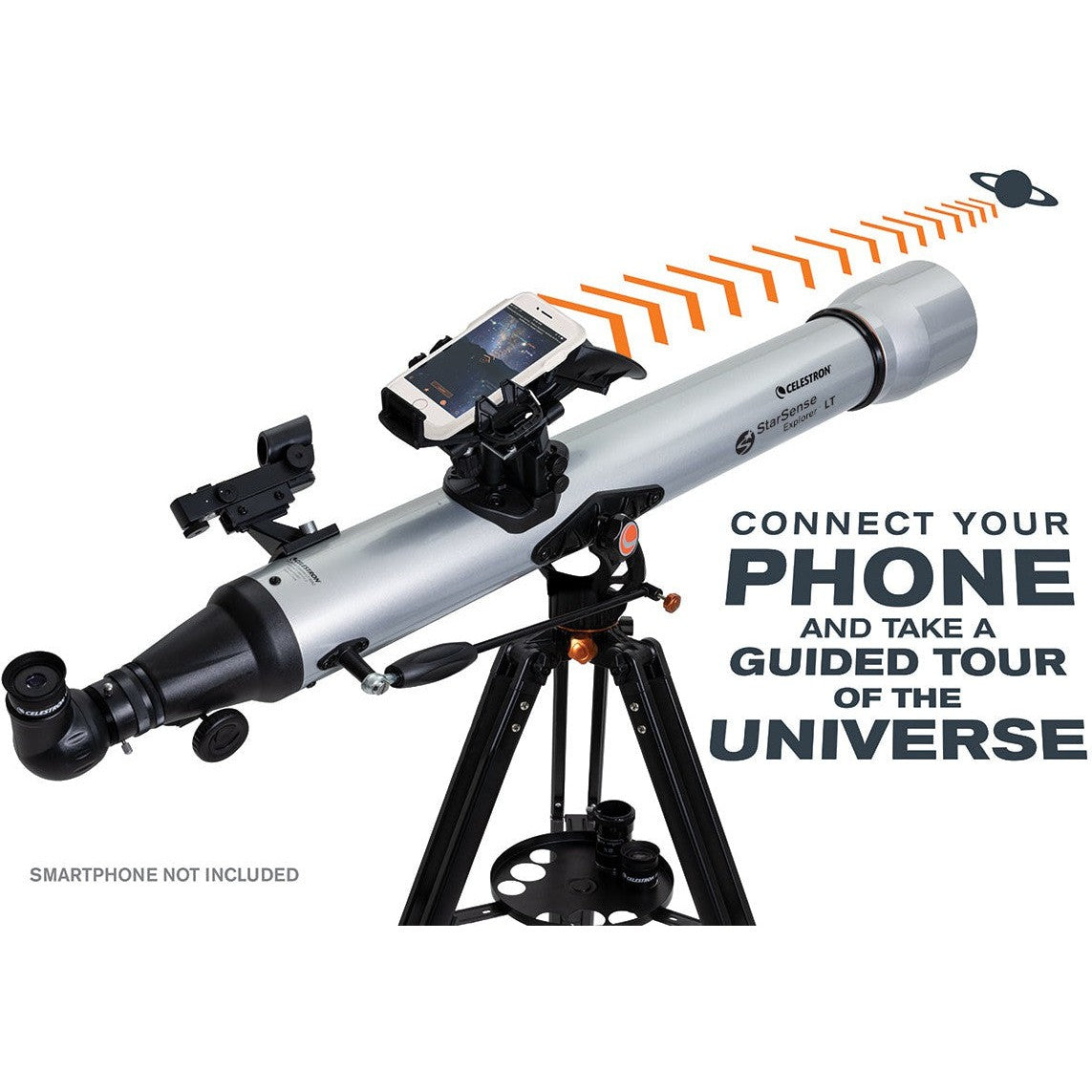
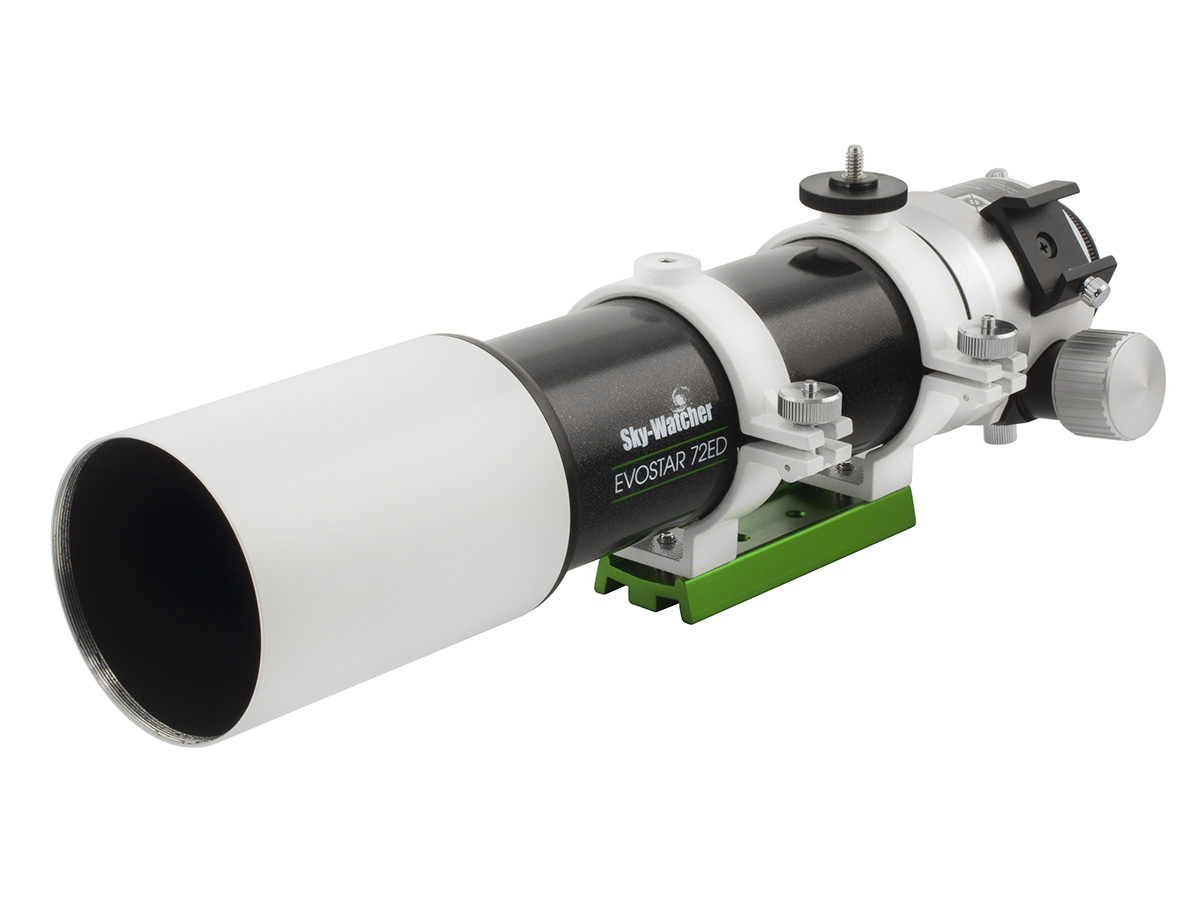
The Celestron StarSense Explorer LT 80AZ is a complete setup. The Sky-Watcher Evostar 72ED needs a mount before it's usable.
Affiliate links — we earn from qualifying purchases at no extra cost to you.
First light
Celestron · 80mm · £159
The simple alt-az visual scope
- 80mm refractor on a simple alt-az mount
- Good for: Moon, planets, bright open clusters
- No alignment required — quick to set up, intuitive to move
- Finding objects requires learning to star-hop: navigate with a finder scope and sky chart
- 5.8kg total — manageable to carry to dark-sky sites
Sky-Watcher · 72mm · £199
The custom-rig optical tube
- 72mm refractor — optical tube only, no mount included
- 420mm focal length at f/5.83
- Requires a compatible mount before you can observe anything
- Best for: observers who already own a suitable mount or are building a specific imaging rig
- Not a complete purchase — budget at least £100–300 extra for a mount before observing
The full picture
The numbers that separate these two scopes — and what they mean at the eyepiece.
Aperture
Celestron StarSense Explorer LT 80AZ gathers 1.2× more light. On bright targets — Moon, Saturn, Jupiter — you won't notice. On fainter targets — dim galaxies, faint globular clusters — the gap is real.
Focal length
Celestron StarSense Explorer LT 80AZ's longer focal length reaches higher magnification with the same eyepiece — better reach for planetary detail. Sky-Watcher Evostar 72ED's shorter focal length gives a wider true field — better for large open clusters and extended nebulae.
Focal ratio
Sky-Watcher Evostar 72ED's faster f/5.83 delivers wider fields with any eyepiece — better for open clusters and large nebulae. Celestron StarSense Explorer LT 80AZ's f/11.25 provides more magnification per eyepiece — better for fine planetary detail.
Mount type
Sky-Watcher Evostar 72ED has no mount — add a compatible mount before you can observe. Celestron StarSense Explorer LT 80AZ is a complete ready-to-use system.
Weight (OTA)
Similar optical tube weight. Any portability difference between these setups comes from the mount, not the tube itself.
Optical design
Both are refractors — no mirrors to collimate, good contrast, colour-free stars with ED or APO glass. The differences between them are in aperture, focal ratio, and glass quality.
At the eyepiece
| Target | Celestron StarSense Explorer LT 80AZ | Sky-Watcher Evostar 72ED |
|---|---|---|
| Planets | ||
| Moon | Excellent 80mm aperture clears the threshold, and f/11.25 provides high-contrast, high-magnification lunar detail — craters, rilles, and terminator shadows are crisp | Moderate 72mm aperture shows craters and terminator detail, but short focal length (420mm) means high magnification requires very short eyepieces; ED glass gives clean, colour-free views |
| Saturn | Good 80mm and 900mm focal length show rings clearly separated from the disc; Cassini Division visible in good seeing | Moderate Rings visible and disc discernible at 70–100×, but Cassini Division needs excellent seeing; 420mm focal length keeps the image small |
| Jupiter | Good Two main cloud belts and all four Galilean moons visible; the long focal ratio provides clean planetary contrast | Moderate Disc and two main equatorial belts visible, but fine banding and GRS detail require more aperture and focal length |
| Mars | Challenging Small orange disc visible at opposition with hints of a polar cap, but 80mm cannot resolve surface albedo features | Challenging Small orange disc visible at opposition; polar cap may be glimpsed in excellent seeing but surface detail is beyond this aperture |
Deep sky | ||
| Orion Nebula (M42) | Good 80mm gathers enough light to show the bright core and surrounding nebulosity, but the 900mm focal length crops the full extent of the nebula | Good Short focal length frames the full nebula complex nicely; 72mm shows the bright core and surrounding nebulosity but fainter wisps need more aperture |
| Andromeda Galaxy (M31) | Moderate 900mm focal length frames only the bright core; the outer halo and dust lanes are largely lost to the narrow field | Excellent 420mm focal length captures the full extent of M31 including companion galaxies; visually the core is bright but outer arms need dark skies |
| Open clusters | Moderate 900mm focal length means larger clusters like the Pleiades overfill the field; smaller clusters like M36/M37 fare better | Excellent Wide field of view at 420mm is ideal — Pleiades, Double Cluster, and M35 are beautifully framed with surrounding star context |
| Globular clusters | Challenging 80mm aperture shows M13 and M3 as fuzzy unresolved spots — no individual stars resolved | Challenging 72mm cannot resolve individual stars; M13 and M3 appear as fuzzy, unresolved glows |
| Faint galaxies | Challenging 80mm gathers limited light; only the brightest galaxies like M81/M82 are detectable as faint smudges | Challenging 72mm aperture limits detection to only the brightest galaxies; most appear as faint smudges or are invisible |
| Milky Way / wide field | Not recommended 900mm focal length is far too narrow for sweeping star fields or Milky Way scanning | Excellent 420mm at f/5.8 is a natural wide-field instrument — sweeping Milky Way star fields and large-scale structures are this scope's visual sweet spot |
Other | ||
| Double stars | Good 80mm resolves doubles down to about 1.5 arcseconds; the long f/11.25 focal ratio provides clean, high-contrast splits on pairs like Albireo and Mizar | Good 72mm resolves wider doubles like Albireo cleanly with good colour; closer pairs below ~2 arcseconds are beyond the Dawes limit |
| Astrophotography (planetary) | Not applicable | Challenging 72mm aperture and 420mm focal length produce a very small planetary image scale; a Barlow helps but cannot overcome the aperture limit |
| Wide-field astrophotography (nebulae and Milky Way) | Not applicable | Excellent This is the scope's primary design purpose — fast focal ratio, ED glass, and compact size pair perfectly with a star tracker for large emission nebulae, Milky Way panels, and galaxy fields |
The real tradeoff
Both scopes are capable. The question is which one fits the way you actually observe.
Celestron StarSense Explorer LT 80AZ
- You'll unbox this, slot your phone into the StarSense dock, and be looking at Saturn's rings within twenty minutes — no star charts, no alignment routines, no prior knowledge required.
- The long f/11.25 focal ratio means lunar craters and planetary detail punch above this scope's 80mm weight class; you'll spend most sessions on the Moon and Jupiter rather than hunting faint fuzzies, and that's where the views genuinely reward you.
- Everything you need is in the box — mount, tripod, eyepieces, finder — so your £159 buys a complete system, but you'll quickly notice the lightweight mount shaking every time you nudge the tube or twist the focuser.
Sky-Watcher Evostar 72ED
- You'll open the box and find… a tube, a lens cap, and a focuser — no mount, no diagonal, no eyepieces — so your first session is still weeks away while you source a star tracker, adapters, and a camera setup.
- Once that imaging rig comes together, you'll frame the entire Andromeda Galaxy or the full Veil Nebula complex in a single shot; the fast f/5.8 ED optic is designed to feed a camera sensor, not your eye.
- On the rare night you use it visually, you'll love wide-field sweeps through open clusters like the Double Cluster, but planets will look tiny and underwhelming compared to what the StarSense LT 80AZ delivers at its longer focal length.
The dark side
Every scope has a personality. Here’s where each one gets difficult.
Celestron
Celestron StarSense Explorer LT 80AZ
The alt-az mount vibrates noticeably every time you touch the tube or refocus — at 180× on Jupiter, each nudge costs you several seconds of wobbly settling time.
The 900mm focal length narrows the true field so much that showpiece objects like the Pleiades and Andromeda won't fit in the eyepiece, and you have no tracking, so anything at high power drifts out of view within about a minute.
This is a budget achromatic refractor: expect purple fringing on the lunar limb and bright stars at high magnification, and the included Kellner eyepieces do little to flatter the optics.
Sky-Watcher
Sky-Watcher Evostar 72ED
The OTA-only price of £199 is deceptive — by the time you add a star tracker or equatorial mount, a diagonal, eyepieces, a camera adapter, and ideally the dedicated field flattener to stop edge-of-sensor star elongation, you're well past £500.
The rack-and-pinion focuser can flex under the weight of a DSLR or guide camera, introducing image shift mid-exposure — serious imagers often budget for a Crayford-style focuser upgrade.
At 72mm of aperture, useful visual magnification tops out around 140×, so Jupiter's disc stays small and globular clusters remain unresolved fuzzy blobs — this is not a telescope that rewards putting your eye to the eyepiece on most targets.
Which is right for you?
Two different buyers. Two different right answers.
The simple alt-az visual scope
Celestron · Celestron StarSense Explorer LT 80AZ
You've never owned a telescope, you don't know Polaris from Procyon, and you just want to see the Moon's craters and Saturn's rings tonight without a steep learning curve. You'll love the StarSense dock pointing you from object to object like a cosmic GPS, and you'll actually use this scope on weeknight impulse sessions because it sets up in minutes with nothing extra to buy. This isn't for you if you're already eyeing camera attachments and long exposures — there's no tracking, no upgrade path to imaging, and 80mm of achromatic glass will leave deep-sky chasers wanting more.
The custom-rig optical tube
Sky-Watcher · Sky-Watcher Evostar 72ED
You already own a DSLR or mirrorless camera, you've taken some Milky Way shots on a tripod, and you're ready to step up to tracked wide-field astrophotography of nebulae and galaxies. You'll thrive with the Evostar 72ED's colour-corrected optics and fast focal ratio once you pair it with a star tracker — but you need to be comfortable assembling a system piece by piece and spending two to three times the OTA price to get there. This isn't for you if you want a complete grab-and-go visual telescope; you'll be disappointed by the bare tube in the box and by how small planets look through 72mm at f/5.8.
Our verdict
This comparison has a catch: the Sky-Watcher Evostar 72ED is a bare optical tube. You cannot use it without a separate mount — which adds meaningful cost and complexity. The Celestron StarSense Explorer LT 80AZ is a complete, ready-to-observe package.
For most buyers, the Celestron StarSense Explorer LT 80AZ is the right choice — you can observe the same night it arrives. The Sky-Watcher Evostar 72ED makes sense if you already own a compatible mount, or are deliberately building a specific imaging setup piece by piece. If I had to choose for a first telescope: the Celestron StarSense Explorer LT 80AZ, without hesitation.
Celestron StarSense Explorer LT 80AZ
View Celestron StarSense Explorer LT 80AZ →Sky-Watcher Evostar 72ED
View Sky-Watcher Evostar 72ED →Affiliate links — we earn from qualifying purchases at no extra cost to you.
Deep field: Full specifications
Every data point, for those who want to go further.
Full specifications
Fields highlighted in blue or amber indicate the better value for that spec. Data is manufacturer-stated and may vary.
How much can it see?
| Spec | Celestron StarSense Explorer LT 80AZ | Sky-Watcher Evostar 72ED |
|---|---|---|
Apertureⓘ The most important spec — bigger = more light = better views | 80mm | 72mm |
Focal Length Longer = more magnification potential | 900mm | 420mm |
Focal Ratio Lower f-number = wider field of view; higher = more magnification per eyepiece | f/11.25 | f/5.83 |
Optical Design The type of optics — each design has different strengths | Refractor | Refractor |
Coatings Better coatings = more light transmission through the optics | Fully coated achromatic refractor optics | Fully multi-coated ED doublet |
How do you point it?
| Spec | Celestron StarSense Explorer LT 80AZ | Sky-Watcher Evostar 72ED |
|---|---|---|
Mount Type The mechanical system that holds and moves the telescope | Alt-Az | None (OTA only) |
GoTo Computer-controlled pointing — finds any of thousands of objects automatically | ||
Tracking Motor keeps objects centred as the Earth rotates — essential for astrophotography |
The focuser
| Spec | Celestron StarSense Explorer LT 80AZ | Sky-Watcher Evostar 72ED |
|---|---|---|
Focuser Size 2" accepts wider eyepieces and gives better low-power views | 1.25" | 2" |
Focuser Type Rack-and-pinion is standard; Crayford and dual-speed are smoother | Rack and pinion | Dual-speed Crayford (with 1.25" adapter) |
Size & weight
| Spec | Celestron StarSense Explorer LT 80AZ | Sky-Watcher Evostar 72ED |
|---|---|---|
OTA Weightⓘ Optical tube only — useful for comparing mount load capacity | 2.1kg | 1.4kg |
Total Weight Full setup including mount — this is what you lug to the car | 5.8kg | — |
Tube Length | 900mm | 390mm |
Tube Material | Aluminium | Aluminium |
What's in the box?
| Spec | Celestron StarSense Explorer LT 80AZ | Sky-Watcher Evostar 72ED |
|---|---|---|
Eyepieces Included eyepieces — more is better, but quality matters more than quantity | 25mm and 10mm eyepieces | — |
Finder Scope Helps you locate areas of the sky before switching to the main eyepiece | StarSense sky recognition dock (uses your smartphone) | — |
Diagonalⓘ Tilts the eyepiece 90° for comfortable viewing — useful on refractors |
Blue highlight: Celestron StarSense Explorer LT 80AZ advantage · Amber highlight: Sky-Watcher Evostar 72ED advantage · Greyed cells: equal or subjective.