Telescope Comparison
Dwarf Labs DWARF II vs Dwarf Labs DWARF III
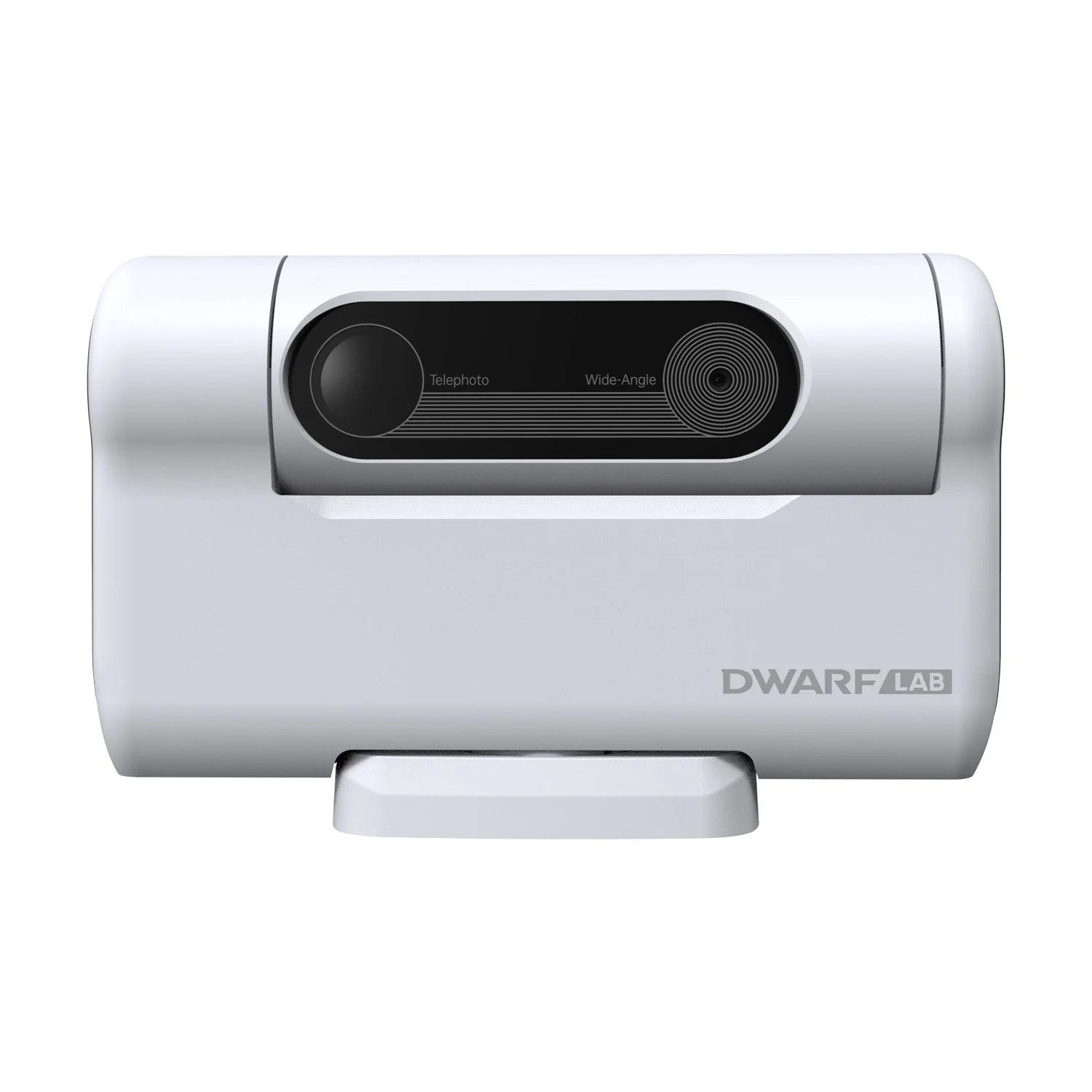
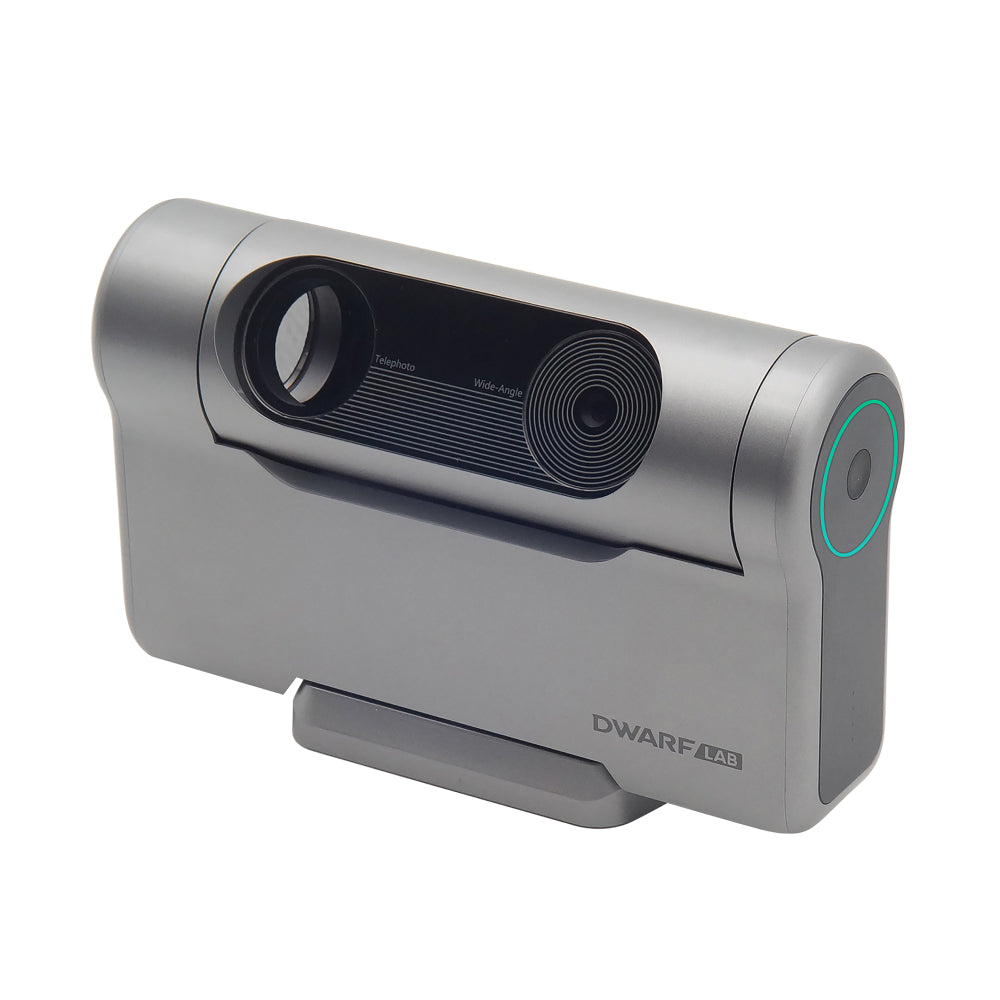
The specs are close. The experience isn't.
Affiliate links — we earn from qualifying purchases at no extra cost to you.
First light
Dwarf Labs · 24mm · £279
The app-native deep-sky imager
- 24mm sensor-based smart telescope — no traditional eyepiece
- Connects to a smartphone app; the app selects, slews to, and stacks targets automatically
- Best for: faint deep-sky objects — galaxies, nebulae, star clusters built up over minutes
- Not for direct eyepiece viewing — every view is delivered on a phone or tablet screen
- 1.35kg compact all-in-one unit
Dwarf Labs · 24mm · £449
The app-native deep-sky imager
- 24mm sensor-based smart telescope — no traditional eyepiece
- Connects to a smartphone app; the app selects, slews to, and stacks targets automatically
- Best for: faint deep-sky objects — galaxies, nebulae, star clusters built up over minutes
- Not for direct eyepiece viewing — every view is delivered on a phone or tablet screen
- 1.5kg compact all-in-one unit
The full picture
The numbers that separate these two scopes — and what they mean at the eyepiece.
Aperture
Effectively equal light-gathering. Aperture won't settle this comparison — the mount, focal ratio, and observing experience are what differ.
Focal length
Same focal length — identical magnification with any given eyepiece. Differences come from optical design and coatings.
Focal ratio
Focal ratio is not meaningful for smart telescope sensor systems — the optics are optimised for the built-in sensor rather than interchangeable eyepieces.
Mount type
Same mount type — setup experience and ergonomics will be similar. Differences lie in build quality and included accessories.
Weight (OTA)
Similar optical tube weight. Any portability difference between these setups comes from the mount, not the tube itself.
Optical design
Both sensor-based smart telescopes — no eyepiece, app-controlled, live stacking. The differences are in sensor size, aperture, and companion software quality.
At the eyepiece
| Target | Dwarf Labs DWARF II | Dwarf Labs DWARF III |
|---|---|---|
| Planets | ||
| Moon | Challenging 24mm aperture captures a small but sharp stacked image showing maria and major craters; far less detail than any conventional telescope | Challenging 24mm aperture captures the full disc with visible maria, but resolution is far below what even a small traditional telescope provides |
| Saturn | Not recommended 100mm focal length and 24mm aperture show a bright dot only — rings are not resolvable | Not recommended 24mm aperture and 100mm focal length produce a tiny dot; ring elongation may be detectable but no meaningful detail |
| Jupiter | Not recommended Disc is a tiny bright point at 100mm focal length; no cloud bands or moon transits visible | Not recommended Disc is barely resolved at 100mm focal length; no cloud bands or moon detail beyond points of light |
| Mars | Not recommended Appears as a bright orange point; no disc or surface features at any opposition | Not recommended Appears as a bright dot with no disc detail even at opposition |
Deep sky | ||
| Orion Nebula (M42) | Moderate f/4.17 speed and wide field frame the full nebula; stacking reveals colour and structure, but 24mm aperture limits faint outer wings | Moderate Core and surrounding nebulosity visible after stacking; fast f/4.17 and wide field suit this target well, but 24mm aperture limits faint outer structure |
| Andromeda Galaxy (M31) | Excellent 100mm focal length frames the full galaxy extent; stacking reveals core and hints of dust lanes from dark sites | Good 100mm focal length captures the full galaxy extent; live stacking reveals the core and oval halo, with dust lane hints after extended integration |
| Open clusters | Excellent 100mm focal length gives a wide field ideal for framing large clusters like the Pleiades and Double Cluster | Good Wide 100mm field of view is ideal for large clusters like the Pleiades and Double Cluster; stacking reveals star colours |
| Globular clusters | Not recommended 24mm aperture cannot resolve individual stars; globulars appear as dim fuzzy spots even with stacking | Not recommended 24mm aperture cannot resolve individual stars; clusters appear as small unresolved fuzzy patches |
| Faint galaxies | Not recommended Aperture is far too small to collect enough light; most galaxies beyond the Messier brightest remain invisible | Not recommended 24mm aperture collects too little light; only the brightest galaxy cores emerge after very long stacking |
| Milky Way / wide field | Excellent 100mm focal length at f/4.17 is well-suited to rich starfield sweeps and Milky Way patches | Excellent 100mm focal length at f/4.17 is ideally suited to wide Milky Way star fields and large nebula regions |
Other | ||
| Double stars | Not recommended Dawes limit of ~4.8 arcseconds and 100mm focal length make meaningful splitting impossible; camera sensor pixels further limit resolution | Not recommended 24mm aperture has a Dawes limit of roughly 4.8 arcseconds — most interesting doubles are unresolvable, and screen viewing lacks the visual appeal |
| Astrophotography (deep sky) | Moderate Integrated GoTo and tracking with f/4.17 speed produce usable stacked images of bright nebulae and clusters, but 24mm aperture severely limits signal on faint targets | Not applicable |
| Astrophotography (planetary) | Not recommended 24mm aperture and 100mm focal length cannot resolve any planetary surface detail even with lucky imaging | Not applicable |
| Bright emission nebulae | Not applicable | Good Fast f/4.17 optics and wide field suit large nebulae like the Lagoon, Eagle, and North America Nebula; stacking builds up signal well on these targets |
The real tradeoff
Both scopes are capable. The question is which one fits the way you actually observe.
Dwarf Labs DWARF II
- You'll unbox it, connect via Wi-Fi, and be stacking frames of the Orion Nebula within fifteen minutes — but you may spend five of those minutes waiting for plate-solving to lock on, and if it's partly cloudy, it may fail altogether and need a restart.
- You'll get genuinely rewarding images of bright nebulae and open clusters on your phone screen for £279, and during the day you'll use it as a surprisingly capable wildlife telephoto — it's the only scope here that meaningfully doubles as a daytime optic.
- You'll occasionally fight the Wi-Fi connection dropping mid-stack on certain phone models, and on cold nights the autofocus can drift, forcing you to fiddle with manual focus through the app while your fingers go numb.
Dwarf Labs DWARF III
- You'll have an almost identical optical experience to the DWARF II — same 24mm aperture, same 100mm focal length, same f/4.17 ratio — so the nebulae and clusters you capture will look very similar, but you're paying £170 more for the updated platform and revised hardware.
- You'll share live-stacked views with friends and family on your phone in real time, which feels magical the first few times, but you'll notice that on longer deep-sky sessions the internal battery can run out before your stacking is done, so you'll learn to bring a power bank.
- You'll rely entirely on the Dwarf Labs app for every aspect of observing — if a software update introduces a bug or your phone's Bluetooth/Wi-Fi acts up, your telescope is effectively a paperweight until the connection is restored.
The dark side
Every scope has a personality. Here’s where each one gets difficult.
Dwarf Labs
Dwarf Labs DWARF II
The 24mm aperture is smaller than most binoculars — Saturn's rings and Jupiter's cloud bands are completely out of reach, and faint galaxies remain stubborn smudges no matter how long you stack.
Wi-Fi connectivity between the DWARF II and certain phone models is a documented pain point: dropped sessions mid-stack are reported, and there's no fallback — no eyepiece, no standalone screen, nothing.
Plate-solving and GoTo alignment can take several minutes and occasionally fails under partly cloudy skies, which means you may spend a frustrating chunk of a short clear-sky window just getting the scope pointed at your target.
Dwarf Labs
Dwarf Labs DWARF III
The same 24mm aperture and 100mm focal length as the DWARF II means the same hard optical ceiling — planets are featureless dots, and no amount of digital zoom or stacking compensates for the missing glass.
Internal battery life may not survive an extended deep-sky stacking session; if you don't bring external power, the scope can die before you've accumulated enough frames on a faint target.
Total app dependency means software bugs or connectivity failures can completely prevent the telescope from functioning — there is no manual fallback, no optical eyepiece, and no onboard display.
Which is right for you?
Two different buyers. Two different right answers.
The app-native deep-sky imager
Dwarf Labs · Dwarf Labs DWARF II
You've never owned a telescope but you want to see nebulae tonight without learning a single thing about polar alignment or star-hopping — and you'd rather spend £279 than £449 for what is optically the same experience. You're a traveller or hiker who values the sub-1.2kg weight and dual-use daytime telephoto capability. You accept that planets will be dots and that faint galaxies are beyond this aperture. If you already own a camera and a basic star tracker, you'll outgrow this in a week.
The app-native deep-sky imager
Dwarf Labs · Dwarf Labs DWARF III
You want the latest iteration of the DWARF platform and you're willing to pay the £170 premium for the DWARF III's updated hardware and software refinements over the DWARF II, even though the core optics — 24mm aperture, 100mm focal length, f/4.17 — are identical. You value the social experience of sharing live-stacked views on a phone screen with family, and you're comfortable with screen-only observing. This isn't for you if you want to see Saturn's rings, resolve globular clusters, or produce high-resolution astrophotography data — the aperture can't deliver that regardless of price.
Our verdict
At £279 versus £449, the Dwarf Labs DWARF III costs 61% more. The extra money buys a more capable mount and better build quality, not larger optics.
For most buyers starting out, the Dwarf Labs DWARF II is the sensible choice — put the savings into a better eyepiece. The Dwarf Labs DWARF III makes sense once you know exactly why you need what it offers. If I had to choose: the Dwarf Labs DWARF II, and spend the difference on a quality eyepiece.
Dwarf Labs DWARF II
View Dwarf Labs DWARF II →Dwarf Labs DWARF III
View Dwarf Labs DWARF III →Affiliate links — we earn from qualifying purchases at no extra cost to you.
Deep field: Full specifications
Every data point, for those who want to go further.
Full specifications
Fields highlighted in blue or amber indicate the better value for that spec. Data is manufacturer-stated and may vary.
How much can it see?
| Spec | Dwarf Labs DWARF II | Dwarf Labs DWARF III |
|---|---|---|
Aperture The most important spec — bigger = more light = better views | 24mm | 24mm |
Focal Length Longer = more magnification potential | 100mm | 100mm |
Focal Ratio Lower f-number = wider field of view; higher = more magnification per eyepiece | f/4.17 | f/4.17 |
Optical Design The type of optics — each design has different strengths | Smart Telescope | Smart Telescope |
Coatings Better coatings = more light transmission through the optics | Multi-coated telephoto-style objective | Multi-coated objective with upgraded optics |
How do you point it?
| Spec | Dwarf Labs DWARF II | Dwarf Labs DWARF III |
|---|---|---|
Mount Type The mechanical system that holds and moves the telescope | Integrated | Integrated |
GoTo Computer-controlled pointing — finds any of thousands of objects automatically | ||
Tracking Motor keeps objects centred as the Earth rotates — essential for astrophotography |
The focuser
| Spec | Dwarf Labs DWARF II | Dwarf Labs DWARF III |
|---|---|---|
Focuser Size 2" accepts wider eyepieces and gives better low-power views | — | — |
Focuser Type Rack-and-pinion is standard; Crayford and dual-speed are smoother | Fixed focus (app-controlled fine adjustment) | Fixed focus (app-controlled fine adjustment) |
Size & weight
| Spec | Dwarf Labs DWARF II | Dwarf Labs DWARF III |
|---|---|---|
OTA Weightⓘ Optical tube only — useful for comparing mount load capacity | 1.35kg | 1.5kg |
Total Weightⓘ Full setup including mount — this is what you lug to the car | 1.35kg | 1.5kg |
Tube Material | Polycarbonate and aluminium alloy | Polycarbonate and aluminium alloy |
What's in the box?
| Spec | Dwarf Labs DWARF II | Dwarf Labs DWARF III |
|---|---|---|
Diagonal Tilts the eyepiece 90° for comfortable viewing — useful on refractors |
Smart features
| Spec | Dwarf Labs DWARF II | Dwarf Labs DWARF III |
|---|---|---|
Built-in Camera Records and stacks images automatically — no separate camera needed | ||
App Controlled | ||
WiFi | ||
Battery Included | ||
Sensor | 1/2.8" Sony IMX462 CMOS | 1/1.8" Sony CMOS |
Sensor Resolutionⓘ Higher megapixels captures finer detail | 2.1MP | 4MP |
Blue highlight: Dwarf Labs DWARF II advantage · Amber highlight: Dwarf Labs DWARF III advantage · Greyed cells: equal or subjective.