Telescope Comparison
Dwarf Labs DWARF III vs ZWO Seestar S30
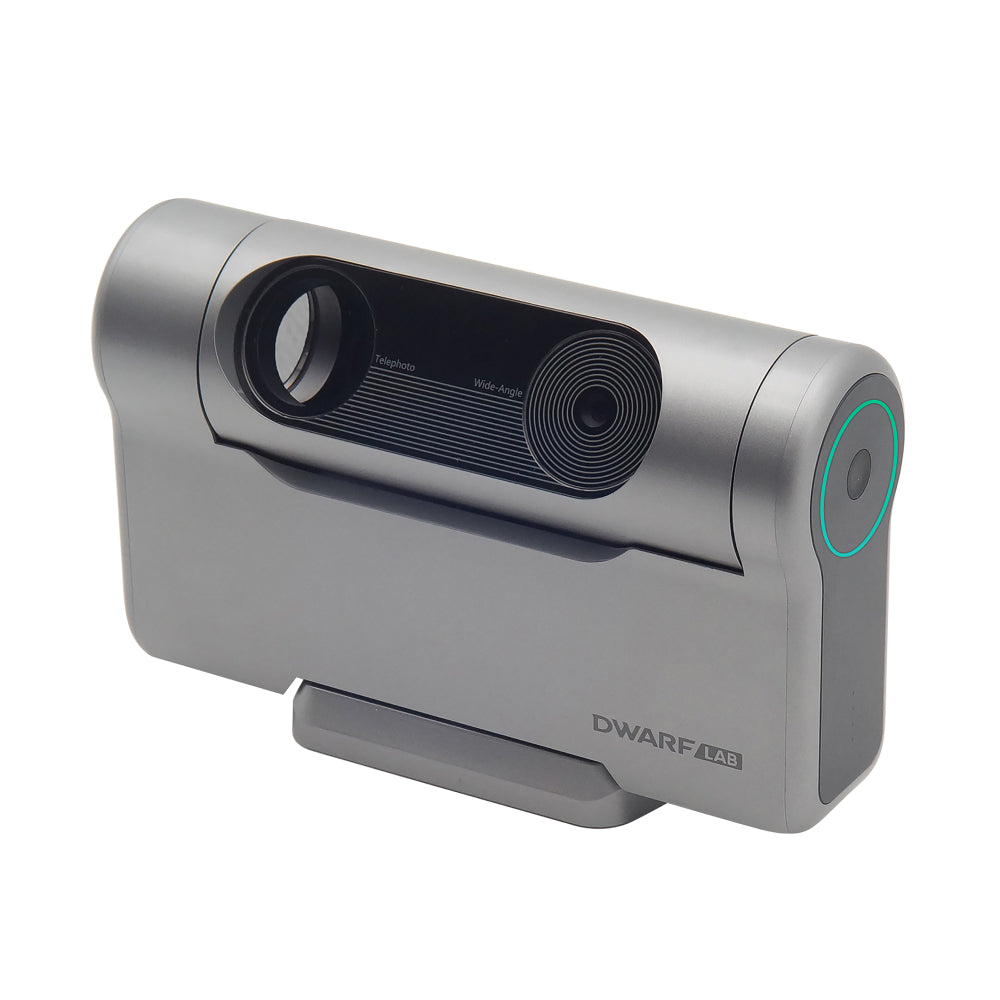
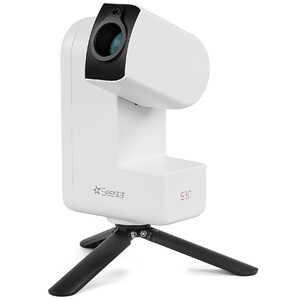
The specs are close. The experience isn't.
Affiliate links — we earn from qualifying purchases at no extra cost to you.
First light
Dwarf Labs · 24mm · £449
The app-native deep-sky imager
- 24mm sensor-based smart telescope — no traditional eyepiece
- Connects to a smartphone app; the app selects, slews to, and stacks targets automatically
- Best for: faint deep-sky objects — galaxies, nebulae, star clusters built up over minutes
- Not for direct eyepiece viewing — every view is delivered on a phone or tablet screen
- 1.5kg compact all-in-one unit
ZWO · 30mm · £329
The app-native deep-sky imager
- 30mm sensor-based smart telescope — no traditional eyepiece
- Connects to a smartphone app; the app selects, slews to, and stacks targets automatically
- Best for: faint deep-sky objects — galaxies, nebulae, star clusters built up over minutes
- Not for direct eyepiece viewing — every view is delivered on a phone or tablet screen
- 1.3kg compact all-in-one unit
The full picture
The numbers that separate these two scopes — and what they mean at the eyepiece.
Aperture
ZWO Seestar S30 gathers 1.6× more light. On bright targets — Moon, Saturn, Jupiter — you won't notice. On fainter targets — dim galaxies, faint globular clusters — the gap is real.
Focal length
ZWO Seestar S30's longer focal length reaches higher magnification with the same eyepiece — better reach for planetary detail. Dwarf Labs DWARF III's shorter focal length gives a wider true field — better for large open clusters and extended nebulae.
Focal ratio
Focal ratio is not meaningful for smart telescope sensor systems — the optics are optimised for the built-in sensor rather than interchangeable eyepieces.
Mount type
Same mount type — setup experience and ergonomics will be similar. Differences lie in build quality and included accessories.
Weight (OTA)
Similar optical tube weight. Any portability difference between these setups comes from the mount, not the tube itself.
Optical design
Both sensor-based smart telescopes — no eyepiece, app-controlled, live stacking. The differences are in sensor size, aperture, and companion software quality.
At the eyepiece
| Target | Dwarf Labs DWARF III | ZWO Seestar S30 |
|---|---|---|
| Planets | ||
| Moon | Challenging 24mm aperture captures the full disc with visible maria, but resolution is far below what even a small traditional telescope provides | Good 30mm aperture is below the 100mm threshold for Excellent, but the integrated camera and stacking deliver detailed crater and maria images on screen |
| Saturn | Not recommended 24mm aperture and 100mm focal length produce a tiny dot; ring elongation may be detectable but no meaningful detail | Not recommended 30mm aperture and 150mm focal length cannot meaningfully resolve the ring system — Saturn appears as a tiny, elongated blob |
| Jupiter | Not recommended Disc is barely resolved at 100mm focal length; no cloud bands or moon detail beyond points of light | Challenging Disc visible but far too small at 150mm focal length for cloud band detail; 30mm aperture limits resolution |
| Mars | Not recommended Appears as a bright dot with no disc detail even at opposition | Not recommended Sub-70mm aperture and very short focal length render Mars as a featureless dot |
Deep sky | ||
| Orion Nebula (M42) | Moderate Core and surrounding nebulosity visible after stacking; fast f/4.17 and wide field suit this target well, but 24mm aperture limits faint outer structure | Moderate Core and inner nebulosity visible with live stacking; 30mm aperture limits fainter outer structure, but 150mm focal length frames it well |
| Andromeda Galaxy (M31) | Good 100mm focal length captures the full galaxy extent; live stacking reveals the core and oval halo, with dust lane hints after extended integration | Moderate 150mm focal length captures the full extent easily, but 30mm aperture means only the bright core and inner disc emerge with stacking |
| Open clusters | Good Wide 100mm field of view is ideal for large clusters like the Pleiades and Double Cluster; stacking reveals star colours | Good 150mm focal length provides a wide field that frames large clusters like the Pleiades and Double Cluster beautifully |
| Globular clusters | Not recommended 24mm aperture cannot resolve individual stars; clusters appear as small unresolved fuzzy patches | Not recommended 30mm aperture cannot resolve individual stars — globulars appear as small, soft smudges even with stacking |
| Faint galaxies | Not recommended 24mm aperture collects too little light; only the brightest galaxy cores emerge after very long stacking | Not recommended 30mm aperture gathers too little light; most galaxies beyond the brightest Messier objects will not emerge meaningfully |
| Milky Way / wide field | Excellent 100mm focal length at f/4.17 is ideally suited to wide Milky Way star fields and large nebula regions | Excellent 150mm focal length and f/5 focal ratio are ideal for sweeping star fields and Milky Way patches |
Other | ||
| Double stars | Not recommended 24mm aperture has a Dawes limit of roughly 4.8 arcseconds — most interesting doubles are unresolvable, and screen viewing lacks the visual appeal | Challenging 30mm aperture limits resolving power to very wide pairs; close doubles are unresolvable, and there is no eyepiece for visual splitting |
| Bright emission nebulae | Good Fast f/4.17 optics and wide field suit large nebulae like the Lagoon, Eagle, and North America Nebula; stacking builds up signal well on these targets | Not applicable |
| Astrophotography (deep sky) | Not applicable | Moderate Integrated GoTo and tracking with f/5 focal ratio suit bright wide-field targets, but 30mm aperture severely limits faint-object reach |
| Astrophotography (planetary) | Not applicable | Not recommended 30mm aperture and 150mm focal length are far below the thresholds for useful planetary imaging |
| Large emission nebulae | Not applicable | Good Wide 150mm field of view and f/5 speed suit targets like the Rosette and North America Nebula; stacking compensates partially for small aperture on bright emission regions |
The real tradeoff
Both scopes are capable. The question is which one fits the way you actually observe.
Dwarf Labs DWARF III
- You'll set up on the patio, open the Dwarf Labs app, and within a few minutes of live stacking you'll watch the Orion Nebula bloom in pink and magenta on your phone — the f/4.17 optics gather light faster per frame than the S30's f/5, so bright nebulae fill in noticeably quicker.
- You'll pay £120 more for a slightly smaller aperture (24mm vs 30mm), but that faster focal ratio and 100mm focal length give you a wider true field of view that frames the biggest emission nebulae like the North America Nebula generously — it's a trade of light-gathering for speed and field.
- You'll find yourself reaching for an external battery pack on longer sessions, because the internal battery can run out before you've stacked enough frames on faint targets — plan your power or plan your targets.
ZWO Seestar S30
- You'll toss this in a jacket pocket or day bag without thinking twice — it's barely larger than a water bottle, meaningfully smaller and lighter than the DWARF III, and at £329 it's the cheapest smart telescope you can buy.
- You'll get about 56% more light-gathering area from the 30mm aperture compared to the DWARF III's 24mm, and the 150mm focal length gives slightly higher magnification on the sensor — so faint targets like M81 will show a touch more signal per frame, even if both scopes ultimately struggle with anything beyond the brightest deep-sky objects.
- You'll live and die by ZWO's Seestar app — there's limited manual camera control and minimal raw data export, so what the app decides to show you is essentially what you get, with little room to tweak results after the fact.
The dark side
Every scope has a personality. Here’s where each one gets difficult.
Dwarf Labs
Dwarf Labs DWARF III
At 24mm, this is the smaller aperture of the two — planets are essentially featureless dots, and even with extended stacking, faint galaxies and globular clusters remain soft, unresolved smudges.
The entire experience depends on the Dwarf Labs app: if the app bugs out or your phone's Wi-Fi connection drops, the telescope is a paperweight until you troubleshoot the link.
Internal battery life may not last through a full deep-sky stacking session — if you're imaging from a remote dark site without mains power, you'll need to bring a power bank or cut your session short.
ZWO
ZWO Seestar S30
30mm aperture gathers roughly one-third the light of ZWO's own Seestar S50 — faint galaxies are marginal and globular clusters show no star resolution even with long stacking, so you're largely limited to bright nebulae and the Moon.
The compact integrated tripod is a known weak point in wind; gusts can introduce vibration that degrades long stacking sequences, and there's little you can do about it short of shielding the scope.
You're locked into ZWO's processing pipeline with limited manual camera control and minimal raw data export — if you want to reprocess your data in PixInsight or similar, this isn't the scope to collect it with.
Which is right for you?
Two different buyers. Two different right answers.
The app-native deep-sky imager
Dwarf Labs · Dwarf Labs DWARF III
You want to share the Orion Nebula with your family on a tablet screen from the back garden, you don't own a telescope yet, and you'd rather spend a bit more (£449) for faster live-stacking results on big, bright nebulae. You're not interested in planets, you don't want to learn polar alignment or collimation, and you value the Dwarf Labs ecosystem and its wider field of view for large emission nebulae. This isn't for you if you want any kind of eyepiece experience, if you're chasing faint galaxies, or if you're an experienced astrophotographer expecting data you can seriously post-process.
The app-native deep-sky imager
ZWO · ZWO Seestar S30
You travel constantly — hiking, camping, flying — and you want a smart telescope that genuinely disappears into a bag. At £329, the S30 is the cheapest way to pull up a live-stacked Andromeda Galaxy on your phone at a campsite, and its 30mm aperture edges out the DWARF III on raw light-gathering. You're happy with bright targets and the Moon, and you accept that the app gives you what it gives you. This isn't for you if you want planetary detail of any kind, if you need to resolve faint deep-sky objects, or if you want manual control over your imaging data.
Our verdict
At similar price points, these scopes offer different amounts of aperture per pound. The ZWO Seestar S30 gives you more light-gathering for your money — and for visual observing, aperture per pound is the most useful single metric.
For pure optical value, the ZWO Seestar S30 is the stronger pick. The Dwarf Labs DWARF III compensates with other features — decide whether those trade-offs justify the premium. If I had to choose: the ZWO Seestar S30 — more aperture per pound means more sky.
Dwarf Labs DWARF III
View Dwarf Labs DWARF III →ZWO Seestar S30
View ZWO Seestar S30 →Affiliate links — we earn from qualifying purchases at no extra cost to you.
Deep field: Full specifications
Every data point, for those who want to go further.
Full specifications
Fields highlighted in blue or amber indicate the better value for that spec. Data is manufacturer-stated and may vary.
How much can it see?
| Spec | Dwarf Labs DWARF III | ZWO Seestar S30 |
|---|---|---|
Apertureⓘ The most important spec — bigger = more light = better views | 24mm | 30mm |
Focal Length Longer = more magnification potential | 100mm | 150mm |
Focal Ratio Lower f-number = wider field of view; higher = more magnification per eyepiece | f/4.17 | f/5 |
Optical Design The type of optics — each design has different strengths | Smart Telescope | Smart Telescope |
Coatings Better coatings = more light transmission through the optics | Multi-coated objective with upgraded optics | Multi-coated ED objective |
How do you point it?
| Spec | Dwarf Labs DWARF III | ZWO Seestar S30 |
|---|---|---|
Mount Type The mechanical system that holds and moves the telescope | Integrated | Integrated |
GoTo Computer-controlled pointing — finds any of thousands of objects automatically | ||
Tracking Motor keeps objects centred as the Earth rotates — essential for astrophotography |
The focuser
| Spec | Dwarf Labs DWARF III | ZWO Seestar S30 |
|---|---|---|
Focuser Size 2" accepts wider eyepieces and gives better low-power views | — | — |
Focuser Type Rack-and-pinion is standard; Crayford and dual-speed are smoother | Fixed focus (app-controlled fine adjustment) | Motorised electric focuser (auto-focus via software) |
Size & weight
| Spec | Dwarf Labs DWARF III | ZWO Seestar S30 |
|---|---|---|
OTA Weightⓘ Optical tube only — useful for comparing mount load capacity | 1.5kg | 1.3kg |
Total Weightⓘ Full setup including mount — this is what you lug to the car | 1.5kg | 1.3kg |
Tube Material | Polycarbonate and aluminium alloy | Aluminium alloy with polycarbonate housing |
What's in the box?
| Spec | Dwarf Labs DWARF III | ZWO Seestar S30 |
|---|---|---|
Diagonal Tilts the eyepiece 90° for comfortable viewing — useful on refractors |
Smart features
| Spec | Dwarf Labs DWARF III | ZWO Seestar S30 |
|---|---|---|
Built-in Camera Records and stacks images automatically — no separate camera needed | ||
App Controlled | ||
WiFi | ||
Battery Included | ||
Sensor | 1/1.8" Sony CMOS | 1/2.8" Sony IMX462 CMOS |
Sensor Resolutionⓘ Higher megapixels captures finer detail | 4MP | 2.1MP |
Blue highlight: Dwarf Labs DWARF III advantage · Amber highlight: ZWO Seestar S30 advantage · Greyed cells: equal or subjective.