Telescope Comparison
Sky-Watcher Evostar 80ED + HEQ5 Pro vs William Optics GT81
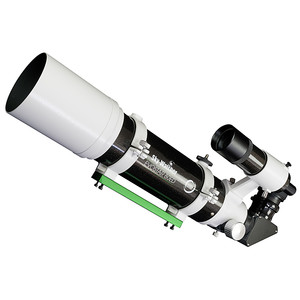
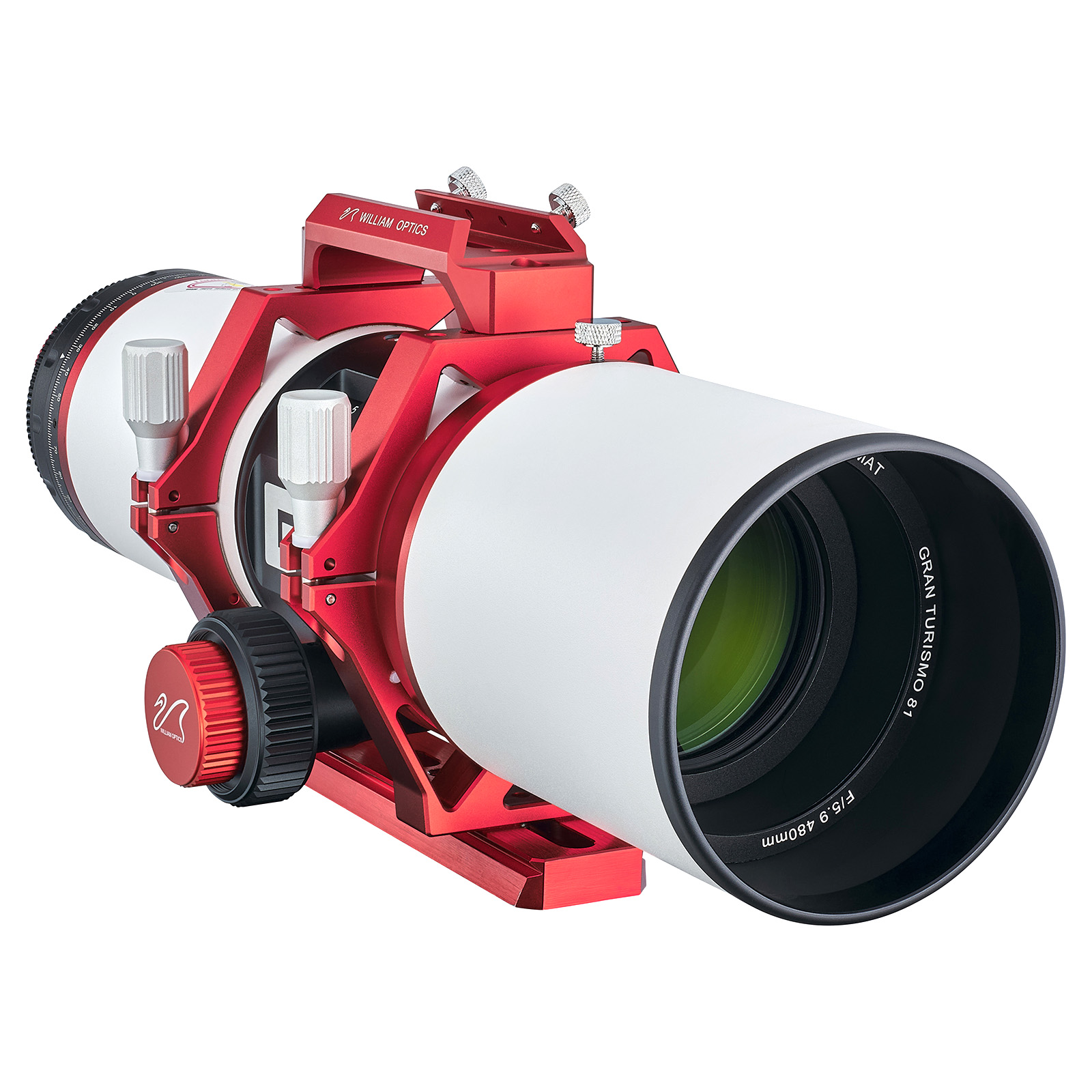
The Sky-Watcher Evostar 80ED + HEQ5 Pro is a complete setup. The William Optics GT81 needs a mount before it's usable.
Affiliate links — we earn from qualifying purchases at no extra cost to you.
First light
Sky-Watcher · 80mm · £690
The automated deep-sky platform
- 80mm refractor on a computerised mount with motorised tracking
- Good for: Moon, planets, bright nebulae, star clusters, and deep-sky objects
- GoTo system finds any object in its database after initial star alignment — no star atlas needed
- Tracking motors keep objects centred as Earth rotates — useful above 100×, essential for photography
- 22.5kg total — requires a fixed garden spot or car transport
William Optics · 81mm · £699
The custom-rig optical tube
- 81mm refractor — optical tube only, no mount included
- 478mm focal length at f/5.9
- Requires a compatible mount before you can observe anything
- Best for: observers who already own a suitable mount or are building a specific imaging rig
- Not a complete purchase — budget at least £100–300 extra for a mount before observing
The full picture
The numbers that separate these two scopes — and what they mean at the eyepiece.
Aperture
Effectively equal light-gathering. Aperture won't settle this comparison — the mount, focal ratio, and observing experience are what differ.
Focal length
Sky-Watcher Evostar 80ED + HEQ5 Pro's longer focal length reaches higher magnification with the same eyepiece — better reach for planetary detail. William Optics GT81's shorter focal length gives a wider true field — better for large open clusters and extended nebulae.
Focal ratio
William Optics GT81's faster f/5.9 delivers wider fields with any eyepiece — better for open clusters and large nebulae. Sky-Watcher Evostar 80ED + HEQ5 Pro's f/7.5 provides more magnification per eyepiece — better for fine planetary detail.
Mount type
William Optics GT81 has no mount — add a compatible mount before you can observe. Sky-Watcher Evostar 80ED + HEQ5 Pro is a complete ready-to-use system.
Weight (OTA)
Similar optical tube weight. Any portability difference between these setups comes from the mount, not the tube itself.
Optical design
Both are refractors — no mirrors to collimate, good contrast, colour-free stars with ED or APO glass. The differences between them are in aperture, focal ratio, and glass quality.
At the eyepiece
| Target | Sky-Watcher Evostar 80ED + HEQ5 Pro | William Optics GT81 |
|---|---|---|
| Planets | ||
| Moon | Good 80mm aperture delivers sharp, colour-free craters and terminator detail; f/7.5 limits extreme magnification compared to longer focal length scopes | Excellent 81mm aperture delivers sharp, high-contrast lunar detail; the triplet design keeps the terminator free of colour fringing, though the short focal length limits magnification without a Barlow |
| Saturn | Moderate Rings clearly visible and disc shows colour, but 600mm focal length keeps the image small — Cassini Division requires excellent seeing and high-power eyepieces | Moderate Rings clearly visible and colour-free, but 81mm aperture and 478mm focal length make the Cassini Division very difficult |
| Jupiter | Moderate Main equatorial belts visible; 80mm aperture and 600mm focal length limit detail on the Great Red Spot and festoons | Moderate Main equatorial belts visible in steady seeing; 81mm resolves limited banding detail and the Great Red Spot is marginal |
| Mars | Challenging Small orange disc visible at opposition; polar cap glimpsable in ideal conditions but surface albedo features are beyond this aperture | Challenging Small orange disc visible at opposition; 81mm aperture insufficient to resolve surface features reliably |
Deep sky | ||
| Orion Nebula (M42) | Excellent Wide 600mm field frames the full nebula and Running Man beautifully — bright enough to show structure visually and a superb imaging target | Excellent Bright nebula easily visible; 478mm focal length at f/5.9 frames the full extent with surrounding nebulosity |
| Andromeda Galaxy (M31) | Excellent 600mm focal length captures the full galaxy extent including companion galaxies; one of this scope's signature imaging targets | Excellent 478mm focal length captures the core and dust lanes in a single wide field; aperture shows the inner halo structure |
| Open clusters | Excellent Wide field perfectly frames the Double Cluster, Pleiades, and other large clusters with pin-sharp stars across the field | Excellent Wide-field sweet spot — Pleiades, Double Cluster, and M35 are beautifully framed with colour-free stars |
| Globular clusters | Challenging 80mm aperture cannot resolve individual stars — M13 and M3 appear as fuzzy, unresolved glows | Challenging 81mm aperture shows globulars like M13 as fuzzy balls with no individual star resolution |
| Faint galaxies | Moderate Visually limited by 80mm aperture; however, with camera and stacked exposures, many faint galaxies are accessible photographically | Moderate Core of brighter galaxies like M81/M82 visible under dark skies, but 81mm gathers limited light for faint targets |
| Milky Way / wide field | Good 600mm focal length is at the long end for sweeping Milky Way fields visually, but on camera the wide field and fast optics capture rich starfields well | Excellent 478mm at f/5.9 is ideal for sweeping rich star fields; low-power eyepieces deliver expansive true fields |
Other | ||
| Double stars | Good Clean ED optics split well-separated doubles cleanly; Dawes limit at 80mm is ~1.45 arcsec, so tight pairs are out of reach | Good Clean optics split wider doubles cleanly with no false colour, but 81mm limits resolution on close pairs below about 1.4 arcseconds |
| Astrophotography (deep sky) | Excellent HEQ5 Pro GoTo mount with tracking, 80mm ED optics at f/7.5 (f/6.3 with reducer), and massive payload headroom make this a benchmark widefield imaging rig | Not recommended No mount or tracking included; however, when paired with a suitable equatorial mount this becomes an excellent deep-sky imaging platform at f/5.9 |
| Astrophotography (planetary) | Challenging 80mm aperture and 600mm focal length produce a small planetary disc — limited detail even with lucky imaging techniques | Challenging 81mm aperture and 478mm focal length produce a small planetary image scale; limited even with a Barlow |
| Large emission nebulae (imaging) | Not applicable | Excellent Fast f/5.9 triplet with flat, colour-free field excels on targets like the Veil, North America Nebula, and Heart Nebula when paired with a narrowband or one-shot colour camera on a tracking mount |
The real tradeoff
Both scopes are capable. The question is which one fits the way you actually observe.
Sky-Watcher Evostar 80ED + HEQ5 Pro
- You arrive at the field with a complete, ready-to-observe system — mount, tripod, and OTA all in hand — and spend your first ten minutes on polar alignment before your autoguider takes over.
- Your observing session unfolds on a camera sensor; you compose wide nebula fields through the camera app, lock in 3–5 minute exposures with autoguiding, and spend your night refining focus and watching guided frames stack.
- You're rewarded with enormous payload headroom — you'll comfortably add a guide scope, camera, filter wheel, and dew heater without taxing the mount, but you're also committed to learning image stacking, PHD2, and ASIAIR or similar software.
William Optics GT81
- You leave the shop with just the tube and must source a mount, diagonal, and eyepieces separately — total system cost balloons beyond the £699 price — but you gain complete freedom to pair it with the mount philosophy that suits your observing style.
- Your observing session is pure widefield visual; you slot in a 20mm or 25mm eyepiece and sweep the Milky Way or frame Andromeda whole, enjoying real-time views without software, sensor cooling, or image stacking.
- You're rewarded with pin-point, colour-free stars across the field and a scope light enough to grab for a quick session, but you'll compromise on planetary detail and must accept that faint galaxies remain invisible no matter how long you stare.
The dark side
Every scope has a personality. Here’s where each one gets difficult.
Sky-Watcher
Sky-Watcher Evostar 80ED + HEQ5 Pro
80mm aperture severely limits visual performance — globular clusters remain unresolved fuzz, galaxies are barely detectable, and planets show only their largest features.
The ED doublet (not a triplet APO) exhibits residual violet fringing on bright stars at high magnification, though this is negligible for imaging work.
Field flattener is sold separately — without it, unguided exposures show pronounced edge coma and field curvature on camera sensors, and even guided imaging benefits from the additional optics.
The HEQ5 Pro weighs ~10 kg at the head alone plus a substantial tripod — this is not a grab-and-go system, and you must perform careful polar alignment before each observing session.
Astrophotography workflow requires significant additional investment in a dedicated astronomy camera, autoguiding system, image stacking software, and accessories well beyond the £899 bundle price.
William Optics
William Optics GT81
Sold as OTA only with no mount, diagonal, or eyepieces included — the £699 price tag masks the true system cost once you add a suitable equatorial mount and accessories.
81mm aperture is fundamentally limiting for planetary and double-star observation — the Cassini Division on Saturn is difficult to resolve, and Mars shows minimal detail except near opposition.
Field curvature at the edges of the native focal plane requires a dedicated flattener for serious astrophotography, adding further cost and optical complication.
Short 478mm focal length forces you to use very short-focal-length eyepieces or a Barlow for high magnification, which compromises eye relief and practical usability for extended lunar or planetary work.
Some production runs lack a built-in focuser lock — under the weight of a heavy imaging camera train, the focuser may slip during long exposures or when moving the scope.
Which is right for you?
Two different buyers. Two different right answers.
The automated deep-sky platform
Sky-Watcher · Sky-Watcher Evostar 80ED + HEQ5 Pro
You'll love this if you're ready to commit to astrophotography and want a complete, GoTo-equipped system that tracks reliably through long exposures and carries serious accessory payload without strain. You're comfortable spending time on polar alignment and learning image acquisition software, and you're drawn to nebulae, galaxies, and starfields rather than planetary detail. The HEQ5 Pro's accuracy and the ED refractor's colour-free, wide-field imaging character will reward your investment with stunning widefield deep-sky frames. This isn't for you if you want a grab-and-go visual telescope, demand high-power planetary views, or resent the learning curve of autoguiding and image stacking.
The custom-rig optical tube
William Optics · William Optics GT81
You'll love this if you're a visual observer seeking a lightweight, colour-corrected widefield instrument that lets you sweep the Milky Way and frame entire nebulae in a single eyepiece view, and you're willing to source your own mount and accessories to suit your preferences. You value simplicity in the field — no autoguider, no software, just pure looking — and you don't mind spending money on a quality equatorial mount because you've already chosen your observing philosophy. This isn't for you if you want a ready-to-use package with no assembly required, if you crave planetary detail and fine lunar features, or if you expect to pull detail from faint galaxies with an 81mm aperture.
Our verdict
This comparison has a catch: the William Optics GT81 is a bare optical tube. You cannot use it without a separate mount — which adds meaningful cost and complexity. The Sky-Watcher Evostar 80ED + HEQ5 Pro is a complete, ready-to-observe package.
For most buyers, the Sky-Watcher Evostar 80ED + HEQ5 Pro is the right choice — you can observe the same night it arrives. The William Optics GT81 makes sense if you already own a compatible mount, or are deliberately building a specific imaging setup piece by piece. If I had to choose for a first telescope: the Sky-Watcher Evostar 80ED + HEQ5 Pro, without hesitation.
Sky-Watcher Evostar 80ED + HEQ5 Pro
View Sky-Watcher Evostar 80ED + HEQ5 Pro →William Optics GT81
View William Optics GT81 →Affiliate links — we earn from qualifying purchases at no extra cost to you.
Deep field: Full specifications
Every data point, for those who want to go further.
Full specifications
Fields highlighted in blue or amber indicate the better value for that spec. Data is manufacturer-stated and may vary.
How much can it see?
| Spec | Sky-Watcher Evostar 80ED + HEQ5 Pro | William Optics GT81 |
|---|---|---|
Apertureⓘ The most important spec — bigger = more light = better views | 80mm | 81mm |
Focal Length Longer = more magnification potential | 600mm | 478mm |
Focal Ratio Lower f-number = wider field of view; higher = more magnification per eyepiece | f/7.5 | f/5.9 |
Optical Design The type of optics — each design has different strengths | Refractor | Refractor |
Coatings Better coatings = more light transmission through the optics | Fully multi-coated ED glass, FMC on all air-to-glass surfaces | Fully multi-coated FMC ED triplet on all air-to-glass surfaces |
How do you point it?
| Spec | Sky-Watcher Evostar 80ED + HEQ5 Pro | William Optics GT81 |
|---|---|---|
Mount Type The mechanical system that holds and moves the telescope | GoTo (Computerised) | None (OTA only) |
GoToⓘ Computer-controlled pointing — finds any of thousands of objects automatically | ||
Trackingⓘ Motor keeps objects centred as the Earth rotates — essential for astrophotography |
The focuser
| Spec | Sky-Watcher Evostar 80ED + HEQ5 Pro | William Optics GT81 |
|---|---|---|
Focuser Size 2" accepts wider eyepieces and gives better low-power views | 2" | 2" / 1.25" |
Focuser Type Rack-and-pinion is standard; Crayford and dual-speed are smoother | Crayford dual-speed (with 1.25" adapter) | Dual-speed Crayford 2" (10:1 reduction fine focus) |
Size & weight
| Spec | Sky-Watcher Evostar 80ED + HEQ5 Pro | William Optics GT81 |
|---|---|---|
OTA Weightⓘ Optical tube only — useful for comparing mount load capacity | 2.2kg | 2.5kg |
Total Weight Full setup including mount — this is what you lug to the car | 22.5kg | — |
Tube Length | 600mm | 380mm |
Tube Material | Aluminium, white powder coat | Aluminium, anodised |
What's in the box?
| Spec | Sky-Watcher Evostar 80ED + HEQ5 Pro | William Optics GT81 |
|---|---|---|
Eyepieces Included eyepieces — more is better, but quality matters more than quantity | 25mm Super eyepiece | — |
Finder Scope Helps you locate areas of the sky before switching to the main eyepiece | 8x50 right-angle correct-image finder with illuminated reticle | — |
Diagonal Tilts the eyepiece 90° for comfortable viewing — useful on refractors |
Blue highlight: Sky-Watcher Evostar 80ED + HEQ5 Pro advantage · Amber highlight: William Optics GT81 advantage · Greyed cells: equal or subjective.