Telescope Comparison
Sky-Watcher Explorer 150PL vs Sky-Watcher Heritage 150P
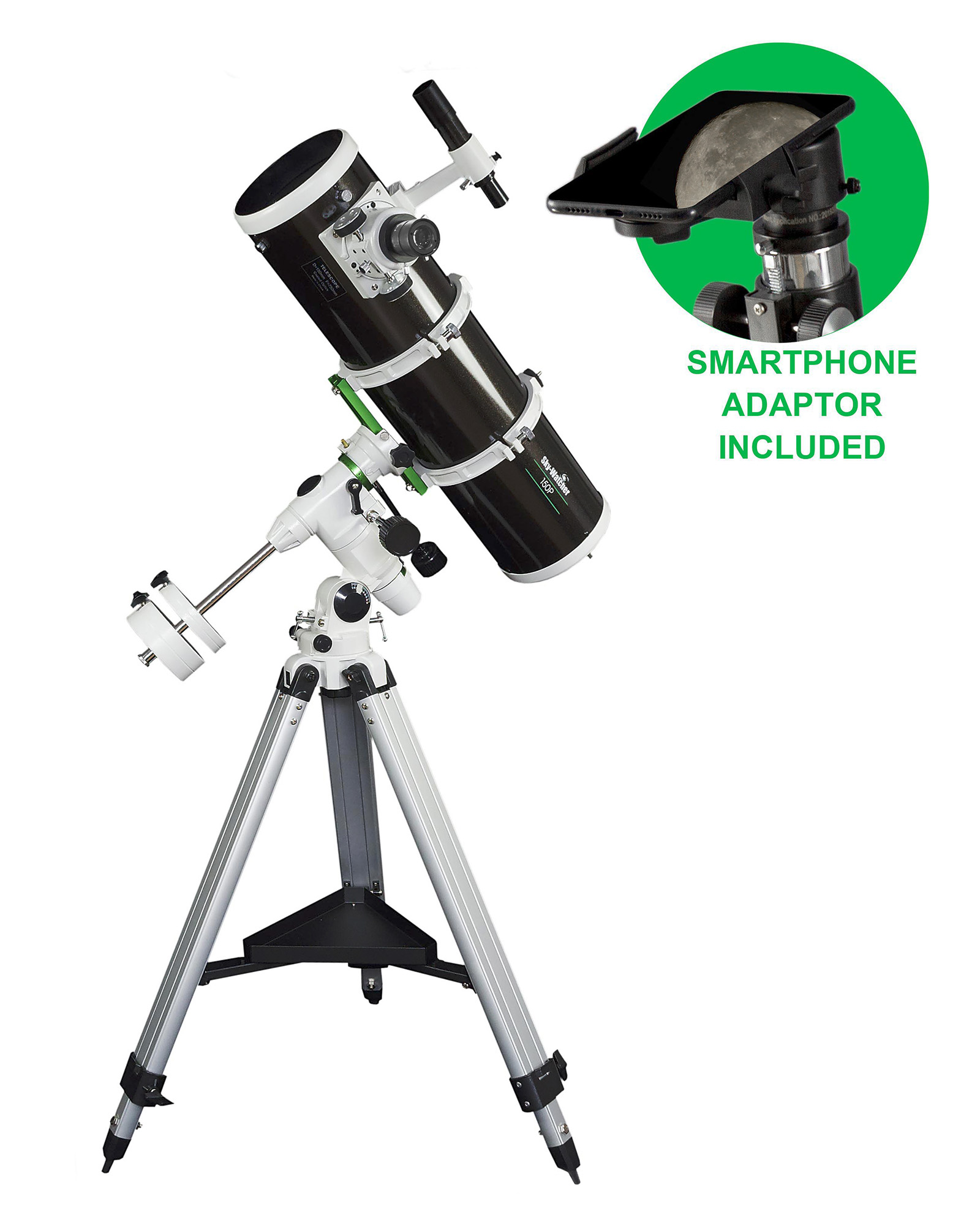
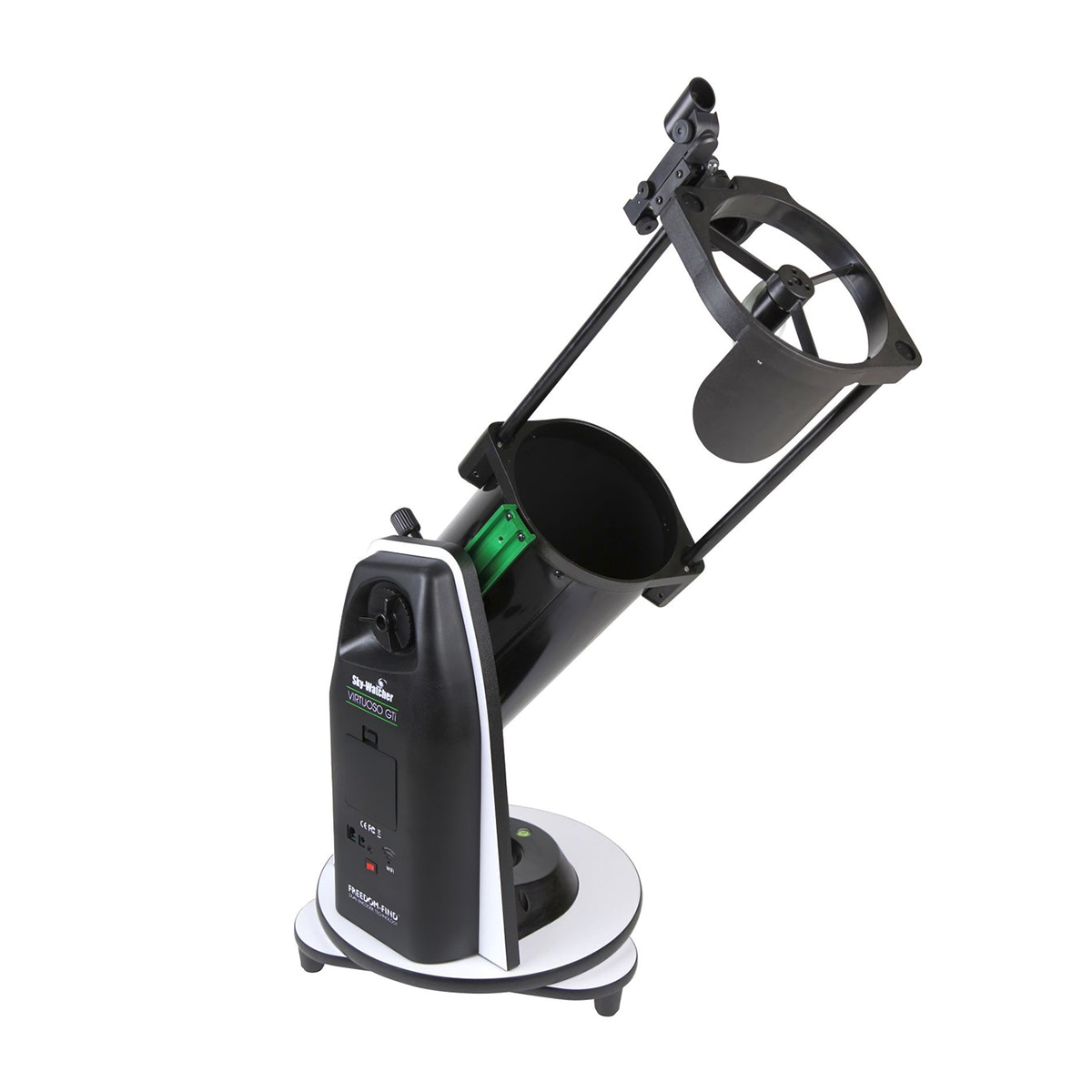
Same optics. Different mount philosophy.
Affiliate links — we earn from qualifying purchases at no extra cost to you.
First light
Sky-Watcher · 150mm · £249
The sky-learner's equatorial scope
- 150mm newtonian reflector on a manual equatorial mount
- Good for: Moon, planets, bright star clusters and nebulae
- Setup includes rough polar alignment before observing — more steps than a simple alt-az
- Mount axes feel counterintuitive at first; users find they become natural after several sessions
- Keeps the door open for adding tracking motors and moving into astrophotography later
Sky-Watcher · 150mm · £199
The grab-and-go tabletop reflector
- 150mm Newtonian on a tabletop Dobsonian rocker-box mount
- Good for: Moon, planets, open clusters, bright nebulae
- No alignment procedure — set it on any solid surface and observe immediately
- Needs a stable surface at a comfortable height: garden table, wall, or car tailgate
- Mirrors need occasional collimation — straightforward with a Cheshire eyepiece once learned
The full picture
The numbers that separate these two scopes — and what they mean at the eyepiece.
Aperture
Effectively equal light-gathering. Aperture won't settle this comparison — the mount, focal ratio, and observing experience are what differ.
Focal length
Sky-Watcher Explorer 150PL's longer focal length reaches higher magnification with the same eyepiece — better reach for planetary detail. Sky-Watcher Heritage 150P's shorter focal length gives a wider true field — better for large open clusters and extended nebulae.
Focal ratio
Sky-Watcher Heritage 150P's faster f/5 delivers wider fields with any eyepiece — better for open clusters and large nebulae. Sky-Watcher Explorer 150PL's f/8 provides more magnification per eyepiece — better for fine planetary detail.
Mount type
Sky-Watcher Heritage 150P's Dobsonian is immediately intuitive — no alignment, push to aim, observe. Sky-Watcher Explorer 150PL's equatorial mount requires polar alignment before each session but tracks the sky as Earth rotates, keeping objects centred.
Weight (OTA)
Similar optical tube weight. Any portability difference between these setups comes from the mount, not the tube itself.
Optical design
Both are Newtonian reflectors — the same optical formula. Any performance difference comes from collimation quality, focal ratio, and eyepiece choice, not the design itself.
At the eyepiece
| Target | Sky-Watcher Explorer 150PL | Sky-Watcher Heritage 150P |
|---|---|---|
| Planets | ||
| Moon | Excellent 150mm aperture and f/8 focal ratio reward high-magnification lunar detail — craterlets, rilles, and shadow play along the terminator are superb. | Excellent 150mm aperture delivers crisp crater walls, rilles, and shadow detail; the relatively short f/5 ratio benefits from a Barlow for high-power lunar work |
| Saturn | Excellent 150mm aperture and 1200mm focal length put Cassini Division and cloud banding within reach in steady seeing. | Good Rings clearly defined, Cassini Division visible in steady seeing; 750mm focal length means you'll need a short eyepiece or Barlow for best scale |
| Jupiter | Excellent Multiple cloud belts, the Great Red Spot, and Galilean moon shadows are visible at 150–200x. | Good Two main equatorial belts, Great Red Spot, and Galilean moons; 150mm resolves some secondary belt structure in good conditions |
| Mars | Good 150mm aperture shows the polar cap and dark surface markings near opposition — benefits from the long focal length for scale. | Good At opposition the disc shows polar cap and dark surface markings; limited by the 750mm focal length requiring high-power eyepieces |
Deep sky | ||
| Orion Nebula (M42) | Good Bright core and Trapezium are striking, but the 1200mm focal length crops the outer nebulosity compared to a wider-field scope. | Excellent Bright nebulosity fills the field with sweeping wings of gas; Trapezium stars cleanly split; f/5 speed gives excellent surface brightness |
| Andromeda Galaxy (M31) | Moderate Bright core is easy, but the galaxy's full extent far exceeds the narrow field — only the central region is visible. | Good Bright core and inner halo visible with hints of dust lane; at 750mm focal length the full 3° extent is cropped in most eyepieces but the core view is detailed |
| Open clusters | Moderate Larger clusters like the Double Cluster overfill the field at 1200mm; smaller, compact clusters fare better. | Excellent 750mm focal length with a wide-field eyepiece frames the Double Cluster, Pleiades, and M35 beautifully; f/5 speed gives bright star images |
| Globular clusters | Good 150mm begins to resolve stars at the edges of M13 and M22 — a clear step up from smaller apertures. | Good M13 and M3 show partial resolution into stars at the edges with a granular core — 150mm is right at the threshold for meaningful resolution |
| Faint galaxies | Good 150mm gathers enough light to detect many Messier and brighter NGC galaxies, though detail is limited. | Good 150mm pulls in galaxies like M81/M82, M51, and the Leo Triplet as defined smudges with hints of structure under dark skies |
| Milky Way / wide field | Not recommended 1200mm focal length gives far too narrow a field for sweeping Milky Way star fields. | Good 750mm focal length with a 25mm+ eyepiece gives attractive star-rich sweeps through Cygnus and Sagittarius; wider dedicated instruments do this better |
Other | ||
| Double stars | Excellent 150mm aperture and f/8 focal ratio produce clean, high-contrast Airy discs — resolves pairs down to about 0.8 arcseconds. | Good 150mm resolves doubles down to about 0.8 arcseconds; the f/5 focal ratio means less clean diffraction patterns than a long-focal-ratio refractor, but Albireo, the Double Double, and Mizar are easy |
| Astrophotography (planetary) | Good 150mm aperture and 1200mm focal length suit webcam planetary imaging; the optional RA motor drive is strongly recommended to reduce drift. | Moderate Short planetary video captures are possible with a webcam or phone adapter, but manual tracking makes keeping the planet centered difficult at high magnification |
The real tradeoff
Both scopes are capable. The question is which one fits the way you actually observe.
Sky-Watcher Explorer 150PL
- You spend your first ten minutes on polar alignment, then settle in for hours tracking Saturn's Cassini Division and Jupiter's Great Red Spot without the field drifting away from you — the equatorial mount keeps your planetary targets steady as you dial up the magnification.
- You'll need to manually guide objects back into view at high power, but the slow-motion controls let you chase fine detail at 200x or more, rewarding patience with views of tight double stars like Castor that few other £250 scopes can split cleanly.
- Your observing sessions demand setup time: the 1.2-metre tube needs careful balancing, storage space, and transport planning, but once mounted it transforms into a dedicated planetary instrument that doesn't ask you to compromise on eyepiece quality.
Sky-Watcher Heritage 150P
- You grab it from the cupboard, plonk it on your garden table, and within two minutes you're sweeping the Milky Way and resolving globular clusters into stars — there's no alignment, no collimation cap fuss, no tube balancing, just pure spontaneity.
- The wide f/5 field of view means M42 fills the eyepiece with nebulosity and the Double Cluster frames beautifully, but push the magnification for planets and you'll find yourself nudging the base constantly to keep Jupiter centred, and the view softens at the field edges unless you invest in better eyepieces.
- You're confined to observing from a sturdy table or stand — ground use is awkward because the 5.6 kg tube sits too high — but in return you get genuine deep-sky punch in a package that collapses small enough to live in a flat or travel in a car boot.
The dark side
Every scope has a personality. Here’s where each one gets difficult.
Sky-Watcher
Sky-Watcher Explorer 150PL
The EQ3-2 mount is marginal for the long 150PL tube; wind and vibration cause noticeable shake at high magnification, especially on nights with breeze.
No motor drive included, so objects drift out of view at high power and require constant manual correction via slow-motion controls — this is tedious for casual planetary viewing.
The 1200mm tube is roughly 1.2 metres long, creating genuine headaches for storage, transport, and balancing; collimation is required periodically and the supplied 6x30 finder is small and dim enough that most users will want to upgrade.
Sky-Watcher
Sky-Watcher Heritage 150P
Requires a sturdy table or stand — the 5.6 kg tube is too tall and heavy for comfortable ground use, and a wobbly surface will ruin planetary contrast and fine deep-sky detail.
The open FlexTube design lets stray light enter from the side, significantly degrading contrast on deep-sky objects unless you use a fabric light shroud; collimation will drift over time with the collapsible tube and needs a collimation cap or laser collimator.
The f/5 focal ratio is demanding on eyepieces — the included 25mm and 10mm are adequate but not sharp enough to exploit the aperture fully, and budget Plössls and Kellners show noticeable coma and blurring at the field edge.
Which is right for you?
Two different buyers. Two different right answers.
The sky-learner's equatorial scope
Sky-Watcher · Sky-Watcher Explorer 150PL
You'll love the 150PL if you're a patient planetary observer willing to invest setup time for high-magnification lunar and planetary views, or if you want to learn equatorial mount control without GoTo complexity — the 1200mm focal length and equatorial tracking give you clean, steady views of Saturn's divisions and close double stars that justify the long tube and careful balancing. This isn't for you if you crave spontaneity, need wide-field deep-sky framing, or lack storage space for a 1.2-metre tube.
The grab-and-go tabletop reflector
Sky-Watcher · Sky-Watcher Heritage 150P
You'll love the Heritage 150P if you want genuine aperture in a grab-and-go package that sets up on any sturdy garden table in seconds, or if your observing life revolves around deep-sky objects like globular clusters and nebulae where the f/5 field of view shines — you get real structure in M13 and M42 without needing an expensive equatorial mount. This isn't for you if you lack a dedicated observing table at the right height, if you're a high-magnification planetary fanatic who won't tolerate constant nudging, or if you expect to use the scope fresh from the box without investing in a light shroud and better eyepieces.
Our verdict
Same aperture, same light-gathering, £50 price difference. The extra cost of the Sky-Watcher Explorer 150PL buys a different mount — not better optics.
For most beginners, the Sky-Watcher Heritage 150P is the right starting point — the optics are identical and the savings are better spent on a quality eyepiece or a dark-sky trip. The Sky-Watcher Explorer 150PL makes sense if the mount it comes with is specifically what you want to learn. If I had to choose: the Sky-Watcher Heritage 150P — same sky, less money.
Sky-Watcher Explorer 150PL
View Sky-Watcher Explorer 150PL →Sky-Watcher Heritage 150P
View Sky-Watcher Heritage 150P →Affiliate links — we earn from qualifying purchases at no extra cost to you.
Deep field: Full specifications
Every data point, for those who want to go further.
Full specifications
Fields highlighted in blue or amber indicate the better value for that spec. Data is manufacturer-stated and may vary.
How much can it see?
| Spec | Sky-Watcher Explorer 150PL | Sky-Watcher Heritage 150P |
|---|---|---|
Aperture The most important spec — bigger = more light = better views | 150mm | 150mm |
Focal Length Longer = more magnification potential | 1200mm | 750mm |
Focal Ratio Lower f-number = wider field of view; higher = more magnification per eyepiece | f/8 | f/5 |
Optical Design The type of optics — each design has different strengths | Newtonian Reflector | Newtonian Reflector |
Coatings Better coatings = more light transmission through the optics | Parabolic primary mirror with multi-coated optics | Parabolic primary mirror with multi-coated optics |
How do you point it?
| Spec | Sky-Watcher Explorer 150PL | Sky-Watcher Heritage 150P |
|---|---|---|
Mount Type The mechanical system that holds and moves the telescope | Equatorial | Dobsonian |
GoTo Computer-controlled pointing — finds any of thousands of objects automatically | ||
Tracking Motor keeps objects centred as the Earth rotates — essential for astrophotography |
The focuser
| Spec | Sky-Watcher Explorer 150PL | Sky-Watcher Heritage 150P |
|---|---|---|
Focuser Size 2" accepts wider eyepieces and gives better low-power views | 1.25" | 1.25" |
Focuser Type Rack-and-pinion is standard; Crayford and dual-speed are smoother | Rack and pinion | Rack and pinion |
Size & weight
| Spec | Sky-Watcher Explorer 150PL | Sky-Watcher Heritage 150P |
|---|---|---|
OTA Weightⓘ Optical tube only — useful for comparing mount load capacity | 5.1kg | 5.2kg |
Total Weightⓘ Full setup including mount — this is what you lug to the car | 14kg | 5.2kg |
Tube Length | 900mm | 550mm |
Tube Material | Steel | Steel (collapsible FlexTube) |
What's in the box?
| Spec | Sky-Watcher Explorer 150PL | Sky-Watcher Heritage 150P |
|---|---|---|
Eyepieces Included eyepieces — more is better, but quality matters more than quantity | 25mm and 10mm Kellner | 25mm and 10mm Super eyepieces |
Finder Scope Helps you locate areas of the sky before switching to the main eyepiece | 6x30 optical finder scope | Red dot finder |
Diagonal Tilts the eyepiece 90° for comfortable viewing — useful on refractors |
Blue highlight: Sky-Watcher Explorer 150PL advantage · Amber highlight: Sky-Watcher Heritage 150P advantage · Greyed cells: equal or subjective.