Telescope Comparison
Sky-Watcher Quattro 150P vs Sky-Watcher Virtuoso GTi 130P
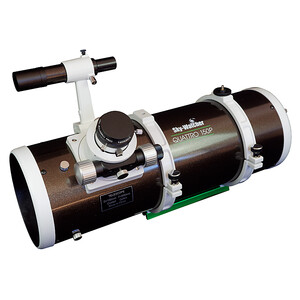
The Sky-Watcher Virtuoso GTi 130P is a complete setup. The Sky-Watcher Quattro 150P needs a mount before it's usable.
Affiliate links — we earn from qualifying purchases at no extra cost to you.
First light
Sky-Watcher · 150mm · £399
The custom-rig optical tube
- 150mm newtonian reflector — optical tube only, no mount included
- 750mm focal length at f/5
- Requires a compatible mount before you can observe anything
- Best for: observers who already own a suitable mount or are building a specific imaging rig
- Not a complete purchase — budget at least £100–300 extra for a mount before observing
Sky-Watcher · 130mm · £349
The guided beginner's telescope
- 130mm newtonian reflector on a computerised mount with motorised tracking
- Good for: Moon, planets, bright nebulae, star clusters, and deep-sky objects
- GoTo system finds any object in its database after initial star alignment — no star atlas needed
- Tracking motors keep objects centred as Earth rotates — useful above 100×, essential for photography
- 4.8kg total — requires a fixed garden spot or car transport
The full picture
The numbers that separate these two scopes — and what they mean at the eyepiece.
Aperture
Sky-Watcher Quattro 150P gathers 1.3× more light. On bright targets — Moon, Saturn, Jupiter — you won't notice. On fainter targets — dim galaxies, faint globular clusters — the gap is real.
Focal length
Sky-Watcher Quattro 150P's longer focal length reaches higher magnification with the same eyepiece — better reach for planetary detail. Sky-Watcher Virtuoso GTi 130P's shorter focal length gives a wider true field — better for large open clusters and extended nebulae.
Focal ratio
Same focal ratio — the same eyepiece gives equivalent magnification and true field in both scopes.
Mount type
Sky-Watcher Quattro 150P has no mount — add a compatible mount before you can observe. Sky-Watcher Virtuoso GTi 130P is a complete ready-to-use system.
Weight (OTA)
Similar optical tube weight. Any portability difference between these setups comes from the mount, not the tube itself.
Optical design
Both are Newtonian reflectors — the same optical formula. Any performance difference comes from collimation quality, focal ratio, and eyepiece choice, not the design itself.
At the eyepiece
| Target | Sky-Watcher Quattro 150P | Sky-Watcher Virtuoso GTi 130P |
|---|---|---|
| Planets | ||
| Moon | Excellent 150mm aperture delivers crisp lunar detail; the f/5 focal ratio is less forgiving at high magnification but still rewards visual observation | Excellent 130mm resolves fine crater detail, rilles, and mountain shadows; GoTo tracking keeps it centred as you explore at high magnification |
| Saturn | Good 150mm resolves rings and Cassini Division; 750mm focal length falls short of the 1000mm+ ideal for high-magnification planetary detail | Good Rings clearly defined, Cassini Division visible in good seeing; 650mm focal length benefits from a Barlow for more image scale |
| Jupiter | Good Cloud belts, GRS, and Galilean moons visible; faster focal ratio demands quality eyepieces for clean high-power views | Good Two main equatorial belts, GRS transits, and all four Galilean moons; a Barlow lens helps push useful magnification higher |
| Mars | Good 150mm aperture shows polar caps and major albedo features near opposition; limited focal length constrains useful magnification | Moderate Small orange disc at opposition with hints of polar cap and dark albedo features; 130mm at 650mm focal length limits surface detail |
Deep sky | ||
| Orion Nebula (M42) | Excellent 150mm aperture and wide f/5 field frame the full nebula with surrounding running man region — superb both visually and for imaging | Excellent 130mm aperture at f/5 gives a bright, wide-field view showing the Trapezium, nebula wings, and surrounding gas structure |
| Andromeda Galaxy (M31) | Excellent 750mm focal length captures the full extent of M31 on an APS-C sensor; visually the core and dust lanes are evident | Excellent 650mm focal length frames the full core and inner halo comfortably; 130mm aperture hints at dust lanes under dark skies |
| Open clusters | Excellent Wide field at 750mm frames large clusters like the Double Cluster and Pleiades beautifully | Excellent Wide true field at 650mm shows the Pleiades, Double Cluster, and M35 as resolved sprays of stars with room to spare |
| Globular clusters | Good 150mm begins to resolve outer stars in M13 and M22; core remains granular rather than fully resolved | Moderate M13 and M92 appear granular with hints of individual stars at the edges, but the core remains unresolved at 130mm |
| Faint galaxies | Good 150mm gathers enough light for many NGC galaxies; imaging with stacked exposures reveals detail well beyond what's visible at the eyepiece | Moderate M81/M82 pair visible as distinct elongated smudges; fainter galaxies are detectable but featureless at 130mm |
| Milky Way / wide field | Good 750mm focal length gives rich star fields but is narrower than the sub-400mm ideal for true Milky Way sweeps | Good 650mm focal length gives pleasant star-field sweeping; wider than most GoTo scopes but not a true wide-field instrument |
Other | ||
| Double stars | Good 150mm resolves sub-arcsecond pairs in theory, but the f/5 focal ratio is less forgiving than long focal ratio refractors for clean splitting | Good Albireo, Mizar, and wider doubles split cleanly; the fast f/5 ratio is less forgiving on tight sub-arcsecond pairs than a longer focal ratio scope |
| Astrophotography (planetary) | Good 150mm provides decent planetary image scale; a 2× Barlow brings effective focal length to 1500mm which helps, but no mount is included | Moderate 130mm captures reasonable detail in lucky-imaging video stacks; a 2× Barlow brings effective focal length to 1300mm for better image scale |
| Astrophotography (deep sky) | Not recommended No mount or tracking included — the OTA is designed for deep-sky imaging but requires a separately purchased equatorial mount to function as an astrograph | Moderate Alt-az GoTo tracks well but introduces field rotation, limiting exposures to roughly 10 seconds; suitable for EAA and live stacking, not traditional long-exposure imaging |
| Emission nebulae (wide-field imaging) | Excellent The f/5 speed and 750mm focal length are ideal for large emission targets like the Rosette, Veil, and North America Nebulae when paired with a suitable mount and narrowband filters | Not applicable |
The real tradeoff
Both scopes are capable. The question is which one fits the way you actually observe.
Sky-Watcher Quattro 150P
- You'll spend your observing sessions staring at a computer screen or tablet, watching your camera integrate light onto the sensor—this scope only truly comes alive when a camera is attached.
- You'll invest heavily upfront in a mount, coma corrector, and guiding equipment before your first photon reaches a sensor, but those four-minute exposures will reward you with nebulosity detail that the Virtuoso simply cannot gather.
- You'll master collimation quickly because f/5 demands it; every session begins with a laser collimator check, but your wide-field frames of the Veil Nebula or North America Nebula will justify the discipline.
Sky-Watcher Virtuoso GTi 130P
- You'll hold an eyepiece to your eye and watch Saturn's rings rotate, Jupiter's moons drift, and the Moon's terminator reveal crater walls—this scope rewards visual observing with real-time discovery.
- You'll tap your phone to find and track any of thousands of objects automatically, spending your night hopping between targets rather than fumbling with star charts and manual slow-motion controls.
- You'll carry this scope to your garden on a regular table and be observing within five minutes, but you'll accept that deep-sky details will remain fainter and planetary magnification will be limited by that f/5 focal ratio.
The dark side
Every scope has a personality. Here’s where each one gets difficult.
Sky-Watcher
Sky-Watcher Quattro 150P
Ships as a bare OTA with no mount, coma corrector, finder scope, or eyepieces—the true entry cost is three to four times the £399 price tag once you add a tracking mount and imaging accessories.
The f/5 focal ratio produces severe coma at field edges without a dedicated coma corrector, making it mandatory rather than optional for any imaging work.
Collimation is critical and required regularly; without laser collimation tools, optical performance degrades quickly, and the short 750mm focal length already limits planetary imaging scale to begin with.
Sky-Watcher
Sky-Watcher Virtuoso GTi 130P
The tabletop design offers no tripod—you must provide your own sturdy table or pier, and any wobble directly blurs your view and ruins tracking performance.
The f/5 focal ratio creates noticeable comet-shaped coma at field edges, especially when using wide-field eyepieces that otherwise would be perfect for this scope's wide true field.
Alt-az GoTo tracking causes field rotation during long exposures, limiting unguided deep-sky astrophotography to roughly ten seconds or less before stars begin to trail.
Which is right for you?
Two different buyers. Two different right answers.
The custom-rig optical tube
Sky-Watcher · Sky-Watcher Quattro 150P
You're right for the Quattro 150P if you've already committed to astrophotography, own or have access to a sturdy equatorial mount, and want to capture wide-field nebulae and large galaxy groups with integration times that fight light pollution. You'll love this if the idea of a 1.7° × 1.1° field framing the entire Veil Nebula complex excites you more than eyepiece observing. This isn't for you if you want a ready-to-observe scope out of the box, if you're a visual-only observer, or if you haven't yet learned polar alignment and guiding workflows.
The guided beginner's telescope
Sky-Watcher · Sky-Watcher Virtuoso GTi 130P
You're right for the Virtuoso GTi 130P if you want to point at the sky with your phone and actually see Saturn's rings, Jupiter's belts, and the Orion Nebula's trapezium stars without needing a laptop or guiding camera. You'll love this if the convenience of automated object location matters more than collecting faint outer arms on distant galaxies, and if you're willing to set it up on a table rather than a floor-standing pier. This isn't for you if serious deep-sky astrophotography is your goal, if high-magnification planetary detail is essential, or if you need a scope that integrates light for longer than ten seconds without field rotation ruining the frame.
Our verdict
This comparison has a catch: the Sky-Watcher Quattro 150P is a bare optical tube. You cannot use it without a separate mount — which adds meaningful cost and complexity. The Sky-Watcher Virtuoso GTi 130P is a complete, ready-to-observe package.
For most buyers, the Sky-Watcher Virtuoso GTi 130P is the right choice — you can observe the same night it arrives. The Sky-Watcher Quattro 150P makes sense if you already own a compatible mount, or are deliberately building a specific imaging setup piece by piece. If I had to choose for a first telescope: the Sky-Watcher Virtuoso GTi 130P, without hesitation.
Sky-Watcher Quattro 150P
View Sky-Watcher Quattro 150P →Sky-Watcher Virtuoso GTi 130P
View Sky-Watcher Virtuoso GTi 130P →Affiliate links — we earn from qualifying purchases at no extra cost to you.
Deep field: Full specifications
Every data point, for those who want to go further.
Full specifications
Fields highlighted in blue or amber indicate the better value for that spec. Data is manufacturer-stated and may vary.
How much can it see?
| Spec | Sky-Watcher Quattro 150P | Sky-Watcher Virtuoso GTi 130P |
|---|---|---|
Apertureⓘ The most important spec — bigger = more light = better views | 150mm | 130mm |
Focal Length Longer = more magnification potential | 750mm | 650mm |
Focal Ratio Lower f-number = wider field of view; higher = more magnification per eyepiece | f/5 | f/5 |
Optical Design The type of optics — each design has different strengths | Newtonian Reflector | Newtonian Reflector |
Coatings Better coatings = more light transmission through the optics | Parabolic primary mirror, fully multi-coated | Parabolic primary mirror with multi-coated optics |
How do you point it?
| Spec | Sky-Watcher Quattro 150P | Sky-Watcher Virtuoso GTi 130P |
|---|---|---|
Mount Type The mechanical system that holds and moves the telescope | None (OTA only) | GoTo (Computerised) |
GoToⓘ Computer-controlled pointing — finds any of thousands of objects automatically | ||
Trackingⓘ Motor keeps objects centred as the Earth rotates — essential for astrophotography |
The focuser
| Spec | Sky-Watcher Quattro 150P | Sky-Watcher Virtuoso GTi 130P |
|---|---|---|
Focuser Size 2" accepts wider eyepieces and gives better low-power views | 2" | 1.25" |
Focuser Type Rack-and-pinion is standard; Crayford and dual-speed are smoother | Dual-speed Crayford (10:1 reduction) | Rack and pinion |
Size & weight
| Spec | Sky-Watcher Quattro 150P | Sky-Watcher Virtuoso GTi 130P |
|---|---|---|
OTA Weightⓘ Optical tube only — useful for comparing mount load capacity | 4.6kg | 4.8kg |
Total Weight Full setup including mount — this is what you lug to the car | — | 4.8kg |
Tube Material | Steel | Steel (collapsible FlexTube) |
What's in the box?
| Spec | Sky-Watcher Quattro 150P | Sky-Watcher Virtuoso GTi 130P |
|---|---|---|
Eyepieces Included eyepieces — more is better, but quality matters more than quantity | — | 25mm and 10mm Super eyepieces |
Finder Scope Helps you locate areas of the sky before switching to the main eyepiece | — | Red dot finder |
Diagonal Tilts the eyepiece 90° for comfortable viewing — useful on refractors |
Smart features
| Spec | Sky-Watcher Quattro 150P | Sky-Watcher Virtuoso GTi 130P |
|---|---|---|
Built-in Camera Records and stacks images automatically — no separate camera needed | ||
App Controlled | ||
WiFi | ||
Battery Included |
Blue highlight: Sky-Watcher Quattro 150P advantage · Amber highlight: Sky-Watcher Virtuoso GTi 130P advantage · Greyed cells: equal or subjective.