Telescope Comparison
Sky-Watcher Quattro 200P vs Sky-Watcher Quattro 250P
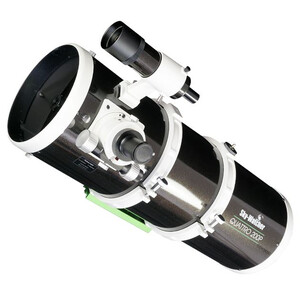
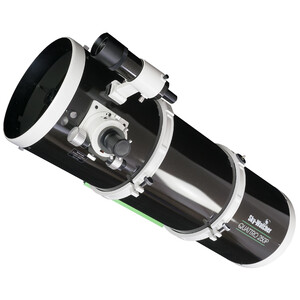
The price gap is real. The question is whether the extra capability is worth it at your stage.
Affiliate links — we earn from qualifying purchases at no extra cost to you.
First light
Sky-Watcher · 200mm · £599
The custom-rig optical tube
- 200mm newtonian reflector — optical tube only, no mount included
- 800mm focal length at f/4
- Requires a compatible mount before you can observe anything
- Best for: observers who already own a suitable mount or are building a specific imaging rig
- Not a complete purchase — budget at least £100–300 extra for a mount before observing
Sky-Watcher · 254mm · £999
The custom-rig optical tube
- 254mm newtonian reflector — optical tube only, no mount included
- 1000mm focal length at f/3.94
- Requires a compatible mount before you can observe anything
- Best for: observers who already own a suitable mount or are building a specific imaging rig
- Not a complete purchase — budget at least £100–300 extra for a mount before observing
The full picture
The numbers that separate these two scopes — and what they mean at the eyepiece.
Aperture
Sky-Watcher Quattro 250P gathers 1.6× more light. On bright targets — Moon, Saturn, Jupiter — you won't notice. On fainter targets — dim galaxies, faint globular clusters — the gap is real.
Focal length
Sky-Watcher Quattro 250P's longer focal length reaches higher magnification with the same eyepiece — better reach for planetary detail. Sky-Watcher Quattro 200P's shorter focal length gives a wider true field — better for large open clusters and extended nebulae.
Focal ratio
Same focal ratio — the same eyepiece gives equivalent magnification and true field in both scopes.
Mount type
Neither scope includes a mount — both require a separate purchase before you can observe.
Weight (OTA)
Sky-Watcher Quattro 200P's optical tube is 6.0kg lighter. Relevant if you plan to use it on multiple mounts or carry the tube to dark-sky sites separately.
Optical design
Both are Newtonian reflectors — the same optical formula. Any performance difference comes from collimation quality, focal ratio, and eyepiece choice, not the design itself.
At the eyepiece
| Target | Sky-Watcher Quattro 200P | Sky-Watcher Quattro 250P |
|---|---|---|
| Planets | ||
| Moon | Excellent 200mm resolves fine crater detail, rilles, and mountain shadows — though f/4 limits useful magnification compared to slower designs before image quality softens | Excellent 254mm aperture delivers superb lunar detail, though the fast f/3.9 ratio limits useful magnification compared to longer focal length scopes |
| Saturn | Good 200mm shows rings, Cassini Division, and cloud banding, but the 800mm focal length requires heavy Barlowing for ideal planetary scale | Good 254mm resolves rings, Cassini Division, and cloud banding, but 1000mm focal length at f/3.9 makes high-power planetary observation less comfortable than a longer focal ratio instrument |
| Jupiter | Good Cloud belts, GRS, and Galilean moons visible, but the short focal length means you need a Barlow to reach useful magnification | Good Aperture easily resolves cloud belts and the Great Red Spot, but the fast focal ratio and imaging-oriented design are not ideal for sustained high-magnification visual planetary work |
| Mars | Good 200mm aperture resolves polar cap and major surface albedo features at opposition, though 800mm focal length keeps the disc small | Good 254mm aperture shows polar caps and dark surface features at opposition; limited by 1000mm focal length for high-magnification detail |
Deep sky | ||
| Orion Nebula (M42) | Excellent 200mm at f/4 delivers bright, contrasty nebulosity with the Trapezium cleanly split; wide field captures the full extent including the Running Man | Excellent 254mm of aperture and f/3.9 speed make this a superb imaging target; visually the nebulosity is stunning with extended structure visible |
| Andromeda Galaxy (M31) | Excellent 800mm focal length frames the bright core and inner spiral arms well; 200mm aperture reveals dust lanes visually and captures the full halo in imaging | Good 1000mm focal length captures the bright core and inner disc but crops the full 3° extent; excellent for imaging the core and dust lanes |
| Open clusters | Excellent 800mm focal length and wide true field frame large clusters like the Double Cluster, Pleiades, and M35 beautifully | Good 1000mm focal length frames smaller open clusters like M35 and M37 well; larger clusters like the Double Cluster may overfill the field |
| Globular clusters | Good 200mm partially resolves outer stars in M13 and M22; core remains granular but not fully resolved | Excellent 254mm aperture resolves individual stars across globulars like M13 and M3; imaging at f/3.9 captures them quickly |
| Faint galaxies | Good 200mm gathers enough light to detect galaxies in the Virgo Cluster and Leo Triplet; structure hints visible under dark skies | Excellent 254mm aperture and fast focal ratio are ideal for pulling faint galaxy detail — spiral arms, tidal streams — in short integration times |
| Milky Way / wide field | Moderate 800mm is wider than most 8-inch Newtonians but still too narrow for sweeping Milky Way panoramas; f/4 speed helps with rich star fields | Not recommended 1000mm focal length is far too narrow for sweeping Milky Way fields; this is a medium-field deep-sky instrument |
Other | ||
| Double stars | Good 200mm resolves down to sub-arcsecond pairs, but f/4 makes tight doubles trickier — diffraction effects are more pronounced than in slower scopes | Excellent 254mm aperture has a Dawes limit around 0.45 arcseconds, resolving tight doubles; however the fast focal ratio makes clean splitting less comfortable than a long-FL refractor |
| Astrophotography (deep sky) | Not recommended No mount or tracking included — the OTA is excellent for deep-sky imaging but only once paired with a capable equatorial mount like the EQ6-R Pro | Not recommended OTA only — no mount or tracking included; on a suitable equatorial mount (EQ6-R or better) this would rate Excellent, but the scope as sold cannot track |
| Astrophotography (planetary) | Moderate 200mm aperture is capable but 800mm focal length is short for planetary scale; needs a Barlow and a tracking mount not included | Not recommended No mount or tracking included; with a tracking mount the 254mm aperture and 1000mm focal length (extendable with a Barlow) would rate Good to Excellent |
| Emission nebulae (imaging) | Excellent The f/4 speed is ideal for narrowband imaging of large emission nebulae like the Veil, Rosette, and Heart — when mounted on an equatorial platform with guiding | Excellent The f/3.9 speed is purpose-built for faint emission targets — Veil, North America, Heart and Soul — requiring a fraction of the exposure time of slower scopes |
| Galaxy groups (imaging) | Not applicable | Excellent 1000mm focal length and large aperture frame galaxy groups like the Leo Triplet and Markarian's Chain with strong detail on spiral arms and faint extensions |
The real tradeoff
Both scopes are capable. The question is which one fits the way you actually observe.
Sky-Watcher Quattro 200P
- You'll spend £1,200–£1,500 on a capable mount and still have a nimble imaging rig that fits in a car and doesn't demand reinforced observing furniture.
- Your observing sessions favour moderate-sized targets — the 1.7° field on APS-C lets you frame M31's full inner structure or the Veil Nebula's individual arcs, but you'll need multiple frames for truly vast nebula complexes.
- You'll collimate frequently but not obsessively; the f/4 optics are unforgiving enough to punish sloppiness within a session, yet more forgiving than f/3.9 designs if you're learning the discipline.
Sky-Watcher Quattro 250P
- You'll commit to a heavy-duty mount in the £1,500–£3,000 range and accept that your entire rig becomes a semi-permanent fixture or a serious logistics challenge.
- Your observing sessions reward patience with large faint targets — the extra 54mm of aperture and f/3.9 speed let you detect spiral arms and HII regions that the 200P would require longer exposures to reach, especially on galaxies and emission nebulae.
- You'll fight the shallow depth of focus (50 microns) every session; a motorised focuser becomes essential rather than optional, and you'll check collimation before almost every night because the fast focal ratio punishes even small misalignment.
The dark side
Every scope has a personality. Here’s where each one gets difficult.
Sky-Watcher
Sky-Watcher Quattro 200P
No mount supplied — you must budget at least £1,200 additional for an equatorial mount capable of supporting the OTA and camera payload.
A coma corrector is essential; without it, stars elongate badly across the field edge for both imaging and visual use, making the telescope functionally compromised.
Collimation is critical at f/4 and will need frequent checking, especially after transport, as the fast focal ratio is unforgiving of misalignment.
Sky-Watcher
Sky-Watcher Quattro 250P
No mount supplied — requires a heavy-duty equatorial mount in the EQ6-R class minimum, typically costing £1,500–£3,000, making total rig cost prohibitive for most hobbyists.
At f/3.9, coma correction is absolutely essential; stars will be severely distorted across most of the field without a matched coma corrector.
Very shallow depth of focus (~50 microns) demands precise, repeatable focusing — a motorised focuser is strongly recommended, and the dual-speed Crayford focuser may struggle under heavy camera loads, with some users reporting focuser sag.
Collimation must be checked and adjusted frequently; even small shifts degrade image quality at this focal ratio.
The OTA weighs approximately 12kg before camera, corrector, and guide scope, with total imaging payload exceeding 15kg, making the telescope impractical for portable setups.
Which is right for you?
Two different buyers. Two different right answers.
The custom-rig optical tube
Sky-Watcher · Sky-Watcher Quattro 200P
You'll love this if you're an intermediate astrophotographer ready to invest in a dedicated imaging rig around a proven f/4 astrograph, comfortable with collimation discipline, and want to frame large nebulae and galaxy fields efficiently without the expense and logistics of a truly heavy-duty mount. This isn't for you if you're a beginner without mount experience, prefer visual observing, or need planetary imaging performance — the 800mm focal length and coma issues at the field edge without correction will frustrate both.
The custom-rig optical tube
Sky-Watcher · Sky-Watcher Quattro 250P
You'll love this if you're an experienced astrophotographer who already owns or has committed to a heavy-duty equatorial mount, specialises in capturing faint galaxies and emission nebulae with fast integration times, and is comfortable managing the exacting collimation and focuser demands of a fast f/3.9 design. This isn't for you if you're a visual observer, a beginner without Newtonian collimation experience, prefer portable setups, or can't justify the £1,500–£3,000 mount investment — the 250P demands serious infrastructure and expertise to realise its potential.
Our verdict
At £599 versus £999, the Sky-Watcher Quattro 250P costs 67% more. It delivers 54mm more aperture — a real and visible advantage on faint targets.
If budget is a genuine constraint, the Sky-Watcher Quattro 200P will make you a happy observer. The Sky-Watcher Quattro 250P's optical advantage on faint targets is real and you are unlikely to regret it if you can stretch. If I had to choose without knowing your situation: start with the Sky-Watcher Quattro 200P, use it for a year, then upgrade knowing exactly what you want.
Sky-Watcher Quattro 200P
View Sky-Watcher Quattro 200P →Sky-Watcher Quattro 250P
View Sky-Watcher Quattro 250P →Affiliate links — we earn from qualifying purchases at no extra cost to you.
Deep field: Full specifications
Every data point, for those who want to go further.
Full specifications
Fields highlighted in blue or amber indicate the better value for that spec. Data is manufacturer-stated and may vary.
How much can it see?
| Spec | Sky-Watcher Quattro 200P | Sky-Watcher Quattro 250P |
|---|---|---|
Apertureⓘ The most important spec — bigger = more light = better views | 200mm | 254mm |
Focal Length Longer = more magnification potential | 800mm | 1000mm |
Focal Ratio Lower f-number = wider field of view; higher = more magnification per eyepiece | f/4 | f/3.94 |
Optical Design The type of optics — each design has different strengths | Newtonian Reflector | Newtonian Reflector |
Coatings Better coatings = more light transmission through the optics | Parabolic primary mirror, fully multi-coated | Parabolic primary mirror, fully multi-coated |
How do you point it?
| Spec | Sky-Watcher Quattro 200P | Sky-Watcher Quattro 250P |
|---|---|---|
Mount Type The mechanical system that holds and moves the telescope | None (OTA only) | None (OTA only) |
GoTo Computer-controlled pointing — finds any of thousands of objects automatically | ||
Tracking Motor keeps objects centred as the Earth rotates — essential for astrophotography |
The focuser
| Spec | Sky-Watcher Quattro 200P | Sky-Watcher Quattro 250P |
|---|---|---|
Focuser Size 2" accepts wider eyepieces and gives better low-power views | 2" | 2" |
Focuser Type Rack-and-pinion is standard; Crayford and dual-speed are smoother | Dual-speed Crayford (10:1 reduction) | Dual-speed Crayford (10:1 reduction) |
Size & weight
| Spec | Sky-Watcher Quattro 200P | Sky-Watcher Quattro 250P |
|---|---|---|
OTA Weightⓘ Optical tube only — useful for comparing mount load capacity | 7.5kg | 13.5kg |
Tube Material | Steel | Steel |
What's in the box?
| Spec | Sky-Watcher Quattro 200P | Sky-Watcher Quattro 250P |
|---|---|---|
Diagonal Tilts the eyepiece 90° for comfortable viewing — useful on refractors |
Blue highlight: Sky-Watcher Quattro 200P advantage · Amber highlight: Sky-Watcher Quattro 250P advantage · Greyed cells: equal or subjective.