Telescope Comparison
Sky-Watcher Quattro 200P vs Sky-Watcher Virtuoso GTi 150P
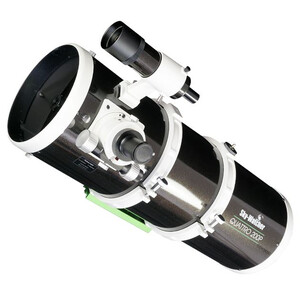
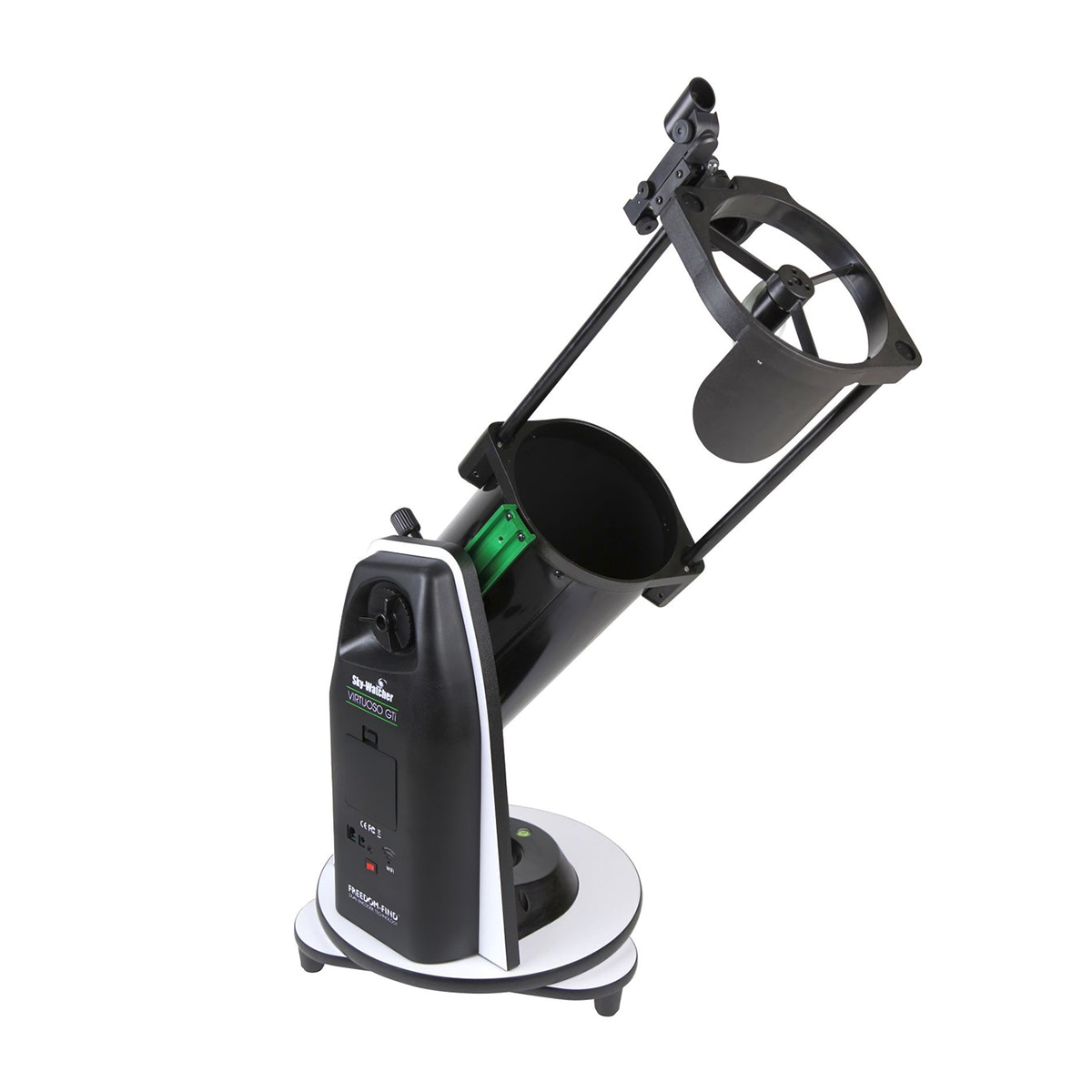
The Sky-Watcher Virtuoso GTi 150P is a complete setup. The Sky-Watcher Quattro 200P needs a mount before it's usable.
Affiliate links — we earn from qualifying purchases at no extra cost to you.
First light
Sky-Watcher · 200mm · £599
The custom-rig optical tube
- 200mm newtonian reflector — optical tube only, no mount included
- 800mm focal length at f/4
- Requires a compatible mount before you can observe anything
- Best for: observers who already own a suitable mount or are building a specific imaging rig
- Not a complete purchase — budget at least £100–300 extra for a mount before observing
Sky-Watcher · 150mm · £449
The guided beginner's telescope
- 150mm newtonian reflector on a computerised mount with motorised tracking
- Good for: Moon, planets, bright nebulae, star clusters, and deep-sky objects
- GoTo system finds any object in its database after initial star alignment — no star atlas needed
- Tracking motors keep objects centred as Earth rotates — useful above 100×, essential for photography
- 6.5kg total — requires a fixed garden spot or car transport
The full picture
The numbers that separate these two scopes — and what they mean at the eyepiece.
Aperture
Sky-Watcher Quattro 200P gathers 1.8× more light. On bright targets — Moon, Saturn, Jupiter — you won't notice. On fainter targets — dim galaxies, faint globular clusters — the gap is real.
Focal length
Sky-Watcher Quattro 200P's longer focal length reaches higher magnification with the same eyepiece — better reach for planetary detail. Sky-Watcher Virtuoso GTi 150P's shorter focal length gives a wider true field — better for large open clusters and extended nebulae.
Focal ratio
Sky-Watcher Quattro 200P's faster f/4 delivers wider fields with any eyepiece — better for open clusters and large nebulae. Sky-Watcher Virtuoso GTi 150P's f/5 provides more magnification per eyepiece — better for fine planetary detail.
Mount type
Sky-Watcher Quattro 200P has no mount — add a compatible mount before you can observe. Sky-Watcher Virtuoso GTi 150P is a complete ready-to-use system.
Weight (OTA)
Sky-Watcher Virtuoso GTi 150P's optical tube is 1.0kg lighter. Relevant if you plan to use it on multiple mounts or carry the tube to dark-sky sites separately.
Optical design
Both are Newtonian reflectors — the same optical formula. Any performance difference comes from collimation quality, focal ratio, and eyepiece choice, not the design itself.
At the eyepiece
| Target | Sky-Watcher Quattro 200P | Sky-Watcher Virtuoso GTi 150P |
|---|---|---|
| Planets | ||
| Moon | Excellent 200mm resolves fine crater detail, rilles, and mountain shadows — though f/4 limits useful magnification compared to slower designs before image quality softens | Excellent 150mm resolves craters, rilles, and mountain shadows in fine detail; the fast f/5 ratio means slightly lower magnification per eyepiece, but a Barlow unlocks high-power lunar work |
| Saturn | Good 200mm shows rings, Cassini Division, and cloud banding, but the 800mm focal length requires heavy Barlowing for ideal planetary scale | Good Rings clearly separated, Cassini Division visible in good seeing; 750mm focal length benefits from a Barlow for higher magnification |
| Jupiter | Good Cloud belts, GRS, and Galilean moons visible, but the short focal length means you need a Barlow to reach useful magnification | Good Two main equatorial belts, colour variation, and up to four Galilean moons; a Barlow helps push useful magnification |
| Mars | Good 200mm aperture resolves polar cap and major surface albedo features at opposition, though 800mm focal length keeps the disc small | Good 150mm aperture shows disc detail and polar cap at opposition; benefits from high magnification via Barlow |
Deep sky | ||
| Orion Nebula (M42) | Excellent 200mm at f/4 delivers bright, contrasty nebulosity with the Trapezium cleanly split; wide field captures the full extent including the Running Man | Excellent 150mm at f/5 delivers bright, wide-field views with sweeping nebulosity and a resolved Trapezium |
| Andromeda Galaxy (M31) | Excellent 800mm focal length frames the bright core and inner spiral arms well; 200mm aperture reveals dust lanes visually and captures the full halo in imaging | Excellent 750mm focal length frames the bright core and inner halo well; 150mm aperture helps reveal outer structure in dark skies |
| Open clusters | Excellent 800mm focal length and wide true field frame large clusters like the Double Cluster, Pleiades, and M35 beautifully | Excellent 750mm focal length gives wide enough fields to frame the Pleiades, Double Cluster, and similar targets attractively |
| Globular clusters | Good 200mm partially resolves outer stars in M13 and M22; core remains granular but not fully resolved | Good 150mm begins to resolve individual stars at the edges of M13 and M92; cores remain unresolved but granular |
| Faint galaxies | Good 200mm gathers enough light to detect galaxies in the Virgo Cluster and Leo Triplet; structure hints visible under dark skies | Good 150mm gathers enough light for dozens of Messier and brighter NGC galaxies as distinct shapes; structural detail limited to the brightest |
| Milky Way / wide field | Moderate 800mm is wider than most 8-inch Newtonians but still too narrow for sweeping Milky Way panoramas; f/4 speed helps with rich star fields | Good 750mm focal length gives pleasant sweeping fields but falls short of the ultra-wide context a shorter-focus instrument provides |
Other | ||
| Double stars | Good 200mm resolves down to sub-arcsecond pairs, but f/4 makes tight doubles trickier — diffraction effects are more pronounced than in slower scopes | Good 150mm resolves doubles down to roughly 0.8 arcseconds; f/5 focal ratio is less forgiving on tight pairs than a longer-ratio scope |
| Astrophotography (deep sky) | Not recommended No mount or tracking included — the OTA is excellent for deep-sky imaging but only once paired with a capable equatorial mount like the EQ6-R Pro | Moderate Alt-az GoTo tracks objects but introduces field rotation, limiting exposures to a few seconds — useful for EAA and live stacking only |
| Astrophotography (planetary) | Moderate 200mm aperture is capable but 800mm focal length is short for planetary scale; needs a Barlow and a tracking mount not included | Moderate 150mm aperture captures decent planetary video for stacking; GoTo tracking keeps the target centred, but 750mm native focal length needs a Barlow for image scale |
| Emission nebulae (imaging) | Excellent The f/4 speed is ideal for narrowband imaging of large emission nebulae like the Veil, Rosette, and Heart — when mounted on an equatorial platform with guiding | Not applicable |
The real tradeoff
Both scopes are capable. The question is which one fits the way you actually observe.
Sky-Watcher Quattro 200P
- You'll spend your observing sessions staring at a laptop or tablet, watching 60-second exposures stack into the Rosette Nebula or the Heart Nebula — the fast f/4 mirror collects light so quickly that even under light pollution, narrowband imaging becomes practical within an hour.
- You'll need to budget an additional £1,200–£1,500 for an equatorial mount before you can even point this scope at the sky, and another £1,000+ for a camera, guide scope, and coma corrector — this is a commitment to a complete rig, not a standalone telescope.
- You'll fight collimation maintenance regularly; after every transport or rough session, you'll spend 20 minutes at the eyepiece checking mirror alignment because f/4 Newtonians punish sloppy optics far more than slower designs.
Sky-Watcher Virtuoso GTi 150P
- You'll pick this scope up from a shelf, set it on your dining table, open the SynScan app on your phone, and be looking at M13 within ten minutes — the GoTo system finds objects for you while you sip coffee instead of squinting at a star chart.
- You'll see Saturn's rings clearly separated and the Cassini Division in steady seeing, Jupiter's cloud bands with colour, and nebulae like M42 with real wispy structure — it's a proper visual telescope that rewards eyepieces, not sensors.
- You'll accept that this scope lives on a table, not a pier — it's genuinely portable and grabs-and-go, but a wobbly surface or a carpet under the tripod feet will introduce vibration that ruins contrast on planets and annoys you during every session.
The dark side
Every scope has a personality. Here’s where each one gets difficult.
Sky-Watcher
Sky-Watcher Quattro 200P
No mount included; you must budget at least £1,200 extra for a capable equatorial mount like the EQ6-R Pro to use this OTA at all.
A coma corrector is essential at f/4 — without one, stars at the field edges are badly elongated for both imaging and visual use, making this an effectively mandatory additional cost.
Collimation is critical at f/4 and much less forgiving than slower Newtonians; frequent checking after transport is necessary, and collimation errors are immediately visible in star elongation.
The 800mm focal length limits planetary magnification compared to longer-focal-length designs of the same aperture, making it poorly suited to high-resolution planetary work.
Total imaging rig cost (mount, camera, guiding, corrector) typically exceeds £2,500 on top of the OTA price.
The fast focal ratio makes the scope sensitive to tilt, spacing errors, and focuser flex — precise backfocus to the coma corrector is critical.
Sky-Watcher
Sky-Watcher Virtuoso GTi 150P
Tabletop design requires a sturdy, vibration-free surface at roughly waist height — an unsuitable table introduces vibration that degrades planetary contrast and frustrates every session.
The f/5 focal ratio produces noticeable coma at field edges with standard Plössl or Kellner eyepieces; quality wide-field or ED eyepieces are recommended to avoid this distortion.
Alt-az GoTo mount introduces field rotation during tracking, limiting useful astrophotography exposures to a few seconds at most — long-exposure imaging is not viable.
Collimation is needed periodically; this fast Newtonian is sensitive to mirror alignment, and transport can knock it out of spec.
The included 25mm and 10mm eyepieces are basic; serious observers will want to upgrade promptly for better contrast and wider true fields.
WiFi alignment via the SynScan app requires a smartphone or tablet — there is no hand controller included, which may frustrate observers who prefer physical buttons.
Which is right for you?
Two different buyers. Two different right answers.
The custom-rig optical tube
Sky-Watcher · Sky-Watcher Quattro 200P
You'll love the Quattro 200P if you're an intermediate astrophotographer ready to build a dedicated deep-sky imaging rig and have already chosen your camera, mount, and guiding strategy — the fast f/4 mirror and 200mm aperture will pull faint nebulae and galaxy detail that smaller astrographs miss, and you're committed to the collimation discipline and total rig cost (£2,500+) that f/4 demands. This isn't for you if you're a beginner, a casual visual observer, or a planetary enthusiast; you'll end up frustrated by the missing mount, the coma without a corrector, and the 800mm focal length's limitations on planetary magnification.
The guided beginner's telescope
Sky-Watcher · Sky-Watcher Virtuoso GTi 150P
You'll love the Virtuoso GTi 150P if you're a visual observer who wants genuine GoTo convenience without hauling a heavy equatorial mount and tripod around, and you appreciate seeing structure in nebulae and galaxies with an eyepiece rather than a sensor — the 150mm aperture is the sweet spot where deep-sky objects stop being smudges and start showing real granularity, and the app-controlled GoTo means you'll actually observe instead of star-hopping. This isn't for you if you want to do serious long-exposure astrophotography (the alt-az mount introduces field rotation), need a floor-standing setup (this scope demands a sturdy table), or are a high-power planetary specialist unwilling to invest in quality eyepieces to tame the f/5 coma.
Our verdict
This comparison has a catch: the Sky-Watcher Quattro 200P is a bare optical tube. You cannot use it without a separate mount — which adds meaningful cost and complexity. The Sky-Watcher Virtuoso GTi 150P is a complete, ready-to-observe package.
For most buyers, the Sky-Watcher Virtuoso GTi 150P is the right choice — you can observe the same night it arrives. The Sky-Watcher Quattro 200P makes sense if you already own a compatible mount, or are deliberately building a specific imaging setup piece by piece. If I had to choose for a first telescope: the Sky-Watcher Virtuoso GTi 150P, without hesitation.
Sky-Watcher Quattro 200P
View Sky-Watcher Quattro 200P →Sky-Watcher Virtuoso GTi 150P
View Sky-Watcher Virtuoso GTi 150P →Affiliate links — we earn from qualifying purchases at no extra cost to you.
Deep field: Full specifications
Every data point, for those who want to go further.
Full specifications
Fields highlighted in blue or amber indicate the better value for that spec. Data is manufacturer-stated and may vary.
How much can it see?
| Spec | Sky-Watcher Quattro 200P | Sky-Watcher Virtuoso GTi 150P |
|---|---|---|
Apertureⓘ The most important spec — bigger = more light = better views | 200mm | 150mm |
Focal Length Longer = more magnification potential | 800mm | 750mm |
Focal Ratio Lower f-number = wider field of view; higher = more magnification per eyepiece | f/4 | f/5 |
Optical Design The type of optics — each design has different strengths | Newtonian Reflector | Newtonian Reflector |
Coatings Better coatings = more light transmission through the optics | Parabolic primary mirror, fully multi-coated | Parabolic primary mirror with multi-coated optics |
How do you point it?
| Spec | Sky-Watcher Quattro 200P | Sky-Watcher Virtuoso GTi 150P |
|---|---|---|
Mount Type The mechanical system that holds and moves the telescope | None (OTA only) | GoTo (Computerised) |
GoToⓘ Computer-controlled pointing — finds any of thousands of objects automatically | ||
Trackingⓘ Motor keeps objects centred as the Earth rotates — essential for astrophotography |
The focuser
| Spec | Sky-Watcher Quattro 200P | Sky-Watcher Virtuoso GTi 150P |
|---|---|---|
Focuser Size 2" accepts wider eyepieces and gives better low-power views | 2" | 1.25" |
Focuser Type Rack-and-pinion is standard; Crayford and dual-speed are smoother | Dual-speed Crayford (10:1 reduction) | Rack and pinion |
Size & weight
| Spec | Sky-Watcher Quattro 200P | Sky-Watcher Virtuoso GTi 150P |
|---|---|---|
OTA Weightⓘ Optical tube only — useful for comparing mount load capacity | 7.5kg | 6.5kg |
Total Weight Full setup including mount — this is what you lug to the car | — | 6.5kg |
Tube Material | Steel | Steel (collapsible FlexTube) |
What's in the box?
| Spec | Sky-Watcher Quattro 200P | Sky-Watcher Virtuoso GTi 150P |
|---|---|---|
Eyepieces Included eyepieces — more is better, but quality matters more than quantity | — | 25mm and 10mm Super eyepieces |
Finder Scope Helps you locate areas of the sky before switching to the main eyepiece | — | Red dot finder |
Diagonal Tilts the eyepiece 90° for comfortable viewing — useful on refractors |
Smart features
| Spec | Sky-Watcher Quattro 200P | Sky-Watcher Virtuoso GTi 150P |
|---|---|---|
Built-in Camera Records and stacks images automatically — no separate camera needed | ||
App Controlled | ||
WiFi | ||
Battery Included |
Blue highlight: Sky-Watcher Quattro 200P advantage · Amber highlight: Sky-Watcher Virtuoso GTi 150P advantage · Greyed cells: equal or subjective.