Telescope Comparison
Sky-Watcher Quattro 250P vs Sky-Watcher Skyliner 350P
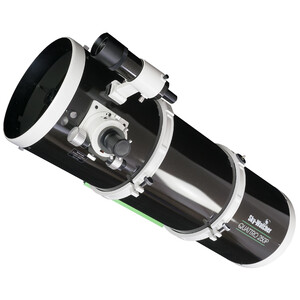
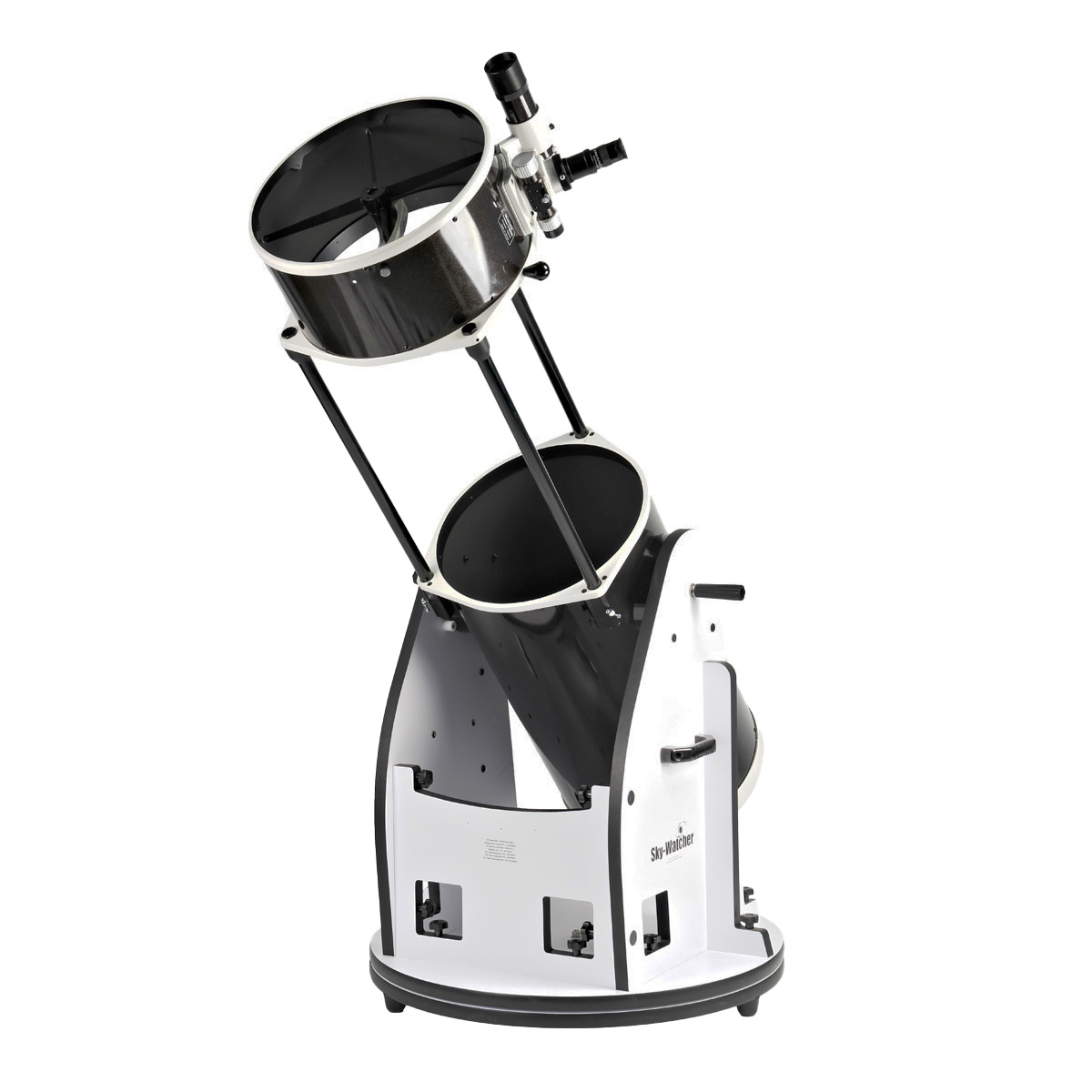
The Sky-Watcher Skyliner 350P is a complete setup. The Sky-Watcher Quattro 250P needs a mount before it's usable.
Affiliate links — we earn from qualifying purchases at no extra cost to you.
First light
Sky-Watcher · 254mm · £999
The custom-rig optical tube
- 254mm newtonian reflector — optical tube only, no mount included
- 1000mm focal length at f/3.94
- Requires a compatible mount before you can observe anything
- Best for: observers who already own a suitable mount or are building a specific imaging rig
- Not a complete purchase — budget at least £100–300 extra for a mount before observing
Sky-Watcher · 355mm · £1,099
The maximum-aperture visual reflector
- 355mm Newtonian on a floor-standing Dobsonian alt-az rocker box
- Good for: full visual programme — planets, Moon, globular clusters, galaxies, nebulae
- No alignment required — set up and observe in under 10 minutes
- No motorised tracking — targets drift at high magnification as Earth rotates
- 58kg total — designed for a fixed garden or regular dark-sky site, not casual transport
The full picture
The numbers that separate these two scopes — and what they mean at the eyepiece.
Aperture
Sky-Watcher Skyliner 350P gathers 2× more light. On bright targets — Moon, Saturn, Jupiter — you won't notice. On fainter targets — dim galaxies, faint globular clusters — the gap is real.
Focal length
Sky-Watcher Skyliner 350P's longer focal length reaches higher magnification with the same eyepiece — better reach for planetary detail. Sky-Watcher Quattro 250P's shorter focal length gives a wider true field — better for large open clusters and extended nebulae.
Focal ratio
Sky-Watcher Quattro 250P's faster f/3.94 delivers wider fields with any eyepiece — better for open clusters and large nebulae. Sky-Watcher Skyliner 350P's f/4.51 provides more magnification per eyepiece — better for fine planetary detail.
Mount type
Sky-Watcher Quattro 250P has no mount — add a compatible mount before you can observe. Sky-Watcher Skyliner 350P is a complete ready-to-use system.
Weight (OTA)
Sky-Watcher Quattro 250P's optical tube is 22.5kg lighter. Relevant if you plan to use it on multiple mounts or carry the tube to dark-sky sites separately.
Optical design
Sky-Watcher Quattro 250P is a Newtonian reflector (mirrors, needs occasional collimation); Sky-Watcher Skyliner 350P is a DOBSONIAN. Different optical formulas produce different strengths — reflectors give more aperture per pound; refractors give sharper contrast and require no collimation.
At the eyepiece
Sky-Watcher
Sky-Watcher Quattro 250P
The Moon fills the field at low power with more detail than you'll have time to explore on any given night. Saturn's rings are unmistakable from the first session; in good seeing, the Cassini Division — the dark gap between the A and B rings — is a genuine target at higher magnification. Jupiter shows two equatorial cloud bands clearly, the four Galilean moons changing position night to night. The Orion Nebula (M42) shows wide nebulosity with the Trapezium splitting cleanly into four points at 80×. The Hercules Cluster (M13) begins to resolve into individual stars at the outer edges at higher magnification. The Andromeda Galaxy (M31) fills a wide-field eyepiece; the bright core and inner disc are obvious, and on a dark night the dust lane becomes visible with careful looking.
Sky-Watcher
Sky-Watcher Skyliner 350P
The Moon fills the field at low power with more detail than you'll have time to explore on any given night. Saturn's rings are unmistakable from the first session; in good seeing, the Cassini Division — the dark gap between the A and B rings — is a genuine target at higher magnification. Jupiter shows two equatorial cloud bands clearly, the four Galilean moons changing position night to night. The Orion Nebula (M42) shows wide nebulosity with the Trapezium splitting cleanly into four points at 80×. The Hercules Cluster (M13) begins to resolve into individual stars at the outer edges at higher magnification. The Andromeda Galaxy (M31) fills a wide-field eyepiece; the bright core and inner disc are obvious, and on a dark night the dust lane becomes visible with careful looking. The Sky-Watcher Skyliner 350P gathers 2× more light than the Sky-Watcher Quattro 250P — a difference that's marginal on bright targets but visible on fainter ones: dimmer galaxies, faint globular clusters, and extended nebulosity that sits below the threshold of the smaller aperture.
The real tradeoff
Both scopes are capable. The question is which one fits the way you actually observe.
Sky-Watcher Quattro 250P
- You'll spend your observing session at a computer or beside your camera, watching data accumulate on a sensor rather than looking through an eyepiece — faint nebulae and galaxies emerge from the raw frames, not from your eye.
- You'll invest heavily in mount hardware (£1,500–£3,000+) before you can use this scope at all, and your first night involves polar alignment, motorised focusing, and coma-corrector adjustment before you take a single image.
- You'll be rewarded with four times the light-gathering speed of an f/8 scope, meaning the Veil Nebula or Lagoon Nebula yields usable data in minutes rather than hours — but only if your collimation is perfect and your focuser doesn't sag under a 15kg payload.
Sky-Watcher Skyliner 350P
- You'll look through the eyepiece and see genuine deep-sky structure — faint galaxy groups, nebula detail, globular cluster cores resolved to their hearts — rewards that come immediately and directly from your eye.
- You'll need a van or ground-floor storage for a 58kg rig, and a helper or trolley to move it between car and observing site; every session begins with a 45–60 minute cooldown and critical collimation checks that cannot be skipped.
- You'll manually track objects at high magnification by hand, nudging the scope constantly as they drift through the field, but you'll own a light bucket that pulls in detail invisible to 10-inch scopes — the Antennae Galaxies, dim planetary nebulae, and cores of globular clusters become real discoveries.
The dark side
Every scope has a personality. Here’s where each one gets difficult.
Sky-Watcher
Sky-Watcher Quattro 250P
No mount included — you must buy a heavy-duty equatorial mount (EQ6-R class minimum) at additional cost of £1,500–£3,000+, effectively doubling the system price.
At f/3.9, coma correction is non-negotiable; stars will be severely distorted across most of the field without a matched coma corrector, rendering images unusable.
Extremely shallow depth of focus (~50 microns) demands motorised focusing and precise, repeatable focus procedures; manual focusing makes usable imaging nearly impossible.
Collimation must be checked and adjusted frequently; even small shifts noticeably degrade image quality at this focal ratio.
The OTA weighs approximately 12kg before adding camera, corrector, and guide scope — total imaging payload can exceed 15kg, pushing the limits of smaller equatorial mounts.
The dual-speed Crayford focuser may sag under heavy camera loads without careful tension adjustment, requiring constant refocusing during long imaging sessions.
Not practical for high-magnification planetary visual work due to the fast focal ratio and imaging-optimised mechanical design.
Sky-Watcher
Sky-Watcher Skyliner 350P
Total weight with rocker box approaches 58kg — requires two people or a trolley to move, and transport needs a van or large estate car; backyard-to-car movement is a genuine logistical burden.
At f/4.5, coma is severe toward the field edge; a coma corrector (Paracorr or similar) is effectively required for wide-angle eyepieces to avoid distorted star images.
Collimation is critical and must be checked every session — small misalignment visibly degrades planetary and high-power performance.
No tracking or GoTo — at 178x+ magnification, objects drift through the field quickly, requiring constant manual nudging to keep targets centred.
The open truss tube needs a light shroud in anything other than fully dark sites to maintain contrast and suppress stray light.
Cooldown time is significant — expect 45–60 minutes for the 355mm primary mirror to reach thermal equilibrium before imaging or high-magnification observation begins.
Which is right for you?
Two different buyers. Two different right answers.
The custom-rig optical tube
Sky-Watcher · Sky-Watcher Quattro 250P
You're an experienced astrophotographer who already owns or is committed to investing in a heavy-duty equatorial mount; you want to capture faint nebulae and galaxies on a camera sensor with the fastest possible light collection and don't mind spending time on collimation, motorised focusing, and image processing to achieve short exposure times. You'll love this if you're building a dedicated imaging rig and have the bench space, power, and dark skies to justify a £2,500+ system investment.
The maximum-aperture visual reflector
Sky-Watcher · Sky-Watcher Skyliner 350P
You're an experienced visual observer who wants to see faint galaxies, resolve globular clusters, and pull planetary detail with your own eye; you have a van or reliable ground-floor storage, and you're willing to arrive early to let the scope cool, perform critical collimation, and manually track objects at high magnification. This isn't for you if you need portability, live in a light-polluted area without easy access to dark skies, or expect the scope to be ready to observe within minutes of arrival.
Our verdict
This comparison has a catch: the Sky-Watcher Quattro 250P is a bare optical tube. You cannot use it without a separate mount — which adds meaningful cost and complexity. The Sky-Watcher Skyliner 350P is a complete, ready-to-observe package.
For most buyers, the Sky-Watcher Skyliner 350P is the right choice — you can observe the same night it arrives. The Sky-Watcher Quattro 250P makes sense if you already own a compatible mount, or are deliberately building a specific imaging setup piece by piece. If I had to choose for a first telescope: the Sky-Watcher Skyliner 350P, without hesitation.
Sky-Watcher Quattro 250P
View Sky-Watcher Quattro 250P →Sky-Watcher Skyliner 350P
View Sky-Watcher Skyliner 350P →Affiliate links — we earn from qualifying purchases at no extra cost to you.
Deep field: Full specifications
Every data point, for those who want to go further.
Full specifications
Fields highlighted in blue or amber indicate the better value for that spec. Data is manufacturer-stated and may vary.
How much can it see?
| Spec | Sky-Watcher Quattro 250P | Sky-Watcher Skyliner 350P |
|---|---|---|
Apertureⓘ The most important spec — bigger = more light = better views | 254mm | 355mm |
Focal Length Longer = more magnification potential | 1000mm | 1600mm |
Focal Ratio Lower f-number = wider field of view; higher = more magnification per eyepiece | f/3.94 | f/4.51 |
Optical Design The type of optics — each design has different strengths | Newtonian Reflector | Dobsonian |
Coatings Better coatings = more light transmission through the optics | Parabolic primary mirror, fully multi-coated | Parabolic primary mirror, fully multi-coated |
How do you point it?
| Spec | Sky-Watcher Quattro 250P | Sky-Watcher Skyliner 350P |
|---|---|---|
Mount Type The mechanical system that holds and moves the telescope | None (OTA only) | Dobsonian |
GoTo Computer-controlled pointing — finds any of thousands of objects automatically | ||
Tracking Motor keeps objects centred as the Earth rotates — essential for astrophotography |
The focuser
| Spec | Sky-Watcher Quattro 250P | Sky-Watcher Skyliner 350P |
|---|---|---|
Focuser Size 2" accepts wider eyepieces and gives better low-power views | 2" | 2" |
Focuser Type Rack-and-pinion is standard; Crayford and dual-speed are smoother | Dual-speed Crayford (10:1 reduction) | Dual-speed Crayford (10:1 reduction) |
Size & weight
| Spec | Sky-Watcher Quattro 250P | Sky-Watcher Skyliner 350P |
|---|---|---|
OTA Weightⓘ Optical tube only — useful for comparing mount load capacity | 13.5kg | 36kg |
Total Weight Full setup including mount — this is what you lug to the car | — | 58kg |
Tube Length | — | 1600mm |
Tube Material | Steel | Steel |
What's in the box?
| Spec | Sky-Watcher Quattro 250P | Sky-Watcher Skyliner 350P |
|---|---|---|
Eyepieces Included eyepieces — more is better, but quality matters more than quantity | — | 25mm and 10mm Super eyepieces |
Finder Scope Helps you locate areas of the sky before switching to the main eyepiece | — | 8x50 right-angle correct-image finder |
Diagonal Tilts the eyepiece 90° for comfortable viewing — useful on refractors |
Blue highlight: Sky-Watcher Quattro 250P advantage · Amber highlight: Sky-Watcher Skyliner 350P advantage · Greyed cells: equal or subjective.