Telescope Comparison
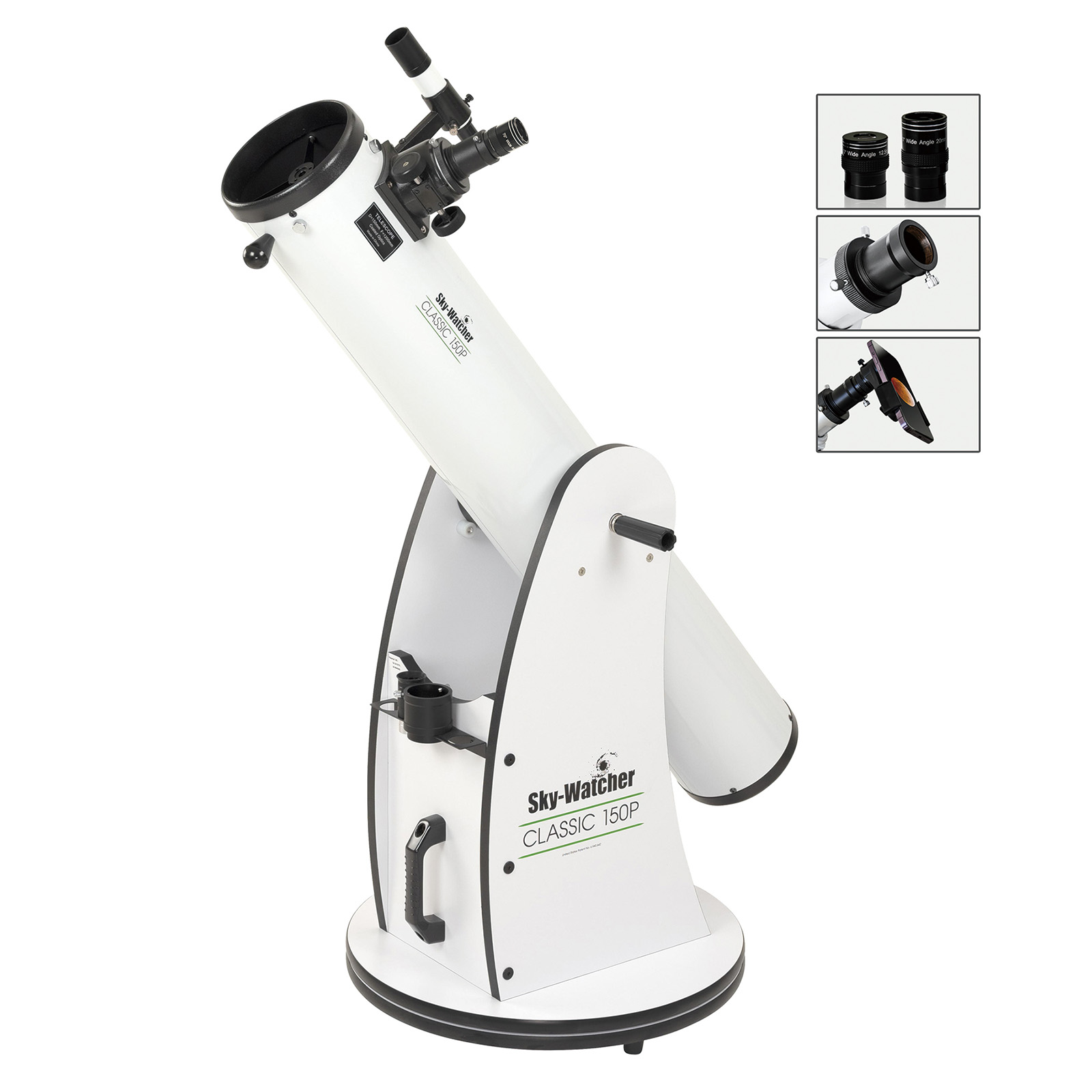
Sky-Watcher Skyliner 150P vs Sky-Watcher Skyliner 200P
The specs are close. The experience isn't.
Affiliate links — we earn from qualifying purchases at no extra cost to you.
First light
Sky-Watcher · 150mm · £229
The maximum-aperture visual reflector
- 150mm Newtonian on a floor-standing Dobsonian alt-az rocker box
- Good for: full visual programme — planets, Moon, globular clusters, galaxies, nebulae
- No alignment required — set up and observe in under 10 minutes
- No motorised tracking — targets drift at high magnification as Earth rotates
- 13kg total — designed for a fixed garden or regular dark-sky site, not casual transport
Sky-Watcher · 200mm · £414
The maximum-aperture visual reflector
- 200mm Newtonian on a floor-standing Dobsonian alt-az rocker box
- Good for: full visual programme — planets, Moon, globular clusters, galaxies, nebulae
- No alignment required — set up and observe in under 10 minutes
- No motorised tracking — targets drift at high magnification as Earth rotates
- 17.5kg total — designed for a fixed garden or regular dark-sky site, not casual transport
The full picture
The numbers that separate these two scopes — and what they mean at the eyepiece.
Aperture
Sky-Watcher Skyliner 200P gathers 1.8× more light. On bright targets — Moon, Saturn, Jupiter — you won't notice. On fainter targets — dim galaxies, faint globular clusters — the gap is real.
Focal length
Same focal length — identical magnification with any given eyepiece. Differences come from optical design and coatings.
Focal ratio
Sky-Watcher Skyliner 200P's faster f/6 delivers wider fields with any eyepiece — better for open clusters and large nebulae. Sky-Watcher Skyliner 150P's f/8 provides more magnification per eyepiece — better for fine planetary detail.
Mount type
Same mount type — setup experience and ergonomics will be similar. Differences lie in build quality and included accessories.
Weight (OTA)
Sky-Watcher Skyliner 150P's optical tube is 4.4kg lighter. Relevant if you plan to use it on multiple mounts or carry the tube to dark-sky sites separately.
Optical design
Same optical design — differences between these scopes come from aperture, mount, and focal ratio.
At the eyepiece
| Target | Sky-Watcher Skyliner 150P | Sky-Watcher Skyliner 200P |
|---|---|---|
| Planets | ||
| Moon | Excellent 150mm aperture and f/8 focal ratio reward high magnification — craters, rilles, and shadow detail are crisp and high-contrast | Excellent 200mm resolves extraordinary lunar detail — crater terracing, rilles, and the Straight Wall are all within reach at 200×+ |
| Saturn | Excellent 150mm and 1200mm focal length put this squarely in the top tier — rings well-defined, Cassini Division visible in good seeing | Excellent 1200mm focal length and 200mm aperture show the Cassini Division, cloud banding on the disc, and multiple moons in good seeing |
| Jupiter | Excellent Multiple cloud bands, GRS, and Galilean moon shadow transits visible at 150–200x | Excellent Multiple cloud bands, the Great Red Spot, and Galilean moon shadow transits are all accessible at 150–250× |
| Mars | Good 150mm shows the disc clearly at opposition with polar cap and dark surface markings; needs very steady seeing | Good Polar cap and dark albedo markings visible at opposition; the 1200mm focal length benefits from a Barlow for extra image scale |
Deep sky | ||
| Orion Nebula (M42) | Excellent 150mm gathers plenty of light for nebulosity and the Trapezium; the 1200mm focal length crops the outermost extent but core detail is superb | Excellent Bright nebulosity with layered structure, the Trapezium cleanly split; some colour perception possible under dark skies |
| Andromeda Galaxy (M31) | Moderate 1200mm focal length shows only the bright core and inner halo — the full 3° extent of the galaxy is well beyond the field of view | Moderate 1200mm focal length shows the bright core and inner dust lanes well, but the full 3° extent of the galaxy overfills the field even with a wide 2-inch eyepiece |
| Open clusters | Moderate Narrower field means large clusters like the Pleiades overfill the view; compact clusters like M35 and the Double Cluster fare better | Moderate Smaller clusters like the Double Cluster and M35 look good, but large objects like the Pleiades overfill the field at 1200mm focal length |
| Globular clusters | Good 150mm begins resolving individual stars at the edges of M13 and M92 — a clear step up from smaller scopes | Excellent 200mm resolves individual stars across M13, M92, and M3 — a major step up from smaller apertures |
| Faint galaxies | Good 150mm pulls in galaxies like M81, M82, M51, and M104 as soft glows with hints of structure under dark skies | Good 200mm reveals dozens of galaxies in Virgo and Leo as distinct glows; spiral structure visible in the brightest examples under dark skies |
| Milky Way / wide field | Not recommended 1200mm focal length gives too narrow a field for sweeping star fields — a job better suited to binoculars or short-tube scopes | Not recommended 1200mm focal length gives too narrow a field for sweeping Milky Way star fields — a short-focal-length instrument is better suited |
Other | ||
| Double stars | Excellent 150mm aperture and long f/8 focal ratio produce clean Airy discs — splits close pairs like Albireo, Epsilon Lyrae, and Castor easily | Excellent 200mm aperture resolves doubles below 1 arcsecond; f/6 is shorter than ideal for splitting but performs well with quality eyepieces |
| Astrophotography (deep sky) | Not applicable | Not recommended Manual Dobsonian mount has no tracking — exposures beyond a fraction of a second show star trails |
| Astrophotography (planetary) | Not applicable | Challenging Aperture and focal length are sufficient for lucky imaging with a high-speed camera, but manual tracking makes keeping the planet centred very difficult |
The real tradeoff
Both scopes are capable. The question is which one fits the way you actually observe.
Sky-Watcher Skyliner 150P
- You'll spend your nights locked onto planetary detail — Saturn's Cassini Division and Jupiter's cloud bands snap into view and stay sharp, rewarding your patience with manual tracking as objects drift.
- Your eyepiece collection will focus on magnification: a 25mm for context, a 10mm for detail, and you'll rarely need to swap below 50× because the narrow field doesn't reward panoramic sweeping.
- Setup takes five minutes and your observing sessions flow smoothly — no polar alignment, no tracking corrections at low power, just point and look.
Sky-Watcher Skyliner 200P
- You'll spend your nights recovering faint galaxies and nebulae that simply don't exist in the 150P — M51 finally shows spiral structure, M57 appears as a genuine ring, and globular clusters resolve into individual stars rather than grain-like fuzz.
- You'll learn to love the aperture trade-off: manual tracking becomes slightly more demanding at high magnification on planets, but the extra light-gathering opens up the entire deep-sky catalogue instead of just its brightest members.
- Your observing sessions will feel more deliberate — you'll spend longer at each target because there's always more detail to find, and the 1200mm focal length rewards patience and perfect collimation.
The dark side
Every scope has a personality. Here’s where each one gets difficult.
Sky-Watcher
Sky-Watcher Skyliner 150P
Objects drift out of view at high magnification and require manual re-centering every 30–60 seconds — there is no tracking, so planetary observing at ×200+ means constant small adjustments.
The 1.2-metre tube is awkward to store and transport; it won't fit in a standard car boot without the rocker box dismantled, and moving the fully assembled scope between observing sites is a two-person job.
Collimation is required after transport and periodically during the season — you will need to learn this procedure or keep a collimation cap and laser collimator on hand.
The included Plössl eyepieces are functional but noticeably soft at the edges and narrow in apparent field; most observers replace them within a year.
The 1200mm focal length limits the true field to approximately 1° with standard eyepieces — the full extent of M31 or the Pleiades simply will not fit in a single field of view.
Sky-Watcher
Sky-Watcher Skyliner 200P
Objects drift out of view at high magnification and require manual nudging — this is the same limitation as the 150P, but more noticeable because you'll be observing planets at higher power more often.
The tube is 1200mm long and weighs over 11kg; combined with the rocker box the total package approaches 24kg, making this a two-person carry and a storage puzzle for apartments or small homes.
Collimation is required out of the box and periodically thereafter — the primary and secondary mirrors will not arrive perfectly aligned, and a collimation cap or laser collimator is practically essential rather than optional.
The open-tube design exposes the secondary mirror to dew and stray light; you'll want to purchase or fabricate a light shroud to protect observing quality on humid nights.
Coma is visible at the edges of wide-angle eyepieces due to the f/6 focal ratio — a coma corrector improves edge sharpness but adds £80–150 to the total cost and complicates the optical train.
The included 10mm and 25mm eyepieces are basic Plössl-type and will feel outmatched by the aperture; most owners replace them quickly, adding to the real cost of entry.
Which is right for you?
Two different buyers. Two different right answers.
The maximum-aperture visual reflector
Sky-Watcher · Sky-Watcher Skyliner 150P
You'll love this if you're drawn to the Moon and planets — lunar detail, Saturn's rings, and Jupiter's cloud belts are your obsession, and you're happy to trade deep-sky faintness for superior planetary image scale. You want a scope that's genuinely portable by car, never needs polar alignment, and works perfectly from your garden in five minutes. You're a beginner who doesn't want to master collimation or eyepiece theory, and you'd rather spend money on astronomy books than climbing the accessory ladder.
The maximum-aperture visual reflector
Sky-Watcher · Sky-Watcher Skyliner 200P
This is for you if deep-sky observing is your priority — spiral galaxies, planetary nebulae, and globular clusters resolved into stars are the targets that excite you, and you're willing to accept that planets will never be quite as pinpoint as they could be. You're experienced enough to collimate mirrors and patient enough to learn star-hopping rather than relying on GoTo. You've accepted that this scope will live in your home or car long-term, not travel between dark-sky sites every month, and the extra weight and volume are reasonable trade-offs for the aperture that unlocks the deep-sky catalogue.
Our verdict
The Sky-Watcher Skyliner 150P is designed to get a new observer to the eyepiece quickly with minimal friction. The Sky-Watcher Skyliner 200P assumes you already know what you want from the sky, or are genuinely willing to put in the learning time.
If this is your first telescope, buy the Sky-Watcher Skyliner 150P. You'll spend a year learning what you actually want, and those lessons are cheaper at £229. The Sky-Watcher Skyliner 200P is the scope to buy when you've outgrown your first one and know exactly why you want it. If I had to choose for a first-time buyer: the Sky-Watcher Skyliner 150P.
Sky-Watcher Skyliner 150P
View Sky-Watcher Skyliner 150P →Sky-Watcher Skyliner 200P
View Sky-Watcher Skyliner 200P →Affiliate links — we earn from qualifying purchases at no extra cost to you.
Deep field: Full specifications
Every data point, for those who want to go further.
Full specifications
Fields highlighted in blue or amber indicate the better value for that spec. Data is manufacturer-stated and may vary.
How much can it see?
| Spec | Sky-Watcher Skyliner 150P | Sky-Watcher Skyliner 200P |
|---|---|---|
Apertureⓘ The most important spec — bigger = more light = better views | 150mm | 200mm |
Focal Length Longer = more magnification potential | 1200mm | 1200mm |
Focal Ratio Lower f-number = wider field of view; higher = more magnification per eyepiece | f/8 | f/6 |
Optical Design The type of optics — each design has different strengths | Dobsonian | Dobsonian |
Coatings Better coatings = more light transmission through the optics | Parabolic primary mirror, fully multi-coated | Parabolic primary mirror, fully multi-coated |
How do you point it?
| Spec | Sky-Watcher Skyliner 150P | Sky-Watcher Skyliner 200P |
|---|---|---|
Mount Type The mechanical system that holds and moves the telescope | Dobsonian | Dobsonian |
GoTo Computer-controlled pointing — finds any of thousands of objects automatically | ||
Tracking Motor keeps objects centred as the Earth rotates — essential for astrophotography |
The focuser
| Spec | Sky-Watcher Skyliner 150P | Sky-Watcher Skyliner 200P |
|---|---|---|
Focuser Size 2" accepts wider eyepieces and gives better low-power views | 1.25" | 2" |
Focuser Type Rack-and-pinion is standard; Crayford and dual-speed are smoother | Rack and pinion | Dual-speed Crayford (10:1 reduction) |
Size & weight
| Spec | Sky-Watcher Skyliner 150P | Sky-Watcher Skyliner 200P |
|---|---|---|
OTA Weightⓘ Optical tube only — useful for comparing mount load capacity | 6.8kg | 11.2kg |
Total Weightⓘ Full setup including mount — this is what you lug to the car | 13kg | 17.5kg |
Tube Length | 1150mm | 1200mm |
Tube Material | Steel | Steel |
What's in the box?
| Spec | Sky-Watcher Skyliner 150P | Sky-Watcher Skyliner 200P |
|---|---|---|
Eyepieces Included eyepieces — more is better, but quality matters more than quantity | 25mm and 10mm Super eyepieces | 25mm and 10mm Super eyepieces |
Finder Scope Helps you locate areas of the sky before switching to the main eyepiece | 6x30 optical finder | 8x50 right-angle correct-image finder |
Diagonal Tilts the eyepiece 90° for comfortable viewing — useful on refractors |
Blue highlight: Sky-Watcher Skyliner 150P advantage · Amber highlight: Sky-Watcher Skyliner 200P advantage · Greyed cells: equal or subjective.