Telescope Comparison
Sky-Watcher Skyliner 300P vs Sky-Watcher Skyliner 350P
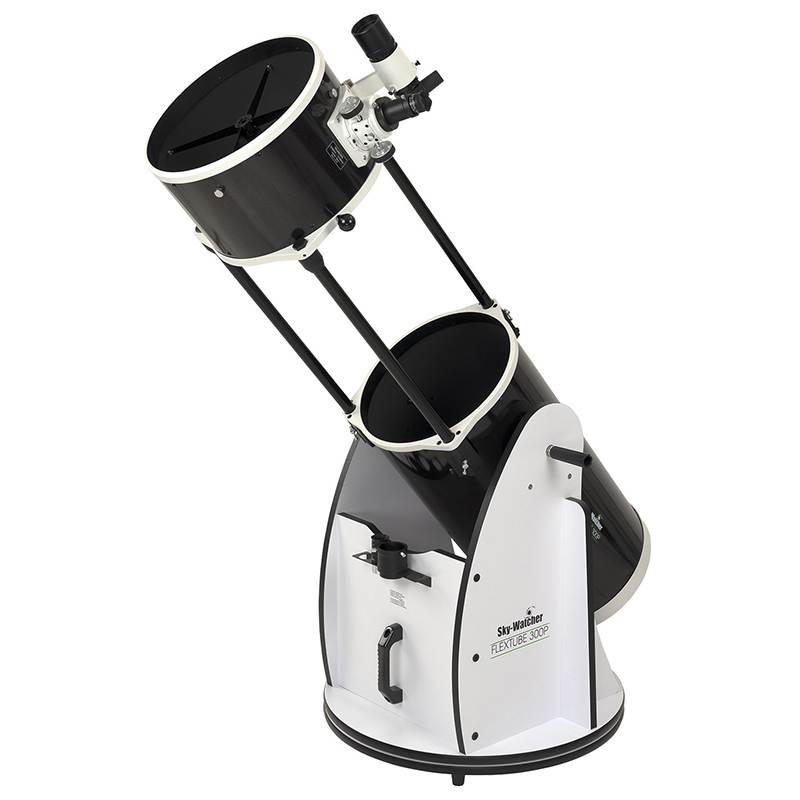
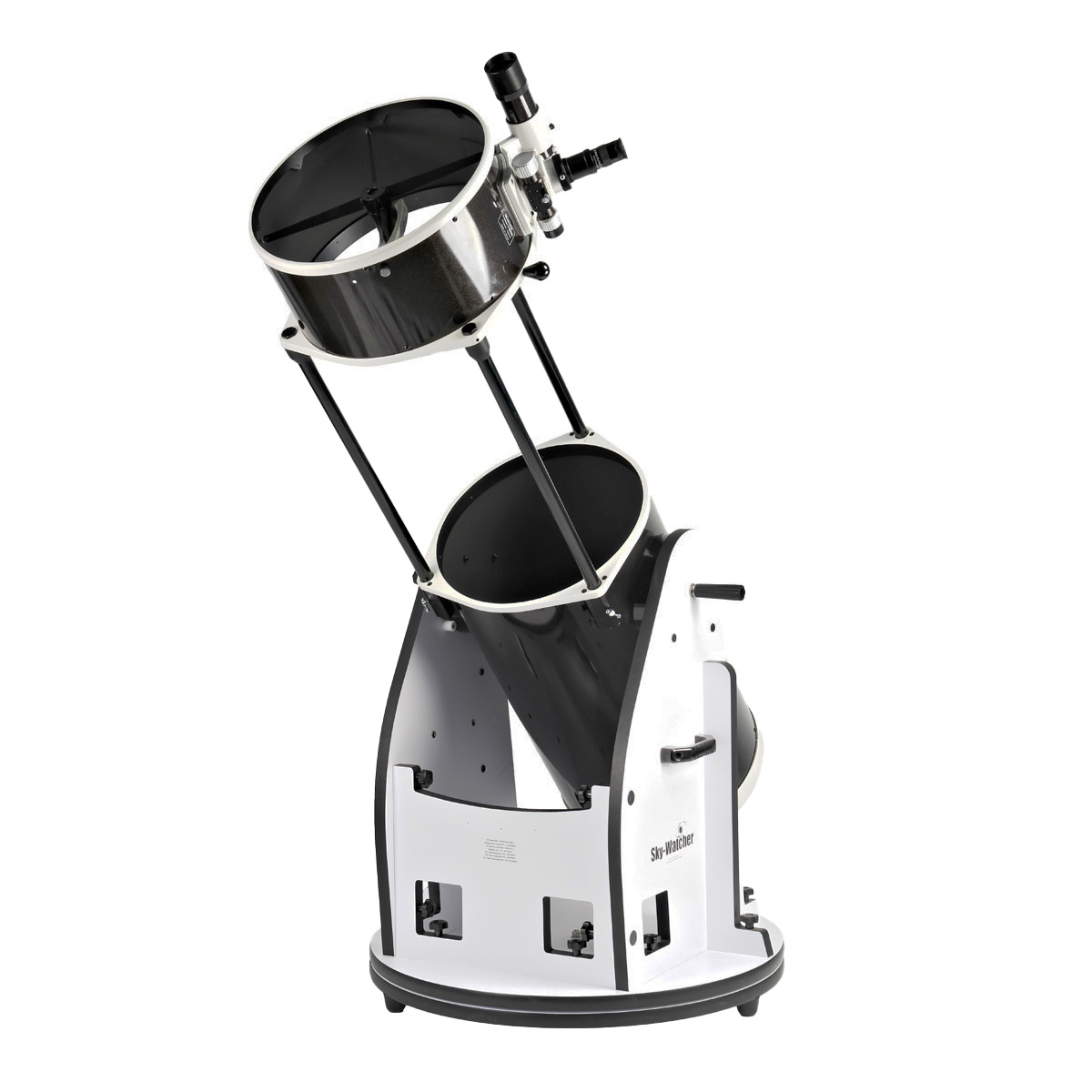
The price gap is real. The question is whether the extra capability is worth it at your stage.
Affiliate links — we earn from qualifying purchases at no extra cost to you.
First light
Sky-Watcher · 304mm · £659
The maximum-aperture visual reflector
- 304mm Newtonian on a floor-standing Dobsonian alt-az rocker box
- Good for: full visual programme — planets, Moon, globular clusters, galaxies, nebulae
- No alignment required — set up and observe in under 10 minutes
- No motorised tracking — targets drift at high magnification as Earth rotates
- 38kg total — designed for a fixed garden or regular dark-sky site, not casual transport
Sky-Watcher · 355mm · £1,099
The maximum-aperture visual reflector
- 355mm Newtonian on a floor-standing Dobsonian alt-az rocker box
- Good for: full visual programme — planets, Moon, globular clusters, galaxies, nebulae
- No alignment required — set up and observe in under 10 minutes
- No motorised tracking — targets drift at high magnification as Earth rotates
- 58kg total — designed for a fixed garden or regular dark-sky site, not casual transport
The full picture
The numbers that separate these two scopes — and what they mean at the eyepiece.
Aperture
Sky-Watcher Skyliner 350P gathers 1.4× more light. On bright targets — Moon, Saturn, Jupiter — you won't notice. On fainter targets — dim galaxies, faint globular clusters — the gap is real.
Focal length
Sky-Watcher Skyliner 350P's longer focal length reaches higher magnification with the same eyepiece — better reach for planetary detail. Sky-Watcher Skyliner 300P's shorter focal length gives a wider true field — better for large open clusters and extended nebulae.
Focal ratio
Sky-Watcher Skyliner 350P's faster f/4.51 delivers wider fields with any eyepiece — better for open clusters and large nebulae. Sky-Watcher Skyliner 300P's f/4.93 provides more magnification per eyepiece — better for fine planetary detail.
Mount type
Same mount type — setup experience and ergonomics will be similar. Differences lie in build quality and included accessories.
Weight (OTA)
Sky-Watcher Skyliner 300P's optical tube is 12.0kg lighter. Relevant if you plan to use it on multiple mounts or carry the tube to dark-sky sites separately.
Optical design
Same optical design — differences between these scopes come from aperture, mount, and focal ratio.
At the eyepiece
| Target | Sky-Watcher Skyliner 300P | Sky-Watcher Skyliner 350P |
|---|---|---|
| Planets | ||
| Moon | Excellent 304mm aperture delivers overwhelming lunar detail — tiny craterlets, rilles, and mountain shadows at 250x+ | Excellent 355mm aperture delivers overwhelming lunar detail — rilles, dome fields, and tiny craterlets visible at high magnification in steady seeing |
| Saturn | Excellent Cassini Division clear, cloud banding on the disc, and multiple moons visible at 200–300x | Excellent Cassini Division, ring structure, and subtle cloud banding on the disc; 1600mm focal length supports high magnification |
| Jupiter | Excellent Multiple belt structures, festoons, GRS, and moon shadow transits visible in good seeing | Excellent Festoons, barges, and fine belt structure visible; GRS detail and moon shadow transits are striking at 200x+ |
| Mars | Excellent 304mm aperture and 1500mm focal length resolve dark surface features and polar caps at opposition | Excellent 355mm aperture and 1600mm focal length exceed the rubric thresholds — surface albedo features, polar caps, and limb phenomena at opposition |
Deep sky | ||
| Orion Nebula (M42) | Excellent Layered nebulosity with structure and possible colour; Trapezium stars pinpoint-sharp | Excellent Massive aperture reveals layered nebulosity and faint outer wings; Trapezium E and F stars resolved — though the 1600mm focal length shows the core region more than the full extent |
| Andromeda Galaxy (M31) | Moderate 1500mm focal length crops the outer halo — you see the bright core and dust lanes, but the full 3° extent is lost | Moderate 1600mm focal length crops the outer halo heavily — you see the bright core and inner dust lanes but not the full 3° extent |
| Open clusters | Moderate 1500mm focal length means many large clusters (Pleiades, Double Cluster) overfill the field; compact clusters fare better | Moderate 1600mm focal length means large clusters like the Double Cluster or Pleiades overfill the field; compact clusters like M11 and M37 fare better |
| Globular clusters | Excellent 304mm resolves individual stars across the face of M13, M3, M5 and others — a showpiece target for this scope | Excellent 355mm resolves individual stars well into the core of M13, M5, and M22 — even dimmer globulars like M56 show granularity |
| Faint galaxies | Excellent Spiral arms in M51, dust lane in M82, Leo Triplet resolved — this is where 12 inches of aperture justifies itself | Excellent The scope's strongest suit — 355mm pulls spiral arm hints from M51, reveals the dust lane in NGC 891, and makes Virgo Cluster galaxies accessible by the dozen |
| Milky Way / wide field | Not recommended 1500mm focal length gives far too narrow a field for sweeping Milky Way star fields | Not recommended 1600mm focal length and minimum magnification ~50x make sweeping star fields impractical — use binoculars instead |
Other | ||
| Double stars | Excellent 304mm aperture resolves sub-arcsecond pairs; the f/4.9 ratio is less forgiving of seeing than a long-focus refractor, but raw resolving power is high | Excellent 355mm gives a Dawes limit around 0.33 arcsec; tight doubles like Porrima and Epsilon Boötis split cleanly when collimation and seeing cooperate |
| Astrophotography (deep sky) | Not recommended Manual Dobsonian mount with no tracking — long-exposure imaging is not viable | Not applicable |
| Astrophotography (planetary) | Challenging Planetary video capture is theoretically possible with short exposures, but manual tracking at 1500mm makes it very difficult in practice | Good 355mm aperture and 1600mm focal length suit high-resolution planetary imaging with a high-speed camera, but manual alt-az tracking limits capture run length |
The real tradeoff
Both scopes are capable. The question is which one fits the way you actually observe.
Sky-Watcher Skyliner 300P
- You'll fit this in most hatchbacks and manage the 38kg rig solo with effort — a realistic weekend trip to a dark site becomes a one-person decision rather than a logistics problem.
- You get galaxy structure and globular cluster resolution that justifies dark-sky drives, but your eyepiece field of view stays narrow enough that you'll spend observing sessions hunting one target at a time rather than sweeping the Milky Way.
- Your collimation routine takes 10–15 minutes after transport and your cool-down clock reads 30–45 minutes, so a typical session feels like: arrive, collimate, wait, then observe — manageable friction for dedicated observers.
Sky-Watcher Skyliner 350P
- You need a van or large estate car and genuinely need two people or a trolley to move this — a 58kg rig with a 1.9m tube means observing trips demand planning weeks ahead, not weekend spontaneity.
- You'll see faint galaxy groups and interacting pairs that the 300P renders as single smudges, and your globular clusters resolve deeper into the core — the aperture advantage is real and compounds at dark sites.
- Your collimation is more critical and less forgiving at f/4.5, your cool-down stretches to 45–60 minutes, and at 1600mm focal length you'll spend high-power sessions nudging constantly — you're committing to a discipline, not a casual hobby.
The dark side
Every scope has a personality. Here’s where each one gets difficult.
Sky-Watcher
Sky-Watcher Skyliner 300P
Total weight with rocker box is approximately 38kg and the 1.5m tube will not fit in many hatchbacks — you must measure your car boot before buying.
At f/4.9, coma is significant across the outer field — a coma corrector is strongly recommended for wide-field eyepieces.
Collimation is required after every transport session and should be checked before every observing session; cool-down time for the 12-inch mirror can be 30–60 minutes in cold weather.
Sky-Watcher
Sky-Watcher Skyliner 350P
Total weight with rocker box approaches 58kg and requires two people or a trolley to move — transport needs a van or large estate car.
At f/4.5 coma is severe toward the field edge; a coma corrector (Paracorr or similar) is effectively required for wide-angle eyepieces.
Collimation is critical and must be checked every session — small misalignment visibly degrades planetary and high-power performance; no tracking means objects drift through the field quickly at 178x+, requiring constant manual nudging.
Which is right for you?
Two different buyers. Two different right answers.
The maximum-aperture visual reflector
Sky-Watcher · Sky-Watcher Skyliner 300P
You'll love this if you have a hatchback and the discipline to collimate regularly — you want genuine deep-sky reach (galaxy structure, resolved globulars) without needing a van or a partner to transport it. You're experienced enough to navigate manual finding at high power, dark-site savvy, and you've done the math that 304mm for under £700 is exceptional value. This isn't for you if you lack a vehicle, can't handle 38kg, or want grab-and-go convenience.
The maximum-aperture visual reflector
Sky-Watcher · Sky-Watcher Skyliner 350P
You'll love this if you have van access, a storage space for a 1.9m tube, and the aperture hunger that makes faint galaxy groups and core-resolved globulars worth the logistics. You're an experienced observer who understands that f/4.5 collimation is critical, that cool-down takes an hour, and that the step from 304mm to 355mm aperture unlocks genuinely new targets. This isn't for you if you lack ground-floor storage, need portability, or want a scope that works casually — this demands commitment.
Our verdict
At £659 versus £1,099, the Sky-Watcher Skyliner 350P costs 67% more. It delivers 51mm more aperture — a real and visible advantage on faint targets.
If budget is a genuine constraint, the Sky-Watcher Skyliner 300P will make you a happy observer. The Sky-Watcher Skyliner 350P's optical advantage on faint targets is real and you are unlikely to regret it if you can stretch. If I had to choose without knowing your situation: start with the Sky-Watcher Skyliner 300P, use it for a year, then upgrade knowing exactly what you want.
Sky-Watcher Skyliner 300P
View Sky-Watcher Skyliner 300P →Sky-Watcher Skyliner 350P
View Sky-Watcher Skyliner 350P →Affiliate links — we earn from qualifying purchases at no extra cost to you.
Deep field: Full specifications
Every data point, for those who want to go further.
Full specifications
Fields highlighted in blue or amber indicate the better value for that spec. Data is manufacturer-stated and may vary.
How much can it see?
| Spec | Sky-Watcher Skyliner 300P | Sky-Watcher Skyliner 350P |
|---|---|---|
Apertureⓘ The most important spec — bigger = more light = better views | 304mm | 355mm |
Focal Length Longer = more magnification potential | 1500mm | 1600mm |
Focal Ratio Lower f-number = wider field of view; higher = more magnification per eyepiece | f/4.93 | f/4.51 |
Optical Design The type of optics — each design has different strengths | Dobsonian | Dobsonian |
Coatings Better coatings = more light transmission through the optics | Parabolic primary mirror, fully multi-coated | Parabolic primary mirror, fully multi-coated |
How do you point it?
| Spec | Sky-Watcher Skyliner 300P | Sky-Watcher Skyliner 350P |
|---|---|---|
Mount Type The mechanical system that holds and moves the telescope | Dobsonian | Dobsonian |
GoTo Computer-controlled pointing — finds any of thousands of objects automatically | ||
Tracking Motor keeps objects centred as the Earth rotates — essential for astrophotography |
The focuser
| Spec | Sky-Watcher Skyliner 300P | Sky-Watcher Skyliner 350P |
|---|---|---|
Focuser Size 2" accepts wider eyepieces and gives better low-power views | 2" | 2" |
Focuser Type Rack-and-pinion is standard; Crayford and dual-speed are smoother | Dual-speed Crayford (10:1 reduction) | Dual-speed Crayford (10:1 reduction) |
Size & weight
| Spec | Sky-Watcher Skyliner 300P | Sky-Watcher Skyliner 350P |
|---|---|---|
OTA Weightⓘ Optical tube only — useful for comparing mount load capacity | 24kg | 36kg |
Total Weightⓘ Full setup including mount — this is what you lug to the car | 38kg | 58kg |
Tube Length | 1500mm | 1600mm |
Tube Material | Steel | Steel |
What's in the box?
| Spec | Sky-Watcher Skyliner 300P | Sky-Watcher Skyliner 350P |
|---|---|---|
Eyepieces Included eyepieces — more is better, but quality matters more than quantity | 25mm and 10mm Super eyepieces | 25mm and 10mm Super eyepieces |
Finder Scope Helps you locate areas of the sky before switching to the main eyepiece | 8x50 right-angle correct-image finder | 8x50 right-angle correct-image finder |
Diagonal Tilts the eyepiece 90° for comfortable viewing — useful on refractors |
Blue highlight: Sky-Watcher Skyliner 300P advantage · Amber highlight: Sky-Watcher Skyliner 350P advantage · Greyed cells: equal or subjective.