Telescope Comparison
Sky-Watcher Virtuoso GTi 150P vs StellaLyra 6" f/8 Planetary Dobsonian
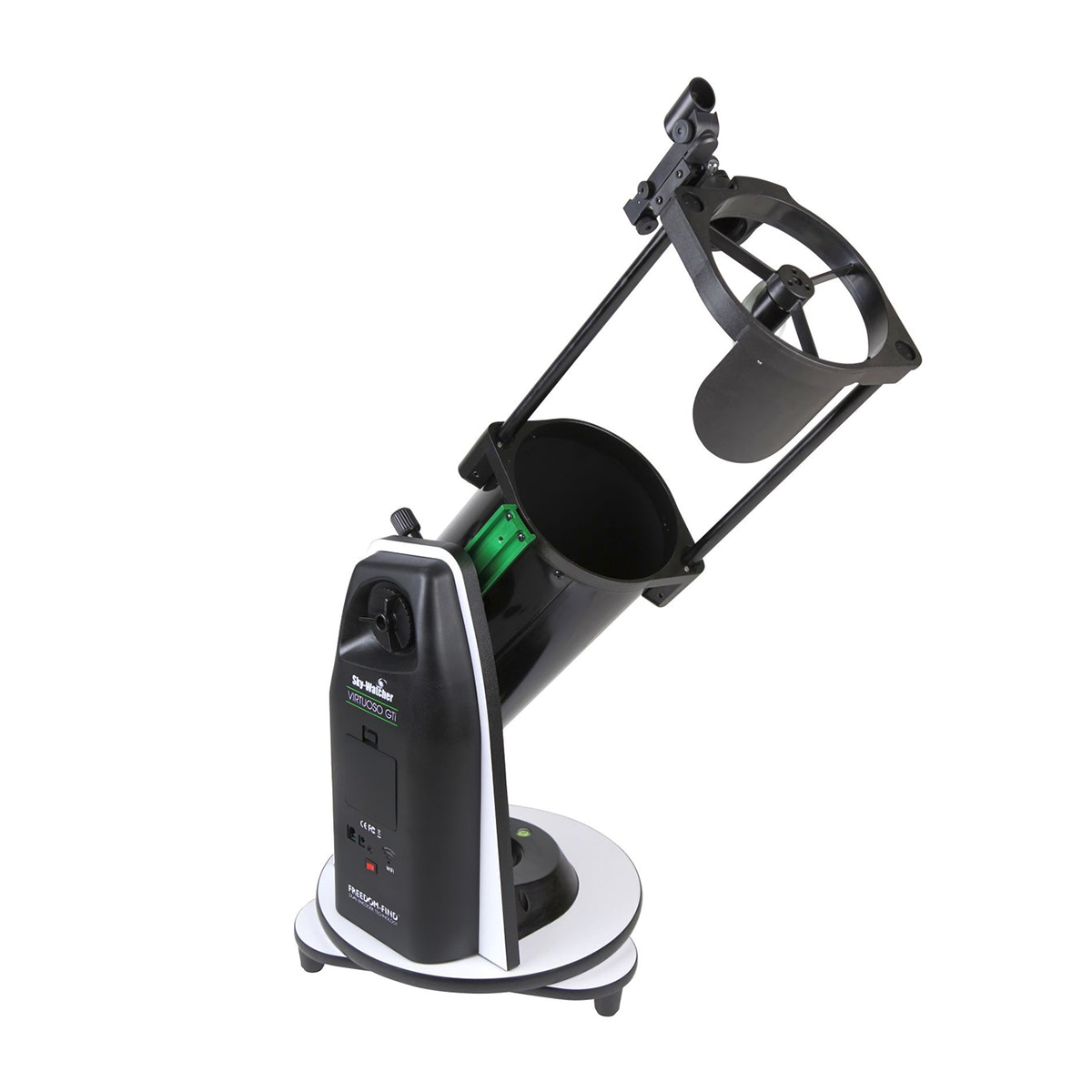
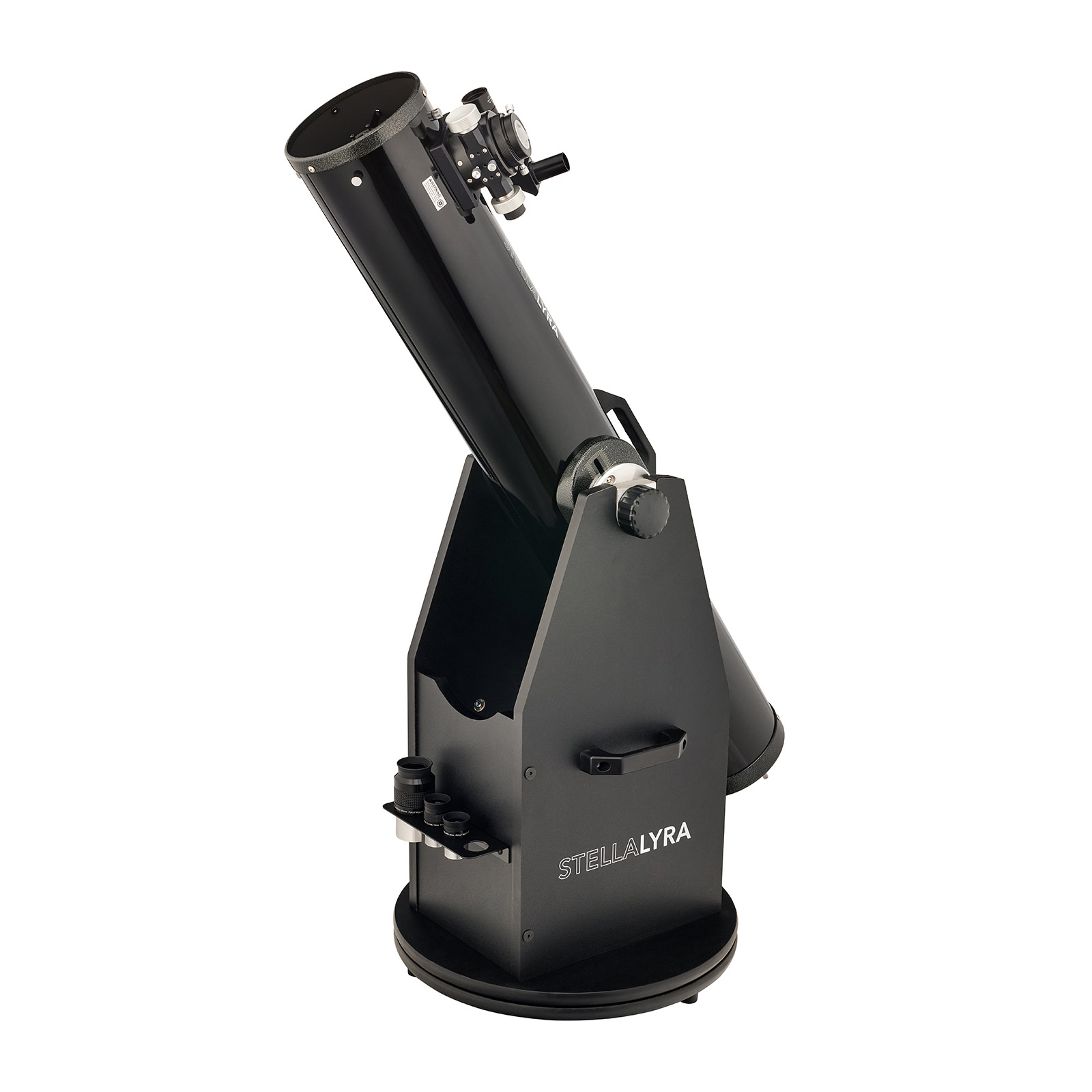
One finds objects for you. The other makes you learn the sky — and gives you more aperture in return.
Affiliate links — we earn from qualifying purchases at no extra cost to you.
First light
Sky-Watcher · 150mm · £449
The guided beginner's telescope
- 150mm newtonian reflector on a computerised mount with motorised tracking
- Good for: Moon, planets, bright nebulae, star clusters, and deep-sky objects
- GoTo system finds any object in its database after initial star alignment — no star atlas needed
- Tracking motors keep objects centred as Earth rotates — useful above 100×, essential for photography
- 6.5kg total — requires a fixed garden spot or car transport
StellaLyra · 152mm · £349
The maximum-aperture visual reflector
- 152mm Newtonian on a floor-standing Dobsonian alt-az rocker box
- Good for: full visual programme — planets, Moon, globular clusters, galaxies, nebulae
- No alignment required — set up and observe in under 10 minutes
- No motorised tracking — targets drift at high magnification as Earth rotates
- 20.9kg total — designed for a fixed garden or regular dark-sky site, not casual transport
The full picture
The numbers that separate these two scopes — and what they mean at the eyepiece.
Aperture
Effectively equal light-gathering. Aperture won't settle this comparison — the mount, focal ratio, and observing experience are what differ.
Focal length
StellaLyra 6" f/8 Planetary Dobsonian's longer focal length reaches higher magnification with the same eyepiece — better reach for planetary detail. Sky-Watcher Virtuoso GTi 150P's shorter focal length gives a wider true field — better for large open clusters and extended nebulae.
Focal ratio
Sky-Watcher Virtuoso GTi 150P's faster f/5 delivers wider fields with any eyepiece — better for open clusters and large nebulae. StellaLyra 6" f/8 Planetary Dobsonian's f/7.9 provides more magnification per eyepiece — better for fine planetary detail.
Mount type
Sky-Watcher Virtuoso GTi 150P adds GoTo — it finds any target in its database after alignment. StellaLyra 6" f/8 Planetary Dobsonian requires manual navigation.
Weight (OTA)
Sky-Watcher Virtuoso GTi 150P's optical tube is 2.5kg lighter. Relevant if you plan to use it on multiple mounts or carry the tube to dark-sky sites separately.
Optical design
Sky-Watcher Virtuoso GTi 150P is a Newtonian reflector (mirrors, needs occasional collimation); StellaLyra 6" f/8 Planetary Dobsonian is a DOBSONIAN. Different optical formulas produce different strengths — reflectors give more aperture per pound; refractors give sharper contrast and require no collimation.
At the eyepiece
Both scopes · same aperture
Both are 151mm Newtonian reflectors — light gathering is identical. What you see through each depends on your eyepieces, your sky, and the steadiness of the atmosphere, not which scope you bought. Saturn's rings separate clearly from the disk; in good seeing, the Cassini Division — the dark gap between the A and B rings — is a genuine target at moderate magnification. Jupiter shows two equatorial cloud bands reliably, four Galilean moons changing position night to night. The Orion Nebula (M42) shows real nebulosity around the Trapezium, which splits into four stars at moderate magnification. The Andromeda Galaxy (M31) fills a wide-field eyepiece, the bright core distinct from the outer halo. What separates these scopes is the mount, the setup experience, and where you can use them — not what you see through them.
The real tradeoff
Both scopes are capable. The question is which one fits the way you actually observe.
The Sky-Watcher Virtuoso GTi 150P handles object location automatically — align once, then it slews to anything in its database. The StellaLyra 6" f/8 Planetary Dobsonian asks you to navigate by star-hopping with a finder scope and sky chart.
For most beginners in light-polluted areas, GoTo removes the biggest early frustration: not being able to find anything. Choose the StellaLyra 6" f/8 Planetary Dobsonian if learning the sky manually is genuinely part of what you want from the hobby.
The dark side
Every scope has a personality. Here’s where each one gets difficult.
Sky-Watcher
Sky-Watcher Virtuoso GTi 150P
Alignment required every session
GoTo star alignment cannot be skipped — the mount needs to know where it is pointing before it can find objects. This adds several minutes to the start of every session, every time.
Collimation: the skill nobody mentions in the listing
The mirrors go out of alignment with use. Stars look bloated rather than sharp when this happens. Users report that a Cheshire eyepiece makes collimation straightforward once learned, but most beginners don't discover they need it until their second or third month.
StellaLyra
StellaLyra 6" f/8 Planetary Dobsonian
Objects drift out of view at high magnification
There is no tracking. At high magnification, targets drift across the field as Earth rotates and require regular manual nudging to keep them centred.
Too large for spontaneous outings
At 20.9kg total, getting this scope to a dark-sky site requires planning and ideally a second pair of hands. It suits a fixed garden setup or a dedicated trip, not an impulsive clear-night dash.
Which is right for you?
Two different buyers. Two different right answers.
The guided beginner's telescope
Sky-Watcher · Sky-Watcher Virtuoso GTi 150P
You’ll love this if…
- You want to navigate straight to targets without a star atlas — align once and the scope slews to any object in its database on demand
- You observe from a light-polluted garden where star-hopping to faint deep-sky objects would take most of a clear night
- You want objects to stay centred at high magnification without having to manually nudge the scope every few minutes
This will frustrate you if…
- You find the star alignment required at the start of every session frustrating — GoTo alignment cannot be skipped, and several minutes on a cold night before you can observe is the reality
- You notice that stars look bloated rather than sharp and don't know why — users report this is usually a collimation issue that's straightforward to fix once you know about it, but the listing doesn't mention it
The maximum-aperture visual reflector
StellaLyra · StellaLyra 6" f/8 Planetary Dobsonian
You’ll love this if…
- More aperture per pound is your main criterion — this design gives more light-gathering for your money than any other mount type at this price
- You plan to observe from a fixed garden or regular dark-sky site where you can set it up and leave it between sessions
- You prefer manual navigation — the Dobsonian rewards patient, hands-on observing and builds genuine sky knowledge over time
This will frustrate you if…
- You want to observe at high magnification without nudging the scope constantly — there is no tracking, and targets drift across the field as Earth rotates
- You want to take it to different locations easily — at this weight and size, it's a significant lift and benefits from a second pair of hands
- You want to take it out for spontaneous sessions — at this weight, getting it in and out of a car on your own requires planning and ideally a second pair of hands
Our verdict
The Sky-Watcher Virtuoso GTi 150P handles object location automatically — align once, the scope slews to anything in its database. The StellaLyra 6" f/8 Planetary Dobsonian asks you to navigate by star-hopping, which takes longer but builds real sky knowledge.
For most beginners, the Sky-Watcher Virtuoso GTi 150P removes the biggest early frustration: not being able to find anything from a light-polluted garden. The StellaLyra 6" f/8 Planetary Dobsonian is the better choice if learning the sky manually is part of why you want a telescope. If I had to choose for a first-time buyer: the Sky-Watcher Virtuoso GTi 150P — find things first, learn the sky later.
Sky-Watcher Virtuoso GTi 150P
View Sky-Watcher Virtuoso GTi 150P →StellaLyra 6" f/8 Planetary Dobsonian
View StellaLyra 6" f/8 Planetary Dobsonian →Affiliate links — we earn from qualifying purchases at no extra cost to you.
Deep field: Full specifications
Every data point, for those who want to go further.
Full specifications
Fields highlighted in blue or amber indicate the better value for that spec. Data is manufacturer-stated and may vary.
How much can it see?
| Spec | Sky-Watcher Virtuoso GTi 150P | StellaLyra 6" f/8 Planetary Dobsonian |
|---|---|---|
Apertureⓘ The most important spec — bigger = more light = better views | 150mm | 152mm |
Focal Length Longer = more magnification potential | 750mm | 1200mm |
Focal Ratio Lower f-number = wider field of view; higher = more magnification per eyepiece | f/5 | f/7.9 |
Optical Design The type of optics — each design has different strengths | Newtonian Reflector | Dobsonian |
Coatings Better coatings = more light transmission through the optics | Parabolic primary mirror with multi-coated optics | — |
How do you point it?
| Spec | Sky-Watcher Virtuoso GTi 150P | StellaLyra 6" f/8 Planetary Dobsonian |
|---|---|---|
Mount Type The mechanical system that holds and moves the telescope | GoTo (Computerised) | Dobsonian |
GoToⓘ Computer-controlled pointing — finds any of thousands of objects automatically | ||
Trackingⓘ Motor keeps objects centred as the Earth rotates — essential for astrophotography |
The focuser
| Spec | Sky-Watcher Virtuoso GTi 150P | StellaLyra 6" f/8 Planetary Dobsonian |
|---|---|---|
Focuser Size 2" accepts wider eyepieces and gives better low-power views | 1.25" | 2" |
Focuser Type Rack-and-pinion is standard; Crayford and dual-speed are smoother | Rack and pinion | 2" dual-speed Crayford (10:1) |
Size & weight
| Spec | Sky-Watcher Virtuoso GTi 150P | StellaLyra 6" f/8 Planetary Dobsonian |
|---|---|---|
OTA Weightⓘ Optical tube only — useful for comparing mount load capacity | 6.5kg | 9kg |
Total Weightⓘ Full setup including mount — this is what you lug to the car | 6.5kg | 20.9kg |
Tube Length | — | 1100mm |
Tube Material | Steel (collapsible FlexTube) | — |
What's in the box?
| Spec | Sky-Watcher Virtuoso GTi 150P | StellaLyra 6" f/8 Planetary Dobsonian |
|---|---|---|
Eyepieces Included eyepieces — more is better, but quality matters more than quantity | 25mm and 10mm Super eyepieces | 9mm and 15mm 1.25" Super-Plössl, 30mm 2" Superview |
Finder Scope Helps you locate areas of the sky before switching to the main eyepiece | Red dot finder | 6x30 right-angled |
Diagonalⓘ Tilts the eyepiece 90° for comfortable viewing — useful on refractors | — |
Smart features
| Spec | Sky-Watcher Virtuoso GTi 150P | StellaLyra 6" f/8 Planetary Dobsonian |
|---|---|---|
Built-in Camera Records and stacks images automatically — no separate camera needed | ||
App Controlled | ||
WiFi | ||
Battery Included |
Blue highlight: Sky-Watcher Virtuoso GTi 150P advantage · Amber highlight: StellaLyra 6" f/8 Planetary Dobsonian advantage · Greyed cells: equal or subjective.