Telescope Comparison
Vixen SD81S vs William Optics FluoroStar 91
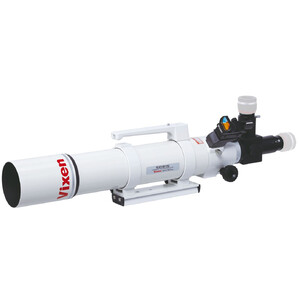
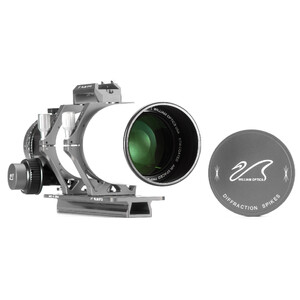
The specs are close. The experience isn't.
Affiliate links — we earn from qualifying purchases at no extra cost to you.
First light
Vixen · 81mm · £1,199
The custom-rig optical tube
- 81mm refractor — optical tube only, no mount included
- 625mm focal length at f/7.72
- Requires a compatible mount before you can observe anything
- Best for: observers who already own a suitable mount or are building a specific imaging rig
- Not a complete purchase — budget at least £100–300 extra for a mount before observing
William Optics · 91mm · £1,299
The custom-rig optical tube
- 91mm refractor — optical tube only, no mount included
- 537mm focal length at f/5.9
- Requires a compatible mount before you can observe anything
- Best for: observers who already own a suitable mount or are building a specific imaging rig
- Not a complete purchase — budget at least £100–300 extra for a mount before observing
The full picture
The numbers that separate these two scopes — and what they mean at the eyepiece.
Aperture
William Optics FluoroStar 91 gathers 1.3× more light. On bright targets — Moon, Saturn, Jupiter — you won't notice. On fainter targets — dim galaxies, faint globular clusters — the gap is real.
Focal length
Vixen SD81S's longer focal length reaches higher magnification with the same eyepiece — better reach for planetary detail. William Optics FluoroStar 91's shorter focal length gives a wider true field — better for large open clusters and extended nebulae.
Focal ratio
William Optics FluoroStar 91's faster f/5.9 delivers wider fields with any eyepiece — better for open clusters and large nebulae. Vixen SD81S's f/7.72 provides more magnification per eyepiece — better for fine planetary detail.
Mount type
Neither scope includes a mount — both require a separate purchase before you can observe.
Weight (OTA)
Vixen SD81S's optical tube is 1.2kg lighter. Relevant if you plan to use it on multiple mounts or carry the tube to dark-sky sites separately.
Optical design
Both are refractors — no mirrors to collimate, good contrast, colour-free stars with ED or APO glass. The differences between them are in aperture, focal ratio, and glass quality.
At the eyepiece
| Target | Vixen SD81S | William Optics FluoroStar 91 |
|---|---|---|
| Planets | ||
| Moon | Excellent 81mm aperture with superb colour correction delivers crisp, fringe-free lunar detail; f/7.7 supports rewarding high-magnification views | Excellent 91mm aperture and fluorite correction deliver sharp, high-contrast lunar detail with no false colour on the limb |
| Saturn | Good Rings clearly defined, Cassini Division visible in good seeing; 625mm focal length limits image scale but clean optics compensate | Good Ring structure and Cassini Division visible in good seeing, though short focal length requires high-power eyepieces to push magnification |
| Jupiter | Good Main equatorial belts and GRS visible with high contrast and no false colour; aperture limits finer belt detail | Good Main cloud belts and GRS visible; 91mm resolves some detail but the 537mm focal length limits comfortable high-power use |
| Mars | Challenging Small disc visible at opposition with possible polar cap hint, but 81mm aperture cannot resolve surface albedo features | Challenging Disc visible at opposition with hints of albedo features, but 91mm aperture and short focal length make surface detail very difficult |
Deep sky | ||
| Orion Nebula (M42) | Excellent 625mm focal length frames the nebula well; 81mm gathers enough light to show core structure and nebulosity wings | Excellent 91mm aperture and 537mm focal length at f/5.9 frame the full nebula complex with bright, detailed nebulosity and resolved Trapezium |
| Andromeda Galaxy (M31) | Excellent 625mm focal length captures the galaxy's full extent; core and dust lanes visible, though outer halo is faint at 81mm | Excellent 537mm focal length captures the full extent of M31 including companion galaxies; 91mm aperture shows hints of outer halo structure |
| Open clusters | Excellent Wide true field at 625mm beautifully frames clusters like the Pleiades and Double Cluster with pinpoint stars | Excellent Wide field at 537mm beautifully frames large clusters like the Double Cluster and Pleiades with tight, colour-free stars |
| Globular clusters | Challenging 81mm cannot resolve individual stars — globulars appear as fuzzy, concentrated glows | Moderate 91mm shows globulars as granular, concentrated balls — M13 has a bright core but individual stars remain unresolved |
| Faint galaxies | Moderate Brighter Messier galaxies visible as diffuse patches; 81mm lacks the light grasp for structure or fainter NGC targets | Challenging 91mm gathers limited light for faint galaxies visually; brighter Messier galaxies visible as faint smudges, but detail is minimal |
| Milky Way / wide field | Good 625mm focal length is moderately wide; rich starfields are enjoyable but the scope is too narrow for grand sweeping views | Excellent 537mm at f/5.9 is ideal for rich Milky Way sweeps — star fields through Cygnus and Sagittarius are stunning |
Other | ||
| Double stars | Good Clean optics and near-zero chromatic aberration make this a satisfying double star scope; Dawes limit around 1.4 arcseconds | Good 91mm resolves wide and moderate doubles cleanly with excellent colour correction, though close pairs need very short eyepieces at this focal length |
| Astrophotography (deep sky) | Not recommended No mount or tracking included; when paired with a suitable equatorial mount this would rate Excellent (81mm, f/7.7, superb correction) | Not recommended No mount or tracking included — optically superb for deep-sky imaging but requires a separate equatorial mount to realise that potential |
| Astrophotography (planetary) | Moderate Clean optics suit planetary capture, but 81mm aperture and 625mm focal length limit resolution and image scale | Moderate 91mm and 537mm focal length are limited for planetary imaging; usable with a 2–3× Barlow on a tracking mount, but aperture constrains resolution |
| Emission nebulae (imaging) | Not applicable | Excellent Fast f/5.9 fluorite triplet excels at narrowband and broadband emission nebula imaging — Heart, Soul, North America, and Veil nebulae are ideal targets with a matched flattener |
The real tradeoff
Both scopes are capable. The question is which one fits the way you actually observe.
Vixen SD81S
- You'll spend your observing sessions chasing sharp lunar detail and planetary contrast at high magnification — this scope rewards patience and steady seeing, not aperture.
- Your imaging workflow centers on a lightweight OTA that pairs easily with modest mounts, letting you image all night without tracking stress or frequent polar adjustments.
- You'll accept modest deep-sky performance (faint galaxies remain patches, globular clusters stay unresolved) in exchange for the optical purity that makes bright nebulae and star fields sing in your imager.
William Optics FluoroStar 91
- You'll spend your observing sessions at the camera, framing wide fields of nebulae and Milky Way structure that simply don't fit in the SD81S's narrower field — your real-world image scale is what justifies the price.
- Your imaging workflow demands a proper field flattener and a serious equatorial mount, but the payoff is stars that stay pinpoint edge-to-edge without the false colour that plagues cheaper optics.
- You'll accept that visual observing is secondary — the fluorite premium makes sense only if you're spending 90% of your time stacking exposures, not eyeballing the eyepiece.
The dark side
Every scope has a personality. Here’s where each one gets difficult.
Vixen
Vixen SD81S
Sold as OTA only — no mount, finder, diagonal, or eyepiece, making the true entry cost substantially higher than the £1199 listed price.
81mm aperture is a genuine ceiling for planetary detail and faint deep-sky objects; similarly-priced 130mm Newtonians will outperform it on these targets decisively.
Vixen's proprietary dovetail and accessory ecosystem may require adapters when pairing with third-party mounts, and the dedicated SD flattener (£250–£350) is nearly mandatory for serious imaging.
William Optics
William Optics FluoroStar 91
Sold as OTA only — no mount, diagonal, finder, or eyepieces included, pushing total system cost well above the £1299 sticker price.
91mm aperture and 537mm focal length restrict high-magnification planetary work; you cannot reach the detail possible with longer-focal-length 100mm+ refractors or larger apertures.
Field curvature without a matched flattener/reducer produces elongated stars at sensor edges, and the short focal length requires very short-focal-length eyepieces or a Barlow for useful visual magnification — added expense and complexity.
Which is right for you?
Two different buyers. Two different right answers.
The custom-rig optical tube
Vixen · Vixen SD81S
You'll love this if you're an experienced astrophotographer who values portability and optical elegance, and you're willing to build the complete system around a lightweight OTA. You already own a decent equatorial mount, you prioritise colour correction in widefield nebula and star-field imaging, and you don't need to resolve fine planetary detail or faint galaxies. You're comfortable with the Vixen ecosystem or happy to source adapters for third-party accessories.
The custom-rig optical tube
William Optics · William Optics FluoroStar 91
This is for you if you're committed to deep-sky astrophotography with a dedicated imaging mount, and you want the best possible colour correction on large-sensor rigs where every fraction of arc-second matters. You frame wide targets — entire nebula complexes, galaxy groups, Milky Way sweeps — and you're willing to pay for fluorite glass because you'll spend 90% of your time at the camera, not the eyepiece. You already have a substantial equatorial mount and you're chasing the last refinement in image quality, not your first refractor.
Our verdict
These two are closer than most comparisons on this site. The spec differences are genuine — mount type, focal ratio — but neither is the wrong answer for a typical observer starting out.
If I had to choose between them: the Vixen SD81S is the scope most people will be using regularly six months from now. The William Optics FluoroStar 91 rewards you more once you know what you're doing — it's worth revisiting after your first year.
Vixen SD81S
View Vixen SD81S →William Optics FluoroStar 91
View William Optics FluoroStar 91 →Affiliate links — we earn from qualifying purchases at no extra cost to you.
Deep field: Full specifications
Every data point, for those who want to go further.
Full specifications
Fields highlighted in blue or amber indicate the better value for that spec. Data is manufacturer-stated and may vary.
How much can it see?
| Spec | Vixen SD81S | William Optics FluoroStar 91 |
|---|---|---|
Apertureⓘ The most important spec — bigger = more light = better views | 81mm | 91mm |
Focal Length Longer = more magnification potential | 625mm | 537mm |
Focal Ratio Lower f-number = wider field of view; higher = more magnification per eyepiece | f/7.72 | f/5.9 |
Optical Design The type of optics — each design has different strengths | Refractor | Refractor |
Coatings Better coatings = more light transmission through the optics | Fully multi-coated SD (Super Duplex) glass doublet | Fully multi-coated fluorite triplet on all air-to-glass surfaces |
How do you point it?
| Spec | Vixen SD81S | William Optics FluoroStar 91 |
|---|---|---|
Mount Type The mechanical system that holds and moves the telescope | None (OTA only) | None (OTA only) |
GoTo Computer-controlled pointing — finds any of thousands of objects automatically | ||
Tracking Motor keeps objects centred as the Earth rotates — essential for astrophotography |
The focuser
| Spec | Vixen SD81S | William Optics FluoroStar 91 |
|---|---|---|
Focuser Size 2" accepts wider eyepieces and gives better low-power views | 2" | 2" / 1.25" |
Focuser Type Rack-and-pinion is standard; Crayford and dual-speed are smoother | Dual-speed Crayford (with 1.25" adapter) | Dual-speed Crayford 2" (10:1 reduction fine focus) |
Size & weight
| Spec | Vixen SD81S | William Optics FluoroStar 91 |
|---|---|---|
OTA Weightⓘ Optical tube only — useful for comparing mount load capacity | 2kg | 3.2kg |
Tube Length | 540mm | 430mm |
Tube Material | Aluminium | Aluminium, anodised |
What's in the box?
| Spec | Vixen SD81S | William Optics FluoroStar 91 |
|---|---|---|
Diagonal Tilts the eyepiece 90° for comfortable viewing — useful on refractors |
Blue highlight: Vixen SD81S advantage · Amber highlight: William Optics FluoroStar 91 advantage · Greyed cells: equal or subjective.