Browse·Refractors·Askar 151PHQ
Askar
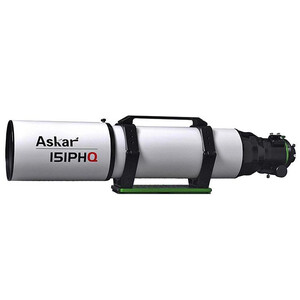
Askar 151PHQ
A bargain 151mm triplet refractor that delivers solid refractor views without premium pricing.
Affiliate link — we earn from qualifying purchases at no extra cost to you.
From the community
What owners say
Based on 17 Cloudy Nights discussions
What they love
- ✓Build quality is robust with well-machined rings and solid focuser including captain's wheel extension
- ✓Minimal dust inside tube when inspected
- ✓Double-boxed packaging with extra foam protection and sturdy carrying case with wheels
- ✓Increased aperture shows noticeably more nebulosity compared to smaller refractors like the SW 150
- ✓Stars appear equally sharp as competing scopes despite larger aperture
What caught them off guard
- !DPAC test results not as good as expected, showing spherochromatism with bending of jail bars
- !Central dip or hill visible in Ronchigram affecting optical correction
- !Optical correction appears worse in green and blue wavelengths
- !Large eyepiece height when mounted on standard tripods requires observer to sit on ground or use tall pier
- !Anodization may fade with sun exposure based on experience with other Chinese equipment
Top targets reported by owners
What you'll see
Jupiter at 150-185x magnification
belts clear, no objectionable false color noted even in suburban skies
M42 nebula
noticeably more nebulosity visible than smaller 150mm APO due to increased aperture
Open clusters like M35
extra aperture made significant difference in detail and star count
Orion Trapezium
equally sharp star test compared to premium 150mm APO; E star visible twinkling in and out
Worth knowing before you buy
DPAC testing shows spherochromatism with noticeable line bending in the ronchigram, particularly in blue wavelengths, with the lens nulled in red performing around 1/6 wave in red, 1/4 wave in green, and 1/2 wave in blue.
The optical design appears to have a central hill or zone visible in DPAC results, similar to the StellarVue SVX180, which may limit contrast and sharpness on planetary observations despite acceptable visual performance.
Eyepiece height requires significant pier/tripod extension to observe near zenith, necessitating observers to sit on the ground or requiring investment in taller pier solutions for comfortable observing.
Head to head
How it compares
Frequently asked
Questions from owners
Sourced from Cloudy Nights discussions.
- How does the Askar 185 compare optically to much more expensive refractors like TEC, CFF, and AP?
- DPAC testing shows the Askar 185 is similar to the StellarVue SVX180 (which costs ~$20k) but slightly worse overall, with spherochromatism visible especially in blue light. However, it compares reasonably well to premium scopes when accounting for its ~$4,800 price versus $17,000-$19,000 for competitors.
- What mounting and pier solutions do I need for the Askar 185?
- The Askar 185 weighs about 38 pounds with rings and is roughly 5 pounds heavier than a carbon-fiber Esprit 150. Owners report that typical iOptron tri-piers are too low for comfortable observing—you may need extended height solutions or a tall ladder to reach the eyepiece when pointed high.
- Is the 185mm too heavy and unwieldy for practical visual observing?
- The entire boxed scope weighs nearly 100 pounds, but the OTA itself at ~38 pounds is manageable once unpacked. The bigger challenge is achieving comfortable eyepiece height—owners found themselves sitting or kneeling to observe, not the weight itself.
- How does the Askar 140 perform compared to the 185?
- The 140 is a 5.5-inch f/7 triplet priced at $1,999, making it more affordable and compact than the 185.
- What is the optical formula and what glass type is used in the Askar 185?
- Askar does not disclose the specific glass type, though expert analysis suggests it is not FPL-53 or equivalent premium glass given the low price point. Expert optical tester peleuba estimated the glass is likely FK-61 or cheaper CDGM materials, and the lens is nulled in red (meaning best correction in red light, with green ~¼ wave out and blue ~½ wave out of spec).
- Will the optics hold up over time and is the build quality reliable?
- Owners praise the tube construction, machined rings, and solid focuser assembly. However, anodization fade with sun exposure is a known issue across Chinese optics brands (ES, Sharpstar, Askar, etc.
Full Specifications
Optics
| Aperture | 151mm |
| Focal Length | 1057mm |
| Focal Ratio | f/7 |
| Optical Design | Refractor |
| Lens Elements | 5-element |
| Coatings | Fully multi-coated quintuplet with integrated field flattener |
Mount & Tracking
| GoTo (Computerised) | No |
| Tracking | No |
Focuser
| Focuser Size | 2" / 1.25" |
| Focuser Type | Dual-speed Crayford 2" (10:1 reduction) |
Physical
| OTA Weight | 9.5kg |
| Tube Length | 800mm |
| Tube Material | Aluminium |
Included Accessories
| Diagonal | No |