Browse·Reflectors·Bresser Messier N-150/750
Bresser
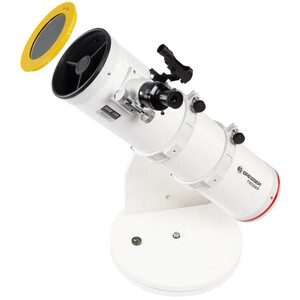
Bresser Messier N-150/750
A fast six-inch reflector delivering wide-field views and surprising planetary performance.
Affiliate link — we earn from qualifying purchases at no extra cost to you.
From the community
What owners say
Based on 19 Cloudy Nights discussions
What they love
- ✓Quick cooldown time (45 minutes from room temperature to low twenties)
- ✓Excellent wide field views, especially with 24mm Panoptic eyepiece
- ✓Very good planetary viewing capability, including clear views of Cassini division in Saturn's rings
- ✓Great for open clusters and lunar observation
- ✓Compact and portable design, easy to set up and grab-and-go
What caught them off guard
- !Pinched optics on some units (though resolvable by reseating primary mirror)
- !Secondary mirror obstruction larger than ideal (2 inch secondary needed for 2 inch focuser compatibility creates 33% cen…
- !Rack and pinion focuser less than ideal compared to Crayford design
- !Excessive back focus for visual use, requiring larger secondary than necessary
- !Some users saw secondary shadow when using wide-field eyepieces with exit pupils larger than 6-7mm
Top targets reported by owners
What you'll see
Saturn
Cassini division clearly visible in the rings under good seeing conditions at 188x magnification
Jupiter
good detail visible, multiple cloud bands and features resolvable
Double stars
the Double Double (Epsilon Lyrae) cleanly split with 7mm eyepiece
Open clusters
entire Pleiades frames with room to spare using 24mm 68-degree eyepiece; northern Ophiuchus clusters…
Worth knowing before you buy
Secondary mirror obstruction is larger than necessary (2 inches vs 1.
Focuser has excessive back focus distance designed for astrophotography, forcing a larger secondary mirror and reducing…
Mirror often arrives with pinched optics requiring removal and reseating of the primary mirror from its cell to correct
Head to head
How it compares
Messier N-150/750
Bresser
SkyQuest XT6 Classic Dobsonian
Orion
150mm · Manual Newtonian Reflector vs 150mm · Manual Dobsonian
Full comparison →
Messier N-150/750
Bresser
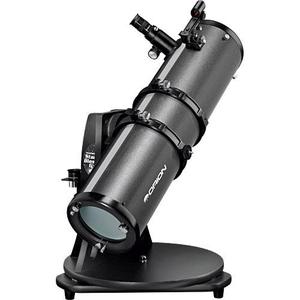
StarBlast 6 Astro Reflector
Orion
150mm · Manual Newtonian Reflector vs 150mm · Manual Newtonian Reflector
Full comparison →
Messier N-150/750
Bresser
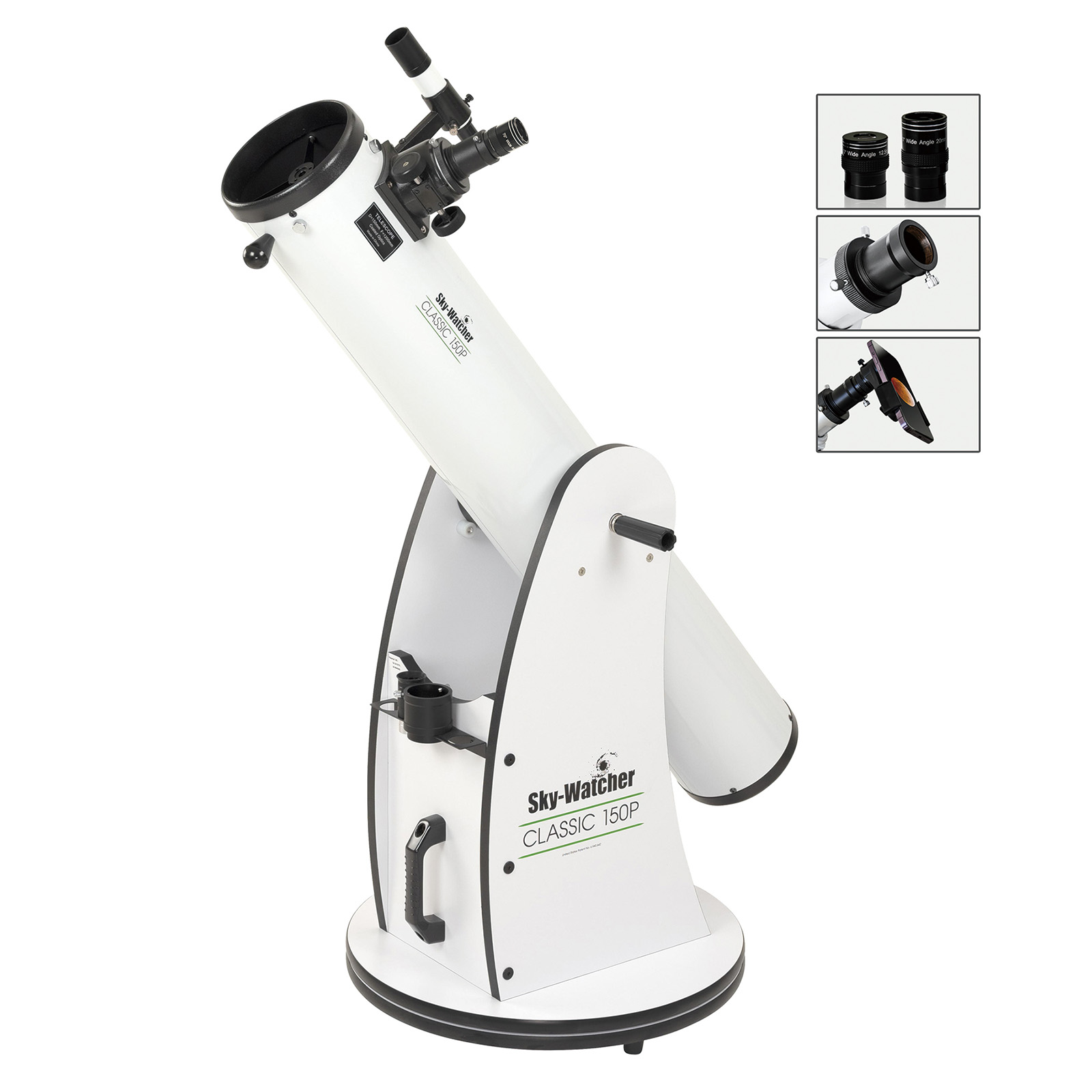
Skyliner 150P
Sky-Watcher
150mm · Manual Newtonian Reflector vs 150mm · Manual Dobsonian
Full comparison →
Messier N-150/750
Bresser
Explorer 150PDS OTA
Sky-Watcher
150mm · Manual Newtonian Reflector vs 150mm · Manual Newtonian Reflector
Full comparison →
Frequently asked
Questions from owners
Sourced from Cloudy Nights discussions.
- Is this scope good for planetary viewing or is it just a wide-field instrument?
- Members consistently report excellent planetary performance despite the f/5 ratio. Users regularly achieve sharp views at 150–200× magnification on Jupiter and Saturn, with some pushing to 280× under excellent seeing conditions.
- What eyepieces should I use, and will a 2-inch focuser be worthwhile?
- A 2-inch focuser works well if your pupils are dark-adapted and you avoid eyepieces larger than 24–28mm to prevent secondary mirror shadow at low magnification. For most viewing, 1.
- Does the included red dot finder work, or should I upgrade to a Telrad or Quickfinder?
- The red dot finder works adequately for beginners with practice, though some users find it can be adjusted too bright. A Rigel Quickfinder is recommended as a better option for this scope size, while a Telrad is considered too large and heavy for the tube.
- How quickly does it cool down, and is temperature control an issue?
- Members report rapid cooldown in 30–45 minutes from room temperature, making it ideal for winter observing. Some users install a small fan behind the primary mirror to further reduce thermal effects and improve contrast.
- Can I improve the optics and design after purchase?
- Yes—members routinely enhance these scopes by flocking the tube interior, adding a dew shield, refiguring the mirror, upgrading the focuser to a Crayford, and replacing the secondary mirror for lower obstruction. Several users report that even stock mirrors are decent quality, though some arrive with slight pinched optics that resolve after reseating.
- Is the tabletop design (table dobsonian) practical for regular use, or should I get a full-height dobsonian instead?
- The tabletop design requires standing on a chair, table, or vehicle hood to view comfortably, which is awkward and limits portability. A full-height 8-inch dobsonian at f/8 costs about the same, offers more aperture with simpler eyepieces, and eliminates the positioning hassle.
Full Specifications
Optics
| Aperture | 150mm |
| Focal Length | 750mm |
| Focal Ratio | f/5 |
| Optical Design | Newtonian Reflector |
| Coatings | Parabolic primary mirror, fully coated |
Mount & Tracking
| Mount Type | Equatorial |
| GoTo (Computerised) | No |
| Tracking | No |
Focuser
| Focuser Size | 2" |
| Focuser Type | Dual-speed Crayford (2" with 1.25" adapter) |
Physical
| OTA Weight | 5kg |
| Total Weight (with mount) | 13.5kg |
| Tube Length | 670mm |
| Tube Material | Steel |
Included Accessories
| Eyepieces | 25mm and 10mm eyepieces |
| Finder Scope | 8x50 optical finder |
| Diagonal | No |