Browse·Dobsonians·Omegon N 305/1500 Dobson
Omegon
Omegon N 305/1500 Dobson
Twelve inches of aperture is where amateur astronomy starts to overlap with what professional observatories were doing not so long ago. Objects that are faint smudges in smaller scopes become structured, detailed targets: the dark lane in NGC 891, the spiral arms of M51, the core of M13 resolved to individual stars. The Omegon 305/1500 Dobson sits in a competitive bracket alongside the Bresser 12-inch Messier Dob and the Sky-Watcher Skyliner 300P, and typically undercuts both on price. It is a large, heavy telescope that needs storage space and a car to transport — but for observers who have dark-sky access and want maximum aperture per pound, this is hard to beat.
Affiliate link — we earn from qualifying purchases at no extra cost to you.
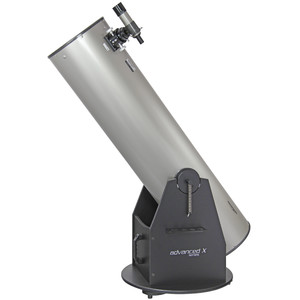
What you'll see
The Omegon N 304/1500 (12" F/5) will show you noticeably more than a 10"-class scope, delivering roughly 0.4 magnitudes greater depth and gathering 45% more light. Where a 10" delivers satisfying views of major Messier objects, galaxies like M51 appear 'significantly beefier' and dust lanes in M31 become visible at the 12". Lunar and planetary work is very capable, though the F/5 design produces coma that benefits from a corrector (adding £200+) for the sharpest planetary views—this is not a critical issue for deep-sky work. The scope's real strength lies in its ability to sustain long observing sessions on faint objects; one user successfully logged 107 of 110 Messier objects in a single night, primarily using just a 21mm eyepiece for wide-field sweeping.
However, the 12" F/5 solid tube presents logistical trade-offs that genuinely affect real-world use. The 53 lb OTA and 72 lb total weight, combined with its 1.5-meter length, makes it a committed piece of furniture—it will not fit lengthwise in most cars without reconfiguration, and moving it becomes a two-person job or requires a hand truck. Thermal stabilization takes ~60 minutes (versus 40 for a 10"), meaning you cannot take it outside for a quick 30-minute session. Multiple experienced users report that after the initial excitement, the 12" solid tube began seeing less use than a 10", and some actively regretted the purchase because the bulk itself became a friction point discouraging observing. For a stationary backyard setup with a hand truck and sheltered storage, this is far less of an issue; for future dark-sky trips with family in a car, you may find yourself wishing you had the portability of a 10" or the modularity of a 12" truss design.
For observing program completion and detecting subtle detail, the 12" is genuinely the better instrument. But the consensus from users who own both sizes is stark: 'The best telescope is the one you use.' If the 12"'s bulk discourages regular observing, a 10" that gets used weekly will show you more in the end than a 12" that sits idle. Consider whether your observing will be truly backyard-focused and sheltered, or whether regular transport and quick-setup sessions matter to your long-term engagement with the hobby.
Worth knowing before you buy
The 12'' F/5 OTA is approximately 1.
The 12'' solid tube Dobsonian is bulky and heavy (53 lbs OTA, 72 lbs total), causing owners to use it less frequently ov…
Mirror cooling time for the 12'' is significantly longer than smaller scopes (approximately 60 minutes versus 40 minutes…
Head to head
How it compares
N 305/1500 Dobson
Omegon
Meade LightBridge 12" Truss Dobsonian
Meade Instruments
305mm · Manual Dobsonian vs 305mm · Manual Dobsonian
Full comparison →
N 305/1500 Dobson
Omegon
SkyQuest XT10 Classic Dobsonian
Orion
305mm · Manual Dobsonian vs 254mm · Manual Dobsonian
Full comparison →
N 305/1500 Dobson
Omegon
AD10 Dobsonian
Apertura
305mm · Manual Dobsonian vs 254mm · Manual Dobsonian
Full comparison →
N 305/1500 Dobson
Omegon
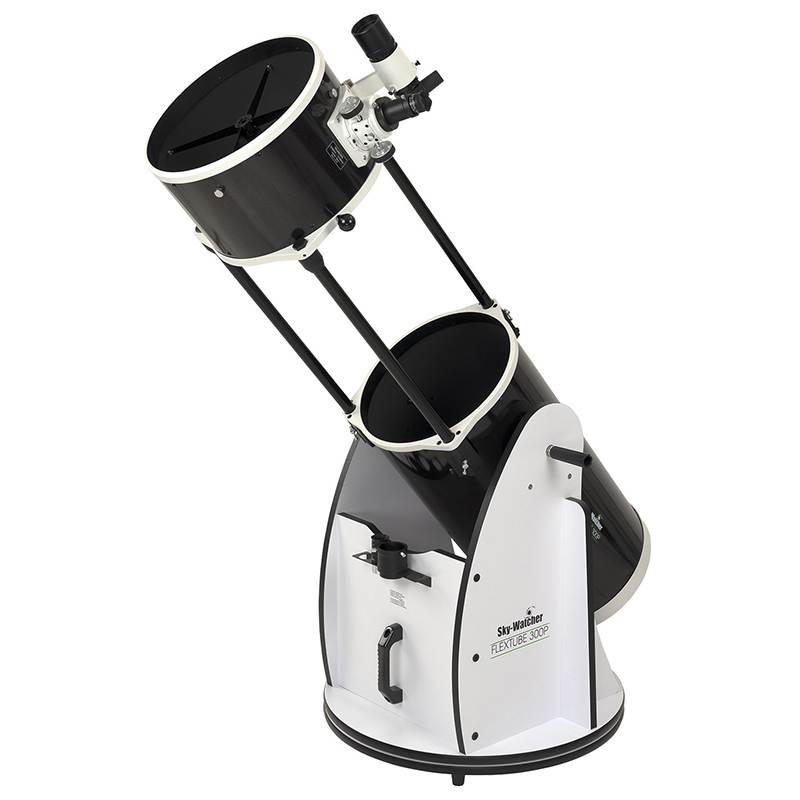
Skyliner 300P
Sky-Watcher
305mm · Manual Dobsonian vs 304mm · Manual Dobsonian
Full comparison →
Full Specifications
Optics
| Aperture | 305mm |
| Focal Length | 1500mm |
| Focal Ratio | f/4.9 |
| Optical Design | Dobsonian |
| Coatings | Parabolic primary mirror with aluminium coating and SiO2 overcoat |
Mount & Tracking
| Mount Type | Dobsonian |
| GoTo (Computerised) | No |
| Tracking | No |
Focuser
| Focuser Size | 2" |
| Focuser Type | Dual-speed Crayford |
Physical
| OTA Weight | 18.5kg |
| Total Weight (with mount) | 27kg |
| Tube Length | 1460mm |
| Tube Material | Aluminium |
Included Accessories
| Eyepieces | 10mm and 25mm eyepieces |
| Finder Scope | 8x50 right-angle finder scope |
| Diagonal | No |