Browse·Reflectors·Sky-Watcher Explorer 200P
Sky-Watcher
Sky-Watcher Explorer 200P
A capable eight-inch Dobsonian delivering excellent planetary and deep-sky performance nightly.
Affiliate link — we earn from qualifying purchases at no extra cost to you.
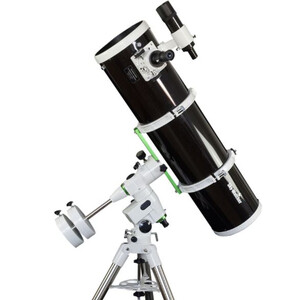
Worth knowing before you buy
Plastic focuser components on some units, with reports of parts being plastic rather than all-metal construction like ol…
Equatorial mounts are difficult for beginners to use and understand, leading some owners to convert scopes to Dobsonian…
Spherical mirrors instead of parabolic despite marketing claims, resulting in poor performance at high magnification on…
Head to head
How it compares
Explorer 200P
Sky-Watcher
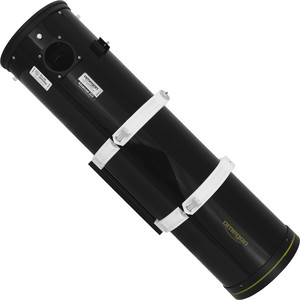
Advanced 203/1000 EQ4
Omegon
200mm · Manual Newtonian Reflector vs 203mm · Manual Newtonian Reflector
Full comparison →
Explorer 200P
Sky-Watcher
SkyQuest XT8 Classic Dobsonian
Orion
200mm · Manual Newtonian Reflector vs 203mm · Manual Dobsonian
Full comparison →
Explorer 200P
Sky-Watcher
AD8 Dobsonian
Apertura
200mm · Manual Newtonian Reflector vs 203mm · Manual Dobsonian
Full comparison →
Explorer 200P
Sky-Watcher

8" f/6 Dobsonian
StellaLyra
200mm · Manual Newtonian Reflector vs 203mm · Manual Dobsonian
Full comparison →
Frequently asked
Questions from owners
Sourced from Cloudy Nights discussions.
- Is the mirror parabolic or spherical?
- The Explorer 200P's mirror is spherical, not parabolic despite marketing claims. At f/8 focal ratio, a spherical mirror performs acceptably for visual observation and handles high magnification reasonably well, though it won't match true parabolic performance.
- How does this scope perform on planets?
- Forum members report the 200P works well for planetary observation when properly collimated and cooled to ambient temperature. Magnifications between 150-250x produce good views on average nights, with 300x+ possible on steady nights.
- What eyepieces should I buy to start?
- Members recommend avoiding the budget eyepiece kits and instead investing in a zoom eyepiece like the Celestron 8-24mm (around $59-89) paired with a quality 2x barlow, or buying individual eyepieces with 60+ degree apparent field of view. Budget options like Svbony aspherics (10mm and 26mm) or Orion Expanse eyepieces offer good value and noticeably outperform factory Plössls.
- Can I use a barlow lens without losing image quality?
- Yes, GSO-type shorty barlows and quality 2x barlows do not noticeably reduce image quality. Many owners successfully pair barlows with zoom eyepieces to achieve higher magnifications, and this approach is preferred over buying multiple fixed eyepieces, especially for planetary observation on steady nights.
- How important is collimation for this scope?
- Collimation is critical—multiple members note that poor collimation makes spherical aberration worse and severely limits planetary performance. The primary mirror must be collimated for best results; a collimation cap and center dot (which this scope should have) make adjustment straightforward.
- What mount comes with this scope and is it adequate?
- Based on similar budget reflectors discussed, equatorial mounts included with this class of scope are typically difficult for beginners to use and unstable. Members routinely recommend converting to or building a dobsonian mount, which dramatically improves usability and tracking, especially for planetary observation.
Full Specifications
Optics
| Aperture | 200mm |
| Focal Length | 1000mm |
| Focal Ratio | f/5 |
| Optical Design | Newtonian Reflector |
| Coatings | Parabolic primary mirror with multi-coated optics |
Mount & Tracking
| Mount Type | Equatorial |
| GoTo (Computerised) | No |
| Tracking | No |
Focuser
| Focuser Size | 2" |
| Focuser Type | Dual-speed Crayford |
Physical
| OTA Weight | 6.2kg |
| Total Weight (with mount) | 17.5kg |
| Tube Length | 850mm |
| Tube Material | Steel |
Included Accessories
| Eyepieces | 25mm and 10mm Super eyepieces |
| Finder Scope | 8x50 right-angle finder |
| Diagonal | No |