Browse·Dobsonians·Sky-Watcher Heritage 76
Sky-Watcher
Sky-Watcher Heritage 76
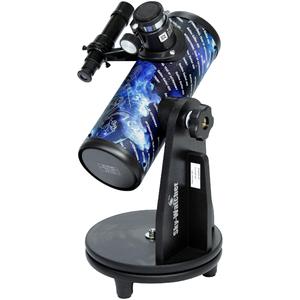
The Heritage 76 is the smallest telescope in Sky-Watcher's Heritage tabletop Dobsonian range, and it is remarkably capable for its size and price. The f/3.9 focal ratio makes it extremely compact — the tube is barely 21cm long — and the wide field of view suits star clusters and the Moon beautifully. At 76mm aperture, you are genuinely limited by the optics for fine planetary detail, but for a scope you can take on a camping trip, leave by the window on an impulse clear night, or hand to a child without worrying, nothing else comes close at this price. The Heritage 76 is where a lot of people discover that astronomy can be casual and immediate, not just serious and cold.
Affiliate link — we earn from qualifying purchases at no extra cost to you.
What you'll see
The Sky-Watcher Heritage 76 excels as a grab-and-go lunar and bright-object scope from suburban or reasonably dark skies. Owners consistently praise its performance on the Moon—revealing detail like small rilles and 3 km craters—and its ability to frame bright clusters like the Pleiades in stunning wide-field views. Large nebulae (Veil, Rosette, North American) transform under a UHC filter, appearing far more impressive than the small aperture suggests. Jupiter and Saturn are well within its reach, and the scope handles mid-range magnifications capably. The fast f/4.4 focal ratio and compact, lightweight design make it genuinely portable and require minimal cool-down time.
However, realistic expectations matter. This is not a planetary powerhouse—the 1.25" focuser limits eyepiece selection for high magnification, and extreme powers (beyond ~150x) start to show the limits of the small mirror. Faint deep-sky objects and galaxies demand darker skies and patience; one owner succeeded with M51 but this is not the scope's strength. The standard alt-azimuth mount can wobble, though quality of mechanics varies by variant (Zhumell and Orion versions have been reported with noticeably different build quality). Collimation is straightforward and essential—the fast mirror shows defects readily—but with smooth optics and a properly collimated mirror, owners report the 76mm 'holds power extremely well' and will deliver surprising sharpness even at magnifications that should theoretically exceed its limits.
What sets this scope apart is its portability married to genuine optical capability. It is one of the few reflectors light enough to carry as a true grab-and-go, yet capable of revealing lunar detail, nebular structure, and deep-sky clusters that belie its aperture. For someone who prioritizes convenience and wants to actually *use* their telescope regularly—rather than let it sit assembled in the back of a closet—the 76mm's combination of ease of use, quick setup, low cost, and surprising performance on bright objects makes it memorable.
Worth knowing before you buy
The 1.
The mount is wobbly and unstable, particularly the altitude arm and tripod legs, limiting how well the scope can hold po…
The original secondary mirror diagonal is undersized and doesn't utilize the full aperture, reducing light gathering abi…
Full Specifications
Optics
| Aperture | 76mm |
| Focal Length | 300mm |
| Focal Ratio | f/3.9 |
| Optical Design | Dobsonian |
| Coatings | Parabolic primary mirror with aluminium coating |
Mount & Tracking
| Mount Type | Dobsonian |
| GoTo (Computerised) | No |
| Tracking | No |
Focuser
| Focuser Size | 1.25" |
| Focuser Type | Rack and pinion |
Physical
| OTA Weight | 0.9kg |
| Total Weight (with mount) | 1.6kg |
| Tube Length | 210mm |
| Tube Material | Aluminium |
Included Accessories
| Eyepieces | 10mm and 25mm eyepieces |
| Finder Scope | Red dot finder |
| Diagonal | No |