Browse·Dobsonians·StellaLyra 8" f/6 Dobsonian
StellaLyra
StellaLyra 8" f/6 Dobsonian
A premium-feeling Dobsonian that delivers genuinely impressive views straight out of the box.
Affiliate link — we earn from qualifying purchases at no extra cost to you.

From the community
What owners say
Based on 24 Cloudy Nights discussions
What they love
- ✓Exceptional planetary views, particularly of Mars showing albedo features and Syrtis Major clearly at around 150x power,…
- ✓Sharp, high-contrast views of Jupiter with subtle hues in belts and zones, described as 'up there with the best I've see…
- ✓Impressive deep sky performance on showpiece objects like M45, the Double Cluster, and M31 with bright central core and…
- ✓The dual-speed Crayford focuser praised as immediately valuable, especially for planetary observation
- ✓The RACI finderscope and Rigel Quickfinder combination worked well for star hopping to targets
What caught them off guard
- !No obvious place to grip the tube when slewing — no navigation knob at the top end and no carrying handle, making the sc…
- !Primary mirror adjustment knobs protrude beyond the end of the OTA, meaning they act as 'feet' when the tube is stood on…
- !No collimation cap included in the box, unlike some competing models
- !The altitude bearing tensioning system, while well-engineered, has limited range of travel and can run out of adjustment…
- !M33 (Triangulum Galaxy) could not be located even under Bortle 4 skies with the 8-inch aperture, suggesting it is a stre…
Top targets reported by owners
What you'll see
Jupiter at ~100x: pristine sharp views with a range of subtle hues in the belts and zones, colour and contrast described as 'up there with the best I've seen', four Galilean moons well resolved
Mars at ~150x: Syrtis Major visible with defined shape and colour described as 'almost textbook'; dark albedo features contrasting clearly with rusty red background
owner called it 'by far the best view I've had'
Double Cluster (NGC 869/884): both clusters framed well in the 32mm eyepiece, NGC 869's concentrated core obvious, range of orange/yellow and blue/white stars visible
M31 at 37.5x: bright central oval core with fainter outer glow extending across the full eyepiece diameter
Worth knowing before you buy
No carrying handle on the OTA, making transport awkward especially after a dew-covered session; multiple owners noted this as a significant omission compared to competing designs.
No navigation/slewing knob at the top end of the tube, leaving users to grip the slippery outer rim of the OTA when nudging the scope during observation.
The altitude tension adjustment system has very limited travel (approximately 15mm of adjustment range), meaning users who add accessories like a StarSense unit, phone mount, and heavy eyepieces can run out of adjustment and cannot achieve balance without adding external counterweights.
Head to head
How it compares
8" f/6 Dobsonian
StellaLyra
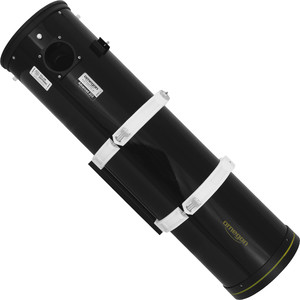
Advanced 203/1000 EQ4
Omegon
203mm · Manual Dobsonian vs 203mm · Manual Newtonian Reflector
Full comparison →
8" f/6 Dobsonian
StellaLyra
SkyQuest XT8 Classic Dobsonian
Orion
203mm · Manual Dobsonian vs 203mm · Manual Dobsonian
Full comparison →
8" f/6 Dobsonian
StellaLyra
AD8 Dobsonian
Apertura
203mm · Manual Dobsonian vs 203mm · Manual Dobsonian
Full comparison →
8" f/6 Dobsonian
StellaLyra
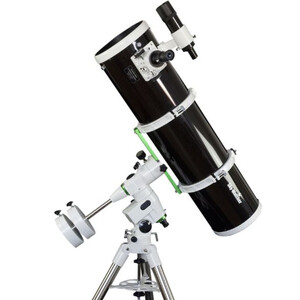
Explorer 200P
Sky-Watcher
203mm · Manual Dobsonian vs 200mm · Manual Newtonian Reflector
Full comparison →
Frequently asked
Questions from owners
Sourced from Cloudy Nights discussions.
- Does the StellaLyra 8" Dobsonian balance properly with heavy accessories like a StarSense unit, Rigel Quickfinder, and heavy eyepieces?
- Multiple owners report that with lighter loads the tensioning/fulcrum system works well, but adding a StarSense unit, Rigel Quickfinder, phone, and a heavy eyepiece like a Baader Morpheus can exhaust the available adjustment travel. When the limit is reached, users resort to counterweights — either neodymium pot magnets placed on the tube or adhesive draught-excluder strips to give the magnets a sliding track.
- Is the StellaLyra 8" Dobsonian difficult to carry and handle without a built-in grip or handle?
- The absence of a carrying handle and a navigation knob at the top of the tube is the most commonly cited practical complaint across discussions. Owners note there is nowhere obvious to grip the tube when slewing, and a dewed-up tube after a session makes carrying it especially awkward.
- How does the StellaLyra 8" Dobsonian compare to the Skywatcher 200P and Celestron StarSense Dob in terms of included accessories?
- The StellaLyra is consistently rated above the Skywatcher on accessories: it includes a dual-speed Crayford focuser, brass compression rings on both 2" and 1.25" barrels, a RACI finderscope, a battery-powered cooling fan, and better quality eyepieces (30mm Superview and 9mm Plössl).
- Is the azimuth movement on the StellaLyra 8" Dobsonian smooth enough for planetary observing?
- Multiple owners describe the roller bearing azimuth system as smooth and solid, with easy friction adjustment via the central bolt. One reviewer explicitly rates it above both the Skywatcher's and Celestron's Teflon pad systems for precise nudging and ease of getting the right friction level.
- Is the StellaLyra 8" Dobsonian the same scope as the Zhumell, Apertura, or Orion Skyline Dobsonians?
- Forum members confirm the StellaLyra is manufactured by GSO and is essentially identical to the Zhumell Z8, Apertura AD8, and Orion Skyline 8" in optical and mechanical design, with the same specification going back to at least 2009. However, members caution that not all GSO-badged versions include the same accessories — some international variants ship with a straight-through finder instead of the RACI, a single-speed focuser, and standard Teflon bearings, so buyers are advised to check the specific accessory list carefully.
- Do the primary mirror collimation knobs on the StellaLyra 8" Dobsonian protrude beyond the tube end, and is this a problem?
- Several members confirm that the collimation knobs protrude beyond the end of the main tube, meaning the knobs act as 'feet' when the OTA is stood on end. This is noted as a design imperfection but not considered a serious issue in practice.
Full Specifications
Optics
| Aperture | 203mm |
| Focal Length | 1200mm |
| Focal Ratio | f/5.9 |
| Optical Design | Dobsonian |
Mount & Tracking
| Mount Type | Dobsonian |
| GoTo (Computerised) | No |
| Tracking | No |
Focuser
| Focuser Size | 2" |
| Focuser Type | 2" dual-speed Crayford (10:1) |
Physical
| OTA Weight | 9.5kg |
| Total Weight (with mount) | 21.6kg |
| Tube Length | 1150mm |
Included Accessories
| Eyepieces | 9mm and 15mm 1.25" Super-Plössl, 30mm 2" Superview |
| Finder Scope | 8x50 right-angled |