Browse·Dobsonians·Ursa Major 8" f/6 Dobsonian
Ursa Major
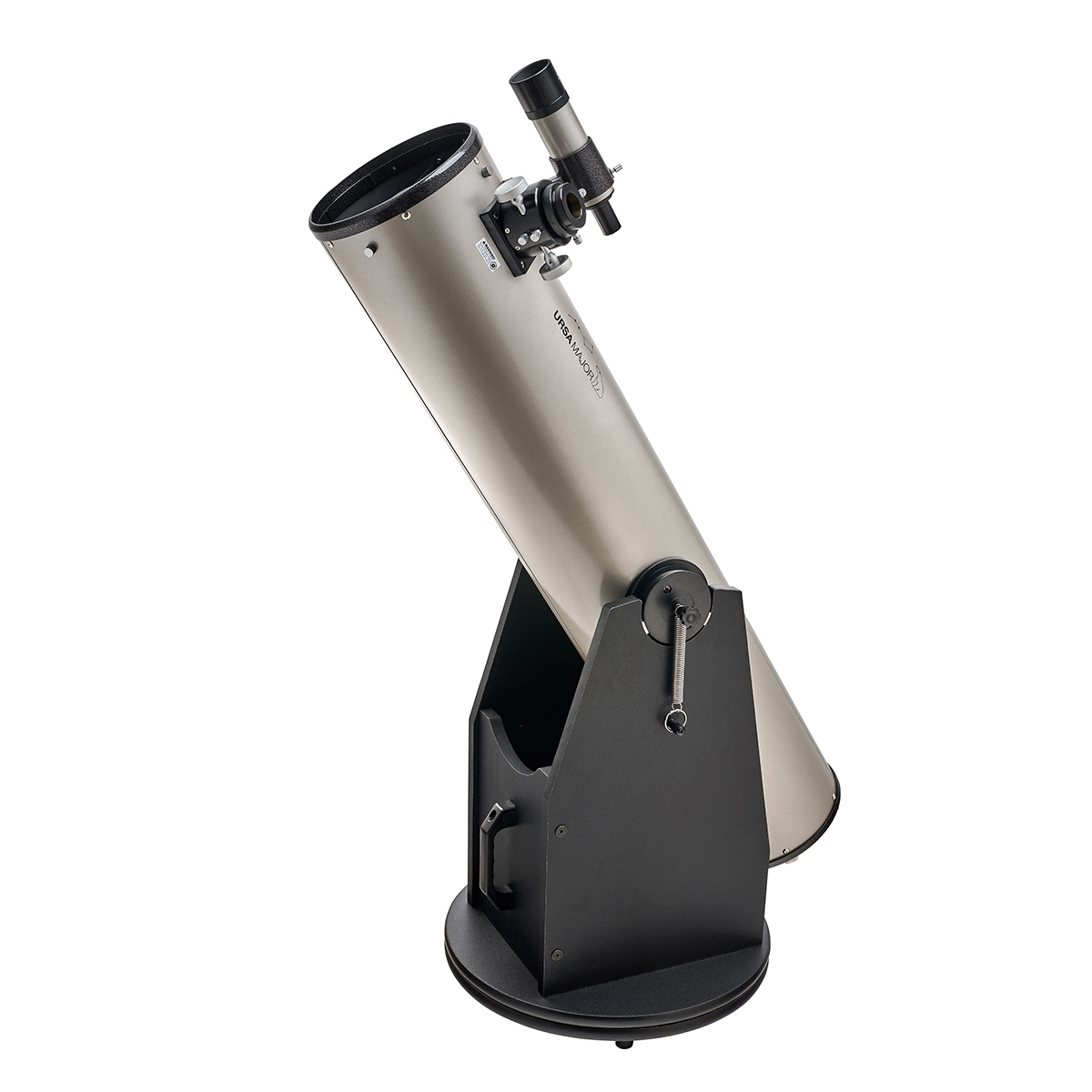
Ursa Major 8" f/6 Dobsonian
A long-focal-length Dobsonian that rewards patience with genuinely sharp, detailed views.
Affiliate link — we earn from qualifying purchases at no extra cost to you.
From the community
What owners say
Based on 24 Cloudy Nights discussions
What they love
- ✓Easy assembly reported by first-time owner, with the base being the only challenging part
- ✓The CNC machined Crayford focuser was noted as very smooth with no play and approximately 5cm of travel
- ✓The OTA movement on the mount described as nice and smooth after assembly
- ✓One user accidentally discovered what appeared to be a double star while panning with the 9mm Plossl, finding the experi…
- ✓The scope described as light and easy to move around
What caught them off guard
- !One new owner found Saturn appeared smaller and dimmer than in their old 80mm Celestron refractor, later attributed to c…
- !The scope arrived needing collimation, which the inexperienced owner was not confident to attempt, leading to a return
- !The straight-through finder scope was found almost unusable by one owner due to awkward viewing angles, requiring borrow…
- !The single-speed Crayford focuser required very precise management, with one owner continuously over-focusing before fin…
- !The focuser tension and locking screws were confusing to new owners, with unclear instructions provided
Worth knowing before you buy
The straight-through finder scope is widely considered inadequate, with multiple owners finding it awkward or unusable, particularly at high or low elevations, and recommending replacement with a RACI finder.
The Crayford focuser has confusing tensioning and locking screws with no clear documentation, requiring users to experiment to achieve proper tension; an improperly set focuser can allow the draw tube to slip, preventing sharp focus.
The dobsonian base is assembled with wood screws going directly into composite board, which at least one owner found disappointing as a cost-cutting measure affecting long-term durability.
Head to head
How it compares
8" f/6 Dobsonian
Ursa Major
SkyQuest XT8 Classic Dobsonian
Orion
203mm · Manual Dobsonian vs 203mm · Manual Dobsonian
Full comparison →
8" f/6 Dobsonian
Ursa Major
AD8 Dobsonian
Apertura
203mm · Manual Dobsonian vs 203mm · Manual Dobsonian
Full comparison →
8" f/6 Dobsonian
Ursa Major
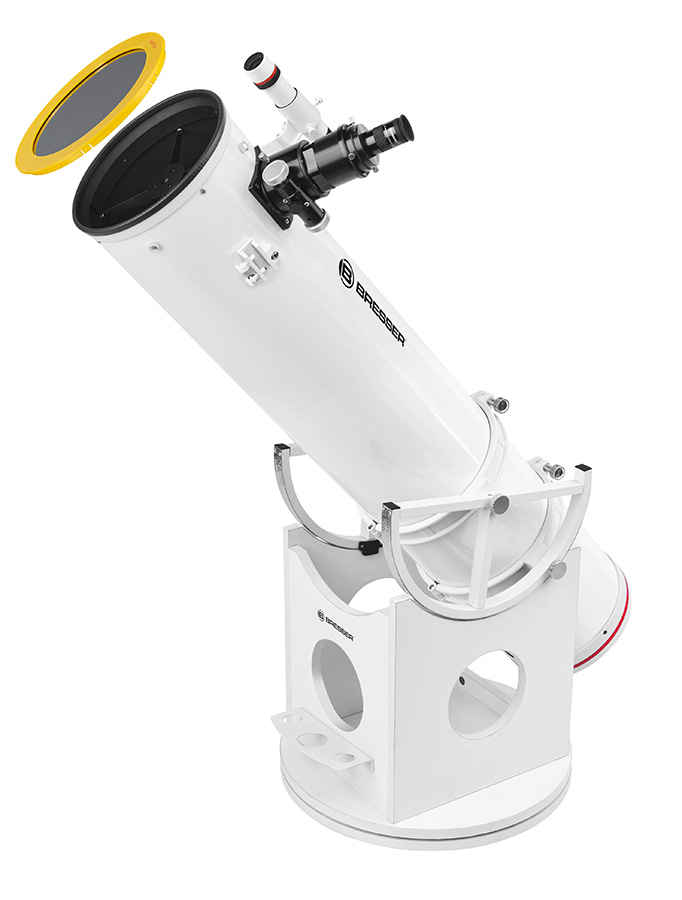
Messier 8" Dobsonian
Bresser
203mm · Manual Dobsonian vs 203mm · Manual Dobsonian
Full comparison →
8" f/6 Dobsonian
Ursa Major
Messier NT-203/800 OTA
Bresser
203mm · Manual Dobsonian vs 203mm · Manual Newtonian Reflector
Full comparison →
Frequently asked
Questions from owners
Sourced from Cloudy Nights discussions.
- How does the Ursa Major 6" Dobsonian compare to a basic 80mm refractor for planetary viewing?
- Multiple forum members assert that a properly set-up and collimated Ursa Major 6" should significantly outperform an 80mm refractor, given its larger aperture and 1200mm focal length. However, one user's real-world experience showed the opposite result until collimation issues were identified, highlighting that out-of-the-box performance may disappoint if the scope arrives needing collimation.
- Does the Ursa Major 6" or 8" Dobsonian arrive in good collimation, or will it need adjustment straight away?
- Several forum members identified collimation as the likely cause of one new owner's very poor initial views, where the Ursa Major 6" appeared worse than a 20-year-old 80mm refractor. Forum members recommended checking and correcting collimation before first serious use, with a link to a beginner's guide by Gary Seronik cited as helpful.
- How does the Ursa Major Dobsonian's Crayford focuser work — which screw is for locking and which is for tension?
- This question came up across multiple threads, with users confused by the focuser's three screws and unclear instructions. A forum member clarified that the bottom screw is the focus lock and the top is the tension adjustment, adding that one screw can restrict full travel if left in place.
- Do the GSO mirror cell springs and collimation screws on the Ursa Major Dobsonian need to be upgraded with Bob's Knobs?
- This is discussed across threads, with some members recommending Bob's Knobs thumbscrews for the secondary and stiffer springs for the primary. However, FLO directly clarified in one thread that the springs fitted to current GSO-manufactured scopes sold under the Ursa Major and StellaLyra brands are not the same weaker springs as earlier models, and that older internet advice about replacing them may no longer be relevant.
- Is the straight-through finder scope on the Ursa Major Dobsonian adequate, or should it be upgraded?
- Multiple users found the stock straight-through finder awkward, particularly at higher elevations, with one user describing it as "almost unusable" due to the uncomfortable viewing angle. Forum members consistently recommended upgrading to a right-angle correct-image (RACI) finder, and one member suggested pairing a cheap red-dot finder with a RACI to locate objects quickly.
- Is the Ursa Major 8" Dobsonian better value than the 6" given the same 1200mm focal length?
- At least one experienced forum member noted that both the 6" and 8" Ursa Major share a 1200mm focal length, and recommended the 8" for its significantly greater light-gathering power — nearly twice that of the 6". The 8" StellaLyra version was also highlighted as coming better-equipped with a two-speed Crayford focuser, smoother alt-az motion, a RACI finder, adjustable balance points, and a cooling fan, which members said more than justified the price difference.
Full Specifications
Optics
| Aperture | 203mm |
| Focal Length | 1200mm |
| Focal Ratio | f/5.9 |
| Optical Design | Dobsonian |
Mount & Tracking
| Mount Type | Dobsonian |
| GoTo (Computerised) | No |
| Tracking | No |
Focuser
| Focuser Size | 2" |
| Focuser Type | 2" CNC Crayford |
Physical
| OTA Weight | 9.5kg |
| Total Weight (with mount) | 21.5kg |
| Tube Length | 1150mm |
Included Accessories
| Eyepieces | 9mm and 25mm 1.25" Super-Plössl |
| Finder Scope | 8x50 straight-through |