You've read several buying guides and you're more confused than when you started. Focal ratios, alt-az, GoTo, Dobsonian, collimation — all thrown at you before anyone explained what actually matters. Here's the version that cuts to it.
Our top pick for most people#

Sky-Watcher
Heritage 130P
A five-inch tabletop Dobsonian that shows Saturn's rings, Jupiter's cloud bands, and a dozen deep-sky objects on night one — with no alignment routine, no batteries, and no faff. The community consensus on Cloudy Nights is consistent: for most beginners, nothing comes close at this price.
130mm
Aperture
~2min
Setup time
f/5
Focal ratio
"Able to see Jupiter, its moons, Mars, and Saturn's rings right out of the box with minor setup."
— Owner account, Cloudy Nights
Not sure which one is right for you?#
Answer three questions and we'll point you in the right direction.
Question 1 of 3
What's your budget?
The full shortlist#
Five scopes, five different situations. The Heritage 130P is right for most people — but read on if you're not sure it fits yours.
Sky-Watcher
Heritage 100P
Strengths
- ✓Sharp optics — parabolic mirror, impressive for the price
- ✓Lightest and most portable of all five picks
- ✓Same Dobsonian simplicity as the 130P — no tripod, no alignment
Limitations
- ✗Less aperture — faint objects noticeably dimmer than the 130P
- ✗Primary mirror non-collimatable (not usually an issue in practice)
"Optics are impressive for the price, particularly sharp performance."
Cloudy Nights owners
Best for
Tight budgets, children, or anyone testing the hobby before committing more.
Sky-Watcher
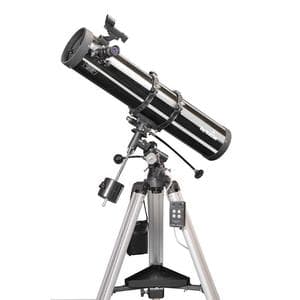
Explorer 130M
Strengths
- ✓Same 130mm aperture as the Heritage 130P
- ✓Equatorial mount teaches you to track with the Earth's rotation
- ✓Foundation for adding motorised tracking later
Limitations
- ✗Polar alignment required — there's a real learning curve
- ✗Stock focuser is the weak point — many owners upgrade it eventually
Best for
Someone who has decided they want to learn equatorial mechanics, or who has a clear path to astrophotography.
Celestron
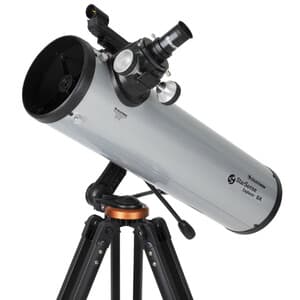
StarSense Explorer DX 130AZ
Strengths
- ✓Smartphone app navigates to any object — no motors, no alignment routine
- ✓No batteries needed — your phone does the work
- ✓Owners find far more objects per session than star-hopping manually
Limitations
- ✗Mount and tripod undersized — vibration after touching the focuser
- ✗Included eyepieces and diagonal are poor — budget extra for replacements
"Found 10 celestial objects in less than half an hour — vs 1.5 hours manually."
Cloudy Nights owners
Best for
Suburban observers where star-hopping is difficult, or people who want to skip the navigation learning curve.
ZWO
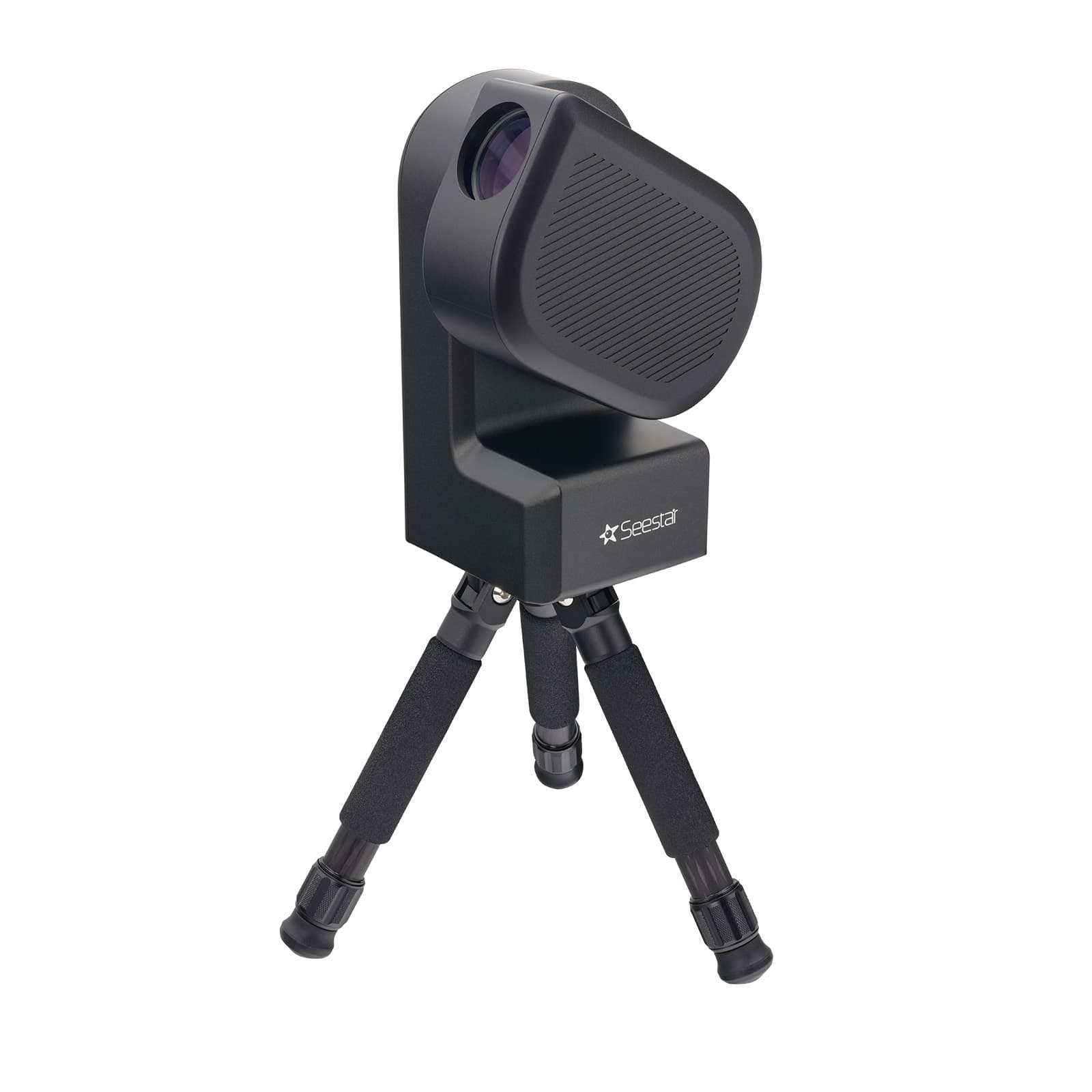
Seestar S50
Strengths
- ✓5-minute setup, phone-based — no eyepiece, no alignment, no dark adaptation
- ✓Deep-sky images that a visual scope of the same size can't match
- ✓Shareable results — great for families watching together
Limitations
- ✗You're watching a screen, not looking at the sky — a fundamentally different experience
- ✗Poor on planets — not designed for high magnification
- ✗App has been buggy; firmware updates don't always improve stability
"Surprisingly good image quality for the price point, especially for deep-sky objects."
Cloudy Nights owners
Best for
People motivated by images of nebulae and galaxies rather than the experience of looking through an eyepiece.
Compare at a glance#
Feature comparison
Heritage 100P ~£110 | Heritage 130P ★ ~£160 | Explorer 130M ~£200 | StarSense DX ~£280 | Seestar S50 ~£350 | |
|---|---|---|---|---|---|
| No alignment needed | ✓ | ✓ | ✗ | ✓ | ✓ |
| Portable / tabletop | ✓ | ✓ | ✗ | ✗ | ✓ |
| Helps find objects | ✗ | ✗ | ✗ | ✓ | ✓ |
| Good for planets | ◑ | ✓ | ✓ | ✓ | ✗ |
| Good for deep sky | ◑ | ✓ | ✓ | ✓ | ✓ |
| Astrophotography path | ✗ | ✗ | ◑ | ✗ | ✓ |
| Under £200 / $250 | ✓ | ✓ | ✓ | ✗ | ✗ |
Setup time
Setup time
A scope that takes 20 minutes to set up gets used a quarter as often as one you can grab and go. Be realistic about cold Tuesday nights.
Heritage 100P
Tabletop Dob
Heritage 130P
★ Top pick
Seestar S50
Smart scope
StarSense DX
Alt-az tripod
Explorer 130M
EQ mount
Includes unpacking, positioning, and collimation check where needed.
What not to buy#
High-magnification department-store scopes
A box that says "450× Power!" is almost always a warning sign. Maximum useful magnification is determined by aperture — no 60mm refractor is usable at 450×. These scopes typically have cheap wobbly mounts, poor eyepieces, and plastic focusers. They look impressive in a box and produce disappointing views.
Over-buying on complexity for a first scope
A large GoTo equatorial mount sounds ideal on paper. In practice, if you haven't used one before, your first nights will involve more time troubleshooting alignment than looking at the sky. Start on a simple alt-az or Dobsonian, learn to find objects manually, then upgrade the mount once you know what you're doing.
Good optics on a bad mount
The Celestron AstroMaster 130EQ is a common recommendation in some guides, but its mount has documented weaknesses — bolts that don't fill the threaded holes in the tube rings and an undersized counterweight. The optics are fine; the mount lets them down. This pattern is worth watching for at any budget.
Smart telescopes if you want to learn the sky
The Seestar S50 is genuinely impressive — set it up in five minutes, watch images build on your phone. But it does the finding, tracking, and imaging for you. If you want to understand the night sky, learn where things are, and develop an intuition for the seasons, a smart telescope doesn't teach any of that.
Your first night#
What can I actually see?
From a typical suburban sky (Bortle 6). No Moon listed — you can see that with your naked eye.
| Object | 100mm Heritage 100P | 130mm Heritage 130P ★ | 200mm Skyliner 200P |
|---|---|---|---|
| Saturn's rings | Clear | Clear | Excellent |
| Cassini Division | Good seeing | Clear | Excellent |
| Jupiter's cloud bands | Clear | Clear | Excellent |
| Mars surface detail | Dark sky only | Good seeing | Clear |
| Orion Nebula (M42) | Clear | Clear | Excellent |
| M13 globular cluster | Good seeing | Clear | Excellent |
| Faint galaxies | Dark sky only | Dark sky only | Good seeing |
Frequently asked questions#
One thing that doesn't disappoint: the first time you see Saturn's rings clearly. First-light accounts from Heritage 130P owners on Cloudy Nights are consistent on this — people describe stopping in their tracks. That moment is real and it happens on your first clear night. You just have to get there.
What to buy alongside your first scope
Red torch
Preserves your dark adaptation. Any red LED torch works — or tape red film over a regular one. Budget: £5–£15 / $6–$20.
Stellarium app
Free planetarium app. Use in red/night mode. Shows you exactly what's in your sky right now and where to find it.
One better eyepiece
A 32mm Plössl gives a wider field for finding objects. Budget: £25–£50 / $30–$65. Use the included ones for a few sessions first.
You do not need a Barlow lens, a motorised focuser, or any of the other accessories that beginners buy before their first session. Buy the minimum, observe as much as possible, and add things when you understand what problem they're solving.