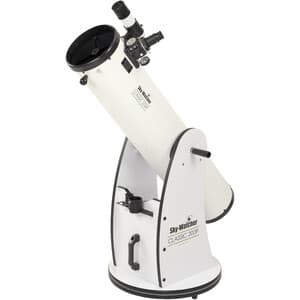
Planets are immediate. You point the telescope and there they are, bright and unmistakeable, rewarding on any night with any aperture. Deep sky objects are different. They ask more of you — a darker sky, more patience, a larger mirror — and they repay it differently. Not with a single wow moment but with a growing sense of scale.
The night you realise that smudge in Andromeda is two million light years away and contains a trillion stars changes how you understand the universe. The first time you resolve M13 — a globular cluster into individual stars, thousands of them spread across the eyepiece like a spray of diamonds — is unlike anything planets can offer.
But most guides miss something critical: deep sky observing isn't just about the telescope. You have two levers — aperture and sky darkness — and you need to understand both before you spend a penny.
The reality check#
Before we talk telescopes, one honest conversation that saves a lot of disappointment.
What astrophotos show
- ✦ Vivid colour in nebulae
- ✦ Stars on pure black sky
- ✦ Galaxy spiral arms visible
- ✦ Fine dust lanes and detail
What your eye sees
- ○ Soft grey-white glow
- ○ Brighter core, fading edges
- ○ Stars at the limit of vision
- ○ No colour — eye is monochrome at low light
Cameras accumulate light over minutes or hours. Your eye sees a single instant. That's why astrophotos look nothing like the eyepiece view. This isn't a failure — it's a different kind of experience. The Orion Nebula as a faint, wispy shape you found yourself, in a sky full of stars your naked eye can't see, is extraordinary in its own right.
◉If you want the colourful images you see online, you want an astrophotography setup, not a visual observing scope. The two disciplines overlap but they aren't the same. This guide is about visual deep sky observing — which is a richer, more active experience than it sounds.
Why aperture is the main lever#
More aperture means more light collected per second. For deep sky that means brighter objects, more resolved star clusters, and a longer list of things that are actually visible. Nothing else in the spec sheet matters as much.
What your eye sees — aperture by aperture
130mm
f/5 Dob
Hints and suggestions
M13 in Hercules appears as a fuzzy ball with a brighter core — a handful of stars resolve at the very edge at 150×. M42's four Trapezium stars split cleanly. The Andromeda Galaxy (M31) is a large, faint oval. Galaxies beyond the Local Group are mostly invisible without dark skies.
150mm
f/5 Dob
Objects start to resolve
M13 begins to show individual stars across the core. M42 shows real nebulosity extent, not just the Trapezium. The Ring Nebula (M57) is a clear smoke ring. M81 and M82 in Ursa Major become accessible from dark suburban skies.
200mm
Sweet spot
Where deep sky gets serious
M13 is fully resolved — a spectacular spray of thousands of stars. Fainter globulars like M92 and M3 show real structure. The Virgo Cluster yields multiple galaxies in a single sweep. The Veil Nebula becomes visible with an OIII filter. This is the aperture most serious visual observers consider their floor.
300mm+
12" Dob
Objects become statements
Faint suggestions become definite objects. M51 hints at its spiral arms in good seeing from a dark site. The Horsehead Nebula becomes reachable with a H-beta filter. Faint galaxy clusters and objects that aren't on most lists become part of an evening's programme.
Visual observing only. Sky quality significantly affects results — see the Bortle scale below.
The 200mm milestone is real. It's where M13 goes from a fuzzy ball to a resolved sphere of stars, where the Virgo Cluster becomes a proper observing programme, and where the Veil Nebula — the remnant of a supernova that exploded 8,000 years ago — becomes visible with an OIII filter. Most serious visual observers consider 200mm the minimum aperture for a comprehensive deep sky programme.
The second lever: dark skies#
An 8-inch Dobsonian from a suburban back garden is a very different instrument to the same scope under a truly dark sky. Light pollution isn't a minor handicap — it can mean the difference between seeing ten galaxies in an evening and seeing two.
The Bortle Dark-Sky Scale
| Class | Sky type | Typical location | Deep sky impact |
|---|---|---|---|
| 1 | Truly dark | Remote mountains, deserts | Zodiacal light and gegenschein visible. Milky Way casts shadows. Almost every DSO reachable. |
| 2 | Very dark | Dark rural sites | Faint Milky Way structure clear. All Messier objects accessible. NGC catalogue practical. |
| 3 | Rural | Countryside, National Parks | Milky Way clearly structured. Most DSOs visible. Some LP glow low on horizon. |
| 4 | Rural–suburban | Village outskirts, small towns | Milky Way still visible. Fainter galaxies accessible. Good for most observing programmes. |
| 5 | Suburban | Most UK / US suburbs | Milky Way faint or absent. Bright Messiers accessible. Faint galaxies very difficult. |
| 6 | Bright suburban | Town centres, inner suburbs | No Milky Way. Bright clusters fine. Nebulae need filters. Many galaxies invisible. |
| 7 | Suburban–urban | City edges, dense suburbs | Only the brightest DSOs. Deep sky observing becomes frustrating without filters. |
| 8–9 | City | Urban, city centre | Stick to planets and the Moon. Deep sky not viable without travelling out. |
The honest advice: if you're Bortle 6 or worse, the most impactful upgrade you can make to your deep sky observing isn't a bigger telescope. It's a drive to a darker site. A 150mm scope at Bortle 3 will show you far more than a 300mm scope at Bortle 7. Find your local dark sky sites — many countries have dedicated observing fields, and even a 30-minute drive from a city can drop you two or three Bortle classes.
Why a Dobsonian wins for deep sky#
The Dobsonian is not glamorous. It's a large mirror in a box that sits on a rotating platform and points where you push it. But it has one overwhelming advantage: no other mount type gives you as much aperture for your money. A £350 Dobsonian gives you 8 inches of mirror. That same budget on an equatorial GoTo mount gives you 5 or 6.
For deep sky, aperture is king. The Dobsonian is the category winner.
What Dobsonians do well
- ✓Maximum aperture per pound spent
- ✓Simple to use — push and look
- ✓Easy to collimate once you know how
- ✓Collapsible tube models fit in a car
- ✓No alignment routine, no batteries
The honest trade-offs
- ○No tracking — objects drift through the FOV
- ○No GoTo — navigate manually
- ○Large Dobs require transport planning
- ○Collimation needed if bumped in transit
- ○Open tube collects dew and dust faster
GoTo Dobsonians exist — Sky-Watcher's FlexTube Synscan range adds a computerised mount to the collapsible Dobsonian design. They cost significantly more for the same aperture, but are worth considering if you're in a light-polluted area (where GoTo helps you find objects that would otherwise be invisible to the naked eye) or if you simply don't want to learn star-hopping.
Our picks#
Four aperture tiers, each with a clear recommendation. All are Dobsonians — for the reasons above.
Sky-Watcher
Heritage 150P
The jump from 130mm to 150mm is real — M13 starts to resolve, M42 shows genuine nebulosity extent. A tabletop Dob, so you'll need a stable surface. Outstanding value for anyone not ready to commit to a full-sized instrument.
“Owners consistently note that the 150P shows noticeably more than the 130P, particularly on globular clusters and the extent of M42's nebulosity. The extra aperture makes it feel like a different class of instrument.”
One thing to know
The helical focuser has slight play — a thin wrap of PTFE tape sorts it. The single-stalk secondary mount can be knocked out of alignment in transit; check collimation before your first session.
Sky-Watcher
Skyliner 200P
The scope most experienced visual observers would tell you to buy. Eight inches of aperture at f/6, a full-sized rocker-box Dobsonian, at a price that makes every alternative feel like a worse trade-off. M13 fully resolved, Virgo Cluster galaxies in the same field, the Veil Nebula accessible with an OIII filter — this is where serious deep sky observing begins.
“A recurring theme from owners: the 200P with a quality 30mm wide-field eyepiece is transformative. The stock eyepieces have edge-correction limitations — upgrading even one eyepiece noticeably improves the view.”
One thing to know
The stock 23mm eyepiece has poor edge correction at f/6. Even a mid-range wide-field eyepiece (Baader Hyperion or similar) transforms the view.
Sky-Watcher
Skyliner 250PX
If you already know you're serious about deep sky, the 250PX skips a step. Ten inches of parabolic mirror at f/4.7. At 250mm, objects that weren't there at 200mm appear: fainter NGC galaxies, Stephan's Quintet, the Blinking Planetary. The Messier list starts to feel like a warm-up exercise.
“At 250mm, owners start mentioning objects that simply weren't there at 200mm. This is the aperture where a structured observing programme — working through the NGC catalogue systematically — becomes genuinely exciting.”
One thing to know
f/4.7 is fast — budget eyepieces show noticeable coma at the field edge. Budget around £80–100 / $100–125 for a Baader MPCC or similar coma corrector to get the full benefit.
Sky-Watcher / Explore Scientific
Skyliner 300P & ES 12"
At 12 inches, faint suggestions become definite objects. The Skyliner 300P uses a collapsible FlexTube design that fits in most car boots. The Explore Scientific 12" Dob is a truss design — more compact to transport but requires assembly at the site. Both are outstanding instruments for committed dark-site observers.
“Owners of the Skyliner 300P note that the base does not collapse and must ride in the front seat or footwell. Transport planning is essential at this aperture — it rewards those who commit to dark site observing.”
One thing to know
The 300P's three-strut design means a self-supporting light shroud is required — none is included or available off-the-shelf. Most owners make their own. Budget time for this before your first session.
The Skyliner 200P is the right scope for most people reading this guide. It has enough aperture to make the Messier catalogue a genuinely rich programme, it fits in a car, and the price makes it a clear winner over the alternatives. The 250PX makes sense if you already know deep sky is your focus. The 300P tier is for committed observers who are willing to plan their sessions around dark site visits.
What can I see with my setup?#
Your aperture and sky quality together determine what's accessible. Select your setup below.
What can I see with my setup?
Select your aperture and sky conditions to see which deep sky categories are within reach.
My aperture
My sky (Bortle class)
| Object type | Accessible? | Example objects |
|---|---|---|
| Open clusters | Yes — accessible | Pleiades (M45), Beehive (M44), Double Cluster in Perseus |
| Globular clusters | Yes — accessible | M13, M3, M92 in Hercules |
| Bright nebulae | Yes — accessible | Orion Nebula (M42), Lagoon (M8), Omega (M17) |
| Planetary nebulae | Yes — accessible | Ring Nebula (M57), Dumbbell (M27) |
| Galaxies | Yes — accessible | M31 Andromeda, M81/M82, M51 Whirlpool |
| Faint / large nebulae | Possible — with effort | Veil Nebula, Horsehead (with filter), Rosette |
Visual observing only. Results vary with eye adaptation, seeing conditions, and experience.
What to actually look at#
The 110-object Messier catalogue is the traditional deep sky programme for good reason — it was compiled by an 18th-century comet hunter as a list of things that aren't comets, and it accidentally became the definitive starter course for visual observers. Almost everything in it is spectacular. Work through it systematically and you'll have years of observing ahead of you.
Deep sky object categories — by accessibility
| Category | Min aperture | Sky needed | Named examples |
|---|---|---|---|
Open clusters | Any | Any | Pleiades (M45), Beehive (M44), Double Cluster in Perseus |
Globular clusters | 100mm+ | Suburban ok | M13, M92 (Hercules), M3 (Canes Venatici), Omega Centauri |
Bright nebulae | 80mm+ | Suburban ok | Orion Nebula (M42), Lagoon (M8), Eagle (M16), Omega (M17) |
Planetary nebulae | 130mm+ | Suburban ok | Ring Nebula (M57), Dumbbell (M27), Blinking Planetary |
Galaxies | 150mm+ | Bortle 4 or better | M31 Andromeda, M81/M82, M51 Whirlpool, M104 Sombrero |
Faint / large nebulae | 200mm+ | Bortle 3 or better | Veil Nebula (NGC 6992), Horsehead (B33), Rosette (NGC 2244) |
Start with open clusters — they're satisfying at any aperture and from any sky. Move to globular clusters once you've found your way around: M13 in Hercules, M3 in Canes Venatici, M22 in Sagittarius. Add bright nebulae as they come into season — M42 in winter, M8 and M17 in summer. Save galaxies and faint nebulae for dark site sessions. That's a programme that will keep you occupied for years before you've exhausted the possibilities.
What to avoid#
GoTo before you can star-hop
GoTo sounds like a shortcut. It isn't — it's a different skill. Learning to navigate by star-hopping gives you an understanding of the sky that no computer can replace, and means you're not stranded when the alignment fails. Get confident manually first. GoTo becomes genuinely useful once you know where you are.
A fast focal ratio without quality eyepieces
f/4.7 and f/5 scopes are excellent but unforgiving of cheap eyepieces. Stars at the field edge look like tiny comets — this is coma, and it's the eyepiece's fault, not the mirror. A coma corrector (around £80–100 / $100–125) and one good wide-field eyepiece completely transform the view. Budget for the system, not just the scope.
A large Dob without a transport plan
The "12-inch in the corner of the garage" is a well-known phenomenon. A large Dobsonian that doesn't fit in your car, or takes 40 minutes to set up, will not get used. Measure your boot before buying a 12". The best scope is the one you actually take out.
Chasing aperture when the problem is light pollution
Upgrading from 200mm to 300mm in a Bortle 7 sky won't show you the galaxies you can't currently see — they're washed out by skyglow, not limited by aperture. The meaningful upgrade is a drive to a darker site, or an OIII/UHC filter for nebulae. More aperture matters most when your sky is already reasonably dark.