What £500 actually unlocks#
The under-£300 bracket is about getting a genuinely good starter scope. At £500, something meaningfully different happens: you can get a 200mm Dobsonian.
That jump from 130mm to 200mm isn't incremental — it's the difference between glimpsing a galaxy and seeing its structure. It's the difference between a globular cluster as a fuzzy ball and one you can resolve into individual stars across most of its face.
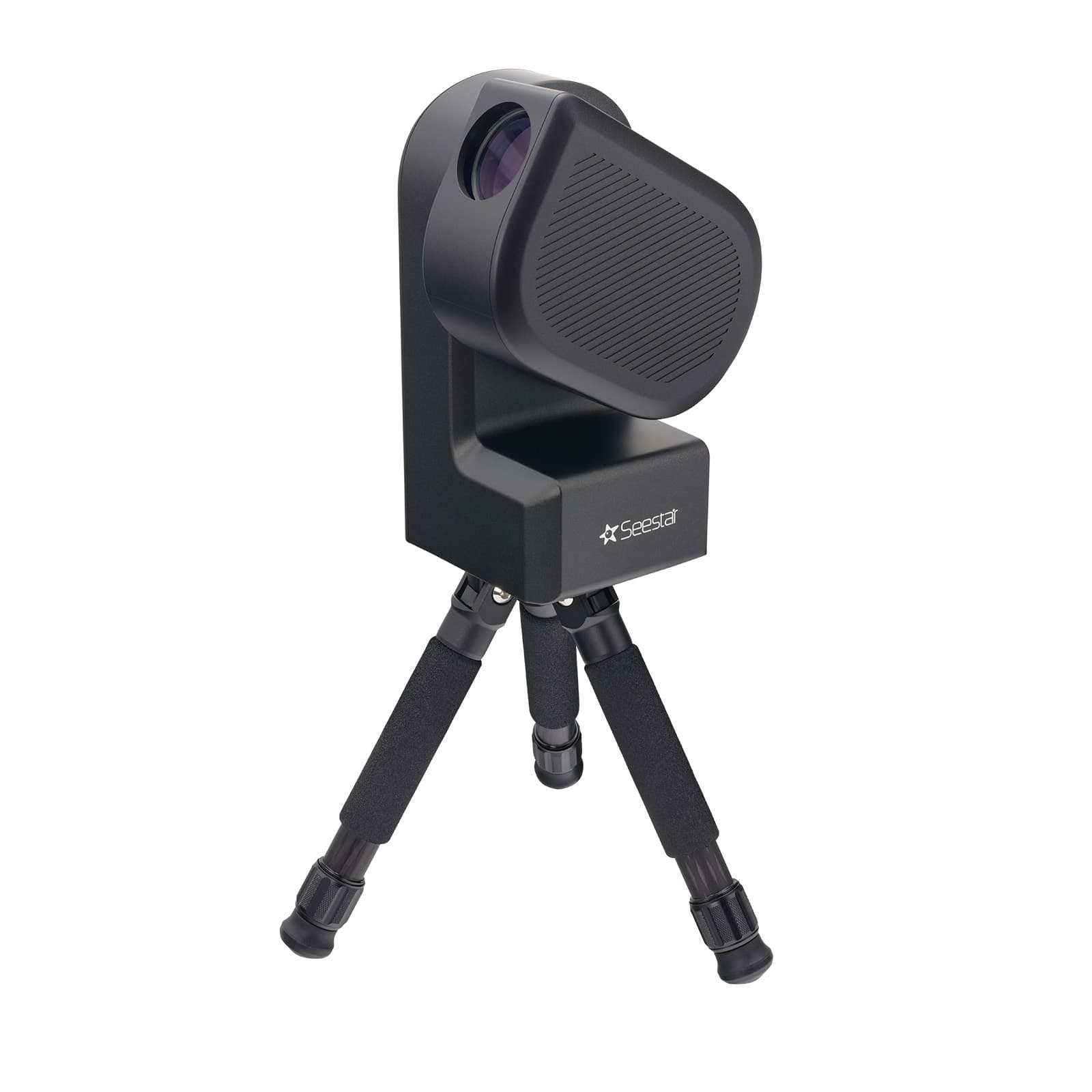
What also enters the picture at this price: the Seestar S50, ZWO's smart telescope that stacks images live on your phone. And the StarSense Explorer DX — Celestron's phone-assisted pointing system that guides you to objects without the cost and complexity of a full motorised GoTo mount.
These are meaningfully different experiences. Here's how the budget bands compare:
| What you get | Under £150 | Under £300 | Under £500 ★ | £500+ |
|---|---|---|---|---|
| Usable aperture | 70–80mm | Available | 150–200mm | 200mm+ |
| 200mm Dobsonian | — | — | ★ Unlocked | Available |
| Smart telescope (Seestar) | — | — | ★ Unlocked | Available |
| Phone-assisted finding | — | — | ★ Unlocked | Available |
| Quality motorised GoTo | — | — | Not yet | From £700+ |
| Equatorial tracking | — | Basic EQ | Available | HEQ5+ |
The central question#
Before we get to specific scopes, there's one question that determines most of the answer. It's not about aperture or mount type — it's about what kind of experience you actually want.
Two very different experiences are available at this price. Knowing which camp you're in will immediately narrow down the options:
I want to look through an eyepiece
You want the real thing — eye to the eyepiece, manually panning across the sky, that moment when a galaxy snaps into focus. You're happy to learn the sky and spend time at the telescope.
I want tech, photos, or maximum ease
You want to point a phone at the sky and have it find things. You want to share the view. Or you're buying for someone who won't spend an hour learning star charts before they look at anything.
A note on GoTo at this price: Motorised GoTo mounts that work reliably start at around £700–£800 / $900–$1,000. Below that price you get mounts that frustrate more than they help. At £500, your money is better spent on aperture or smart technology.
If you want the best views through an eyepiece, the Skyliner 200P is the answer for most people. If you want tech, photos, or an experience that works with minimal effort, the Seestar or StarSense will serve you better — for reasons that have nothing to do with which has more aperture.
Our five picks#
One top pick, four alternatives for specific needs — each with a clear reason to choose it over the 200P.
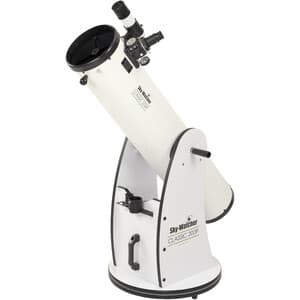
Sky-Watcher Skyliner 200P
200mm Dobsonian · f/6 · Manual alt-az
The community answer to 'what's the best scope at this price' is almost always this one. 200mm of aperture on a simple, rock-solid Dobsonian mount. No alignment routine. No motors to fail. You point it, you look through it, and what you see will surprise you. The jump from 130mm to 200mm more than doubles the light gathered — galaxies you could barely detect through a smaller scope start showing structure. Globular clusters resolve properly. Nebulae fill the eyepiece.
Strengths
- ✓Largest aperture at this price by far
- ✓Zero-friction setup — no alignment needed
- ✓Outstanding Cloudy Nights community reputation
- ✓Smooth alt-az motion, functional eyepieces included
Trade-offs
- —Large: ~120cm tube, ~15kg total
- —No tracking — planets drift from view
- —Needs periodic collimation (5-minute job)
- —Awkward to transport without a car
ZWO Seestar S50
50mm smart telescope · App-controlled · Live stacking
A fundamentally different kind of telescope. The Seestar uses a 50mm sensor-and-lens system that finds objects automatically, stacks exposures in real time, and shows a processed image on your phone within minutes. It's not trying to compete with the 200P for raw aperture — it wins on completely different terms: zero setup friction, shareable results, and the ability to image from a light-polluted balcony that would defeat a visual scope entirely.
Why choose this over the 200P
- ✓Completely automated — point and go
- ✓Takes photos you can share instantly
- ✓Fits in a backpack, balcony-friendly
- ✓Outstanding in light-polluted skies
Trade-offs
- —No eyepiece — screen-only experience
- —50mm aperture limits resolution
- —Weaker than visual scopes for planets
- —Needs a phone and reliable app
Sky-Watcher Heritage 150P
150mm tabletop Dobsonian · f/5 · Collapsible tube
The Heritage 150P is a 200P that fits in a cupboard. At 150mm it gathers around 56% of the light of the 200P, resolves globular clusters well, and shows excellent planetary detail — but collapses to roughly half the stored size. If you live in a flat, have a small car, or want to take a scope on a camping trip, the 150P is the version of this experience that actually fits your life.
Why choose this over the 200P
- ✓Collapsible — fits in a hatchback boot
- ✓~7kg vs ~15kg — one-person carry
- ✓Smaller footprint, flat and balcony friendly
- ✓Noticeably cheaper — more eyepiece budget
Trade-offs
- —~44% less light than the 200P
- —Tabletop mount — needs a stable surface
- —Short focal length calls for quality eyepieces
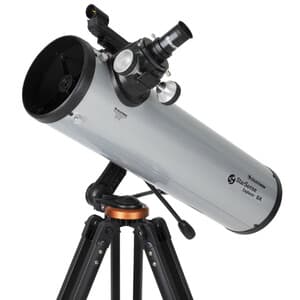
Celestron StarSense Explorer DX 130AZ
130mm Newtonian · Phone-assisted pointing · Manual slew
StarSense is a clever middle ground: your phone clips onto the telescope and uses the camera to analyse the star field, then tells you which direction to push the scope to find your target. No motors, no alignment star routine. It doesn't match the 200P for aperture, but it solves the most common beginner problem — 'I have no idea how to find anything' — elegantly and reliably.
Why choose this over the 200P
- ✓Phone guides you to any object — no star-hopping
- ✓Tripod-mounted — comfortable standing use
- ✓No motors to align, calibrate, or charge
- ✓Lighter and more portable than the 200P
Trade-offs
- —130mm vs 200mm — noticeably less aperture
- —You still push it manually to each target
- —Phone required and must be positioned correctly
Sky-Watcher Explorer 150PL
150mm Newtonian · EQ3-2 mount · f/8
If your priority is planetary observing — long sessions watching Jupiter rotate, tracing Saturn's rings — the Explorer 150PL's equatorial mount is worth the trade-off. Once polar-aligned, you track with a single slow-motion control rather than constantly nudging in two axes. The longer f/8 focal ratio also works well with a range of eyepieces and gives slightly crisper planetary views than a fast-focal-ratio Dob at the same aperture.
Why choose this over the 200P
- ✓Equatorial tracking — single-axis slow-motion
- ✓f/8 — more forgiving eyepiece choice
- ✓Upgradeable to a motor drive later
- ✓Stable views at high magnification
Trade-offs
- —EQ mount has a learning curve
- —150mm vs 200mm — less aperture for deep-sky
- —Long tube — less portable than the Dobs
A note on the picks: the Heritage 150P, StarSense DX, and Explorer 150PL all represent genuine trade-offs rather than compromises. The 150P is the right choice if the 200P genuinely doesn't fit your storage or transport situation. The StarSense DX wins if finding objects is the barrier between you and enjoying the hobby. The Explorer 150PL is for the buyer who specifically wants to learn the equatorial mount, with an eye on planetary observing and maybe motorised tracking later.
Why the 200P is right for most people#
If you want to look through an eyepiece and see as much as possible, the Skyliner 200P wins at this price. The reason is aperture: the jump from 130mm to 200mm is a 2.4× increase in light-gathering area. That's not a marginal upgrade — it's a completely different experience on faint targets.
The community consensus on Cloudy Nights is consistent: if you're asking "what's the best scope for under £500 for visual observing," the answer is the Skyliner 200P. And has been for years.
Here's what 200mm shows you that 130mm can't reliably deliver:
| What you observe | 130mm | 200mm ★ |
|---|---|---|
| Saturn — Cassini division | Visible in good seeing | Clearly split |
| Jupiter — festoons & cloud detail | Cloud bands | Festoons visible |
| M13 — Hercules globular cluster | Resolving at edges | Well resolved |
| M57 — Ring Nebula shape | Ring visible, faint | Ring clearly defined |
| M81 / M82 — galaxy pair | Glow + elongation | Structure visible |
| NGC 891 — edge-on galaxy | Barely detectable | Visible, dust lane hinted |
| Virgo cluster galaxies | Brightest 4–5 only | 10+ in same field |
| Limiting magnitude (dark sky) | ~13.0 | ~14.0 |
Assumes suburban skies (Bortle 5–6) and good seeing. Dark sky access improves deep-sky results significantly.
When the 200P isn't the answer: if you live in a second-floor flat with no car, 120cm of tube and 15kg of telescope is a real problem. If you're buying for someone who'll lose interest if setup takes more than five minutes, the Seestar or StarSense is more likely to stay in use. And if your primary interest is astrophotography, neither the 200P nor any scope at this price has the mount you actually need — save more, or look seriously at the Seestar.
What to avoid at this price#
Celestron NexStar 130SLT — "GoTo at this price" is a trap
The NexStar 130SLT sounds appealing: motorised GoTo, 130mm aperture, Celestron brand. The reality is that the SLT alt-az GoTo mount is the weakest part of an already compromised package. It shakes, the alignment routine frustrates beginners, and battery life is poor. You spend the same money as the Skyliner 200P but get 57% of the aperture on a mount that will test your patience. If you specifically want GoTo, wait and save more — quality GoTo starts around £700 / $900. Below that, your money is better spent on aperture.
"900× magnification" refractors
Any telescope marketed primarily on its maximum magnification — especially over 400× — is designed to look impressive in a shop or on Amazon, not to be used in practice. A 70mm or 80mm refractor physically cannot produce a useful 900× image; the maximum usable magnification is roughly 2× the aperture in mm. So a 70mm scope peaks around 140× before images collapse. The eyepieces bundled with these kits are usually low quality. If magnification is the headline, skip it.
"Complete starter kits" where the accessories cost more than the scope
Some bundles include a telescope, three or four eyepieces, a Barlow, a moon filter, a carry case, and a star chart — all for £299. The problem is the telescope is usually worth £80 and the eyepieces are plastic. A Skyliner 200P with no accessories will outperform any of these kits. Buy the scope first, then buy accessories from reputable brands (Baader, Celestron X-Cel, BST Starguider) separately.
One more to watch for: the Celestron AstroMaster series. Common in Amazon gift guides, and the optics are acceptable — but the EQ mounts on the AstroMaster range are notoriously frustrating as a first equatorial experience. If you want a Dobsonian, get the Skyliner 200P. If you want an EQ mount, get the Explorer 150PL. The AstroMasters sit in awkward middle ground that serves neither goal well.
Which pick is right for you?#
Where will you mostly observe?