Most people who give up on astronomy in the first year didn't buy a bad telescope. They bought the wrong telescope for them — often a perfectly decent scope that didn't match how they actually wanted to use it.
There are three decisions that determine whether you'll still be looking through your scope in two years' time. Everything else — focal ratios, eyepiece designs, computerised pointing — comes after.
The three decisions that actually matter#
Budget
Sets the aperture ceiling. Know your range before looking at specs.
What your budget gets you →Mount type
How you move the telescope. More important than the optics for most beginners.
Mount types explained →Observing goal
Planets or deep sky? Visual or imaging? This changes everything about what to buy.
Five questions to ask →The mount matters as much as the optics#
A wobbly mount makes a good telescope feel terrible. At 150× magnification — the kind you'd use to look at Saturn — any vibration sends the image bouncing around for seconds at a time. An optically mediocre telescope on a solid, smooth mount will give you a better night's observing than a fine optical tube on a flimsy tripod. There are three mount types worth knowing about.
Alt-Azimuth
Moves left-right and up-down. Simple setup, no alignment needed. Used on most beginner and GoTo scopes.
Dobsonian
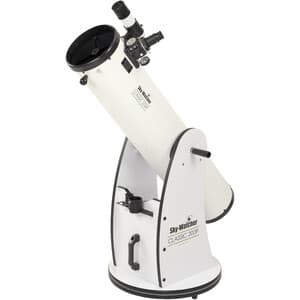
Alt-az rocker box sitting on a ground board. Stable, simple, and allows large mirrors at low cost.
Equatorial
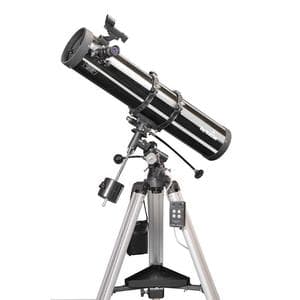
Polar axis tilted to match your latitude. Tracks stars with one-axis movement. Essential for astrophotography.
| Alt-az | Dobsonian | Equatorial | |
|---|---|---|---|
| Setup time | 2 min | 2 min | 15–30 min |
| Learning curve | Minimal | Minimal | Steep |
| Auto tracking | Optional (GoTo) | Manual nudge | Yes (motorised) |
| Astrophotography | Limited | Visual only | Yes |
For a first scope, an equatorial mount is usually overkill and often counterproductive. New observers who get tangled up in polar alignment sometimes give up before they've found anything interesting in the sky. Start on a simple alt-az or Dobsonian first — you can always add an equatorial mount later once you know what you want from it.
GoTo: what it solves and what it doesn't
Motors that point the telescope at any object automatically. Sounds ideal — but read on.
GoTo makes sense if…
- ✓You observe from a light-polluted suburb where star-hopping is genuinely difficult
- ✓You observe infrequently and don't want to re-learn the sky each session
- ✓You can already identify the 10–15 bright stars needed for alignment
GoTo doesn't help if…
- ✗You can't identify alignment stars — GoTo assumes you already can
- ✗The mount is flimsy — pointing accuracy won't fix vibration
- ✗You want to understand the night sky — GoTo does the finding for you, not with you
Honest take: GoTo is more useful at the intermediate level, once you know enough about the sky to troubleshoot alignment, than for absolute beginners.
Optical designs in plain English#
The telescope tube comes in three main types. The design determines the light path — and has practical consequences for cost, portability, and maintenance.
Refractor
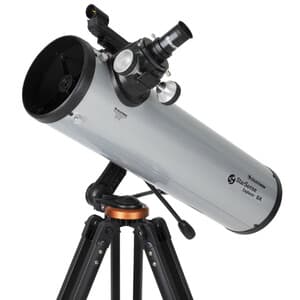
Lens-basedNewtonian Reflector
Most recommendedMirror-basedCompound (Maksutov-Cassegrain)
Mirror + lensWhat your budget actually gets you#
Aperture — the width of the main lens or mirror — determines how much light the telescope gathers. More aperture means brighter, sharper views of faint objects. The type of telescope you choose has a dramatic effect on how much aperture your budget buys.
Aperture you get for your money
At three budget levels — reflectors consistently deliver more
Around £150 / $190
Around £250 / $320
Around £450 / $570
Approximate figures across typical models at each price point.
Entry level
Functional telescopes exist here, but manage expectations carefully. The optics on a decent small refractor or the Heritage 100P tabletop Dobsonian can be genuinely good — what suffers is usually the mount (expect wobble) and the bundled eyepieces. Moon, Saturn's rings, Jupiter's moons, and a handful of bright clusters are within reach. Faint nebulae and galaxies will be disappointingly dim.
The sweet spot
Where most first-scope recommendations live — including the Heritage 130P. Meaningful aperture, usable eyepieces, enough mount quality for genuinely satisfying nights. First-night accounts on Cloudy Nights are striking: owners consistently report Saturn's rings, Jupiter's cloud bands, the Andromeda Galaxy, and multiple star clusters on night one.
Serious beginner / intermediate
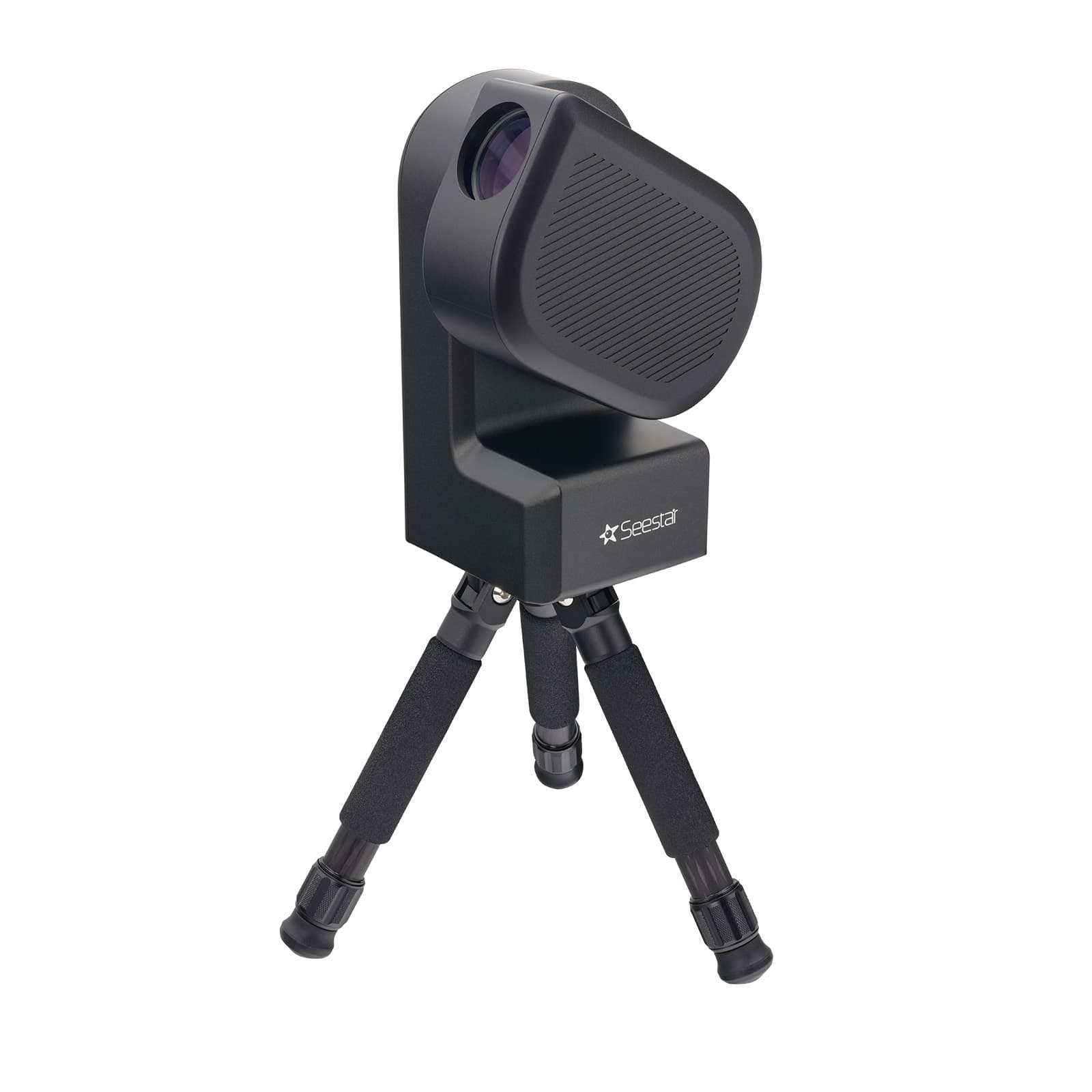
An 8-inch Dobsonian like the Skyliner 200P sits here — enough aperture to show you things you'll remember for years. The ZWO Seestar S50 also enters the picture for people who want a completely different kind of astronomy experience.
Advanced
At this point, you probably know what you want. If you're a beginner spending this much, be very confident you've thought through the five questions below first.
Five questions to answer before you buy#
These will do more for you than any spec comparison.
What will you actually look at?
Planets — Saturn, Jupiter, the Moon — want magnification and contrast: longer focal length, higher focal ratio. A refractor or Maksutov-Cassegrain suits this. Deep-sky objects — nebulae, galaxies, globular clusters — want aperture above all else. A Dobsonian wins here, every time.
Where will you observe from?
A light-polluted city garden is a very different situation from a dark country sky. Under city lights the Moon and planets still shine; faint galaxies don't. A 12-inch Dobsonian in a Bortle 8 suburb can show dimmer galaxies than a 6-inch in a Bortle 4 field. Be honest about where you'll actually use the scope, not where you'd ideally like to.
How much setup time is acceptable?
Underrated question. A scope that takes 20 minutes to set up will get used far less than one you can grab and have running in five. Tabletop Dobsonians are the extreme case: pull them out of a bag, set them on a wall, look. GoTo scopes need alignment routines. Equatorial mounts need polar alignment. Be realistic about your patience on a cold Tuesday night.
Does it need to be portable?
A scope you can carry to a darker observing site is worth more than a larger one stuck in your garden. The Heritage 130P fits in a backpack. An 8-inch Dobsonian fits in a car boot but not on a bus. A 12-inch needs a car and a strong back.
Do you want to do astrophotography?
If yes, the calculation changes substantially — you need a motorised tracking mount as a baseline. For a photography-curious beginner, the Seestar S50 is worth considering: electronically-assisted imaging with essentially zero setup. For developing proper skills with a DSLR or dedicated camera, budget for a decent equatorial mount first and treat the telescope tube as secondary.
Not sure where you land? Answer three questions and we'll point you toward the right scope.
Question 1 of 3
What's your budget?
What to realistically expect on your first night#
The single biggest source of disappointment in beginner astronomy is unmet expectations.
What you will see
- ◎The Moon in stunning detail — craters, mountain ranges, the terminator line
- ◎Saturn, including the rings and often the Cassini Division in good conditions
- ◎Jupiter's cloud bands and its four Galilean moons
- ◎Open star clusters — genuinely beautiful, even from light-polluted skies
- ◎Globular clusters like M13, resolving into stars at higher magnification (130mm+)
What it won't look like
- ◌Anything resembling Hubble photographs — those are hours of long-exposure imaging
- ◌The Orion Nebula as a colour cloud — visually it's a soft grey-green glow
- ◌Galaxy structure: M31 (Andromeda) shows as an elongated glow, not a pinwheel
- ◌Dramatic colour in faint objects — our eyes aren't sensitive enough at low light
First-night accounts on Cloudy Nights for the Heritage 130P are instructive: owners report Saturn's rings, Jupiter with its moons, Mars, and the Moon on the very first clear night, “straight out of the box with minor setup.” That's a realistic expectation for a 130mm reflector.
What to avoid#
High-magnification department-store scopes
A box that says "450× Power!" is almost always a warning sign. Maximum useful magnification is determined by aperture — no 60mm refractor is usable at 450×. These scopes typically have cheap wobbly mounts, poor eyepieces, and plastic focusers. They look impressive in a box and produce disappointing views.
Over-buying on complexity for a first scope
A large GoTo equatorial mount sounds ideal on paper. In practice, if you haven't used one before, your first nights will involve more time troubleshooting alignment than looking at the sky. Start on a simple alt-az or Dobsonian, learn to find objects manually, then upgrade the mount once you know what you're doing.
Good optics on a bad mount
The Celestron AstroMaster 130EQ is a common recommendation in some guides, but its mount has documented weaknesses — bolts that don't fill the threaded holes in the tube rings and an undersized counterweight. The optics are fine; the mount lets them down. This pattern is worth watching for at any budget.
Smart telescopes if you want to learn the sky
The Seestar S50 is genuinely impressive — set it up in five minutes, watch images build on your phone. But it does the finding, tracking, and imaging for you. If you want to understand the night sky, learn where things are, and develop an intuition for the seasons, a smart telescope doesn't teach any of that.
My recommendation#
If you're still not sure after all of this: get the Heritage 130P. It's the scope that most people who've been in this hobby for years wish they'd started with. And if you discover the hobby is for you — which you probably will, on the night you first see Saturn with your own eyes and realise that is actually a real planet hanging in space — you'll have learned enough to know exactly what to buy next.
Sky-Watcher
Heritage 130P
Five inches of aperture, parabolic mirror, Dobsonian rocker box. Two minutes from bag to first light. Enough aperture to show you something real, simple enough that nothing gets in the way of actually using it, and cheap enough that if you discover this hobby isn't for you, you haven't spent your way into regret.
What to buy alongside your scope#
Three things are worth getting at the same time as the telescope.
A red torch
Your eyes take 20–30 minutes to dark-adapt after any white light exposure. A red torch lets you read a chart or adjust eyepieces without ruining your night vision. A £5 / $6 problem with a £5 / $6 solution.
A better eyepiece
The eyepieces bundled with most beginner scopes are functional but uninspiring. A 25mm Plössl gives a wide, comfortable low-power view. Around £20–£30 / $25–$40 and it makes a meaningful difference.
A sky app
Stellarium (free) or SkySafari (paid, worth it) — point your phone at the sky to identify what you're looking at and plan your session. Not a substitute for learning the sky, but an excellent aid while you're doing so.