Most telescope advice starts with aperture — the size of the mirror or lens. That's correct as far as it goes. But it skips the question that trips up almost every first-time buyer: which type of telescope should you actually buy?
A refractor uses a lens. A reflector uses a mirror. A compound scope uses both. Each approach has genuine strengths, genuine weaknesses, and a buyer it suits perfectly. None of them is objectively better than the others — which is why the forums argue about this endlessly and inconclusively.
What follows cuts through that. Start with how the light travels, because that's where every trade-off comes from.
How the light travels#
Inside each optical design
Every trade-off — cost, size, maintenance, performance — follows from how light gets from the sky to your eye.
The diagrams above show the four main optical designs you'll encounter as a telescope buyer. A quick summary of what separates them:
Refractors are the simplest. Light enters the front, gets bent by the objective lens, and converges at a focal point where the eyepiece is waiting. No secondary mirror, no obstruction, nothing to collimate. The downside: glass is expensive, and chromatic aberration — different wavelengths focusing at slightly different points — becomes visible in budget achromat lenses.
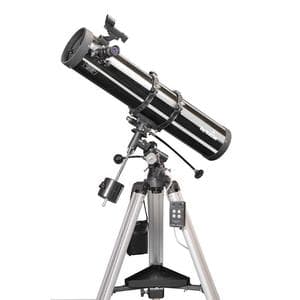
Newtonians replace the lens with a large parabolic primary mirror at the back of the tube, and a small flat diagonal secondary near the front. The light bounces back from the primary, gets redirected 90° by the secondary, and exits through the side of the tube to the eyepiece. Mirrors are much cheaper to manufacture per mm than high-quality lenses, which is why Newtonians deliver more aperture per pound than any other design.
Schmidt-Cassegrains fold the light path three times inside a sealed tube: in through the corrector plate, to the primary mirror at the back, back to the secondary at the front, then rearward through a hole in the primary to the eyepiece. The result is a compact tube with a very long effective focal length — f/10 is typical — in a package much shorter than an equivalent open-tube design.
Maksutov-Cassegrains work on the same principle as SCTs, but use a thick meniscus corrector lens rather than a thin corrector plate, and a silvered spot on the inside of that corrector as the secondary mirror. The optical quality is typically very high. The focal ratio is even longer than an SCT — f/13 to f/15 is common — making them superb planetary scopes but impractical for wide-field deep-sky imaging.
Refractors#
A refractor is what most people picture when they imagine a telescope: a long tube with a lens at one end and an eyepiece at the other.
The closed, sealed design is genuinely convenient. There's nothing to collimate, the tube stays clean, and the sealed air column means you can take a refractor from indoors to a cold garden and start observing immediately without waiting for thermal equilibrium (a real advantage over open-tube designs with heavy mirrors). On planets and the Moon, a good refractor is hard to beat — the absence of a central obstruction means the full aperture is delivering light, and the resulting contrast is excellent.
The limitation is cost per millimetre. At 80mm, a good ED refractor costs around the same as a 200mm Dobsonian. At 120mm, you're in premium territory. Above 130mm, APO refractors become very expensive indeed, and an achromat that size will show significant chromatic aberration.
Achromat vs APO: what “false colour” actually looks like
A glass lens refracts different wavelengths of light by slightly different amounts. The result, in a cheap achromat, is a visible purple/blue fringe around bright objects.
Achromat — 102mm f/5
Visible blue-purple fringing on the Moon, Jupiter, bright stars
ED/APO or Reflector
Tight Airy disk — no wavelength-dependent fringing
In an ED or APO refractor, low-dispersion glass brings all wavelengths to the same focus. The view is as clean as a reflector — at significantly higher cost per mm.
This is the trade-off that defines refractor ownership: if you want a grab-and-go planetary scope with no maintenance, a small APO refractor is excellent. If you want to see as much of the deep sky as possible, the money buys far more aperture in a mirror-based design.
Best for: planetary and lunar observing, double stars, widefield astrophotography with an ED/APO, grab-and-go portability.
Consider: Sky-Watcher Esprit 80ED (APO), Bresser Messier AR-102 (achromat, slower f/6.5 so CA is modest).
Newtonian reflectors and Dobsonians#
Isaac Newton's 1668 design is still the best value in astronomy. A parabolic primary mirror at the back of an open tube, a small diagonal secondary near the front — that's it. No exotic glass, no sealed tube, no complex corrector elements. Just two precisely-shaped mirrors and a focuser.
The aperture-per-pound advantage is real and significant. A 200mm Dobsonian costs roughly what a decent 80mm APO refractor costs. That's 6.25× more light-gathering area for the same money. What you can see through a 200mm Newtonian versus an 80mm refractor is not a subtle difference — it's the difference between a hint of Andromeda and seeing its dust lanes.
What ~£400 buys you in each design
Aperture is the single biggest determinant of what you can see. The optical design governs how much aperture you get per pound.
APO Refractor
e.g. Esprit 80ED
~£450 / $570
Dobsonian
e.g. Skyliner 200P
~£380 / $480
SCT
e.g. NexStar 6SE
~£800 / $1,000
Circle diameter proportional to aperture. Same price bracket — very different light-gathering power.
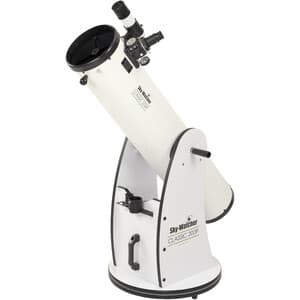
A Dobsonian is simply a Newtonian reflector on an alt-azimuth rocker-box mount. The mount is clever: the large circular bearings let you push the tube smoothly in any direction, and the whole thing sits on the floor or a low table without a tripod. This simplicity is what makes the Dobsonian the recommended first telescope for most people — you spend less money on mount mechanics and more on aperture.
◉ "Collimation" — realigning the two mirrors — sounds intimidating. In practice, with the collimation cap that comes with most Newtonians, it takes less than five minutes once you've done it twice. The mirrors drift slowly over time and with transport; you check alignment before observing and nudge if needed. It becomes routine quickly.
The open tube does mean dust gets in over time, and dew can be a problem on humid nights. A basic tube cover and a dew shield are cheap solutions.
Best for: visual deep-sky observing, anyone who wants maximum aperture on a budget, first scopes for most people.
Consider: Sky-Watcher Heritage 130P (tabletop Dob, excellent first scope), Sky-Watcher Skyliner 200P (200mm, the serious visual observer's choice), Sky-Watcher Explorer 130M (Newtonian on an equatorial mount, for those wanting tracking).
Schmidt-Cassegrains and Maksutovs#
Compound telescopes — also called catadioptric scopes — combine lenses and mirrors to fold the light path into a short, sealed tube. A 200mm SCT is about 40cm long. An equivalent Newtonian would be around 100cm. That compactness matters if storage or transport is a constraint.
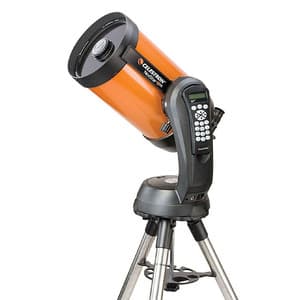
The Schmidt-Cassegrain (SCT) is the most popular compound design. The Celestron NexStar 8SE — 200mm, f/10, with GoTo — is probably the best-selling serious telescope of the past two decades. It handles planets, the Moon, and bright deep-sky objects equally well, and it's been the starting point for tens of thousands of amateur astrophotographers.
The Maksutov-Cassegrain takes the same basic design and refines it. The thick meniscus corrector introduces fewer aberrations than the SCT's thin corrector plate. The resulting focal ratio is longer — f/13 to f/15 — which means lower magnification per eyepiece, but also means the optics are working at a more forgiving ratio. Owners on Cloudy Nights consistently report that a good Mak produces the best planetary views they've seen at its aperture.
The shared weakness of both designs is focal ratio. At f/10 or longer, imaging faint deep-sky objects requires much longer exposures than a fast Newtonian or a short APO refractor. For visual planetary and lunar work this is irrelevant. For deep-sky imaging it becomes a real constraint.
Best for: planetary observing, compact storage, dual visual/imaging use, GoTo convenience.
Consider: Celestron NexStar 8SE (200mm SCT, GoTo, the benchmark), Meade ETX90 Observer (90mm Mak, compact planetary scope with GoTo).
Which type is right for you?#
Honest comparison
Every optical design is a set of trade-offs. This is what they actually look like side by side.
| Criterion | Refractor | Newtonian | Dobsonian | SCT | Maksutov |
|---|---|---|---|---|---|
| Aperture per £ | |||||
| Planetary contrast | |||||
| Deep-sky light gathering | |||||
| Chromatic aberration | Achromat: visible APO/ED: none | None | None | None | None |
| Collimation needed | Never | Occasionally | Occasionally | Rarely | Almost never |
| Portability | |||||
| Astrophotography | APO: excellent Achromat: limited | ||||
| Beginner-friendliness |
StrongAverageWeak
The table above shows the honest trade-offs. No optical design wins on all criteria — which is why this question generates so much forum debate. The right answer depends on what you actually want to do with the telescope.
A few decision rules that hold for most buyers:
If you primarily want planets and the Moon: a refractor (grab-and-go) or a Mak/SCT (more aperture, more permanence). Avoid a fast Newtonian — at f/5 or shorter, edge-of-field coma can be distracting at high magnification.
If you want maximum deep-sky views: a Dobsonian. Full stop. Nothing at the same price gives you more aperture, and aperture is what determines how much of the deep sky you can see.
If you want to do astrophotography: an APO refractor on an equatorial mount for wide-field, or an SCT on an EQ mount for planetary and longer-focal-length work. The mount matters more than the telescope.
If you're a beginner and aren't sure: a Dobsonian reflector. It gives you the most for your money, has the least to go wrong, and teaches you to navigate the sky manually — which makes the hobby stick.
Question 1 of 3
What do you most want to look at?