Browse·Reflectors·Celestron NexStar 130SLT
Celestron
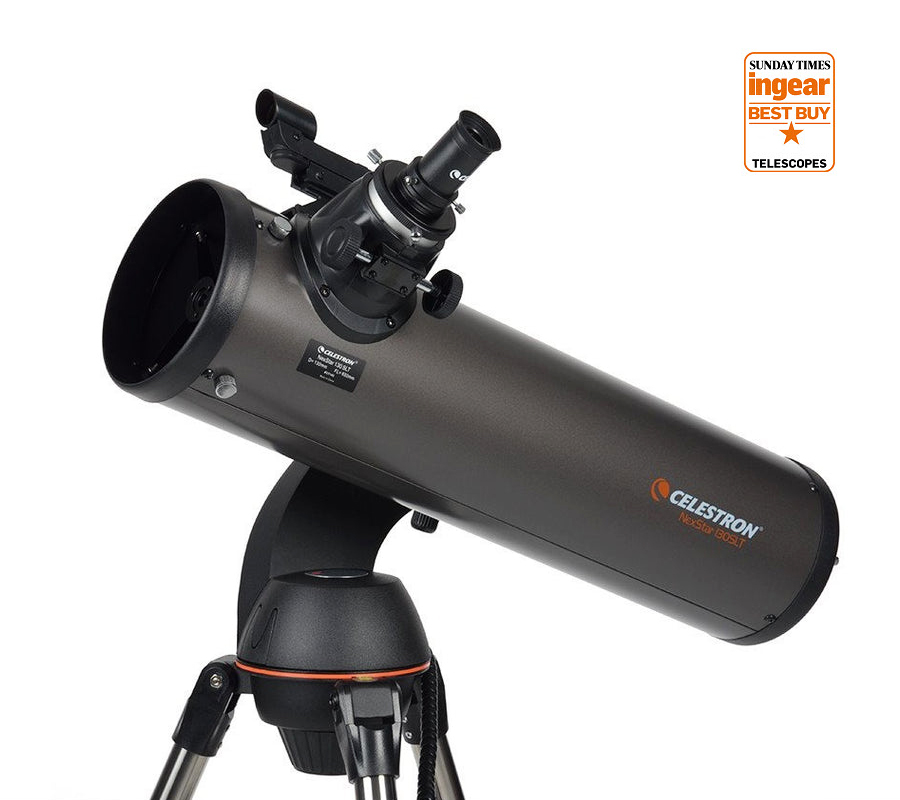
Celestron NexStar 130SLT
A sturdy reflector that excels at planets but struggles with deep sky and astrophotography.
Affiliate link — we earn from qualifying purchases at no extra cost to you.
From the community
What owners say
Based on 25 Cloudy Nights discussions
What they love
- ✓Views of the Moon were fantastic
- ✓Galilean moons of Jupiter were perfectly visible
- ✓Good for planetary viewing, particularly Moon
- ✓Capable of showing some detail on Jupiter and Saturn
What caught them off guard
- !Optical tube felt flimsy, made of tinfoil or tinplate material
- !Focuser bounce at top of tube made focusing on dim objects extremely difficult, especially Jupiter
- !Vibrations took several seconds to die away, making fine-tuning focus a nightmare
- !Couldn't get Jupiter into sharp focus despite Galilean moons being visible
- !Mount felt cheap and not robust, with flimsy-feeling securing arm
Top targets reported by owners
What you'll see
The Moon
described as 'fantastic' views with excellent detail of lunar landscapes
Jupiter
Galilean moons 'perfectly visible', though one user struggled to achieve sharp focus despite apertur…
Saturn
mentioned as suitable for observation
Bright Messier objects
M35, M44, M45 noted as achievable with appropriate eyepieces
Worth knowing before you buy
The focuser causes the OTA to bounce when adjusting focus due to its position at the top end of the tube far from the rotational axis, making it difficult to fine-tune focus on dim objects and planets, with vibrations taking several seconds to die away.
The optical tube feels flimsy and insubstantial, described as tinfoil or tinplate quality, requiring extreme caution when moving the scope to avoid damage.
The mount arm securing the OTA to the motor feels cheap and flimsy, raising concerns about robustness and stability.
Head to head
How it compares
NexStar 130SLT
Celestron

SpaceProbe 130ST EQ Reflector
Orion
130mm · GoTo Newtonian Reflector vs 130mm · Manual Newtonian Reflector
Full comparison →
NexStar 130SLT
Celestron
StarSense Explorer DX 130AZ
Celestron
130mm · GoTo Newtonian Reflector vs 130mm · Manual Newtonian Reflector
Full comparison →
NexStar 130SLT
Celestron
SkyQuest XT6 Classic Dobsonian
Orion
130mm · GoTo Newtonian Reflector vs 150mm · Manual Dobsonian
Full comparison →
NexStar 130SLT
Celestron
StarBlast 6 Astro Reflector
Orion
130mm · GoTo Newtonian Reflector vs 150mm · Manual Newtonian Reflector
Full comparison →
Frequently asked
Questions from owners
Sourced from Cloudy Nights discussions.
- Is the 130SLT suitable for astrophotography?
- The 130SLT is poorly suited for deep-sky astrophotography because it is an alt-az mount, which causes field rotation on exposures over 10-15 seconds. Multiple users report relocating the scope after polar alignment for southern targets makes tracking worse.
- How stable is the mount and tripod?
- The mount arm feels flimsy and cheap to users, and the focuser bounce at the top of the tube makes fine-focus difficult on dim objects—vibrations take several seconds to settle. The plastic spreader on the tripod requires added weight (sand bag) for stability, but it cannot support heavy loads.
- Is the 130SLT too heavy for a small tracking mount like the Sky-Watcher Star Adventurer?
- Yes—the 130SLT is too heavy and has too long a focal length for the Star Adventurer Pro, which has a stated capacity of 11 lbs and should not be loaded to maximum. Forum members advise relegating the 130SLT to visual observing only and using separate, lighter optics (camera lenses or small refractors) on a tracker for astrophotography.
- How does the optical quality compare for planets?
- Views of the Moon are fantastic, but Jupiter and Saturn can be difficult to focus sharply despite the Galilean moons being visible. The aperture is adequate for planetary viewing under light-polluted skies, but the focuser bounce makes fine-tuning frustrating on dim objects and planets alike.
- Should I buy a used 114SLT or 130SLT as a beginner scope?
- For £75–150 outlay, a 114SLT is a reasonable entry point if you intend to resell it later at roughly half price. However, expect the optical tube to feel flimsy and tinny, the focuser to bounce during focus adjustments, and the scope to be bulky and unwieldy.
- What is the main weakness of the focuser?
- The focuser is mounted at the top of the tube far from the rotational axis of the mount, causing significant bounce and vibration when focusing that takes several seconds to settle. This makes precise focus on dim objects nearly impossible and led multiple owners to want an electric focuser or to replace it entirely.
Full Specifications
Optics
| Aperture | 130mm |
| Focal Length | 650mm |
| Focal Ratio | f/5 |
| Optical Design | Newtonian Reflector |
| Coatings | Fully multi-coated parabolic mirror |
Mount & Tracking
| Mount Type | GoTo (Computerised) |
| GoTo (Computerised) | Yes |
| Tracking | Yes |
| Tracking Motor | Single axis (alt-az) |
Focuser
| Focuser Size | 1.25" |
| Focuser Type | Rack and pinion |
Physical
| OTA Weight | 2.9kg |
| Total Weight (with mount) | 8.5kg |
| Tube Length | 620mm |
| Tube Material | Steel |
Included Accessories
| Eyepieces | 25mm and 9mm eyepieces |
| Finder Scope | StarPointer red dot finder |
| Diagonal | No |