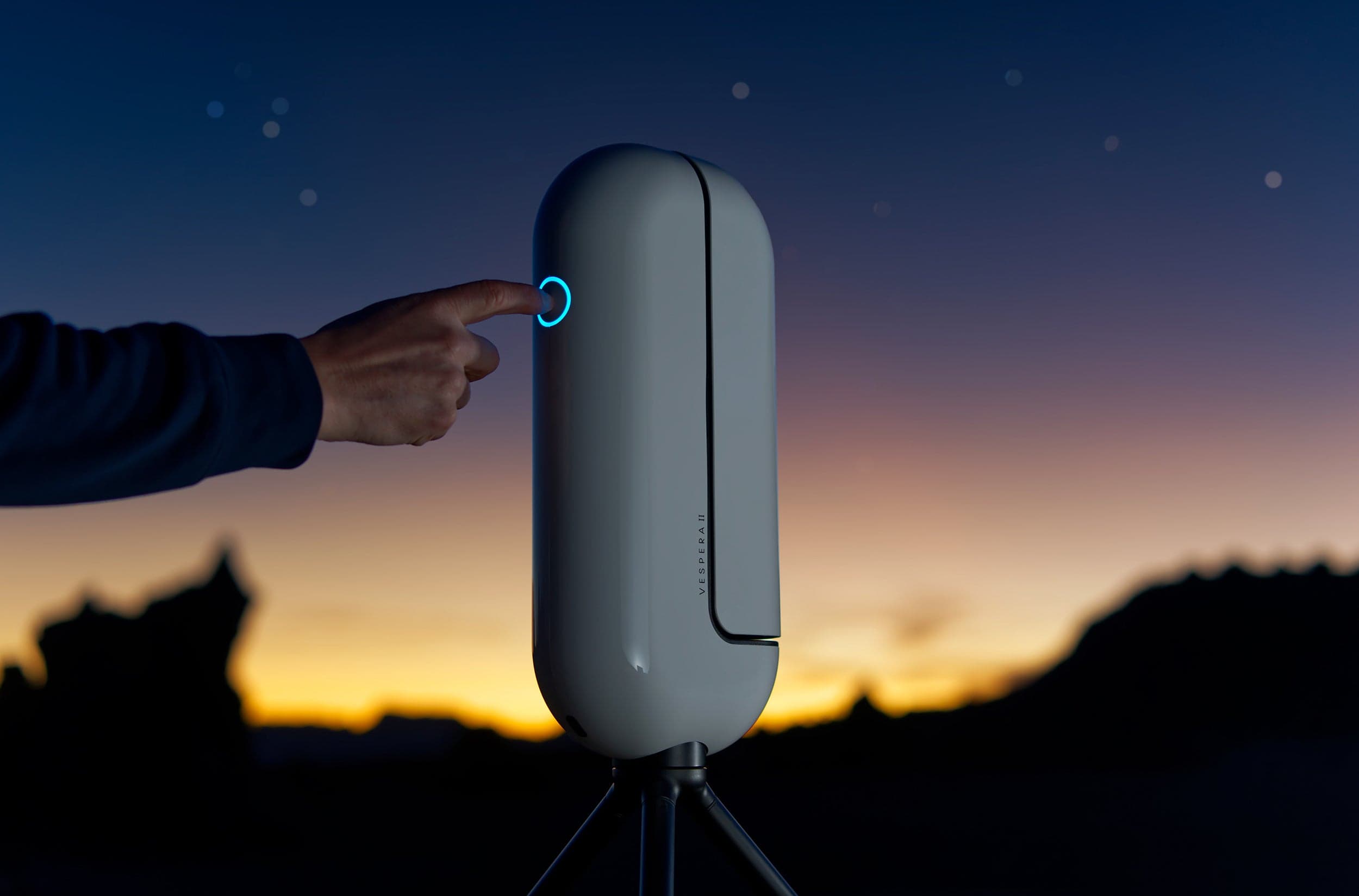
There is no eyepiece. That is the first thing to understand about smart telescopes, and it changes everything.
A smart telescope points itself, takes hundreds of short exposures automatically, and stacks them in real time — showing you the result on your phone or tablet. The image builds over minutes, pulling faint nebulae out of light-polluted city skies in a way no eyepiece can. It is genuinely impressive. It is also not visual observing. Whether that distinction matters to you is the whole decision.
This guide is honest about what smart telescopes are and what they aren't. If they're right for you, we'll tell you which one to buy. If they're not, we'll say so and point you somewhere better.
How live stacking works#
The key concept. Understanding it sets the right expectations before you spend anything.
The telescope stacks short exposures automatically. No photographer needed — just point and wait.
Each exposure is typically 10–30 seconds — long enough to capture faint signal, short enough that atmospheric turbulence and the Earth's rotation don't blur the image. The telescope stacks each new frame onto the previous ones, and the accumulated image gets brighter and more detailed as it goes. After 20 minutes, you're looking at something the equivalent of a 20-minute exposure — which your eye at the eyepiece could never achieve.
The trade-off is that you're doing automated astrophotography, not visual observing. The experience is watching a screen rather than looking through a lens. For some people that's the whole point. For others it's a dealbreaker.
Who smart telescopes are actually for#
Getting this wrong is the most common reason people regret the purchase.
You want images of nebulae and galaxies — not visual observing
The output is a photo, not an eyepiece view. If that's the point, great.
You observe from a light-polluted city or suburb
Live stacking + narrowband filters punch through LP in ways your eye never can.
You want zero setup and zero learning curve
Unbox, connect to Wi-Fi, tap an object. Most smart scopes are imaging in under 5 minutes.
You want to share the experience on a screen
A tablet showing a live-stacking nebula works well for outreach events and groups.
You want to actually look through a telescope
There is no eyepiece. You're looking at a screen. That's a different hobby.
Planets are your main interest
Smart scopes are optimised for faint deep-sky targets. Saturn and Jupiter look mediocre.
You want to learn the night sky
The app does the navigation for you. Even after a year, you wouldn't know where to point a manual telescope.
Budget is tight and you'd compare to a traditional scope
The Skyliner 200P Dobsonian costs a quarter of a Seestar S50 and gathers 4× more light.
The decision point most buyers miss: the question isn't whether a smart scope is impressive — it is. The question is whether the experience it offers is the experience you're actually after. A smart scope is a different hobby to visual astronomy, not a better version of it.
The smart scope market#
Entry
Compact & affordable
£300–450
$380–570
Good results from dark skies. Smaller aperture means more compromise from city light pollution.
Mid-range
SWEET SPOTBest value for most buyers
£420–580
$530–730
The S50 is the default recommendation for most people. Dwarf III if you want manual control and narrowband capability.
Premium
Serious capability, serious price
£800–2,500
$1K–3.2K
Vespera Pro: best software + wide-field mosaic. Equinox 2: longer focal length for smaller, detailed DSOs.
Top-end
Diminishing returns — read carefully
£2,000–4,000
$2.5K–5K
Community consensus: the eVscope 2 is widely considered overpriced for what it delivers. Read our picks section before spending at this level.
The price gap between tiers is not gradual. You jump from the mid-range to the premium tier and spend twice as much for software and mosaic features rather than meaningfully more aperture. At the top end, you are paying for brand, ecosystem, and diminishing optical returns.
Our top picks#
Based on community data from owners on Cloudy Nights, Reddit, and dedicated astronomy forums.
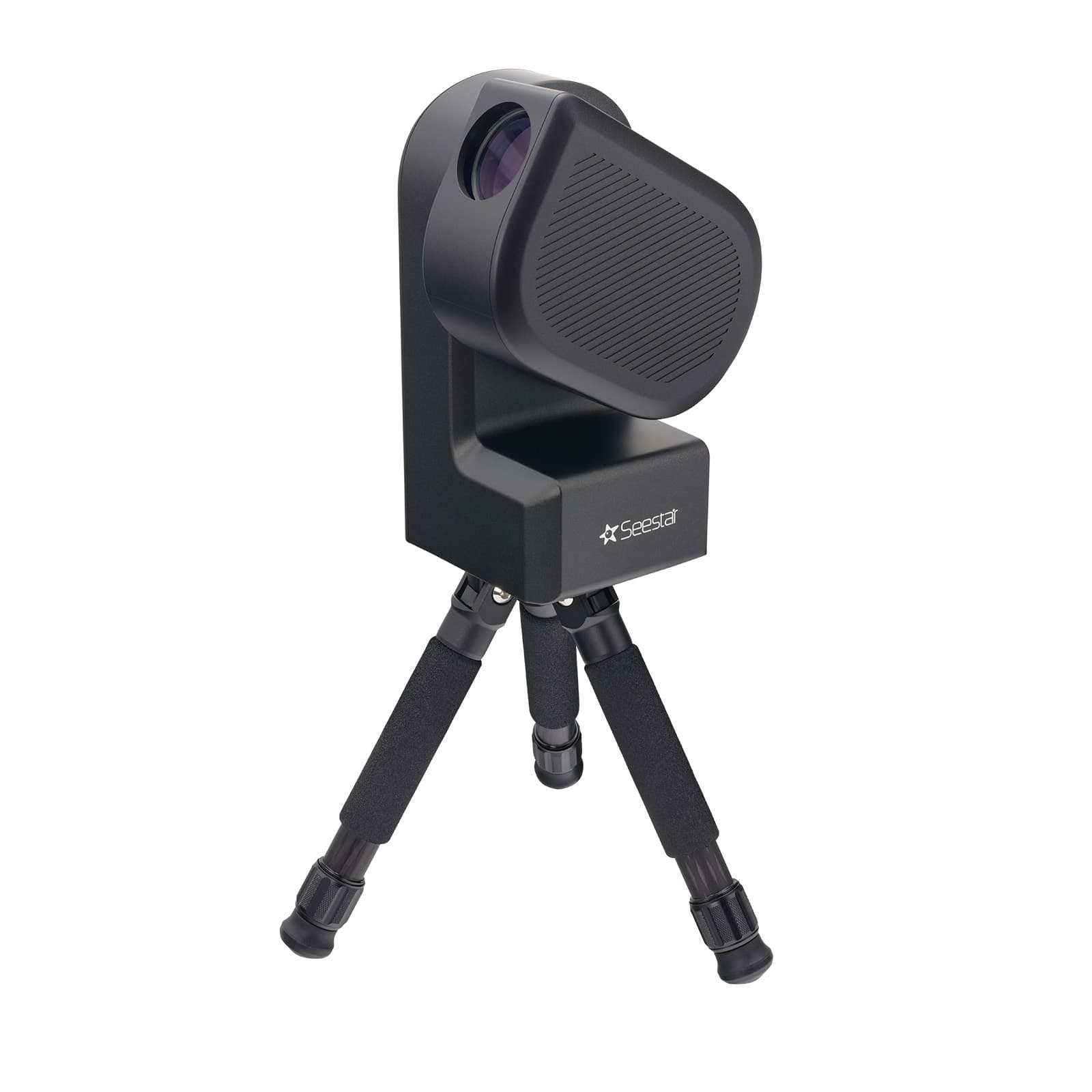
ZWO Seestar S50
50mm f/5 · Sony IMX462 · ~420g
~£420 / $530
View full specs →The answer for most people reading this guide. Owners consistently report imaging within five minutes of unboxing. The software is the most polished in the entry-to-mid range, and its 50mm aperture with the IMX462 sensor regularly pulls faint DSOs out of Bortle 7 skies.
Strengths
- ✓Best software maturity at this price
- ✓Works well from Bortle 6–7 city skies
- ✓Under 5-minute setup
- ✓Largest user community — easy to find help
Limitations
- ✗Software can be buggy between updates
- ✗Planets look mediocre
- ✗Field rotation in long sessions
"Works out of the box in a way no other smart scope at this price does." — owner consensus, Cloudy Nights
Vaonis Vespera Pro
50mm f/4 · Sony IMX585 · wide-field mosaic
~£950 / $1,200
View full specs →The Singularity app is the most mature smart scope software on the market, and the CovalENS mosaic mode is genuinely unique — letting you capture wide-field targets like M31 or the Orion Nebula complex in full. Owners who've used multiple smart scopes consistently praise the Vespera Pro's image quality and workflow.
Strengths
- ✓Most mature, reliable software
- ✓CovalENS mosaic — unique wide-field
- ✓Gallery-quality output
- ✓Excellent for outreach
Limitations
- ✗No manual focus or exposure control
- ✗Blue LED during dark initialisation
- ✗Price is a steep jump from the S50
Dwarf Labs Dwarf III
24mm f/1.25 · Sony IMX678 · narrowband capable
~£540 / $680
View full specs →A smart scope for people who don't want to fully hand over control. You can dial in exposure length, gain, and filters — and the IMX678 handles 60-second subs well, opening the door to proper narrowband Ha/OIII work. The app has a steeper learning curve than the Seestar, but for the motivated imager who wants to grow into the tool, it has a ceiling the S50 doesn't.
Strengths
- ✓Manual exposure and gain control
- ✓Narrowband Ha/OIII/SII capable
- ✓Handles 60-second subs well
Limitations
- ✗Steeper app learning curve
- ✗Smaller aperture than the Equinox 2
- ✗JPEG output disappoints — shoot RAW
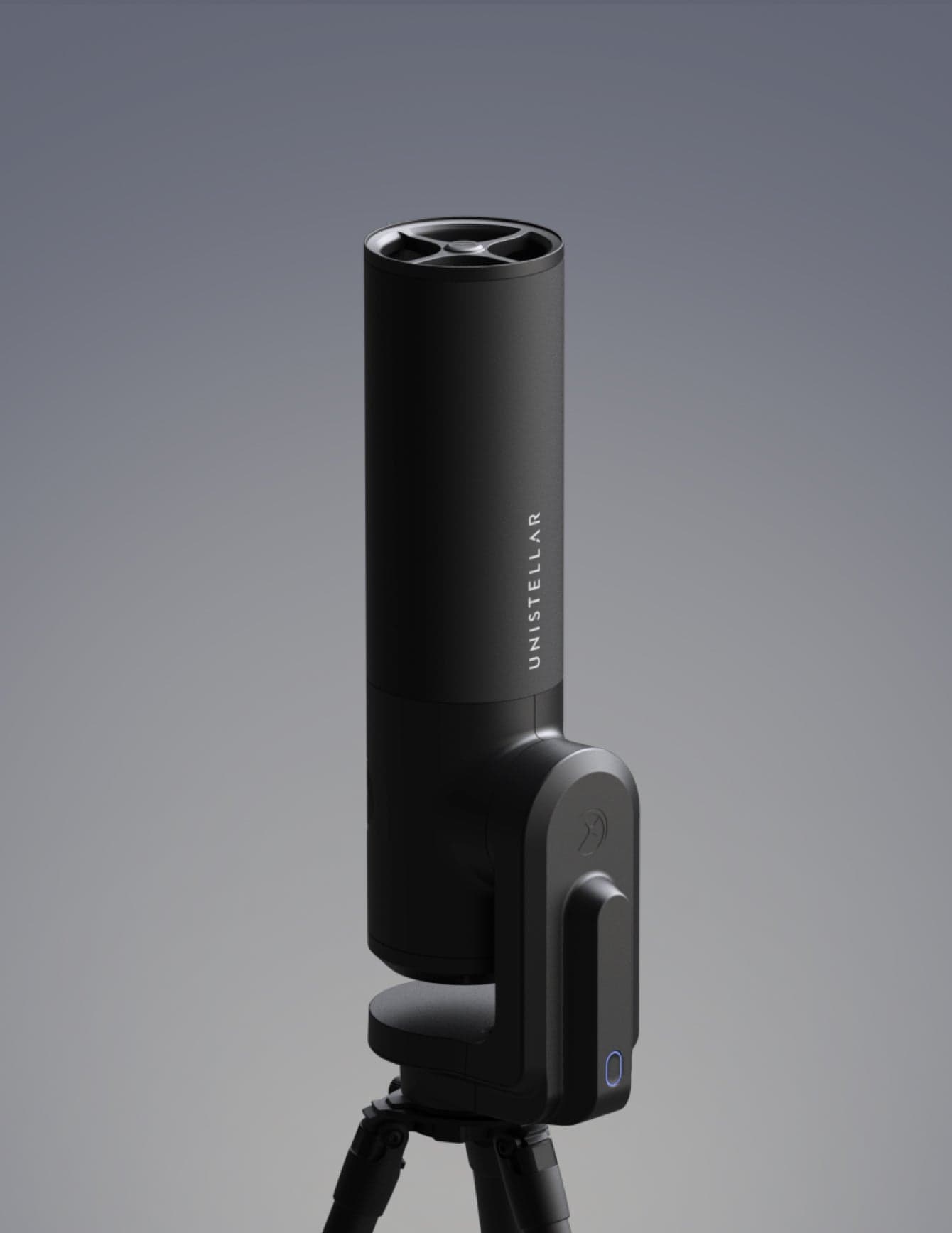
Unistellar Equinox 2
114mm f/4 Newtonian · 450mm focal length
~£2,400 / $3,100
View full specs →The only smart scope here with a meaningful Newtonian reflector. The longer 450mm focal length gives it reach for smaller DSOs — globular clusters, planetary nebulae — that wider-field smart scopes smear into blobs. Owners have confirmed 17.5-magnitude targets from Bortle 5.5. The trade-off: collimation, no autofocus, narrow FOV, and a price that buys many Seestar S50s.
Strengths
- ✓114mm aperture — largest here
- ✓450mm focal length for small DSOs
- ✓17.5-mag targets confirmed from B5.5
Limitations
- ✗Requires manual collimation
- ✗No autofocus
- ✗Narrow field of view
- ✗Very expensive
Unistellar eVscope 2 — consider carefully
At £2,000–2,500 / $2,500–3,200, the eVscope 2 competes with the Vespera Pro while delivering a smaller 1.3MP sensor, no autofocus, a closed catalog, and plastic construction. The community consensus on Cloudy Nights is blunt: it is overpriced relative to what it delivers, and the Vespera Pro is a better buy at every point that matters.
Seestar S50 vs Vespera Pro#
The main decision for mid-to-premium buyers. Every other comparison is simpler.
Seestar S50
~£420 / $530
Vespera Pro
~£950 / $1,200
Buy the S50 if…
Budget matters, you want the biggest community for support, or you're not sure how much you'll use it. The S50 is where almost everyone should start.
Upgrade to Vespera Pro if…
Wide-field mosaics matter to you, you want the most polished software, or you're doing outreach where image quality is on show.
The short version: start with the S50 unless you have a specific reason to spend more. The Vespera Pro is genuinely better — but the gap narrows considerably once you factor in that both scopes have 50mm aperture and that the software difference, while real, matters most to people who will use the scope regularly and who care about gallery-quality output. The S50's community is also far larger, which means more tutorials, more firmware updates, and more people to answer your questions at 11pm when something isn't working.
Should you buy a smart telescope?#
Four questions. Takes 30 seconds.
What do you most want to observe?
What smart telescopes can't do#
These aren't caveats — they're the reality of what you're buying. Worth knowing before you spend.
Planets look mediocre
Smart scopes are optimised for faint, extended objects. Their sensors, focal lengths, and stacking algorithms are tuned for deep sky. Saturn and Jupiter are bright point sources — the resolution is limited and the software doesn't help. You'll be underwhelmed if planets are a priority.
No visual observing — ever
There is no eyepiece to look through. The experience is watching a screen as the image accumulates. If the act of looking at the night sky directly is part of why you're interested in astronomy, a smart scope will feel hollow.
You won't learn the sky
The app navigates for you. Even after a year with a smart scope, you wouldn't know where to point a manual telescope. If building your knowledge of the night sky is part of why you're drawn to astronomy, a traditional scope — even a modest one — will serve that goal far better.
The value argument is real
A Sky-Watcher Skyliner 200P Dobsonian costs around £250 / $320 and gathers 16× more light than the Seestar S50's 50mm aperture. For visual deep-sky observing from a dark site, it isn't close. Smart scopes win on convenience and light pollution handling — not on raw capability per pound.
The traditional-scope comparison is worth sitting with. Around £250 / $320 buys you a Sky-Watcher Skyliner 200P — 200mm of aperture, a solid Dobsonian mount, and enough light-gathering to show you the Virgo Cluster, the Veil Nebula, and hundreds of Messier objects on a good night from a dark site. It won't take photos for you. It won't connect to Wi-Fi. But it will show you things with your own eyes, under the actual sky, in a way that the screen-based experience of a smart scope genuinely cannot replicate.
Neither is better. They're for different people. The smart scope is the right choice if the imaging experience is what appeals — convenience, city skies, the ability to share results on a screen. The traditional scope is the right choice if you want to learn the sky, observe visually, and get the most optical capability per pound.